
The tour continues
Followers and newcomers will know that my tour of unsung media lacks borders. From the safety and comfort of these great United States, I always look outward. My favorite series, medium notwithstanding, have influences upon influences that go back seemingly for millennia. Max Payne? The squinty Finnish bloke who brought us that combined The Matrix with Norse mythos with John Woo operatic gun-fu. God of War? The title alone should tell you it’s Greek before it clues you in to the ancient tragedies and legacy Claymation Greco-Roman film adaptations of the late ’60s and ’70s. Mortal Kombat? Started as a love-letter to kung-fu films, added a flair of body horror–and being the target audience makes it difficult to understand why parents didn’t like it in the ’90s. Then again, consider what made headlines in the ’90s in America:

Among other things, the first black president did NOT have sexual relations with that woman.
To look at one of those influential things that I routinely look outward at, may I humbly present thee with a trio of Asian films spanning different genres: horror, romantic comedy, and action thrillers. And I’ll introduce them in the order that I viewed them. The first of these being:

紅衣小女孩
I first owe an apology for using the Simplified hanzi 红 instead of the Traditional hanzi 紅 for last week’s post. 對不起,台灣的讀者人。I’m still skeptical of Google Translate, but it’s the only resource I have without waking up the green owl from its uninterrupted slumber…
Which brings me to the subject of the section of this post: an urban legend concerning sightings of a little girl in red clothing sighted as early as March 1998. To summarize what was said last week, a family went hiking along the Dakeng Trail, they reviewed the footage and found a little girl they don’t remember encountering at all, one of the family members tragically passed away a few weeks later, and the still shot from the video recording became a national urban legend that, like myself, has transcended international boundaries.
I did mention before that I made the discovery in the early chapters of Kaii to Otome to Kamikakushi.

Nujima’s take on the Taiwanese urban legend is separate in that the little girl in red masquerades as a lost traveler attempting to enter an occupied residency in the middle of a downpour. The first sign of trouble is that no one is on the other side of the door, but the knob will still twist and banging will still sound. Under no circumstances should anyone open the door, lest they become the host of the tag-along.
Both the Taiwanese original and Nujima’s take on the urban legend deal with an unknown figure that can’t be seen with the naked eye, but there’s differences. The Taiwanese original leads travelers astray, and the victims are almost always in vulnerable positions. Nujima’s take on the urban legend operates on the disappearance aspect of Mysterious Disappearances. A loved one disappears without a trace, their friend or loved one searches endlessly, and during an awful storm, knocking can be heard from an unknown, unseen entity, luring the searcher outside and potentially jumping hosts. Worse than that, the previous victim of the tag-along can die. Fortunately, there’s a way to save the potential host and the previous host from peril… and knowing Nujima, Sumireko’s attachment to her top is as airtight as a Parkinson’s sufferer handling Song dynasty artifacts TTwTT

Saucy ( ̄y▽, ̄)╭
The 2015 film adaptation of the story gives the little girl in red a new set of victims, starting first with an unrelated missing person before affecting the central figures in the story. How it begins to affect the main cast is that the main male lead is under financial duress, his girlfriend wishes for a full life unburdened by motherhood, and his grandmother wants him to take a f[knock]king break for once!
Yeah, same old horror tropes, the victim has doubt, the supernatural entity plays on that doubt and cranks it up to eleven million, the victim decides to take care of their own fate, but either suffers toward the end or overcomes it leaving room for an experienced, yet traumatized returning protagonist to feature in the sequel with the lessons learned in the first game through blood, sweat, and tears. If this sounds familiar, then hello Terminator 2 enjoyer.

Perhaps, I’ll find a way to watch the Sarah Connor Chronicles. >_>
Hopefully, that wasn’t much of a spoiler for The Tag-Along film. If you haven’t seen it yet, perhaps you can add it to your bucket list for Christmas. I think I’ve outgrown the traditional slashers and jump scares. Or rather, I’ve grown to expect purpose and meaning from my horror films. Honestly, my relationship to horror films deserves it’s own post sometime in the future; it’s evolved a lot more than my relationship to comedy films.
Which brings us to number 2:

พรหมรัก AI ตุ๊กตาซ่อนรัก
A Thai sex comedy about the son of a pornstar who inherits a sexbot/gynoid that learns how to do more than just, for lack of a better term, sucky-f[anh!]ky, bang-bang.

I speak no hyperbole when I say that I’ve reviewed NSFW games and animanga with a completely straight face and my preference for series that give me f[chime]kings with a laugh instead of trauma (you know what you are, Redo of Healer!) should already be a tell of the kinds of adult stories and gameplay loops I appreciate. Scarlet Maiden’s female lead wears the thickest amount of tooth floss available and that busty babe is a nimble combatant. (^v^)
Now, to the Thai sex comedy. Available on Tubi… they aren’t sponsoring me, but in case they need someone to kiss them on the forehead, I’m up to the task.
My Sex Doll, marketed under the title of My Sex Doll Bodyguard, is about a man named Itt who inherits a sex doll after his pornstar father passes away from a heart attack. Itt is extremely uncomfortable around women. If I had to wager, I’d say, he can communicate with women platonically, but elevating it to believable no-strings-attached romance is something he struggles with. And it’s not subtle about that part either; the poor boy is the butt of a handful of jokes concerning his confidence and manhood. Seems familiar if you’re terminally online… like me TT_TT.
What makes it especially challenging for him is that his dad had sex on camera for a living. But dancing sideways naked with a partner isn’t the same as doing it with a romantic partner. Sex addicts will never tell you that their best relationships last hours instead of years, and for poor Itt, he grew up only ever learning of the physical aspect of these, and his dad being a stellar below-the-belt performer doesn’t mean he was primed to tell his son how to truly love a woman when that love came out of his d[ding]k. All the prowess of the god of sex, but good luck asking the man how to get down on one knee and propose to that special someone.
This deserves nuance though, it’s not unheard of for pornstars to walk away from adult films and lead more wholesome lives. You or someone you know may have done that (I’ll still make jokes, but I promise not to chastise) or someone you follow may have done that. One such example is Kaho Shibuya:

Former adult video actress who offers her own advice to women following the path she used to walk. She can’t tell every woman not to do it, but she can let them know what’s in store for them if they sign on the dotted line.
And it’s worth highlighting that what may seem like raw on-screen nudity and exaggerated moans is what the performers consider a “9-to-5.” ╰( ̄ω ̄o)
So it’s not like Itt’s dad would’ve left his son hanging, despite his own penis hanging from below the low cut robe. Sadly, the advice he would’ve needed for a real relationship is tested on an artificial one with a woman designed in a lab and wearing the skin of a real woman. Wait a minute…

Total Recall also played with this in 1990. F[caw]k me, I’m not intending for science fiction at all and it keeps finding me 〒▽〒
Over the course of Sex Doll Henchwoman, the AI learns how to human and part of that comes with dealing with jealousy and irrationality. Not so much two microseconds on the dark web and deciding humanity needs to be fumigated via Ultron, more like things that make more sense to anyone who’s ever had to teach middle school and high school students before. Adolescents are very hardwired to assume too much–and social media being what it is is why I don’t have Twitter or engage very much on Instagram or anything else that we have. Some motherf[Polska]kers choose not to grow up.

Since the doll is an AI model, it interprets it as a command instead of a threat so no one’s arm gets broken in the process, but like Arnie in Terminator, it doesn’t change anything until directed. But what about when it does learn to human later on in the film? Do robots dream of electric sheep? I’m not so sure Alan Turing ever asked this question. But Philip K. Dick did… I really should’ve been a science fiction reviewer if I’m gonna mention it this much.
Anyway, Itt’s personal convictions about his lack of experience with women does, in some manner, lead to a very old question to a very old problem: can a relationship exist without friction? Short answer: no. Long answer: noooooooooooooooooooooooooooooooooooooooooooooooooooooooooooooooooooooooooooooooooooooooooooooooooooooooooooooooooooooooooooooooooooooooooooooooooooooooooooooooooooooooooooooooooooooooooooooooooooooooooooooooooooooooooooooooooooooooooooooooooooooooooooooooooooooooooooooooo, and you’re a fool for considering anything different. I may be poorly experienced myself, but if I learned a few things from watching relationships turn sour or dissipate around me it’s that there are three things that define a healthy relationship, even if there’s difficulty along the way, and every relationship has difficulties. Watch your nose grow 20 meters from telling me you and your parents had a healthy, drama-free relationship.
The three things I believe are central to long lasting relationships are my Three C’s: communication, consent, and comfort. All three work in conjunction with each other and should be fairly self-explanatory. Two people need to be able to tell each other how the feel about each other, as well as give each other blessing to do XYZ, sexual or otherwise, and if there was no comfort, why are they still together?
So how does this relate to Sex Bot Bodyguard? You know how AI models learn from you? Even if you don’t use the four undecillion chat bots available, you’re leaving a record on the internet for the chat bot to scoop up like a Spider-Man:

You didn’t consent to be a teacher and yet you are.
So the robo-f[rattle]k-doll has adapted to the way human beings speak, stumbled, and continued to learn because the number of people protesting artificial intelligence marching into our world is outnumbered by the engineers who are perfecting the technology. Just wait until 2066 when AI Model No. 6509 is laughing at the coffin-dodging zoomer who says the hard R C-word on his front lawn (assuming they can finally afford houses by then) at every passing cybernetic organism.

And yet, AI Bodyguard Sex Mode Activate does something different from all the other films I keep bringing up (because this trope is so old, it made offerings to f[stone]king Hephaestus), the robot is designed not just to sex, but to protect. Like a yandere?

Not quite.
The devotion of a Yuno Gasai or Yukako Yamagishi can exist without the bloody consequences of the former or the plain yet still traumatically criminal consequences of the latter. My Sex Doll does integrate this into the latter part of the film wherein the bot learns human emotion and plays along, but if like a real robot, the machine maims in an attempt to disarm, then an engineer needs to put physical limiters on the machine so that it doesn’t reenact the injuries that damn near killed Joe Theismann or Clint Malarchuk in football and hockey respectively.
I talked a damn lot about this film. Do I recommend it? Why else would I write about it? In my research for this part of the piece, it’s learning that the trope really is old enough to have prayed to Hephaestus. See the myth of Pygmalion for more details.

We’ve been doing this for so long that artificial intelligence was far as hell away from entering the common lexicon.
The final stop on the Asian cinematic umbrella world tour:

Mga Isla ng Pilipinas
Taiwanese horror, Thai comedy, now I bring ye all to Manila for Philippine crime action-thriller.

To read it from me, this is essentially an anti-war film. It’s not just a critique of the Philippines aggressive approach to the war on drugs, it actually shows the community that’s forced to explore the war between the drug lord and the law enforcement agency. Crime stats will always tell you that innocent people suffer, but very few will show you their perspective or what happens when they’ve had enough of two different titans throwing their weight around. The only example I can think of comes from conventional* wars and that asterisk needs an explanation.
One of my favorite examples comes from the partisans on the eastern front of World War II. Not everyone thought the Nazis were evil and not everyone thought the Soviets were a force for good. Viktor Oleksandrovych Yushchuk presumably may have wanted NOTHING to do with those bastards to his east and west and wanted to get back to raising chickens… for the proletariat. Unfortunately, the Nazis will only leave his mongrel hide alone provided he help them find the filthy Bolsheviks hiding in the snow. Likewise, Stalin needs his kind to fend off the fascists on his doorstep.
Another example I have comes from South Vietnam. The poor unfortunate souls trapped between the dogmatic North Vietnamese communists and the idealistic, anticommunist American and allied forces marching in to tell these people how to live. They fought the French, the Chinese, and the Japanese for far longer than Americans were learning where the f[đéo]k Vietnam was in the world. Give it a f[8008]king rest, caralho!
BuyBust takes place in a single night, like The Warriors. At least the central plot does. Officers of the Philippine Drug Enforcement Administration train to nab a known drug dealer. They have a lead that he operates in the slums of Gracia ni Maria and use one of theirs to infiltrate his inner circle. The dealer’s men catch on and immediately pick up the bait. Thing is, they run the place like a damn fiefdom, but the residents within the slums don’t exactly take their bulls[horns]t lying down. Then when the PDEA comes knocking, it very much turns into a free-for-all. Cop vs thug vs resident.
Wherever you live, you probably get smacked upside the head with the word “innocent” victim. Here’s the thing, the word “innocent” is taking home 20 gold medals in a strongman competition. In a case like this, the third-party isn’t the law, nor is it the thug; it’s the old couple or child who wants to get the hell out of this situation intact, but ultimately has to fight for themselves while two forces descend on each other.
By the way, did you think I mentioned World War II at random?
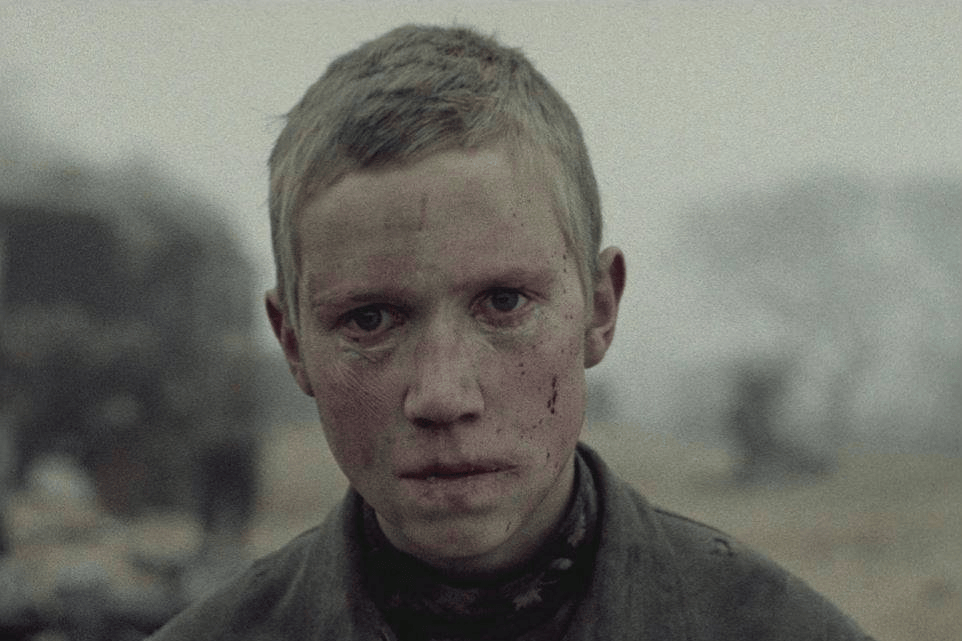
Resisting one invader or both seems easy from the outside when there’s historical precedent, but what’s lost on those who haven’t been trapped by either system is that there are examples like my fictional Yushchuk who’s response isn’t Spartacus-level resilience, but human exhaustion. BuyBust gets to the heart of that by showing everyone’s involvement. Not just the law, not just the cartels, but everyone. And that film doesn’t play nice with anyone.
Matter of fact, several films I’d seen in recent memory dispel the notion that the third-party is an innocent bystander. 2002’s Cidade de Deus hands the reins over from a ruthless criminal to a gang of children. 2007’s Tropa de Elite show why Brazil’s Military Police treat low-level drug lords like they’re terrorists. 2003’s OldBoy shows that neither Oh Dae-su nor Lee Woo-jin was entirely right or wrong. BuyBust can sit among these cinematic masterpieces as a masterclass in dispelling the us and them myth that too many discussions rely on these days. If I was any one of the cops in that slum and everyone wanted my head, I’m gonna fight like hell. If I was a cartel member and a good day was antagonizing the elderly and their grandchildren for pesos, I’m gonna be that bastard. And if I was the resident who was sick as hell of the cops and the cartel making life hard for myself and my family, I’m not showing anyone any mercy. The PDEA better get the hell off what I call a porch and the cartel can go exploit some other f[plink]k.
And to reiterate, this occurs over the course of one night. BuyBust isn’t a multi-layered journey from Manila to Quezon chasing some elusive motherf[crash]ker. It’s a long grueling night in the slums from dark to dawn. And even then, the ending (non-spoiler) isn’t clean. Same as how Cidade de Deus doesn’t end very cleanly. In fact, that movie concludes in the early 1980s when Brazil was a few years away from discarding the military junta government, and a look at crime history from 1981 until the year the movie premiered may reveal some stats. Let me pull some up.
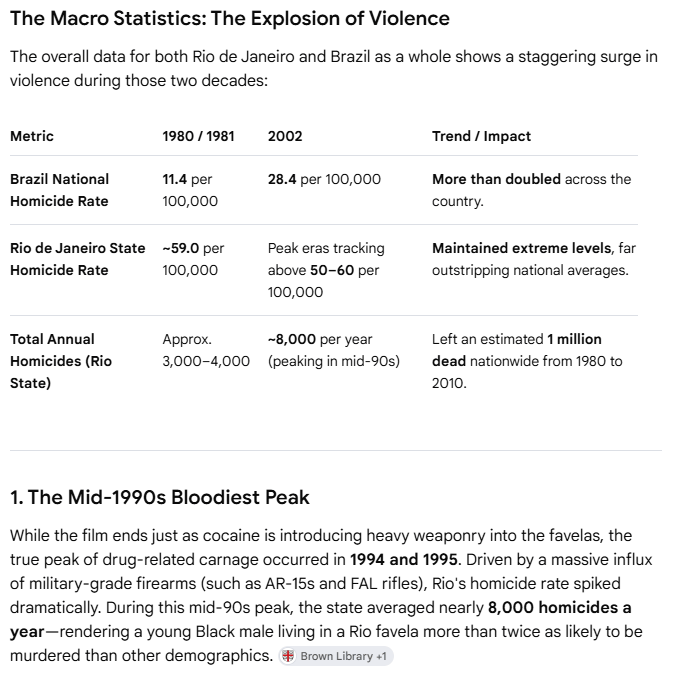
Google’s AI tells me that the need to eliminate a problem wound up bolstering it in the process. Funny how that works. (┬┬﹏┬┬)
I’m not gonna pretend there’s an easy solution to any of this, and I haven’t been at all. I don’t use this soapbox to tell you what to think. You know what you like and if you’ve been here long enough, you know what I like. But why bring Brazilian crime stats into the Philippines, you ask? Largely because this ain’t unique to any one part of the world. It can happen anywhere. Brazil, the Philippines, Russia, China, Japan, Greece, Turkey, Romania, Argentina, Chile, Mexico, Malaysia, Singapore, Indonesia, Australia, South Africa, and the United States. Name the state and it has convinced itself that the danger is indiscriminate, when most often the victim knows the criminal. Never apply clean binaries to complicated issues. Everyone has their own opinions, myself included.
The point of putting this here is to show that every country deals with this in their own manner. Seeing the depiction from just this movie is bit of a narrow lens in which to view it. However, it does give me a window into how it can be planned and how, despite masterful planning, things can still turn diagonal. If I had seen the film years ago, as it did release in 2018, I probably would’ve had some Nordic examples to point to, but in recent times, Sweden and Norway have inherited some of the issues that other countries have had to struggle with. And these countries have always had pathways toward rehabilitation as opposed to blood remuneration of the wicked.
In America, the film is available to watch on Netflix, but if that’s unavailable to you, I could encourage you to sail the high seas like a green-haired minority hunter…

Or if you’ve got the disposable income and you wanna see what I’m on about, then get ahold of that sexy VPN and watch until your eyeballs roll into the kitchen.
Or pirate, like a green-haired minority hunter…
Taiwan, Thailand, the Philippines, three Asian nations with storied production histories and lots of stories to tell. And I’m not gonna stop until I see all the films and lakorns and teleseryes! I will watch them all!!

Gonna be so much fun!
Also, sorry this topic took so long. The research was the easy part. Putting my thoughts into coherent sentences was not. I need to plan these better…
Proceeds to plan worse

