One of the earliest posts on this blog concerned racing games, three of which I ranked in order from great to terrible: Midnight Club 3, Need for Speed: Hot Pursuit 2, and L.A. Rush–with Gran Turismo 4 as the wild card that I would attempt to get back into at a later date due to vague memories of what it entailed.
I made that dedication on April 7, 2023 with this post: Racing Games. Attempts were made to fulfill that promise and short of typing “Results: Inconclusive. Project Cancelled” in bold letters, it’s worth noting what I experienced in the many times I booted the game up on PCSX2 and why it’s better to categorize it as “easy to play, hard to master.”
Two years ago, I dedicated a post to what was then a more recent upswing in Japanese pop culture spreading far and wide: the virtual youtuber, VTuber for short. Sometime later, about a month, around the same time as the release of Call of Duty: Modern Warfare III 2023 and how loved and adored that game’s campaign was, I watched two videos about the game. The first one was by The Act Man, chastising the game for such a sorry excuse of a presentation and structure. The second was a Vtuber reacting to that Act Man video. This one, specifically:
Full disclosure, the first topic lined up was meant to be about the Senran Kagura series, but I haven’t been playing it as much as of late. Work-related stuff among other things took my time, and for the style of gameplay, I’ve seen better. At least it has an anime adaptation. Next to that, was about a series that was subject to limited release outside of Japan — Idolmaster, only I’ve mentioned it before and without access to the whole of the franchise, I’m not able to review it in the manner I’d like. Typically, I start at the beginning, but the circumstances that created this series in particular are only available in Japanese arcades with the Xbox 360 port dying with the console, making the first installment in this franchise semi-lost media. So instead, we’re sticking with Nihon and talking about their movies.
As far as old movies go, whatever I could get my hands on I’d always given it a watch. In community college, I watched 1932’s Scarface and 1933’s King Kong. I managed to find the 1982 film The Wall based on the Pink Floyd album of the same name. I recommend all three by the way. And all of these plus similar films have been my go to for years, from my piracy era to my movie theater era. I’ve heard from the Extra History channel on YouTube in their series on Japanese Militarism that when it comes to studying societal changes in the Axis Countries during WWII, Germany and Italy get over-studied while Japan frustratingly has been under-studied or brushed aside, presumably because they don’t have an equivalent to Hitler and Mussolini, or rather no civilian equivalent with the Japanese military dragging the society down into Hell with them one assassinated politician at a time. I bring up the historical blind spot in an admittedly faulty comparison to my own approach to the Japanese film industry. I’m American, after all, my first movies are going to be American. Sometimes, British cinema will spillover.
Guess I was always a sci-fi fan, I was just denying it because the genre was so broad.
Certainly has been a while since I’ve covered a more niche animanga series, one that had a marketing push on the associated streaming sites, notably Crunchyroll and the now-defunct VRV in 2018. I remember as I’d paid them no mind whilst watching Boruto or FLCL or Soul Eater. Recently, I’d been looking more into Chihayafuru as I’d found very few people talking about it and due to more and more action-heavy series getting adapted that year and the years to follow, it’s no wonder it flew under the radar. As I’d looked further into it, it got me thinking about a series I’d talked about sometime last year: Akane-banashi.
Both are about traditional Japanese cultural products that require research for outsiders to get an idea of what it entails, but can still be enjoyed without prior knowledge; both feature female protagonists engaged in a sport of the mind, further broadening the definition of what a sport is or can entail; both of those female protagonists have a giant competitive edge in said sport; and personality-wise, both girls have a tomboyish history that shines when engaged in their respective sports.
Akane-banashi’s specialty is rakugo, where a lone performer tells any number of comedic stories on a center stage. Normally, they’re old folktales from Japanese history and mythology, and the last time I read the manga, they hardly strayed from the style of storytelling expected of the time they written/spoken, but can sometimes be adapted to more modern audiences, similar to the 1996 adaptation of Shakespeare’s Romeo and Juliet.
For Chihayafuru, the tradition this time is Karuta, a card game based on matching similar looking cards, though in the series it’s more about Japanese poetry. This version of the game has a caller who reads a portion of a poem written in Hiragana and the player nabs the card as fast as they can. Experts can get them before the stanza is fully read aloud. The main lead protagonist is Chihaya Ayase.
Initially, she was (and still is) supportive of her big sister’s modeling future, but became infatuated with Karuta after being introduced to it by a boy from Fukui Prefecture named Arata Wataya. The impoverished little boy didn’t have a lot to his name, living in a dirty, cluttered dwelling with 80% of his clothes being hand-me-downs from relatives. Further isolating him from the rest of his Tokyoite classmates as a child was his “hick” accent. For some reason, people outside of Tokyo Prefecture are referred to like this, which I think is ridiculous, but then again, I live in a country that celebrates even linguistic diversity, so personally, not much separates a Mississippian from a Michigander or a Nevadan. All Americans, different circumstances.
Still, while Arata struggles to fit in, he’s a Karuta prodigy at a young age, taking to heart the adage of: “If you’re going to do one thing, be good at that one thing,” like Zenitsu’s Thunder Breathing.
One-trick pony? It’s easy to say that, but different series like Golden Kamuy capitalize hard on one-trick pony characters, from Sugimoto’s extreme (and painful) survivalism to Shiraishi’s Houdini tactics to Ushiyama’s history as a dangerous judoka. Being good at one thing really only matters if its applicable to other things and in this case, Karuta is both the main connecting element for all the characters and the center of a competition within the series.
Learning from Arata the fundamentals of Karuta, Chihaya is encouraged to go big and make it her dream to become a de facto Karuta world champion, mostly because Karuta doesn’t really exist outside of Japan with the same claim to fame as Mahjong or Hanafuda. Along with the two, an old friend Taichi joins them and his contrast to himself is stark both financially and socially. Taichi is a rich Tokyoite who can actually afford to be petty while Arata’s childhood poverty humbles him greatly. As such, Taichi starts off spoiled and jealous, but his best excuse is due to the high expectations put on him by his family, namely his strict mother. And you thought wealth would be easy!
Yet as the three rejoin as adolescents, they found an afterschool club called the Mizusawa Karuta club and work towards the goal of becoming Karuta champions. I’m still checking the series out as of writing, having only completed episode 1 and the first chapter (and thus getting the research from the Wikipedia page), but other things that stand out is that it’s my first Josei series. Josei is typically aimed at a demographic of young women and is notorious for its inclusion of romance into the plot. Josei itself, sadly, doesn’t get as much exposure as Shonen, Seinen, or Shojo genres which is part of what hurts series like Chihayafuru compared to Akane-banashi, which is under the Shonen genre and licensed by Shonen Jump and Viz Media.
Couple these with the niche of Karuta, whoever expected the series to get wide praise would’ve had to fight sleepless nights for something to hardly ever come from conventional animanga media outlets. And that’s quite a shame. No matter what you think of the concept, the series is beautifully drawn and animated–the production quality narrows the gap between itself and something like The Elusive Samurai.
Channel: Crunchyroll
Speaking of animation, it’s worth pointing out that Chihayafuru was adapted by Madhouse, responsible for Overlord, Trigun, and No Game No Life. This also brings me to another matter going back to Akane-banashi. Niche subjects especially those that would be found in a book on Japanese history and/or culture don’t often get the animanga treatment and if/when they do, not always successfully. Rurouni Kenshin benefits from the battle aspect more so than its setting, as does Samurai Champloo because both series have a concept that has universal knowledge: the samurai and the ronin.
Akane-banashi and Chihayafuru differ by offering battles of wit instead of battles of physical strength and power. They both also rely on parts of Japanese culture that rarely get outside notoriety, leading to limited viewership. I have no idea if the performance of the Chihayafuru anime is a case for why not everything will get an anime adaptation or should not, but if by some chance that was the metric in use, then it’s not a fair assessment to make. Even then, it wouldn’t be the first time the art of rakugo was animated.
Be honest, you only know what this is because of its hyper-energetic ending animation.
No matter the future of Akane-banashi, it still has a future, whereas Chihayafuru’s manga ran from 2007 to 2022 and its anime running from 2011 to 2020. Once again, I call upon my advocacy of piracy to view the anime and/or the manga with little issue.
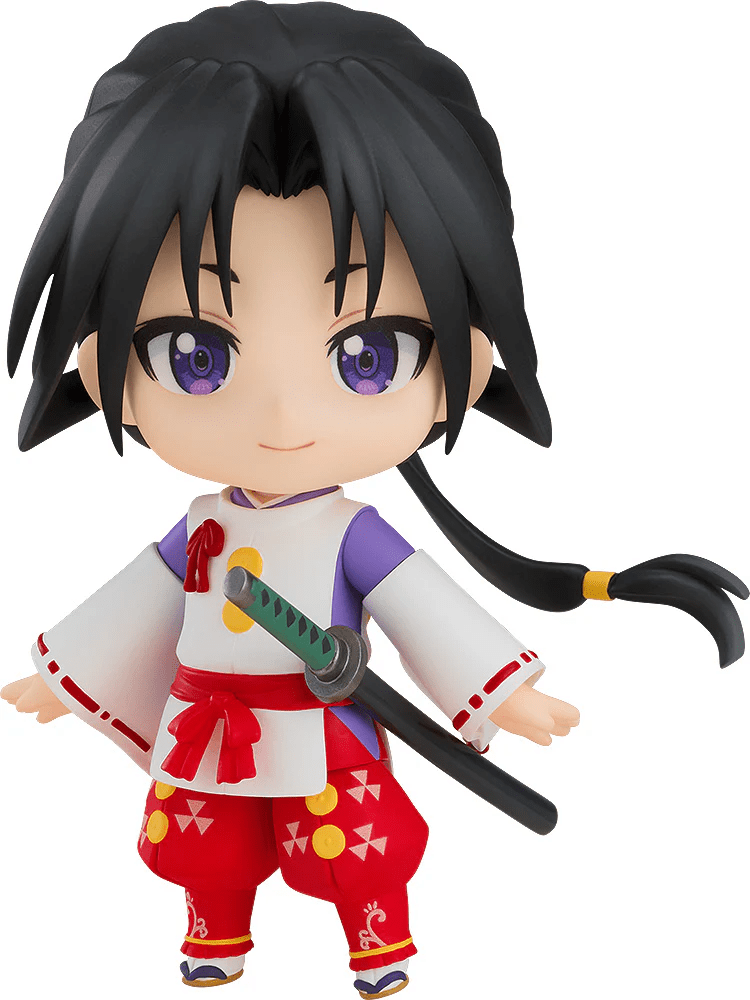
Long time subscribers (and newcomers who’ve searched the archives) know how I feel about history and even Japanese history as a weeb. I’d been followingthis series by Yusei Matsui since the first chapter was licensed for English by Viz Media in late January of 2021. After three years, about 17 volumes (plus more to follow), an anime adaptation, and figures set for release sometime next year; of all the things that could’ve happened to this series, franchising was probably the last thing I expected even for promotional purposes. Then again, this isn’t the first series to get a boost in merchandise time of debut notwithstanding.
Save for the OVAs and the lost 2007 movie, 25 years is a hell of a wait for a proper adaptation.
I’ve already written about the time period Nige Jouzu no Wakagimi takes place in, but as a refresher and to catch newcomers up to speed: between 1180 and 1185 in the Genpei War between the Taira and Minamoto clans, the Minamoto won out and established the Kamakura shogunate in the namesake city of Kamakura where it would be under the de facto rule of the Hojo clan, a Minamoto ally by the 1330s. The retired Emperor Go-Daigo plotted with Hojo clan retainers, the Ashikaga, with the purpose of returning control of Japan from the shogunate to the imperial court.
Following these plans initially, the Ashikaga betrayed the Hojo and led a siege spearheaded by the Ashikaga brothers, Takauji and Tadayoshi, with the purpose of mass elimination of the Hojo clan.
Of course, they had retainers of their own, Ogasawara Sadamune, Ichikawa Sukefusa, Nitta Yoshisada, and several others who rally to the Ashikaga cause. All but one of the Hojo survives, Tokiyuki, who carries more value as the heir to the previous ruler or shikken Takatoki compared to his half-brother Kunitoki, whose mother was a concubine.
These people all did exist in Japanese records, but English-language sources are scarce and my Japanese isn’t proficient enough to try to search through the original sources to look more into their personal lives, but as a spoiler, Hojo Tokiyuki made it all the way to the 1350s running endlessly from the forces of Ashikaga Takauji, escaping until his eventual capture and execution by forces loyal to Ashikaga in the Spring of 1353.
As for Go-Daigo, well Ashikaga seemed to have used the opportunity to betray the Hojo to also betray the emperor. Paying lip service to the idea of a civilian-run government, Go-Daigo’s Kenmu Restoration as it’s known these days was short-lived and Ashikaga implemented the Ashikaga Shogunate in 1336 until it eventually collapsed during the Sengoku era, paving the way for the last shogunate, Tokugawa, until 1868. Never trust a traitor. Though the entire time of the Ashikaga’s brutal rise to power, there were technically two courts in the north and south of Japan which is why this era is also known as the Nanboku-cho period and why there are two sets of emperors whose claim to legitimacy is dubious.
I remember reading about the anime adaptation last year, prompting the first ever full-length post about it the day of. Now that it’s here, I can finally share my thoughts on the adaptation. Clover Works pulled out all the stops to bring this series to the small screen. I’m almost 26 and in all my years as a weeb, I’ve never seen a more beautifully animated piece of media, not even when Toonami pranked us years ago by showing the original dub of Masaaki Yuasa’s 2004 film Mind Game.
Some sore spots exist with the use of CGI in select scenes in the anime, but they don’t really do anything harmful to the overall plot of the series. I admit, I was worried slightly with how much attention other anime were getting around it especially with regular updates on Reddit, but then again, a single social media forum isn’t and shouldn’t be seen as the poster child for all discussion on media, least of all anime. Healthy discussion does exist, but with how big anime has become, I think it’s time for the medium to go back to its roots as showcased in late 90s-early 2000s discussions are concerned, namely, a small group of friends, enthusiasts and connoisseurs (with a strict member limit) who meet up and talk about the latest series and other anime news. Reddit and Twitter are cramping anime’s style, you know?
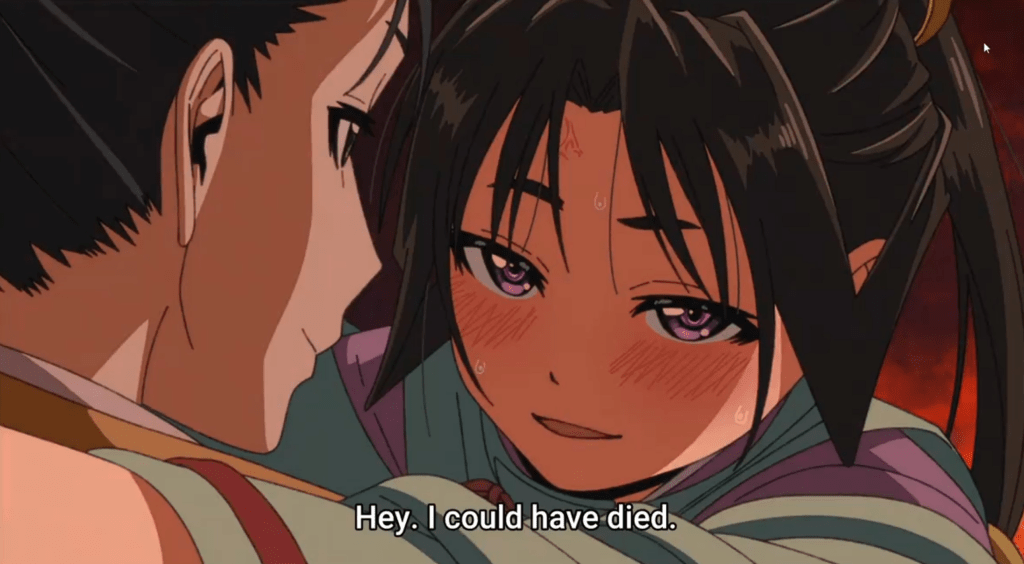
Following on from that point, if you want more evidence that social media is more curse than blessing, I made a discovery about seven or eight episodes in. I didn’t know this at the time, and I know better than to share misery, but in the first episode (spoilers again), there’s a scene where the chief of the Suwa Grand Shrine, Suwa Yorishige, pushes Tokiyuki off a cliff to join his family and be killed, when he shows his max experience in evasion and makes it back up the cliff, he flies into Suwa’s arms, and angrily tells him that he could’ve died down there. Though angrily in this context may not be what you imagine.
Matsui’s pride in femboy characters strikes again, as a disturbingly noticeable percentage of Japanese Twitter saw this scene and exploded with… excitement. I’m not responsible for this scene, but I still feel an apology is owed to someone. Maybe Shinzo Abe’s ghost for all of that excitement going into crumpled up tissues and not the rest of the population for procreation. Sorry, was that vulgar? Have a meme.
Pictured is my reaction to Japanese Twitter’s “awakening.”
Eh, it counts as engagement, so success? I’m still collecting and reading the manga, which I encourage you to do however you see fit. Follow along with the anime (which ends the 1st season at chapter 31), continue in the manga, or if you’ve done/are doing that, then wait with me for the figures to release. Time’s on our side.
On a final note, I heard rumors that a second longer season was in the works. We’ll have to wait for confirmation on that.
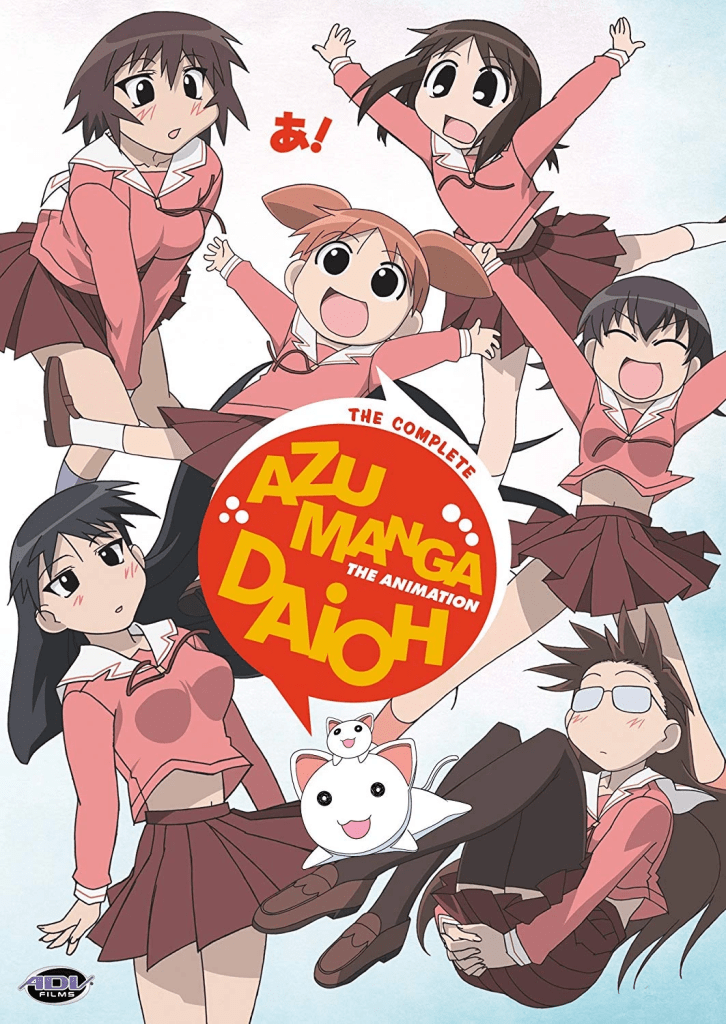
Calling back to a recent post, I once again searched for anime to watch on a whim and with how easy it is to pirate and upload on YouTube (for a time at least), my search led me to another series that needs no introduction: Azumanga Daioh.
A four-panel manga series running from 1999 to 2002, Kiyohiko Azuma’s famous series is about a group of girls navigating their high school and personal lives, with occasional peeks into the lives of two of their teachers. Its anime adaptation follows the manga nearly beat for beat in the sense that every episode is split into different segments. Four-panel manga all have the same layout and are most commonly found in comedy manga series like Azumanga, and are not limited only to Japan. Western comics also have the formula down pat if you’ve ever read the comic strips in newspapers.
As far as plot is concerned, Azumanga is a slice of life series under the “Cute Girls Doing Cute Things” umbrella, a legacy of its era in the moe blob of the 90s going into the 2000s. From start to finish, the manga panels have the star characters and their friends doing really uninteresting stuff, but often in a comedic way. The anime is the same, and having seen it from start to finish the anime translates the humor quite well to the small screen.
Channel: DarkDecietNarcissu
But it still requires a working knowledge of Japanese culture and comedy to understand why it’s like this. Going in blind may not leave as much of an impression compared to going in with this knowledge. The cultural barrier was still standing strong in 2002, and a problem one can see at least with the dub is an old bugbear that only exists when trying to view older anime dubbed in English: poor translations.
One of the strongest concerns in the dub vs sub debate online is whether the translators/localizers, etc. can correctly interpret the scenes and localize them for western audiences without doing away with the original context and humor. Numerous examples of poor translations in the early days exist, but one that makes the rounds regularly online is the Pokémon scene where Brock shares his onigiri rice balls.
By now, everyone has seen onigiri. When it comes to cultural boundaries breaking apart, food also plays a role in that–not just language or history. The faulty dubbing issue isn’t as persistent as it was back in the day, but the concern still exists for many anime fans in the form of internet/video game slang showing up in the subtitles. Personally, I see why this specifically can ruffle some feathers since more and more people watch anime these days and may not always be the same people browsing social media regularly.
From my perspective, Azumanga has a few of these issues here and there, but they didn’t stop me from watching it all the way to the end. As a matter of fact, this series and Azuma’s other series, Yotsuba to!, are a pair of internet darlings. The off-color humor in both series is a source of numerous memes and no-context compilations of the funniest moments from the Azumanga anime due to the style of surreal comedy employed.
Channel: Brolita
Humor like this can show the author’s attention to detail, especially when a seemingly unimportant gag or detail returns in a later episode or two.
Of course, the series isn’t just a barrel of laughs from start to finish. The characters all share intimate moments between each other and in their own personal lives. The character, Yomi, for example is featured in the opening weighing herself, highlighting an insecurity that gets light in the series. Chiyo, being the youngest character, has big shoes to fill with being gifted enough to attend high school at the age of 10. Osaka, real name Ayumu Kasuga, is the outsider, the awkward round peg outnumbered by a bunch of square holes. Her nickname is based on her home city of Osaka and the general perception non-Osakans have of the locals in that prefecture, sorta like how in the U.S. everyone has perceptions of everyone else based on what state they’re from.
Little moments like these help to flesh the characters out and with a small cast to work with, Azuma wasn’t as bogged down trying to give everyone the time of day. This doesn’t necessarily mean that smaller casts are better, but that it takes real care to ensure everyone in a work of fiction is given a piece of the pie. It isn’t always perfect and it doesn’t always need to be as long as all loose ends are tied up. Thankfully, the details in the series are all easy to keep track of through easy-to-remember clauses: one likes animals and tries to pet a finnicky alley cat; one is extra hyper and loaded with energy; one is prone to zoning out at random; one is a sports fanatic; and the list goes on.
Azumanga Daioh is the type of series that one can sit down and relax and have a few laughs while watching these girls go through high school. Its last episode is a neat and tidy conclusion that offers thanks to the viewers as a final goodbye, though I see myself going back for little things in the show.
If the playlist was still available in the English dub I’d provide a link but sadly, the channel that had all 26 episodes dubbed has been removed as of writing this. There still exists the subbed versions on YouTube and the good old-fashioned eyepatch wearing, peg legged, hook hand approach to viewing this series.
With any luck I’ll finally get done with the Undead Unluck anime and provide my thoughts. I’ll do what I can to have it out before the end of the month.
The topic of VTubers is somewhat old hat as of writing this so nothing I write will be new, but my posts since the beginning have mostly always been like that so structurally, nothing’s changing. As for the topic itself, others have mentioned VTubers in the past before and more succinctly so I won’t go into the history as much here. But in case you’re curious on what VTubers are, Gigguk is down below to catch you up to speed. Granted, the video is from October 2020, but all things considered the landscape hasn’t changed all that much.
Channel: Gigguk
All in all, there’s some debate over the beginning of VTubing, but it’s widely accepted that the VTuber Kizuna Ai is the one to spread the idea and popularize it worldwide. Kizuna Ai debuted in November 2016, and many more have followed, mostly of Japanese origin though several from outside Japan, notably the U.S. and U.K. have had their own similar debuts. It wasn’t until 2020, that I was exposed to many of the VTubers mentioned in the video above and the talent agencies (known as tarentos in Japan) that host them and these days many of the notable and newer ones have in some manner populated my feed.
Call me paranoid and nonsensical, but I’d never had that much trust in a machine or any such program. The irony to this was that when I was in Army boot camp initially, I was set for a military occupational specialty (MOS) that would’ve had me working with telecoms networking at the time and here I am with a man vs. technology complex. It’s not all that special, humans have always looked at the strange and foreign with suspicion, but for me it’s just irrational. When I was 16, I binged all the Terminator movies in the lead up to the great disappointment known as Terminator: Genisys and I’ve always chalked that up to the reason I look at new tech with the stink eye.
Nowadays, I don’t really mind the direction AI tech is going since most of the time we’re merely putting in silly prompts and in my case, general history questions. Could we one day mess around and find out Skynet style? Who knows? We’ve got to wait and see. For my exposure to VTubers, it wasn’t around 2019 going into ’20 that I’d gotten more exposure, mostly by proxy through the Trash Taste Podcast when the boys invited VTuber Mori Calliope to the show.
Channel: Trash Taste
And it wouldn’t be the only time a VTuber appeared on the podcast or even individually with the boys on their own channels. Speaking of Kizuna Ai, Joey had her on his channel a few years ago. Gigguk did a few rare collabs with the likes of Hime Hajime, and followers of CDawgVA, the thickest Welsh boy, are very familiar with his dear friend Ironmouse and the pathetic VTuber Rainhoe. These are all jokes, of course. Check them all out when you have the time.
I’d say that VTubers like these helped introduce me to others in my feed as well as the talent agencies that host them. As explained by Gigguk in the first video here, some of the appeal of VTubers comes from the personality themselves and/or the associated lore, other times there’s something unique that comes with VTubers especially in the realm of video gaming where you’ll find a lot of them, and the rest of the time they’re recounting humorous or embarrassing stories or otherwise screwing around. No matter how many clips I find in my feed, this one of VTuber Amano Pikamee making a JoJo reference is always a personal favorite of mine.
Channel: Giobun
But even outside the realm of traditional entertainment, sometimes YouTubers outside Japan have jumped aboard the trend themselves for a variety of reasons and purposes. Back in April, I recommended the YouTube channel Rev Says Desu for his commentary on controversies in and around the anime community, notably in online forums like Twitter. Rev himself uses a VTuber model in his videos and often due to the nature of the content within his videos, he’s normally subject to demonetization at the least and harassment at the most, largely because many of the people he puts on blast from Twitter are a minority of firebrands. Most of Twitter isn’t like that I’m aware, but this is more of a problem of popular and social media giving a lot of power to people who demonstrate that they shouldn’t have it. An age-old bugbear that should’ve been exterminated years ago.
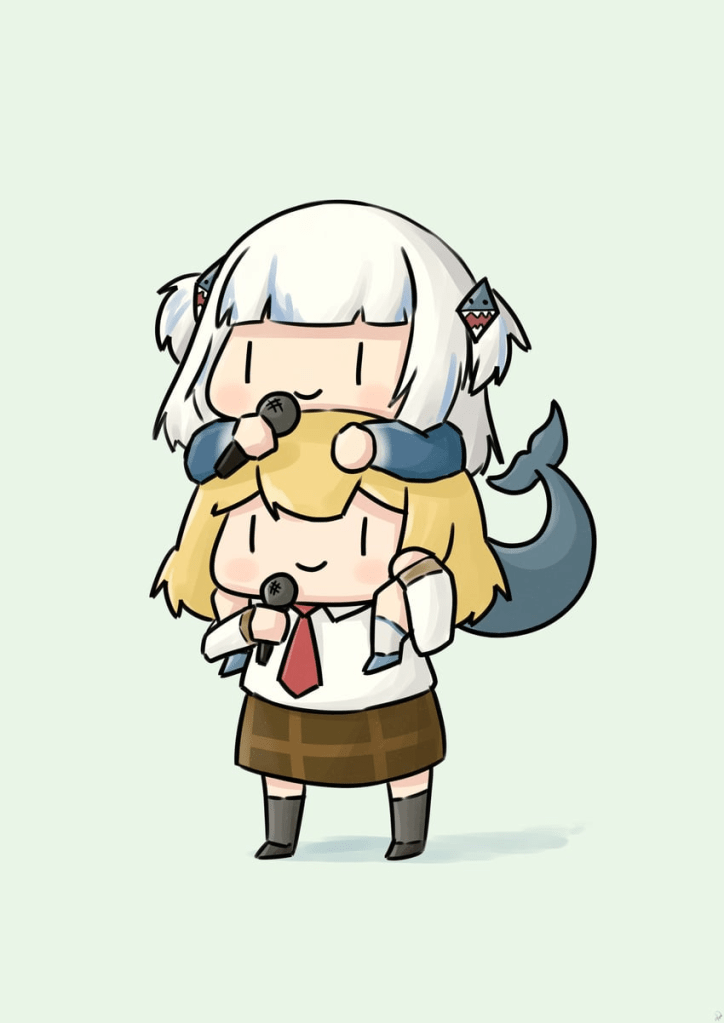
On a more lighthearted note, the messing around, joke around, fun type of VTuber is the kind that has its appeal the world over and has inspired individuals outside Japan as well as English language options being made available for Japan-based VTubers, including but not limited to those associated with the Nijisanji and/or Hololive agencies, sometimes spawning collabs and memes especially in forums like r/Animemes or its sister forum r/goodanimemes. For a while, Gawr Gura and Watson Amelia were featured quite a bit in these subs as one example.
Creator: phdpigeon
And there’s lots more fanart and such to go around.
For my mileage, I’ve come to accept that VTubers are another arm of Japanese pop culture jumping ship and spreading to the rest of the world and rapidly. As Gigguk had mentioned in the above video, some would argue that it’s a fad, a passing fancy, but 2024 is down the street and we still have VTubers debuting these days long after Kizuna Ai helped break the mold, most likely with aid from pioneers from years before. Whatever comes after VTubers I think it’ll be a while before we see it.
This week’s recommendation is a channel known as The4thSnake.
I’ve mentioned this channel on other posts before. This channel is dedicated mainly to fighting games, their lore, and individual plot points, but takes it a step further by mentioning the plots of specific characters over the course of a series’ timeline, clarifying messy plot points, among other stuff. The4thSnake specializes in Mortal Kombat lore and collabs loads of times with another channel I’ve mentioned before: TrueUnderDawgGaming. And since Mortal Kombat 1 has been out for about a month at this point, both of them are set to capitalize on the new lore brought about by this latest installment of Mortal Kombat.