
Hacky, slash-y, chained weapon attack-y
Another week, another comparison between two games I’ve talked about at length on this blog before concerning warriors scorned by the powers that be and in a way that requires service to an opponent and/or taking the entirety of the Pantheon and unleashing the wrath of Timur the Lame onto it.
Maybe it was a coincidence, but Stalin never should’ve trusted Hitler for that long. Same with Mussolini, they already hated each other.
To summarize the plot of Red Ninja again, young Kurenai’s father is killed by the Black Lizard/Kurotokage clan, she is left for dead, and recruited by the enigmatic Mochizuki Chiyome, aligned with the Takeda clan and its leader, Takeda Shingen, to serve him and dismantle both the Kurotokage and Takeda’s enemies: the Oda clan. Her various methods of disposing of enemies consist of a weapon at the end of a chain used creatively, classic shinobi stealth and deceit, her own body as hinted by her suggestive outfit and the video game’s cover art, poison darts, and trademark shinobi tools like kunai and shuriken. There’s a blend of typical tropes and Japanese history, of which I approve as a Japanese history enjoyer.
God of War debuted in 2005 as an homage to claymation sword-and-sandals epic movies from the 1950s through the ’80s like Jason and the Argonauts, Hercules (likely the 1958 version), and Clash of the Titans. The central character is Kratos, a very brutally patriotic Spartan, whose skin is marked, first by the searing chains of the Blades of Chaos awarded to him by Ares, and then by the ashes of his family who was killed in a blinding rage as a means to sever his connection to mortality and commit him to lifetime service to Ares. Say what you will about Ascension and the PSP games, but they all do well to cement his position in a very Greek tragedy way.
Ascension is shortly after he realizes that serving Ares is a ruin. Leaving his service isn’t as easy with the Furies breathing down his neck to bind him to his oath. Chains of Olympus occurs five years into his redemptive service to the larger pantheon sans Ares where his main duty is to retrieve Helios from Hades and drive back Morpheus, the God of Dreams. God of War 2005 is five years after that, and a real chance at redemption arrives at the death of Ares by Kratos’ hand, but due to the nature of his brutality and prior service, the one thing he’s always wanted–a mental cleanse–is out of reach.
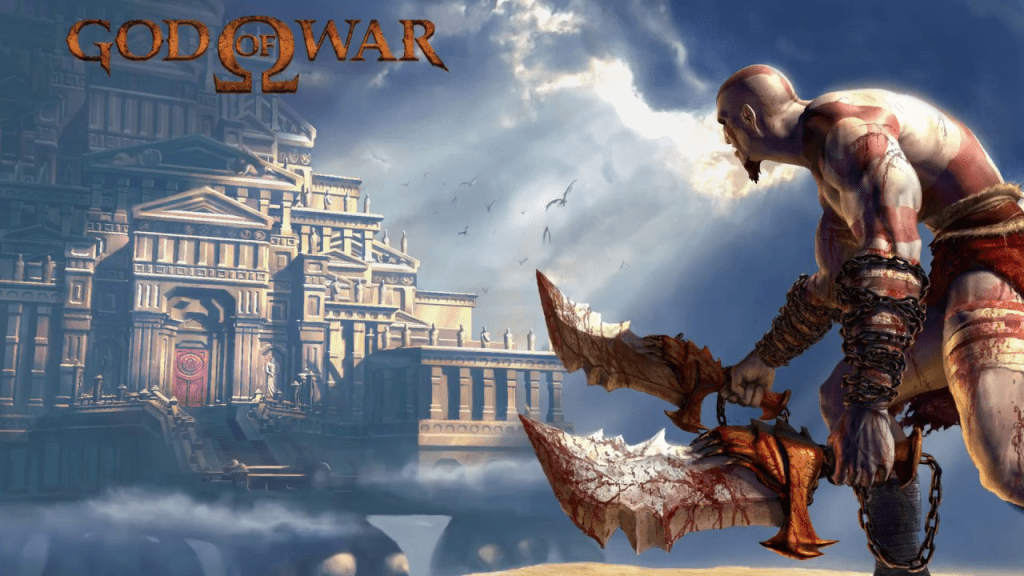
“The gods of Olympus have abandoned me… now there is no hope.”
But Olympus won’t let him go. They award him Ares’ throne, which was never what he wanted, and in Ghost of Sparta (my personal favorite next to II), visions of his childhood and his brother Deimos come back to haunt him. Learning from his mother, who was cursed by Zeus, that Deimos had been held for ages in the Domain of Death, Kratos seeks to free him, and the gods try to stop him tacitly by having Athena talk him out of it and explaining why they thought Deimos was the personification of dread. In Greek mythology, the deity Deimos and his twin brother Phobos represented the concepts of dread and fear respectively. In typical tragic fashion, Ghost of Sparta shows him being kidnapped from Sparta by Ares and Athena themselves to eliminate threats, namely threats to Olympus. Thanatos, the literal black sheep of the pantheon and personification of death, keeps him locked up. Committing to these duties, Thanatos engages them in combat and kills Deimos.
His mother, brother, wife, and child all dead around Kratos and without any human attachments, Athena awards him godhood and the official seat as the god of war. A great boost of morality for Sparta, an asset for Olympus, and a Spartan kick in the teeth for Kratos whose humanity, which he wanted to cling on to, has been stripped away.
Channel: Parts From Movies
I could not resist.
God of War II is where Kratos is in full “f[roar]k this” mode and he personally guides his Spartans into battle with virtually zero resistance from them and all from Olympus who realize they replaced a beast with an even worse monster. A man who cared little for petty godly squabbles is now using his position to discredit their sense of order and elevate himself as a consequence. Now Sparta truly is known throughout the world. Zeus tricked him into stripping himself of his own godly powers and saw to it personally that he would never be able to resist him again… or so he thought until Gaia intervened personally. Kratos angered himself back to life and slaughtered his way to the Isle of Creation to seek counsel from the Sisters of Fate, the literal gatekeepers of time. Ignoring the inherent danger of messing with time to f[SPARTA]k Zeus back, Kratos returned to weaken Zeus, and with the help of the Titans who lost the Titanomachy, he storms Olympus and starts slashing gods one by one, plunging the world into chaos in the process. No gods to manage their domains, no more earth; even the Titans were using him.
Yeah, as epic as this is (and it fu[clash]ing was), there’s a couple of inconsistencies. How does Kratos become the God of War at the end of the 2005 game, but the death of his remaining family solidifies it further? If Kratos could go back in time, why not save his family or stop himself from becoming a servant of Ares to begin with? These kind of ignore what kind of man Kratos was and what the Greek games were. Mythology is never consistent, just look at who the first emperor of Japan is supposed to be compared to who historians believe the real first emperor of Japan was (Jimmu and Kinmei). As for why he didn’t bring Calliope and Lysandra back to life… I chalk it up to Kratos not being that kind of griever. He’s more this kind:
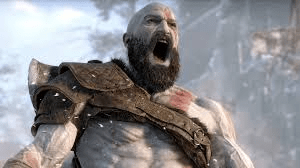
He’s like a Toyota, he only moves forward, even when he goes back.
And that’s all for the plot synopses of Vermillion Ninja and Ghost of Sparta. What do they do that can be compared here? Combat, of course. Each character gets gadgets and weapons to use against their enemies, but the default is a weapon at the end of a chain, or dual weapons in Kratos’ case of which he had several by III. Kurenai is able to use her kusarigama primarily offensively. Kratos’ blades, no matter what shape they take, are more than just offensive combat tools. Grappling, platforming, climbing, fighting from various distances; and a good look at Kratos’ primary weapons shows this:
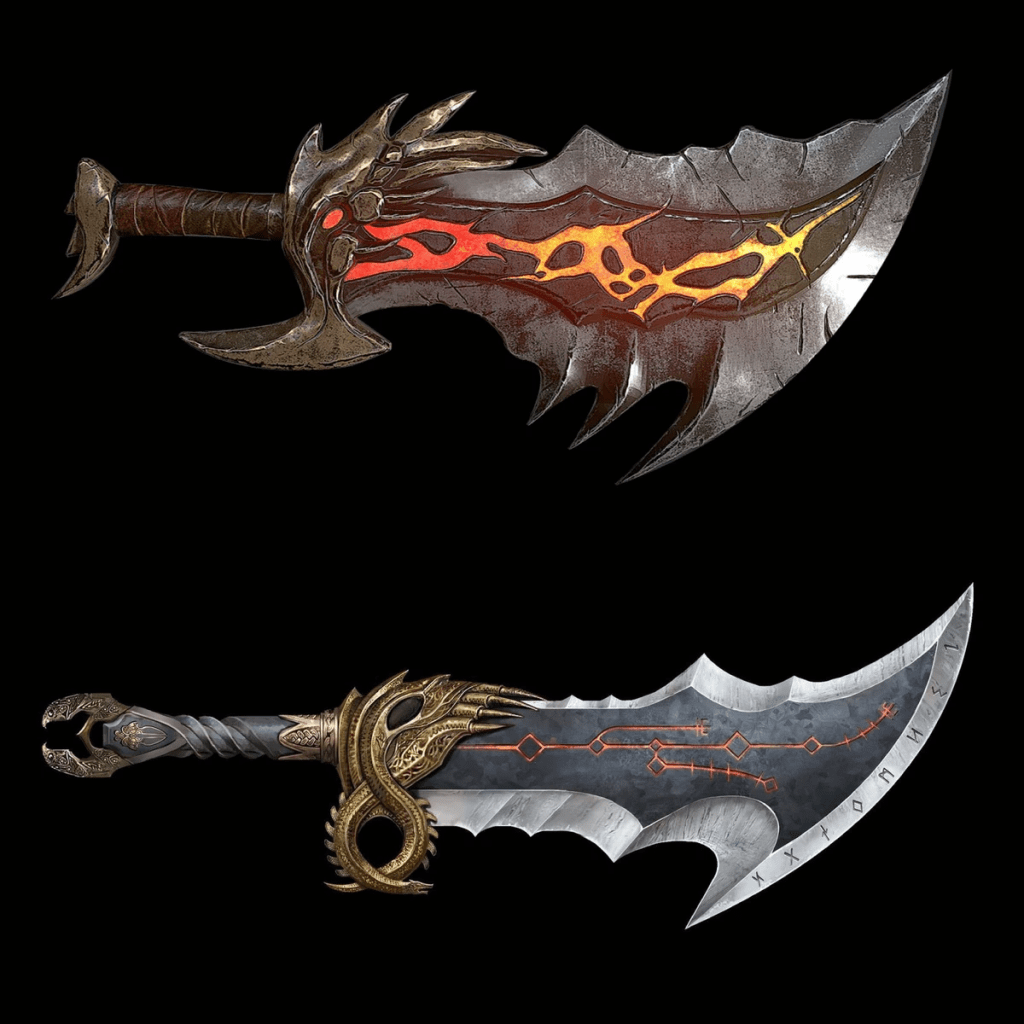
They’re ugly, they cut terribly, they burn and sear, they char, they can wedge and burrow into solid rock, are resistant to scratching and the roughest forms of abuse (which defines Kratos’ fighting style); these blades, forged in the darkest pits of Hades, have raw divine power keeping them in their consistently rough and rugged shape.
They allowed Kratos to fight and platform with acrobatic prowess. They also helped greatly during the countless puzzle segments that defined the Greek era games. Compare that to Kurenai and Crimson Shinobi whose platforming is less jumping onto conveniently exposed platforms and solving puzzles while using her weapon system and more incorporation of trademark shinobi trope tactics. The design leans into some of the mechanics that made Shinobi and Ninja Gaiden staples over the years, but is again, held back by its hybrid implementation of multiple combat and platforming systems, some of which fight each other. For reference, this is a kusarigama:
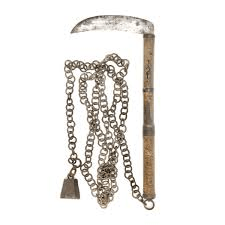
Rather than a pair of chained weapons, Kurenai has one weapon at the end of one chain with the other end being a weight, so it kills and entraps. Which brings her closer to Scorpion from Mortal Kombat.
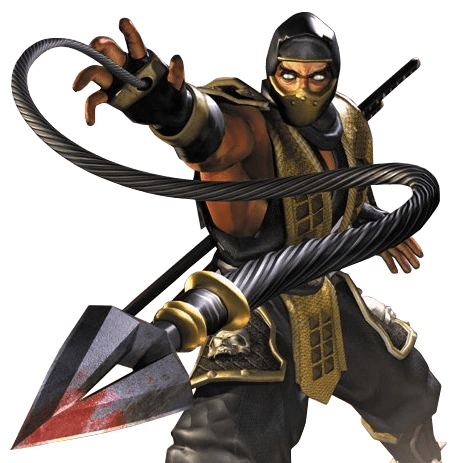
Neither of them uses their signature weapon acrobatically, at least not for Scorpion until Shaolin Monks where he’s a boss battle in the Netherrealm, and I think the budgetary hemorrhage from Midway in the 2000s, coupled with the game’s structure of being a 2D fighter, Shaolin Monks was the only way Ed Boon and the like could use that. Funny enough, all three of these games released across 2005 fighting with a bevy of releasing around the same time. Shaolin Monks was the latest to release (September 16, though sources differ on the precise release date), so while Red Ninja was probably buried by God of War, I wonder if the Midway guys were eyeing God of War and used the spear like that after seeing what Kratos could do. Probably not, but I like to think.
Red Ninja probably could’ve implemented something slightly similar or adjacent to Kratos’ level of platforming, not to mention a better camera, controls, and enemy AI. Actually, Japanese devs can, have, and do use this, typically in Ninja Gaiden. Ryu Hayabusa’s move set is compatible with a wide array of weapons within a ninja’s skillset and outside typical ninja characteristics consistent with the genre as we see it in pop culture. Kurenai is limited to the tools that emphasize stealth, but the game doesn’t behave consistently in a way that allows for that.
But in an age of remakes and remasters, as I said the first time I reviewed Red Ninja in full, a case can be made to apply that to some games that were buried, this one included.
The last game to put side-by-side with this one is a 2020 American homage to Kurosawa samurai epics. Yes indeed I do mean:
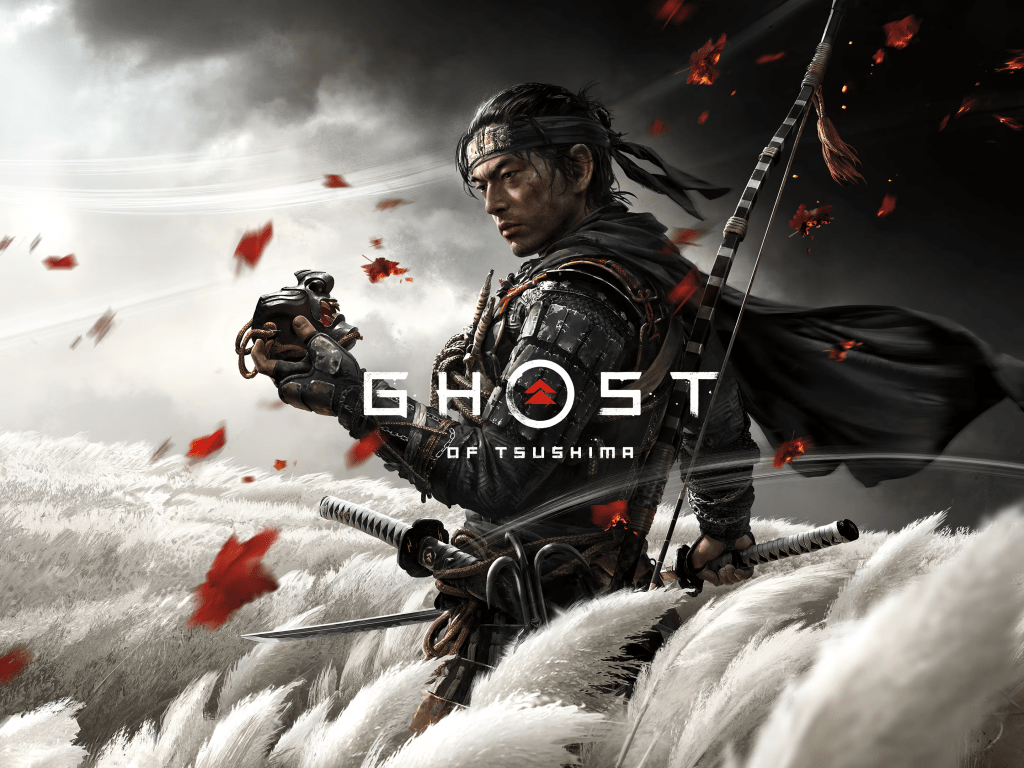
Ghost of Tsushima, also known as The Tale of Sakai Jin or Sakai Jin Monogatari or 境井仁物語. This game is more of an evolution from honorable samurai warrior to deceitful proto-shinobi as the shinobi wouldn’t be put to more use by the samurai and daimyo class until the Sengoku era, but both this and Red Ninja being set in Japan gives me a lot of leeway. Haven’t I written about Japanese historical series before?
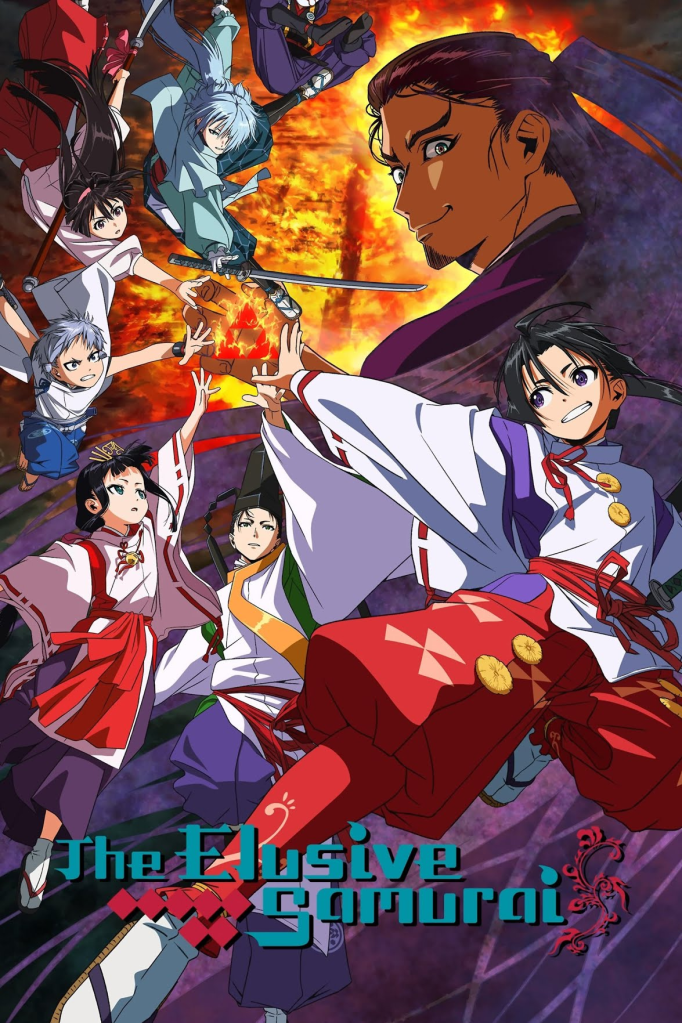
We’re reclaiming Kamakura with this one!!
 Opinions on Entertainment