
Practically just started
Before we start, concerning last week’s surprise destruction of The Escapist’s video team, the YouTube channel Clownfish TV (which I’ve recommended before) uploaded a video a few days later that I contemplated dedicating a post to, but ultimately decided that it wasn’t worth it. The minds behind the channel are staunchly independent of any corporate oversight and maintain this position above all else for a better deal in the long-run. The Escapist was bought by a conglomerate which complicated things, and while the team of Kneon and Geeky Sparkles have zero love for dishonest games journalism, part of what motivated a possible post would’ve been to correct the record and clarify what actually went on… or at least I would have.
After sitting back and analyzing what the video concerned, I realized that most of the criticism was elsewhere on The Escapist site and that one’s opinions seldom influence business rules especially from the outside looking in. For me, it didn’t feel like that because the comments section was what got to me.
It’s worth noting that this tends to be the nature of YouTube communities; channels do have their dedicated base and this often leads to biased echo chambers with again very little influence on what goes on in the afflicted realm. Also worth keeping in mind was that reporting on pop culture in any capacity is merely another day in the office for Clownfish TV. Malice can’t be assumed all things considered. As for the community, the one piece of advice that works for me is to get the entire story before judgment is passed. Get all the context and then give your final thoughts.
Now for the real topic I want to write about: military novels. Personally, I’ve never been all that interested in them, and since I’ve been around on r/Army, reading the occasional news stories of controversies surrounding the special forces community in particular, I’ve held a dash of skepticism to go along with what describe as a Heroic Tit-wank in Print form. If you don’t know, special forces like Army Green Berets or Rangers, Navy SEALs, Recon Marines, Air Force Combat Controllers and all of them tend to get the Hollywood treatment more often than not. I’m not saying they don’t deserve the recognition for their sacrifices, their missions, their stories, but they’re not exactly a monolith.
For every Medal of Honor recipient of any capacity like Dan Daly or Ralph Puckett or Alwyn Cashe, there’s also these guys making fools of themselves:

Credit: Getty Images

Credit: Getty Images
Clearly, the worst or more embarrassing stories of the military’s finest aren’t reflective of everyone including the HR folks or the intelligence or signal branches or anyone else who sees it as just another job, but sometimes it gives me pause for thought. As a history buff, I do like military history as well. The Elusive Samurai motivated me to research the Kenmu Restoration and the Ashikaga Shogunate in medieval Japan, for instance, and more than once I’ve done some light research on Civil War battle orders or even the Roman Empire, among numerous other things.
Before even entertaining the idea of the military as a whole, the movies and whatnot all seemed so cool. Call of Duty and Battlefield led the way in cinematic experiences and memorable characters. After watching some more movies, and going to basic training myself, it’s safe to say that if you’ve been in the military — any military — you’re preconceptions are going to be challenged and your newfound knowledge on how things go in the real military will ruin a lot of movies for you.
Prior to shipping, I thought the boot camp portion of Full Metal Jacket was the highlight of that movie, primarily because of the characters: Joker, Pyle, Cowboy, and Gunny Hartman all make that movie, but stepping back from that, it’s divided first into how Marines are trained (sort of), followed by an active combat deployment to South Vietnam. The greatest irony of that movie is that for an anti-war film, so many incoming recruits watch and quote it ad infinitum, and expectedly so. The actors are the highlights of the movie and if it wasn’t for R. Lee Ermey and the jelly doughnut scene, then it probably wouldn’t have the same influence as it does almost 40 years post-release.
In the veteran community, lots and lots of media is heavily scanned and scrutinized based on what we’re all taught in boot camp and when we go off to train for the occupation we chose or have chosen for us based on test scores. This explains why movies like Generation Kill and the Hollywood misfit In The Army Now are more beloved amongst veterans and servicemembers compared to something like Zero Dark Thirty, American Sniper, or The Hurt Locker. Even vets who’ve never deployed to a combat zone (yes, this happens, ask around) will tell you that an overwhelming majority of the time is spent waiting to do something and that something goes by exceptionally fast. Such urgency…
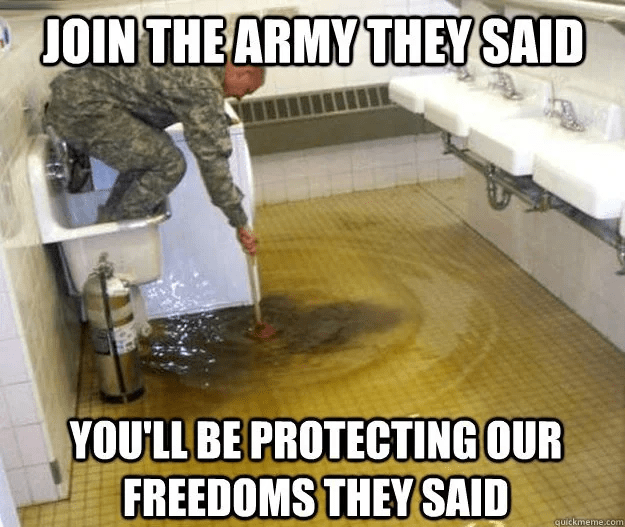
Also, fair warning: the military has a frat house mentality. Keep in mind the ages of the people signing up.
So I’ve been rattling on over about military/war media and the reception based on the community viewing it, but I haven’t mentioned what I’ve been reading. As I said, I hardly ever had an interest, even in passing about these kinds of things, and even over time, now that I’ve been in a military training environment, I trend quite lightly these days. You’re drilled day and night about how to properly wear a uniform and even mishaps in film can get a vet’s dander up more so than stolen valor incidents.
I try my best not to overanalyze this stuff or make a monolith or standard-bearer of military/war media since a lot of it is for the public and like a lot of their real-life units, the special forces movies tend to play by their own rules. My rule for whether I should give something a watch or a read is wide reception. Even if the community hates it, it’s not good to let those opinions overtake or form future opinions on XYZ. But so far I have been enjoying Generation Kill, and I do like Saving Private Ryan and Dunkirk. Some of these I’m introduced to by proxy and they wind up being pretty good.

For Generation Kill, I went for the book first for comparison to the HBO miniseries. Nearly done with the book and the show so I might come back with some final thoughts. And getting back to controversies in the special forces community, there was one book that caught my eye. I don’t remember how I found it, but it’s called Code over Country by Matthew Cole. It’s based on the wide range of corruption and lax oversight within Navy SEAL Team Six. Once I get my hands on the book and get through reading it, I’ll try to make an effort to give my thoughts. Bear in mind, most vets and servicemembers won’t run into anything close to a special forces unit and for security reasons, most of what they do isn’t revealed until after the fact, so corroborating what I hear will have to be done by way of news reports like those featured on Military Times or its branch specific variants.
This post was kind of a misnomer all around, but before I close off, I want to make a case for the manga series Golden Kamuy.

I say this is a military series for a lot of the obvious reasons: veterans of a major war (Russo-Japanese War), active duty soldiers in uniform, commanders doling out orders by their judgment, and more. But it also takes the tropes of traditional westerns like those of the Clint Eastwood or Dances with Wolves variety.
I have a post in the pipeline regarding Golden Kamuy itself so look forward to it in the next few weeks. I’ll elaborate further on my case then.
 Opinions on Entertainment