My Hero Academia: Vigilantes Might Get an Adaptation

An overlooked spin-off may finally get some attention

In my notes, the topic of this spin-off was in the pipeline for at least a few months now, but thanks to recent rumors, it’s possible that the fabled adaptation may be entering its production stage. And as a follower of the series for a time, this has been a long time coming.

The original My Hero Academia launched in 2014 by mangaka Kohei Horikoshi, and was given an adaptation about two years later which, as of writing this, has wrapped up its sixth season a few months ago. Additionally, it’s had a series of light novels, video games, associated apparel and other accessories, and a pair of spin-offs in the form of the aforementioned Vigilantes and a chibi four-panel comic, both of which are much shorter than the original MHA manga which, as of writing this, is nearing 400 chapters and over 30 volumes. All things considered, since Horikoshi was a fan of Naruto growing up, I think it’s safe to say that if part of the dream was to have the same impact that Naruto had in the early 2000s then on that front, he’s succeeded.

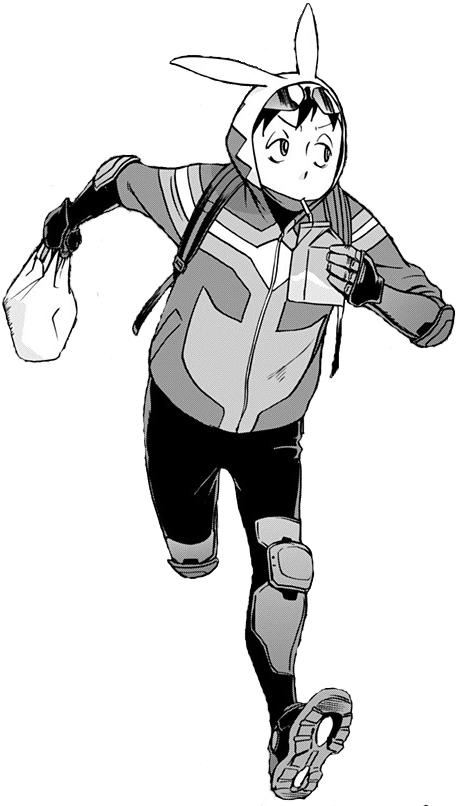
The Vigilantes manga meanwhile sat in the back, being released in April 2016 and running up until May 2022, concluding its story in 15 volumes, so it can be cleared at a faster rate than it would take to catch up to the original manga from the beginning. The protagonists are Koichi Haimawari, a college student and part-time vigilante who mostly patrols a single area of Tokyo under the alter ego of the Crawler, jokingly mispronounced “Cruller”; Kazuho Haneyama, the trademark, pink-haired tsundere high school student who moonlights as an impromptu pop-star under the guise of Pop-Step; and Knuckleduster, a crusty Batman-like archetype, who embraces his quirklessness and dishes out justice the old-fashioned way.
At the outset, you can see the differences between the original’s Izuku Midoriya and this one’s Koichi Haimawari. Izuku, or Deku, began the story quirkless and with zero prospects to become a world-class professional hero until his idol, the world’s Number 1 superhero All Might, observed a hallmark of bravery and allowed him to prepare enough to inherit his quirk One For All, which has been handed down through generations of world-class heroes. Koichi, on the other hand, has a quirk called Slide n’ Glide which allows him to glide around and connect to flat surfaces with three points of contact. Kazuho’s quirk is leap which allows her to jump at great distances; this allows her to live out the idol persona she puts on.

Not just limited to these unofficial heroes, pros from the original series also make an appearance to include, the big man himself All Might, Shota Aizawa, Midnight, Present Mic, Detective Tsukauchi and several more, most of these folks being pros before teaching at UA Hero Academy. Most notably, the tone of Vigilantes is darker and a bit more mature than that of the original as it focuses on a college student this time around than a high school class. As I wrote above, All Might is there, but his presence is more of a backdrop than as a prominence. Koichi’s part-time hobby as a vigilante puts him in a tough spot legally. The original manga introduces the pro heroes who are licensed to step in alongside the proper authorities like the police and courts, and the villains are their polar opposite, but the Vigilantes manga clarifies what this means.

When quirks were first discovered in the MHA world, the laws were nonexistent. Vigilantes were the original unlicensed heroes who stepped up to answer to the rampant chaos borne from the emerging quirk era. The law eventually came up, not to explain the makings of a hero but to classify villains. The first place to have laws written on heroism or villainy was the U.S. state of Rhode Island. Of 189 vigilantes whose candidacy for heroism was up for review, only seven were allowed to continue on as the U.S.’s first pro heroes. The issue for the other 182 candidates was that they didn’t have the qualities that made the trademark hero and either continued on as vigilantes or villains. Ironically, the law’s adherence to licensing puts vigilantes in the same spot as villains despite vigilantes being the origins of the laws and most vigilantes running counter to full-blown villainy. The causal loop is definitely not lost on the manga though.

Burgeoning heroes who find themselves in vigilante limbo though aren’t hopeless thankfully; there’s a program that allows pro heroes to recruit vigilantes as sidekicks and incidentally, some big name pros in the original began as sidekicks before finding their own paths in the hero world. Vigilantes also has a sort of slice of life element to it as well. If Koichi was up for hero candidacy, there’s no shortage of witnesses to his do-gooding in the immediate neighborhood, as well as some pro heroes who can give him a leg up if he needs it. There’s glimpses of him aiding people with minor inconveniences just as he assists his fellow vigilantes and pros in stopping villains in any capacity.

There are also several plot points in the original that have origins in the spin-off series. Another notable difference between Deku and the Crawler were how they both deal with their lots in life: Deku’s aspirations would’ve been impossible even if he had a relatively worthless quirk; meanwhile Crawler’s initial poor handling of his own quirk didn’t really stop him from attempting to help, even if it was with a stray dog (that’s sort of a joke, there is a dog in trouble later in the manga; not so much of a spoiler since it gets resolved in about five panels). Deku obviously starts off in high school with his head in the clouds; Koichi tends to keep it realistic and is more in it for the good of the locals, so if he went the pro hero route, the money wouldn’t be his main motivation, though the same would apply to Deku.

The Vigilantes manga’s place in canon can be interpreted as a sort of foil for the checkerboard presentation of the main plot. Vigilantes as unlicensed, illegal heroes are shown to be a necessary evil in the law’s eyes, and a digestible aid from a practical standpoint. With pro heroes, there’s laws that rein a hero in from overstepping the established boundaries, but vigilantes being unregulated could go a step further to prevent an escalation before it becomes a problem for the pros, which turns out to be Knuckleduster’s own philosophy in the manga.

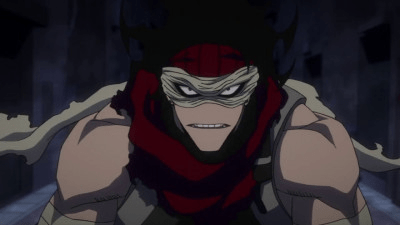
Personally, I welcome Vigilantes as a bit more grounded in its approach to what the original is doing. It’s still a Shonen series at heart, but in practice it takes things a bit further with an older, more mature protagonist who is still optimistic about his future even though he’s buried pretty deep in the gray muck of hero laws. It also has a bit of an edgier portrayal that would really challenge the cast of the original MHA, but not grotesquely or irreverently as Amazon’s The Boys. In the MHA world, Homelander and A-Train would be high on hero killer Stain’s crap list.
If the rumors are to be true, then a notable rarity in anime production would be the adaptation of a complete manga. The only other case that comes to mind would be that of JoJo’s Bizarre Adventure reaching a successful adaptation in 2012, one year after the eighth arc of the manga was being written. That said, all we have are the rumors, so it might not be true until an animator or someone else in the industry has more concrete evidence of an adaptation in the pipeline.

For now, the chapters are available on Viz Media and Shueisha, and its 126 chapters are spread across 15 volumes. To my knowledge there’s no collection or box set to speak of for the lesser known Vigilantes arc, but don’t let that stop you from making your own. For my take, it’s a B+. Avoiding spoilers, there are minor instances that could’ve been reworked or omitted, but the rest of the time it’s a solid manga.

To go along with this overlong recommendation wearing the mask of a blog post is the last YouTube recommendation for the month of June. Adding onto the cadre of Trash Taste affiliates and allies is the YouTube channel Abroad in Japan.

https://www.youtube.com/@AbroadinJapan/about

The channel and other associated Abroad channels are run by British grammar educator and YouTuber Chris Broad who first moved to Japan in 2010. Ever since, he’s made video after video on daily life in Japan going by prefecture, sights to be seen, activities to perform, and generally places to visit. While not a full-blown weeb, his guest appearances on Trash Taste have introduced him to several anime series and he has revealed to the TT boys that his favorites included most of Studio Ghibli’s lineup and anything directed by Hayao Miyazaki or Satoshi Kon or even Kenichiro Watanabe to name a few directors. Normally, when it comes to Japan-based YouTubers, one of the first people to go to is someone who’s native, but spending over a decade and change in Japan should put him in the same room as other Japan-based YouTubers, especially since he’s been up and down the country.

If you’re still looking for a slice of Japan, but you’ve had your fill of anime, Chris Broad’s always got a video or series up, to include the likes of Dr. Jelly as part of a collaboration with The Anime Man, and Wacky Weekends and Journey Across Japan done mostly in collaboration with CDawgVA.

A Somewhat Complex Introduction to Pokémon

Better late than never?

This will serve as both an indictment against me, and as an explanation for what I’ve always thought about the Pokémon franchise. Before we start proper, my original notes were going to say that this was a “Late Intro to Pokémon,” but that’s inaccurate and misleading considering what I grew up with. Such a title would suggest that I had never heard of Pokémon before or bothered to look into the series itself, which just isn’t true of the rest of the franchise outside of the games. The games were what I was late to, not the anime, or the toys, or the cards. So, this post will be mostly about the games.

I say that my introduction to Pokémon is inaccurate because growing up in the 2000s meant seeing some variation of the franchise on TV through the anime or through advertising. I certainly recall tuning in to Pokémon when it was on channels like Cartoon Network, or Nicktoons or 4KidsTV alongside Yu-Gi-Oh!, but admittedly, it hadn’t really caught me the same way Dragon Ball Z did at the time. Still, it was one of the two properties with something that can be imitated in real life in the form of the card games.

If you also grew up in the 2000s and 2010s, you or someone you know probably had a booklet or folder or something similar that had a full deck of cards or more. Like Yu-Gi-Oh!, I was normally just the bystander watching some of my friends play and battle it out from the sidelines. It got the most focus in the latter years of elementary and all throughout middle school, especially during recess. For me, the allure of Shonen series was the more intense battles that could be seen through the original big three: Naruto, One Piece, and Bleach, with a special mention to Dragon Ball. I didn’t know it at the time, but the rest of the franchise went hand in hand with the anime, similarly to Yu-Gi-Oh!, so the point flew over my head on a supersonic jet.

I always thought all of this was enough to get a fill of the series, but there’s a noticeable difference between watching the show, engaging with the cards, and playing the video games; a difference I never saw until recently.

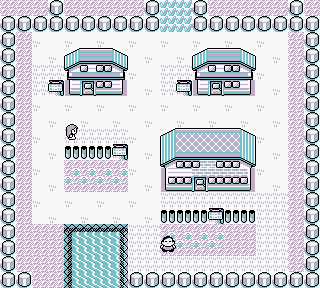
I knew how the games started for the most part: name character, choose starting Pokémon, adventure, battle. Sometime last year, I started the game on a browser emulator which as a sidenote, was not very hard to find, probably because the technology for a handheld is seemingly less complicated than that of a home console (don’t quote me on that), and I began with the first game in the series: Pokémon Red. My starting Pokémon was Squirtle, whom I advanced up to Wartortle after fighting off several wild Pidgeys and Ratatas. Then it hit me… like a wild Pidgey.

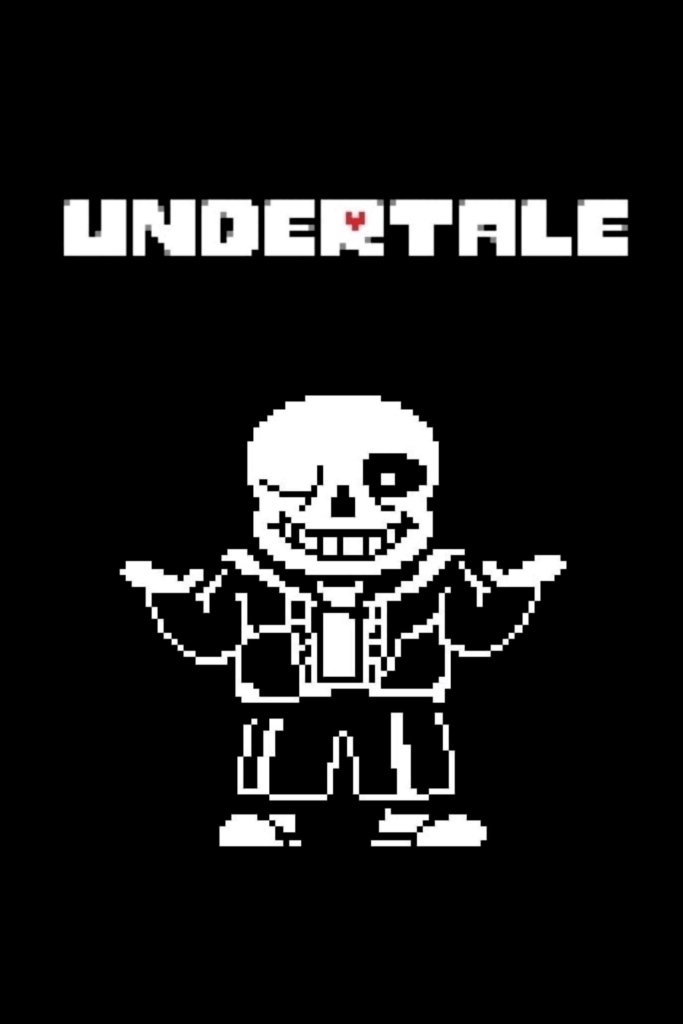
When I started this post, I was certain it was mainly about the Pokemon games’ layout and such, but it seems to be a bit more complicated than even I thought and opened up with. For all the love I give to adventure games and RPGs, some of the gripes came down to leveling up and the random fights that happened no matter what. Then again, there were other games that had this design philosophy and I remember getting far and playing most of them to completion. Naruto: Path of the Ninja, handheld versions of the Avatar games, in some aspects Genshin Impact and most recently Honkai: Star Rail. I even watched gameplay of a pacifist run of Undertale.

So, I clearly had no real issue with RPGs or JRPGs, but I didn’t start or attempt a Pokemon game until I was 23. So, what gives?

I don’t feel like leaving on a cop out answer, but the only one that makes sense to me would probably be overexposure. A franchise this influential to pop culture, media, and such that South Park can parody it, even when it just breaks ground in the west didn’t feel like there would be too much to discover by myself, which may also explain why I’ve been hugging and cheering on underrated and unsung manga like Undead Unluck, The Elusive Samurai, and one that I also discovered recently, but haven’t written about yet, Rokudenashi Blues.

But if you read all that and recalled that I’m so caught up with Naruto that I could in some aspect be the “Boruto Guy” with all the lore in just that franchise, you might also question how I can be overexposed to Pokemon but not take similar issue with Naruto and the other stuff. Why the bias? Well, first that’s a question to be asked about almost everything in life, and in context… as much as I tried to avoid it, the cop out “I don’t know” might have to suffice. Maybe the appeal wasn’t as strong for the games as it was for the 12,000 anime iterations. Unlike most of my friends at the time, I was way more of a moderate consumer of anything Pokemon compared to the other stuff that ate up my attention. Whatever a superfan of Pokemon hoped to have, I sought the same with Naruto all things considered and the free-roaming, adventure style I personally found more engaging then walking around Pallet Town waiting for the danger to find me like I mixed the paranoia pills with strong Colombian coffee.

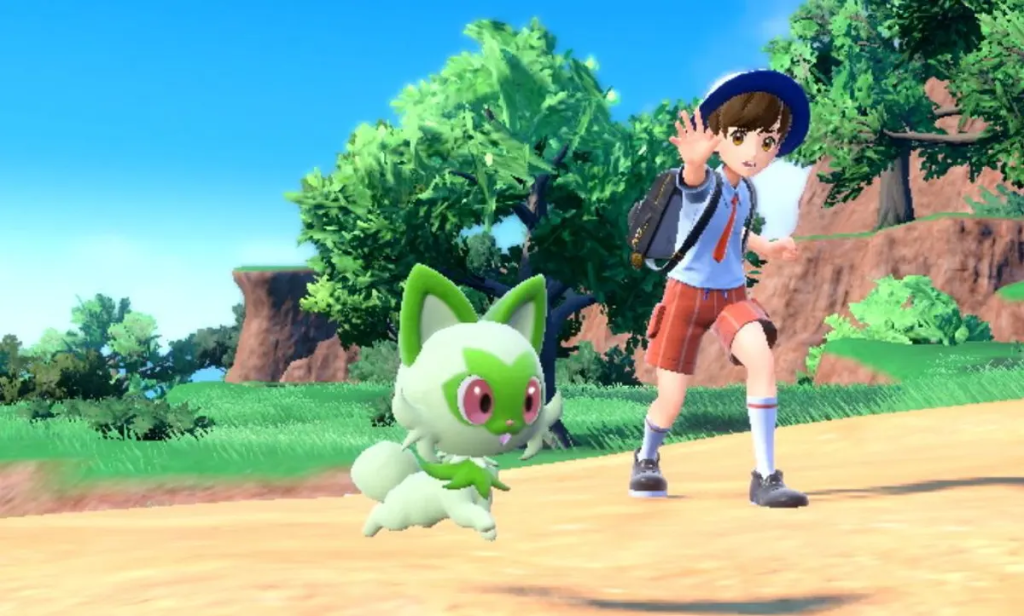
I think it also comes down to the early Pokemon games at the time relying on the player’s imagination to fill in the blanks as opposed to what a modern Pokemon game is capable of now.

That being said, I wouldn’t say I’d want to stop trying to get into Pokemon. Googling the franchise will definitely put it in my radar in the form of banner ads down the line and admittedly none of what I bring up is bound to be a staple of the games anymore. The battles happening at random weren’t any fun in Path of the Ninja and from what I remember the furthest I got there was the Land of Waves arc. I might revisit this in the future after looking at gameplay of later Pokemon games. We’ll have to wait and see.

For this week, I recommend the YouTube channel Clownfish TV.

https://www.youtube.com/@ClownfishTV/about

Clownfish TV is an independent media outlet that focuses on games, TV, animation, comics, and pop culture mainstays and staples, chief among them Disney and its growing properties. Co-hosted by husband and wife duo, Kneon and GeekySparkles, the channel makes daily videos about media at a rate of two to three a day. Additionally, they have merchandise up for sale on their own website and as of this writing, a comic strip based on dialogue spoken in the videos.

JoJo’s Bizarre Adventure: Beautifully Blursed

Supernatural music references

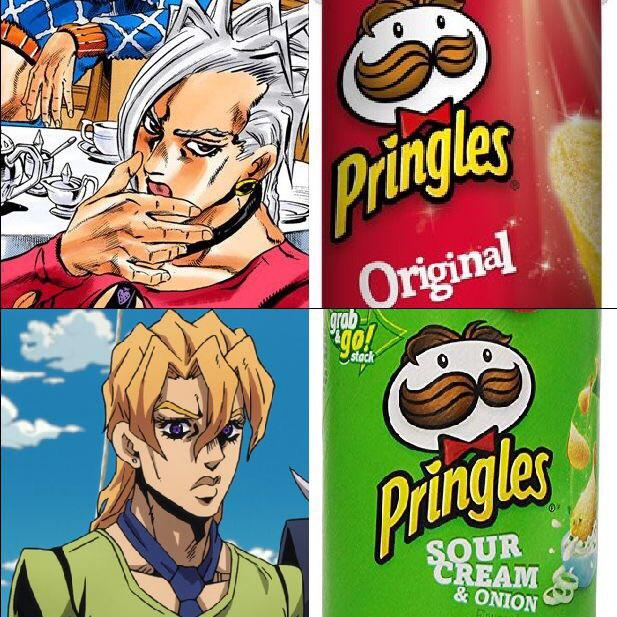
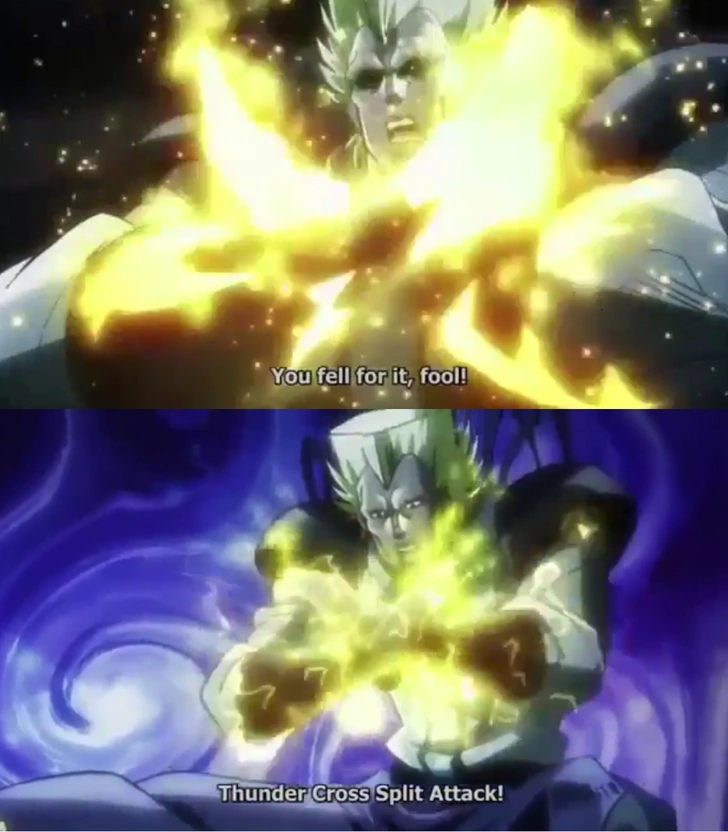
This one is a long-time coming. One of my posts from January of this year included a still frame of a JoJo’s Bizarre Adventure episode that has since been used as one of the countless memes in many anime circles online. For those who need a refresher, it’s not the one where the character Dire feigns incompetence to catch his enemy in a move known as the Thunder Cross Split Attack. Instead, it’s the one where a character named Pesci, notable for his lack of a neck cries in excitement that someone or something took his bait. Example:

The picture I used months ago was larger than that. But swinging back to my point. I won’t be the first person to speak about the JoJo’s Bizarre Adventure series, nor will I expect to be the first person to introduce it to those who haven’t heard of it or were on the fence before. But even if this is the millionth time you’ve heard or read about the series with no clear distinction on whether to see it in action, let me remove the ambiguity: I can’t recommend the series highly enough. I write this with the enthusiasm of a tourist coming back from the best vacation spot ever.

For an introduction, I’m going to try my best to spoil none of the manga or the anime. JoJo’s Bizarre Adventure belongs to the long list of longest running manga series still in production while also sitting on the list of most difficult series to adapt as an anime. For context, the first chapter debuted in December of 1986 with the first volume releasing later in 1987. The modern anime series that you might see on streaming sights like TubiTV or Crunchyroll or even Toonami in the west debuted in April of 2012. There’s a reason for the nearly quarter-century gap between manga and anime and it comes from the way the manga is structured. Artistically, the manga artist, Hirohiko Araki looked more towards Greco-Roman and Renaissance art for inspiration, western fashion magazines, and during the production of the earlier parts of the manga, the days’ most popular musicians to include Michael Jackson, Prince, the Beatles, the Police, and countless others.

The manga itself is divided into nine parts or arcs that center on a different protagonist within the same lineage.

Part 1: Phantom Blood ran from January to October of 1987 and takes place in Victorian England. The protagonist is burgeoning gentleman Jonathan Joestar and the antagonist is his stepbrother Dio Brando.

Part 2: Battle Tendency ran from November 1987 to March 1989 and takes place fifty years later, centering on Jonathan’s grandson Joseph, who is far more rascally and mischievous than his grandfather. The antagonist this time is a trio of ancient Aztec beings known as the Pillar Men named Esidisi, Wamuu, and Kars.

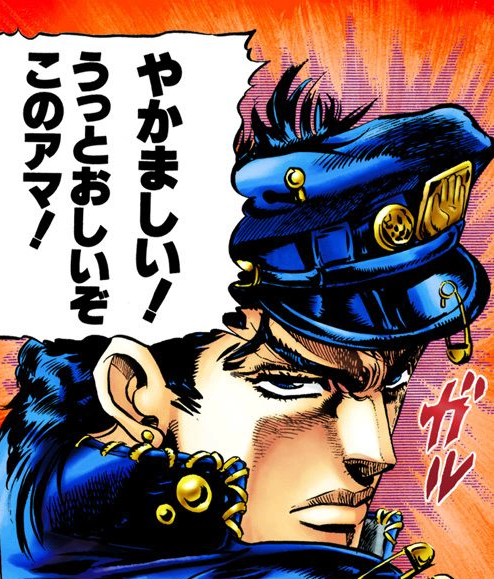
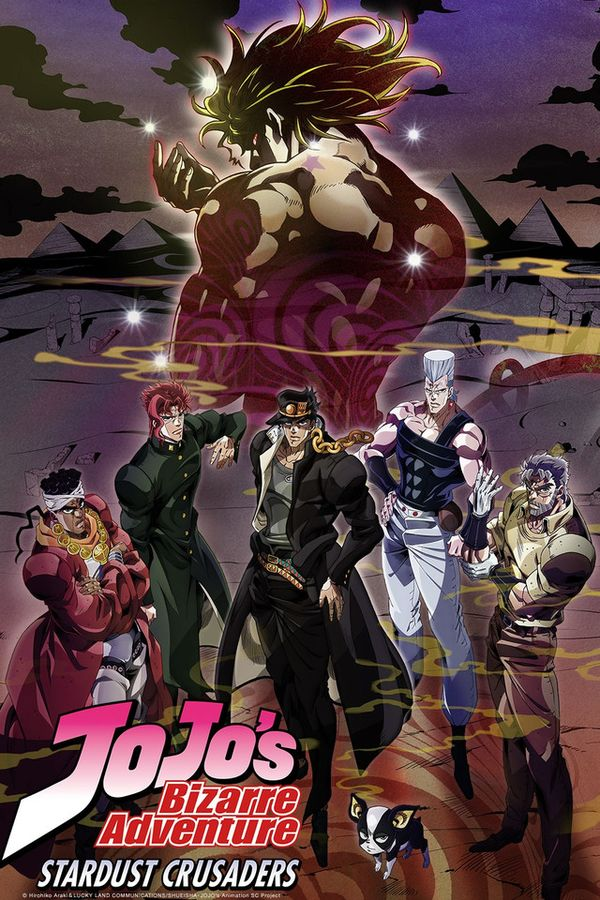
Part 3: Stardust Crusaders ran from the same month the last part ended until April 1992 and this time the protagonist is Japanese delinquent Jotaro Kujo. It begins in Tokyo in the late 1980s, and the antagonist this time is Dio once again, but he’s come back with an upgrade, his name is capitalized as DIO, and this time he has a wider cadre of henchmen in different parts of the world.

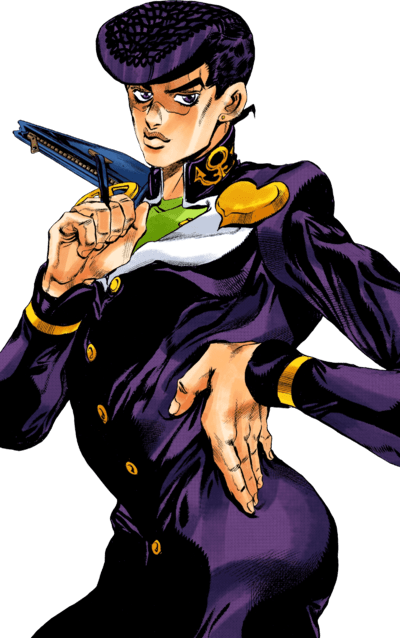
Part 4: Diamond is Unbreakable is set about a decade after the events of the last part. It ran from May of 1992 to December 1995 and features the protagonist Josuke Higashikata. He’s also a delinquent but by the late 1990s, Japanese delinquent culture was losing favor to the emerging gyaru culture to follow in the 2000s. Still, Josuke’s not as rough as Jotaro so long as you don’t badmouth his immaculate hair.

Part 4 is also centered in a fictional town modeled after Araki’s real life home in Sendai and is thus less of a high stakes thriller than the other parts, but there is still an antagonist in the form of department store employee and serial killer Yoshikage Kira.

Part 5: Golden Wind/Vento Aureo also began the same month the previous part ended and ended in April of 1999. It’s set in Spring 2001 around the southern half of the Italian peninsula and features the illegitimate son of DIO, Giorno Giovanna. The antagonist is the mob boss of the Passione mob, Diavolo. Without spoiling much, instead of cooling down like the last part and gradually sprints into its second wind for the plot.

Part 6: Stone Ocean ran from December of 1999 to April 2003 and features the first female protagonist, Jolyne Cujoh/Kujo, the daughter of Jotaro. Its setting this time is in a Florida prison in late 2011 and the antagonist is the prison’s chaplain and protege of DIO himself, Father Enrico Pucci. This part specifically along with Part 5 suffered from a long streak of unpopularity until the Part 6 anime adaptation was announced online in April of 2021. I covered that as it happened in another blog that I started two years ago and needless to say, it was one of the rare moments of hype I’ve ever felt for an upcoming product or series continuation of the sort.

Part 7: Steel Ball Run is set in an alternate continuity and sets the clock back to the 1890s but with a different protagonist who pays homage to the original British Jonathan Joestar. It begins in the western U.S. and ran in Weekly Shonen Jump magazine from January to October 2004 before switching to the more seinen demographic magazine of Ultra Jump for the remainder of its publication from March 2005 to April 2011. The protagonist is Johnny Joestar, a disabled ex-jockey and the antagonist is the 23rd President of the United States, not Benjamin Harrison like in real life, but Union Army cavalryman Funny Valentine.

Part 8: JoJolion (the -lion pronounced the same as in “Evangelion”) was actually set during the modern day. It ran from May 2011 to August 2021 and does almost quite what Part 4 does, supplanting Sendai with the fictional town of Morioh, but uses a real-world disaster as part of its setting. In Spring 2011, an earthquake struck the east coast of the Tohoku region of Japan. It features a similarly named protagonist to Josuke Higashikata from Part 4 (who also has a distant connection to the first guy), but differentiated by way of a different kanji in Japanese, and radically different circumstances. Like the rest of the plot, this time around it’s a more complicated affair with complicated characters and motives who run into each other. As such, the antagonist isn’t easily defined and is absent for a majority of the run, at least until the end.

Part 9: The JOJOLands is the most recent edition to the JoJo saga and is still in production as of this writing. In fact, it just started in February. It’s set in Hawaii in the modern day and its protagonist is Jodio Joestar.

At the outset, this sounds like a lot to get through because it is, but the modern anime adaptation is the best representation of the events in the manga. There have been attempts to adapt it a few years after the first two arcs had concluded with OVAs from the 90s until 2002, a movie from 2007, and in the case of translations that front was even more troubled.

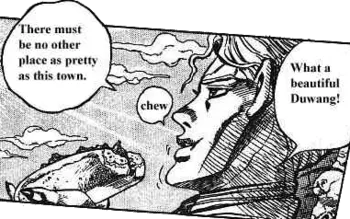
This is one of many examples of troubled attempts to translate the manga from Japanese to English. The problem in this case is that it wasn’t done professionally and Araki, consciously or unconsciously, hasn’t been as definitive in providing details and context until he was interviewed at different points during the production of the manga. For the panel above, which takes place in the middle of Part 4’s run, it was translated from Japanese to English in Taiwan, and the translations were so subpar that for many trying to get into the series, even illegally, had to wade through bad grammar and language until it was given a proper re-publication for the international market in the years leading up to and following the 2012 anime adaptation.

Part 5 had a similar issue back in the day as well and was a large part of its initial disdain from the community until re-publications with better translations rectified the mistakes. And mistakes would follow on even after this. Araki himself is also inconsistent with color schemes when it comes to coloring in the manga, then again, a lot of the monochrome manga is up to interpretation which explains why some characters are colored differently in the anime adaptations than their depictions in the manga.

This example was used as a meme in r/ShitpostCrusaders, but is an example of the degree of freedom afforded to publishers and distributors in the case of JoJo’s Bizarre Adventure. Thankfully, these days it’s gotten exceptionally easier to start JoJo and however you get there, love it or not, it’ll leave a lasting impression.

The art styles of the characters, as I mentioned before aren’t the same as most manga in either the 1980s or even now. It’s art style is a bit of a beefier and more elaborate type found in Berserk, Fist of the North Star, Rokudenashi Blues, or even Yu Yu Hakusho. On reflection, it reminds me of some of the comics from the west like Martin Mystere or the erotic series Druuna, and it’s like that on purpose.

Ever since he debuted as a manga artist, Araki has looked at western styles for inspiration and just about any western artist does well for him, even the ones we learn about like Leonardo da Vinci or Michelangelo.

In anime/manga communities, the term for someone who consumes copious amounts of Japanese media and entertainment, not always limited to manga and anime itself is known as a weeaboo or weeb for short. The term began as an insult in the mid-2000s on forum sites like 4chan and at the time anime hadn’t taken as much of a grip as it does today. Now that the internet is what it is today, the opposite end of the spectrum is the “westaboo,” a term for a Japanese person who consumes more than the doctor’s recommended weight in western comics and cartoons, which would make Araki one of the first to be described as such. And since this appears to be the case, I’d like to be the fly on the wall of a bunch of Japanese internet users having their own dub vs. sub debate on King of the Hill which I learned recently is also popular in Japan.

We’ve come full circle now!

Not limited to just appearances, Araki also looks to music for inspiration. Earlier in this post, you may recall the names of the antagonists of Part 2 are Esidisi, Wamuu and Kars. These are direct references to the real life bands AC/DC, Wham!, and The Cars. This has become one of the numerous features of the JoJo’s Bizarre Adventure series since the beginning. Direct references to artists by name or characters in the books.

This is an interesting source of controversy for the series with specific artists and their estates or just the record labels that worked with them in the past getting uppity over their depictions. It’s also worth noting how complicated this gets in the case of copyright laws the world over, not just in Japan. Because of this, international distribution has had to put in the legwork censoring or altering or requesting alterations from Araki’s team to be able to distribute it in select countries. As an example, there have been more direct references to Michael Jackson and Prince as people than through characters or concepts. The reasons for this come down to when both men were still alive, they were both likely to use the courts to their advantage. I doubt Prince’s estate has kept that up since, but the Jackson family still lives and ex-members of the Jackson five for example can definitely waste that much time, money, and effort in a drawn out legal battle just to change a joke character on page 36 of the 17th volume in the manga. That’s a joke, but it’d be one hell of a read in a newspaper or on the associated wiki. Speaking of which, here’s a link to that:

https://jojowiki.com/JoJo_Wiki

One of the more iconic moments of the JoJo series comes in the supernatural abilities. Parts 1 and 2 begin with an ability known as “Hamon” or the Ripple in English. It functions as an ability that can harness a power similar to that of the sun. Its name derives from the ripples that appear in liquids and its mirroring of the sun’s power makes it an effective tool against vampires. After Part 3, Hamon is mostly done away with in favor of the Stand.

Stands are different from Hamon in the sense that they’re physical representations of one’s soul and can appear in diverse ways. The most common appearance they take is a ghostly humanoid form that stands beside its user and their powers, but can appear is different things; animals, plants, a gun, vehicles, concepts–the sky’s the limit. The only caveat is that only a Stand user can see another Stand, but they impact everyone. So you don’t have to be a Stand user to come under the impact or influence of one. For example, a Stand user who can control the weather can theoretically make it rain or snow on command. When they first debuted in Part 3, they took the names of Tarot cards and Egyptian gods before taking the names of music or musicians.

Following the successful 2012 adaptation, it’s hard to imagine western distribution of anime without JoJo, but the in-between years have a bunch of eye-catching references that a trained eye can find on review. It wasn’t until the most recent and currently produced adaptation that the JoJo’s reach became international and for better or worse, JoJo fans have taken the JoJo’s reference far beyond its roots. Copypastas, poses, iconic characters, parodies; you could sneeze and it would be a JoJo’s reference. Minor spoiler, but that’s also not a joke. On Reddit, there’s two dedicated subreddits centered around the franchise. For fanart, discussions, analyses, and announcements, there’s r/StardustCrusaders, and for memes and meme-related events, there’s the aforementioned r/ShitpostCrusaders.

As hard as it was for JoJo to make it to the west, now that it’s here, the newer debate comes in the form of where to start and how to start. Reading about that sounds absurd. If you’ve never heard of JoJo, but know that it’s divided into parts, your first thought would probably be to start at Part 1. The reason this debate exists is because different people have different opinions on certain parts. Similar to how there are beloved and reviled episodes of a certain cartoon or TV show. Some people will recommend different parts for different reasons revolving around plot and concept and others will recommend starting at the beginning, myself included, so as to get the entirety of the story.

If you want to hear it from me, I’ll start off with how I got into JoJo. It began with Toonami acquiring the license to air Part 3 in 2016 when I was in high school.

Stardust Crusaders was divided into two parts for the anime the Road to Egypt arc and the Battle in Egypt arc. In the middle of the second arc, one of the episodes begins with a character at gunpoint attempting to warn his comrades that an old enemy is back to challenge them and he does this by pointing his tongue in the shape of an arrow.

The art style put me off at first, but I started watching it and watching it even more until eventually, we reached the climax at the end of the arc. I wound up looking for it on YouTube where there are loads of videos in segments and/or playlists, and rewatching it with my fullest attention, made Stardust Crusaders one of my most favorite parts in JoJo.

That being said, the way the other parts are structured might shape your opinion on the part as a whole. As much as I recommend Part 3, I also highly recommend beginning at Part 1 and judging for yourself as you go along. The most recent part to get adapted to the anime was Stone Ocean in December 2021 which finished its batch release in December 2022. So whatever your watch pace, wherever you finish you can look at sources like Mangadex to start on Part 7. The black and white manga isn’t hard to find and recently, fans as well as the distributor Shueisha have been coloring the manga but it isn’t always perfect. All of the anime is also dubbed in English, so there’s pretty much no wrong way to get into JoJo’s Bizarre Adventure. Even if you begin somewhere in the middle, you can also go back to an earlier part or skim through the wiki for a better understanding of an arc or concept.

One more thing before I go:

Just about any frame in the series, anime or manga, can be used as a meme if you’re creative enough. But for the love of all things holy, do not under any circumstances consume the series through just memes. The series is tough to read or watch as it is, and out of context memes don’t help with comprehension. For the most part, those are for people who do understand the series well enough to joke about it. I recommend the wiki and several JoJo-based YouTubers who can explain it in a concise fashion if you’re lost. And you might get lost on the way.

What Happened to the Naruto: Ultimate Ninja series?

The series that had to be soft rebooted

Before we start, I just want to say that I think I meant for last week’s post to be about rewriting the God of War Greek Era narrative in a more cohesive manner considering all the silliness that unearths its plot holes. I’ve defended some overarching stuff since most ancient myths have multiple retellings due to oral tradition, but some specific details are hard to ignore. So, I’ll save that for a future post. This time, we’re gonna talk about the Naruto franchise, more importantly a series of video games based on the franchise that sort of went through a soft reboot about halfway through.

Masashi Kishimoto’s magnum opus, the Naruto franchise, had grown to be a smash hit since its first chapter debuted in 1999. Manga/anime fans hold it in high regard, and it’s part of that generation’s Big Three with the others being Bleach by Tite Kubo and One Piece by Eiichiro Oda. Both of which have gotten their own video games, accessories, figures and more.

With Naruto, part of me wants to say the ninja/shinobi aesthetic was what helped it explode when it began to make waves in the west, so much so that when the anime began dubbing it in English in 2005, the Japanese video games were getting the same treatment soon after. Generally, anime adaptations in Japan are promotional material for the manga, as are the manga’s associated figures, light novels, and other materials. Hence why some of us in the west are still waiting on a second seasons to anime that may never come.

The benefit of releasing in an era where shinobi were the coolest thing since an arctic winter might have heavily tipped the scales in Naruto’s favor, thus explaining the numerous video games associated with it. Specifically, the Ultimate Ninja series. Five main games following the timeline of the manga were released in Japan from October 2003 to December 2007, and ported to the west from June 2006 to November 2009. Likely due to the release of the anime and its western dub, the games loosely follow the events of the manga until they cut off and each successive game adds to the cast of characters to play as.

Ultimate Ninja 1, for instance, starts off with a small cast because it follows the story from the Land of Waves arc until the Destruction of the Leaf/Konoha Crush arc. Many of the important characters are assisting characters during fights, and mostly follow them individually as opposed to staying consistent with the manga, such as the changing around of one or more outcomes of certain battles. The Naruto wiki claims that as far as a presentation goes, critics felt that it left a lot to be desired. Personally, I was introduced to the series through a friend who had the second installment on his PS2 and later I went to buy the first game. From what I’d seen, I agreed with those critics’ statements that more could’ve been done at the outset, and the players and critics got that wish in Ultimate Ninja 2.

In 2004 in Japan and 2007 in the west, the second installment followed up on what the first game brought to the table. Continuing with the rest of the Konoha Crush arc and ending narratively with the Search for Tsunade arc. What became a bit of a trend for the series starting with this game was a game-exclusive arc that can be compared to filler or something along the lines of an OVA. Spoilers to follow: get ready.

After Tsunade is returned to the village to serve as the Fifth Hokage, Orochimaru who didn’t learn his lesson the first time he tried this malarkey has another go at swaying Tsunade’s decision. This time he as an ace in the hole. He and Kabuto were intercepted at the Training Grounds by Kakashi. At this time, Orochimaru’s arms have been sealed and so he needs Kabuto to use his chakra and perform ninjutsu. One such jutsu, is known as the Forbidden Jutsu: Gedo Mark and its main purpose is to limit its opponents.

There’s better pictures for this, I’m sure. Actually, I think it’s better to see it in action.

Sidenote, the YouTube channel in question has a full playthrough of this game among others. I recommend giving it a look.

This next arc sees Orochimaru and Kabuto to try multiple avenues at once to coerce Tsunade into reconsidering releasing Orochimaru’s arms. First, he cripples the more troublesome ninja, namely Kakashi and Naruto, then he uses Reanimation to revive Zabuza Momochi, Haku, and the Third Hokage. After the Leaf ninja find a way to release the Gedo Mark, they soundly defeat Orochimaru and Kabuto and the game ends. Seems even your video games aren’t free from filler. For my take, it’s an interesting story with a lot of stuff that doesn’t make sense. I don’t doubt that Orochimaru’s hunt for the greatest Jutsu ever would lead him to unethical methods, we see this all the way until Boruto confirms that he’s been under lifelong house arrest, but even if he could inhabit another body, the risk to his health in his current state would have even him rethinking his decisions to use ninjutsu willy-nilly like that. Kabuto even says as much. Still enjoyable, and as an added bonus: Taijutsu Naruto.

The Japanese release had characters from the Ninja Clash in the Land of Snow movie.

There’s also a free-roaming mode where players explore the world of Naruto, though considering it stops at the Tsunade Search arc in canon, only a few locations are available. Nonetheless, there’s different activities that can be done with other characters or solo and some of my best memories of the game come from playing with friends at their houses, even if my skills were subpar. Now that the developers were seeing gold, they expanded on this even further in Ultimate Ninja 3.

Released around Christmas 2005 in Japan and in March of 2008 in the west, Ultimate Ninja 3 covers the entirety of Part I from the Land of Waves to the Sasuke Retrieval Mission albeit with some notable omissions, chief among them the Chunin Exam Preliminary Rounds. There might not have been a way get those into the game since the main focus is fighting, but it’s a not insignificant difference that could potentially shape the way someone views the anime if this was their first exposure to the series.

Still, there’s more characters to use, more minigames with the characters, and just like its predecessor there’s an exclusive arc that interestingly got its own OVA for promotional purposes.

Titled “Finally a Clash! Jonin vs. Genin,” the main gist of the OVA is that the Leaf Village in association with the Sand Village puts together a tournament based on a points system. Genin and lower start with one blue crystal worth one point while Chunin and up start with one red crystal worth five points each. Passing a threshold of points advances the ninja to the next round, and passing that threshold allows the victor to pass a regulation that the two villages would follow for a week straight.

It’s initially suggested that battling was the only way to earn crystals but these being physical points you can hold in your hand, you’re not necessarily limited to that kind of all-out battle. Select characters trade them as currency for favors or use them in wagers. There’s also simply looking for the crystals on the ground as they fall out of people’s pockets like change. As for the free-roaming open world element, there’s now jumping and double jumping and the exploration isn’t limited to a few locales, but it’s not the same open world that you’d see in the later Ultimate Ninja Storm series.

This one does a lot more, though I think the limitations of the hardware still did a number on this game since it compresses large arcs into a few battles. I’m not saying I want all the battles and dialogue to be redone in the game, just that a few of the important, plot battles be given theirs. Additionally, it was quite clever of them to hide the Fourth Hokage’s name as simply his nickname in the manga: Yellow Flash, but I’m not sure why he has no speaking role in the game. Something I forgot to mention when talking about Ultimate Ninja 2, that game had a notoriously difficult substitution/rebound system that made it near impossible to properly counter attacks. UN3 and up dumbed that down significantly and I praise the change.

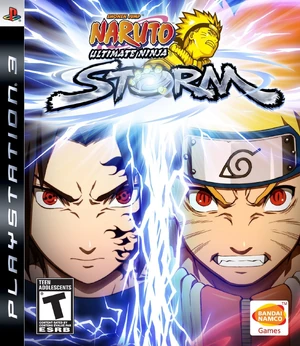
Japanese release: April 2007, and Western release: March 2009, UN4 as seen on the cover starts in the Shippuden era and like its predecessors it has an exclusive arc that is separate from the canon manga arcs and its own open-world RPG-type game mode. This time around, Naruto is still training with Jiraiya. To conclude this round of training, he’s given prayer beads to wrap around each limb and Jiraiya uses a weighting Jutsu to alter the weight of the beads. They change color with experience and when Naruto’s beads glow red, he’s instructed to find Jiraiya who’ll take them off to conclude his training.

In the meantime, the two head to the Tree Felling Village where a girl, Aoi, is to be used as human sacrifice to satisfy a demon known as Black Shadow who lives in the caves. Naruto’s disgust with the practice results in him chasing after the girl who’s determined to go deeper into the cave. Black Shadow physically stops the shinobi, though by now his beads turn red and he’s eager to get them off so he can come back and break down the barrier Black Shadow had summoned earlier.

Before that though, he and Jiraiya gather some information on Aoi and her path as a sacrifice. As it turns out, Aoi was using a desperate though dangerous method to help her ailing mother, Tsubaki, who’s introduced at around the same time Naruto and Jiraiya make it to the Tree Felling Village. The village’s namesake is derived from a tree that blossomed flowers with healing properties. As a bonus, these flowers were a barrier keeping Black Shadow at bay, but when it was chopped down by the villagers and subsequently consumed by Black Shadow all hell broke loose. The villagers then offered an annual sacrifice to the demon to keep him satisfied.

As for Tsubaki’s and Aoi’s lineage, their ancestors were closely linked to the tree and their connects to the tree are limited to a charm with the flower petals inside it since the tree was felled. Aoi’s father died of illness and Tsubaki was on the same path; this culminated in her decision to feign sacrifice as a means of getting close to the tree within Black Shadow and using it as some sort of cure.

After the demon reveals its true form, Naruto fights it, aided by Aoi, and soundly defeats Black Shadow. Unfortunately, the leaves from the tree have long since wilted, save for one that Aoi picks up and I presume is used in tea. Then Naruto falls into a weeklong coma and at awaking, he finds that Tsubaki made a full recovery and Naruto and Jiraiya return to the Leaf Village having made a difference in this family’s life.

Afterwards, the game starts in the Kazekage Rescue arc, but ends halfway through before the Kazekage proper has been saved. I don’t have evidence to support this, but I think the game released as Shippuden was beginning. The only evidence I see is the release date being consistent with the beginning of Shippuden’s anime adaptation.

It’s pretty much the same as the other games, but with more characters, more movement, etc. But even though, the Shippuden arc leaves a lot to be desired, fortunately in the open-world game mode, there are coins known as Pieces of Memory where you can view the story of all of Part I from the Land of Waves arc to the Sasuke Retrieval Mission, so it’s not a total loss.

Naturally, you could assume that a fifth game was on the horizon to restart the first arc of Shippuden and keep it going to at least the end of the Tenchi Bridge Arc where we see Shippuden Sasuke. This was what I thought too at the time and I found out as recently as a few years ago that there was a fifth game that never made it to North America.

In the UN series by itself this is the last of the main Ultimate Ninja games until Ultimate Ninja Storm on the next generation of consoles. Do note that I’m not saying it has no English language release. When the UK was still an EU country, it was eligible for most EU ports of certain games, this being one of them, so while I managed to find an emulated version of the EU release, this game doesn’t exist outside of Japan or Europe and I don’t think my preschool level Japanese is gonna help me if I play with Japanese subtitles and audio.

This game actually is what motivated this post. Four games bear the Ultimate Ninja tag all released on the PS2 and the fifth one was never made for fans from the Americas. What’s the reason for this? My closest source again comes from the Naruto wiki and it can be boiled down to time constraints and dubbing issues. I can’t say with certainty as I have no evidence that this is the case, but I’m at least somewhat positive that the release dates and the evidence in the games is enough of a clue to work with.

Almost all of them released concurrent with the anime adaptation, but several years after the manga was a few arcs ahead of what was depicted, which explains why UN4’s main story is so short compared to the others. Episode 15 was the most recent episode when that game came out. As for time constraints, with the other games coming out as fast as they did, of course time was Namco’s enemy here. I only made it to the title screen as I wanted to finish the UN games before making it to five, but from what I saw even the EU release was botched with only Japanese audio with the selected nation’s language for subtitles.

From what I can gather, they were going to keep up with this trend of releasing the games around the same week as a new arc, but it seems fate forced the devs to rethink things a bit. I could see a UN6 continuing from the emergence of the Akatsuki’s Zombie Combo up until Sasuke’s formation of Team Hebi (later Taka) to finally exact revenge on Itachi for the Uchiha Clan Downfall all those years ago. And follow that trend until the manga concluded with some extra ideas for other exclusive/filler arcs.

Realistically, the problems with keeping this up grew to be untenable. At the same time some of these games were being made, the similar graphics were being used for most of the spin-off and mobile/handheld titles like the Ultimate Ninja Heroes series on the PSP and Ultimate Ninja Impact. It’s not like the Japan-only games that weren’t meant for the west; bad luck essentially forced them to hit the reset button and try again with a better series.

Better graphics, new engine, more characters, more to do with the environment and make it feel as though the player is playing the anime, the UN Storm series is in all aspects a technical upgrade. However, there’s a bunch of from the previous series that several gamers may be disappointed to learn were done away with. It took some getting used to to learn that UN3 onwards discarded the multiple screens for an ultimate jutsu as well as different ultimate jutsu in gameplay, and the RPG-esque text reading at least felt like it was advancing faster because the characters would always voice the lines so you did more than read and listen to the background music.

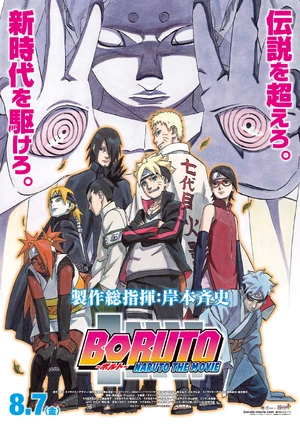
My exposure only comes in the last game Ultimate Ninja 4 which wraps the story up admittedly more beautifully than the anime. At least they did something with the Boruto movie adaptation. And since this was the last of Naruto’s story, if this game was using the Boruto plot to promote the movie then cool!

Though now that I think about it, it’s possible that the reputation of Naruto was what made loads of people expect better from the Boruto series. As much as I’ve been cheerleading Boruto, I also wish it would improve in some areas, though it looks like I’ll get my wish when both the manga and anime return later this year, along with a new game set for release soon.

For this week, I recommend the YouTube channel Alternate History Hub.

https://www.youtube.com/@AlternateHistoryHub/about

This channel specializes mostly in what’s on the tin: alternate history. What if the US stayed out of both world wars? What if Spain stayed Muslim? What if Japan went Catholic? What if the Ottomans colonized the Americas? and other such topics that explore what would happen if history took a different path than what happened in our timeline.

Just like my Trash Taste recommendation from a few months ago, there’s other associated channels with Alternate History Hub. Cody Franklin oversees this channel, he used to oversee the channel Knowledge Hub which is now Knowledge Husk until he gave it to his brother Tyler, and recently, Cody launched the channel Pointless Hub which looks more at entertainment media than something along the lines of geopolitics. You can even support him and his channels through the associated Patreon links.

If alternate history seems right up your alley, give him a follow. If not, then there’s other stuff of his to view.

The Elusive Samurai

The life and times of Hojo Tokiyuki

Clawing out of the deep recesses like the happiest Spartan breaking free from Hades wasn’t without its few perks. To date, this is the third manga presented to me by Viz, so if it feels as though they’re sponsoring me, they aren’t. But I’d be open to covering the works they’re allowed to license to the west if the opportunity comes knocking especially now that two of those series are set for anime releases in the near future: this series and the one about the zombie or something. I don’t know…

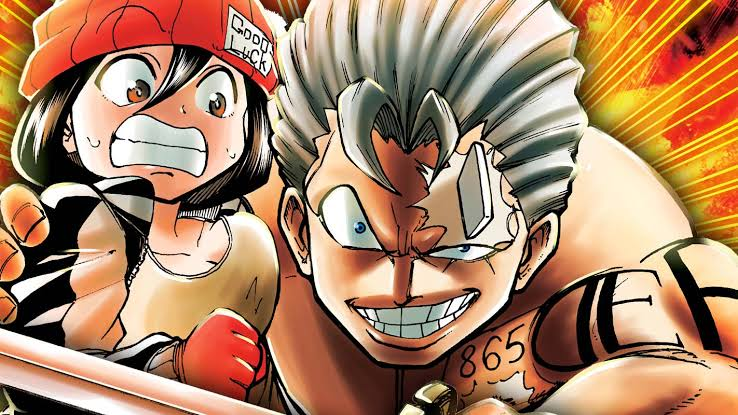
But while Bad Luck Unkillable has a trailer with voice over and all that, Running from the Samurai in Medieval Japan only gave us a teaser trailer which works for me as I have as much time as I feel is appropriate to play catch-ups with the manga.

For research on this post, I’ve had to skim through and remind myself of who’s who, while also brushing up on this period of Japanese history, so wherever there’s a mistake, I’ll amend and correct it once I read up on both. The premise of The Elusive Samurai is thus: the Hojo clan, who held sway over the shogunate and sent most of their own members to work with the imperial family and court, is represented by their two members, current shikken (regent) Hojo Takatoki and his son and heir, Hojo Tokiyuki. Ambitious members of the Ashikaga samurai clan allied with the Emperor Go-Daigo in an attempt to return the imperial court to its seat of power, i.e. overthrow the Hojo-ruled Kamakura shogunate in favor of the emperor. During festivities, the Ashikaga launch their siege on Kamakura and nearly exterminate the Hojo clan. When the dust settles, the Ashikaga realize that the heir, now-shogun, Hojo Tokiyuki has survived and escaped. With the Ashikaga now in power, they use their resources to hunt down and exterminate the boy and every one of his allies.

Brief history lesson: on paper, the imperial court sat at the top of the pillar with the most power, followed by the shogunate, and while they were in power, the shikken. In reality, the Hojo clan shikkens were more powerful than both the shogunate and the imperial court combined. This was the result of the 12th century Genpei War that pitted the Taira and Minamoto clans against each other. Minamoto no Yoritomo won out and as part of the spoils of victory, the imperial court behaved as a figurehead, a position that Go-Daigo was clearly not happy with, hence the Kenmu Restoration’s goal of reversing these circumstances. Fun fact: Kublai Khan found this out the hard way in the lead up to military actions against the imperial court and shogunate when the Mongol-led Yuan dynasty attempted to add the Japanese islands to their list of possessions. Couldn’t go east in the long run so he went hard west.

And thus we learned from the Mongols why it pays to think very hard about an amphibious invasion. Back to the manga, over the course of the Kenmu Restoration period, Tokiyuki-sama embarks on a quest to gain allies and build a force of formidable warriors who can return the Hojo clan to their former glory. It might go in a different direction in the long run considering in real life, the Kenmu Restoration was short-lived and to my interpretation the Ashikaga turned on Go-Daigo and restored the shogunate long enough to stay in power until 1573. Interestingly, this created a split in the historicity of the Japanese emperor’s line of succession briefly with Japan holding two capitals until the Azuchi-Momoyama period.

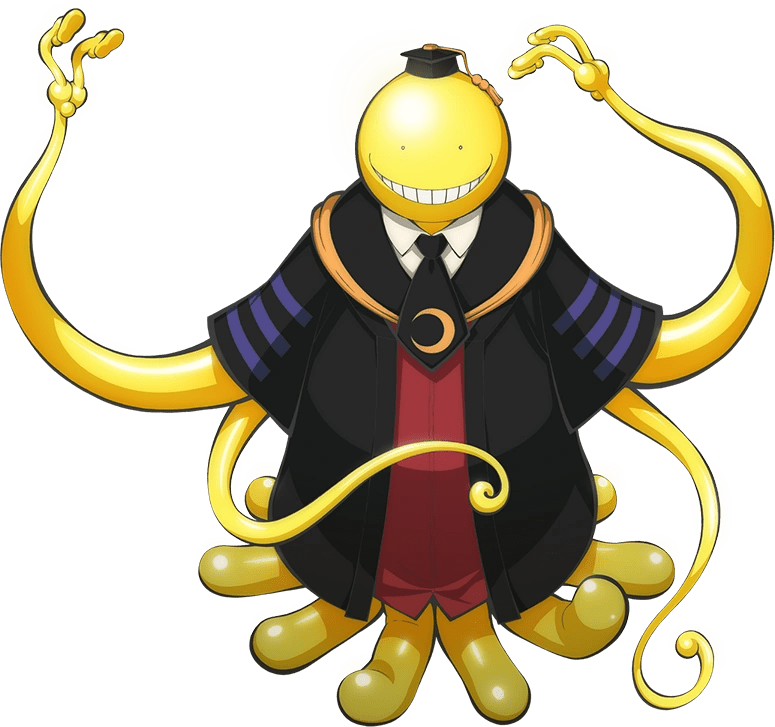
Seriously, I’ve gotta stop jumping the gun here. Alright, so Tokiyuki isn’t completely alone in his quest. He starts out with a few retainers at his side and actually has support from the head of the nearby Suwa clan in the form of Suwa Yorishige who I believe is loosely inspired by the samurai of the same name, though the real life Suwa Yorishige succeeds the fictional one by two centuries. Also, manga Yorishige is reimagined as medieval Japanese Nostradamus with all his predictions about the future and funny enough common manga tropes. Makes me think of Koro-sensei though more self-aware of the manga he’s in.

Structurally, I see a bunch of references to JRPGs like Chrono Trigger or early Final Fantasy. Protagonist with a long term goal, comrades at his side, godlike guide, encroaching force of evil closing in from all sides; the comrades especially exhibit several archetypes in several RPGs, the thief, the brute, the mage, etc. If I was alive in the 1980s, I probably wouldn’t have imagined how many manga series became franchises with spin-offs and video games in tow, but if I had Yorishige’s level of foresight and I could see Dragon Ball getting video games and all that, then I think I can also see other manga following suit. Whether The Elusive Samurai follows suit remains to be seen, but even if it was a fan creation, I could see an Elusive Samurai RPG-style game soon. It’s also worth noting that the art style and writing will feel familiar to fans of Assassination Classroom and that’s because it’s from the same man: Yusei Matsui. Overall, by itself, it seems to be having fun with the historical setting and subject material. Taking the piss outta historical figures is a worldwide pastime, after all. In comparison with Kill School, the most comparable thing they have is the femboy protagonist. Not sure if that’s Matsui’s bread and butter, but these days that might be the case.

The YouTube channel recommendations are coming back for April. Also, Tomorrow being April Fool’s Day, I’ll cover Toonami and Adult Swim’s yearly tradition when those stars align. Look forward to that.

Boruto’s Contrast with Naruto

Three updates so soon

This was about to be last week’s post, but I didn’t think it fair to talk about the same thing thrice in such a short amount of time. I’d been meaning to move onto other manga/anime/entertainment, etc. and I don’t really want to be the Boruto guy. I take in as much of the series as I can when I can, but I don’t want to sound like it’s the only thing I take in; my previous posts suggest otherwise.

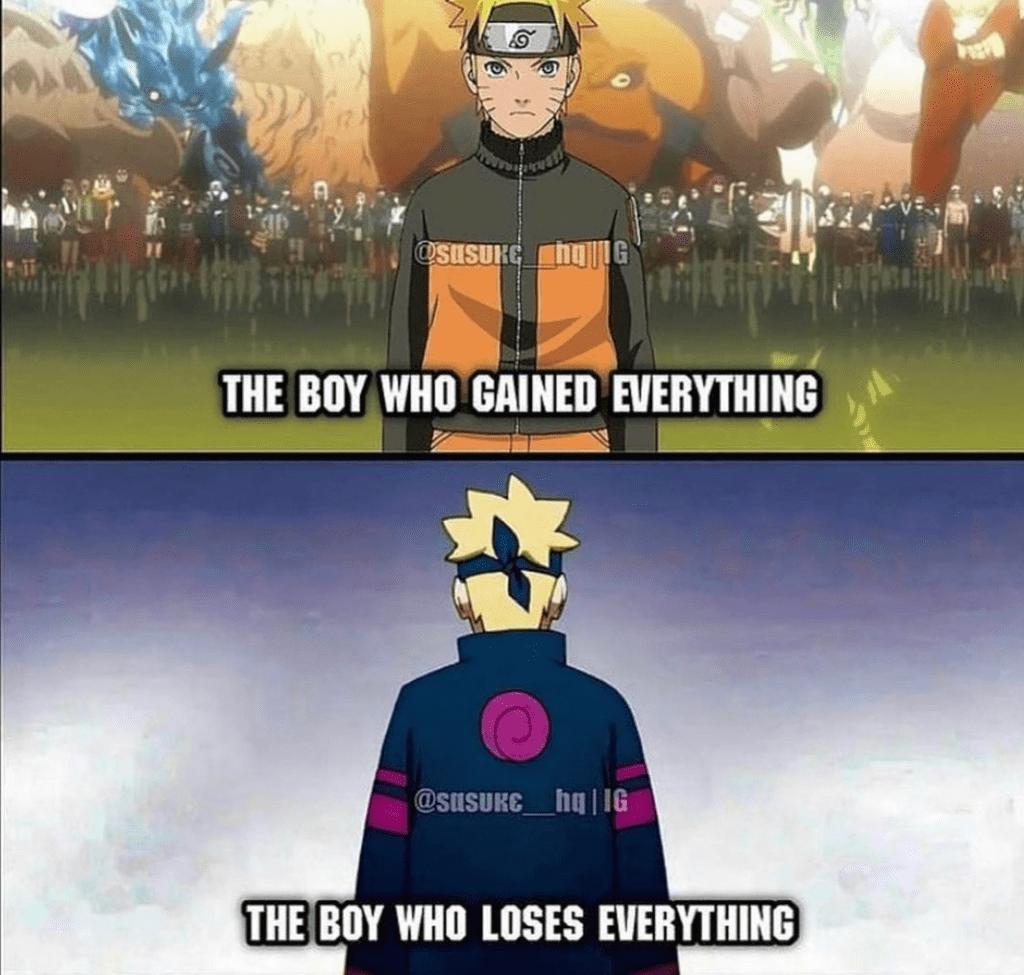
That being said, the above meme gets to the heart of what this post will be about and the fanfare from the release of the latest chapter on Sunday put so much of the community into a frenzy that there were more people who read Boruto than One Piece.

At one point, the Boruto fans claimed the last chapter alone trounced all of One Piece which isn’t so much a shot for the moon from the Earth as it’s a shot to the sun from Planet X. I liked the last chapter a lot, but I wouldn’t say it was that good.

As for the topic this week: Momoshiki’s prediction in like Volume 3 of the manga comes true in the most recent chapter. I’ll put links down below so that readers can see for themselves what he’s been talking about all along:

https://www.viz.com/shonenjump/boruto-chapter-79/chapter/26473

https://w2.boruto-online.com/manga/boruto-manga-chapter-79/

And for those of you who care little for spoilers, picking up from 77 and 78, after Kawaki comes to the conclusion that the life of a shinobi is not a pleasant one, he prefaces his plans to Naruto and Hinata by announcing first that in any other circumstance he would never wish harm against Boruto, but him being part Ohtsutsuki and a vessel for Momoshiki to boot has forced hand, literally as we see later. Distraught, neither the Seventh Hokage nor his wife take kindly to Kawaki’s plans and the boy, expecting this resistance, sends the pair to another dimension, hoping to complete his mission unimpeded by the Hidden Leaf Village’s most powerful ninja.

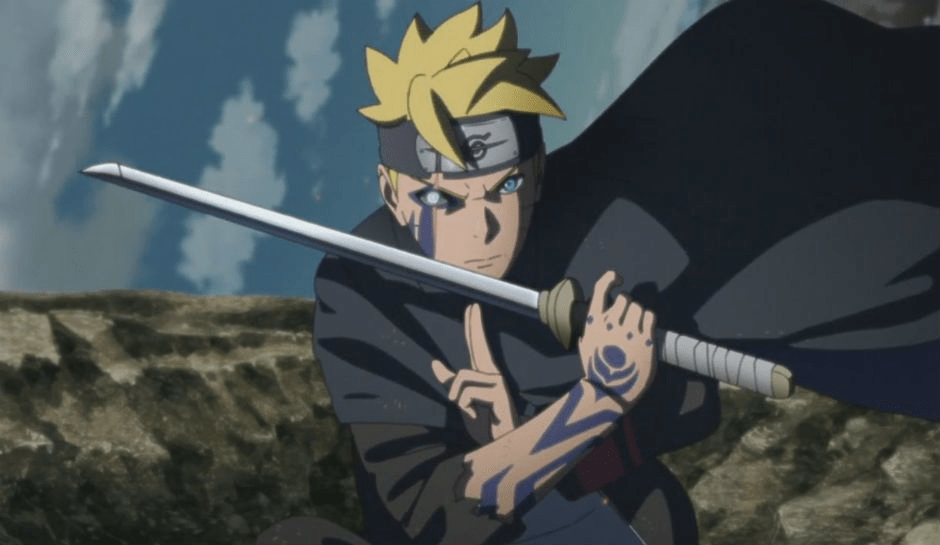
Catching up to Boruto and Sarada, Kawaki strikes, awarding Boruto his new scar only to be apprehended by Sasuke, Shikamaru, and Mitsuki. However, it’s established in an earlier chapter that when Boruto’s chakra reserves are diminished, Momoshiki takes control, as noted by the Jougan’s appearance in Boruto’s right eye. Kawaki breaks free and flees. Eida senses danger coming his way, and catches up to him. Unconsciously, she activates a shinjutsu or god technique known as Omnipotence that reverses Boruto’s and Kawaki’s roles: Kawaki is the one who’s now the son of Naruto Uzumaki and Hinata Hyuga, while Boruto is the nobody, the outcast vessel of Kara and Isshiki Ohtsutsuki while he controlled Jigen’s body.

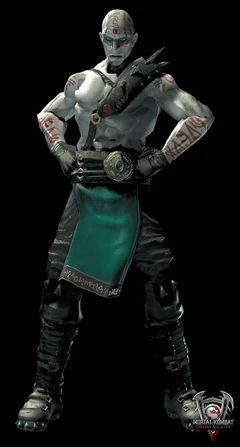
It’s also worth mentioning that the Boruto anime, which airs on Sundays, released a new episode the same day as Chapter 79, so fans got a glimpse of what Momoshiki meant when he made his prophecy while also watching Kawaki try the first time to rid the world of Momoshiki’s presence. I know they’re not meant to be the highlight of Boruto anymore, but the OG Team 7 and the Sixth Hokage could simply tell Kawaki and the new Team 7 why killing an Ohtsutsuki is so tough. It’s like fighting a necromancer: if you kill the necromancer and it’s easy, you didn’t kill him. Am I right, Quan Chi?

So now that we have this set up, I want to try to make predictions. With the announcement a few weeks ago that Boruto’s Part 1 was ending soon, what we know so far is that Boruto lost everything. He’s his father’s son in appearance and often personality, but Naruto grew up a few years and change after the Third Shinobi War ended. Select shinobi who taught or de facto raised him like Kakashi and Jiraiya are war veterans themselves from that conflict or an earlier conflict; Kakashi himself was a child soldier from the Third War. Including teachers, the OG characters from Naruto are in some manner a victim of loss on either a wide or miniature scale.

Boruto doesn’t know that world and neither does his generation. Relatively speaking there’s peace all around, except for one or two bands of rogue ninja. Fifteen years after the devastation of the Fourth Shinobi War, and the peace that Nagato, Jiraiya, and everyone ever wanted has come to fruition thanks in no small part to the will of a knuckleheaded ninja. As a result, Boruto’s generation doesn’t need more shinobi to fill in a gap or because there’s a war on the horizon in need of some fresh meat; it’s mostly general security and escort missions or at least that’s how they always begin. A simple security mission can easily turn sour depending on several conditions. Remember the Mujina bandits?

Now that Boruto’s lost everything he’s ever had, the only route fans can see going forward is that Boruto follows the path of a rogue shinobi, like Sasuke did but with a significant point of divergence. Sasuke chose to acquire power from Orochimaru to get revenge on Itachi; Boruto had this move forced on him by an omnipotent power that honestly no one understands all that well. Another adverse effect of the Omnipotence shinjutsu is that Ohtsutsuki members and their vessels don’t succumb to Eida’s charm ability. Interestingly, Sumire and Sarada are also immune to this ability, which some on r/Boruto have theorized that since she treated these two as friends, they were spared that outcome.

Call it a miscalculation, but has anything good ever happened when children activate godly powers? In all seriousness, this would mean that one or both of them is likely to join up with Boruto for the foreseeable future while he plots to undo Kawaki’s crimes. Whether this extends to the remnants of the Ohtsutsuki remains to be seen. Sarada might go with Boruto, but if her father falls under the same charm as most people then he’ll likely fight her tooth and nail to keep her in the village. Sakura as well.

Sumire could also join Boruto’s quest since the anime gave her a burden of her own to deal with early on in the show’s run in the form of Nue and her father’s connection to the Foundation, the ANBU cell independent of the Hokage’s control. But this could also go wrong as the show rectified the rampage from that arc and allowed her to return to the life she’d gained in the Ninja Academy, even letting her work as an assistant to Dr. Katasuke Tohno in the manga.

These would be unlikely if they join Boruto in defiance of the Hidden Leaf Jonin. If it were a mission, since Boruto is now perceived as an enemy at the terrorist level, it would be an A-rank mission with S-rank potential and only the most advanced level shinobi would be selected for such a mission. It’s not like when Shikamaru’s rag-tag team fought off the Sound Ninja 4 to get Sasuke back. They village might choose to see it as potentially more dangerous, even for a Chunin like Sarada.

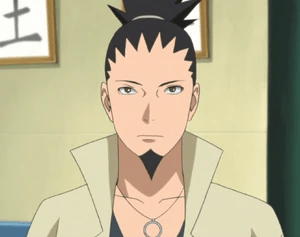
But if they see her potential and do what Hiruzen did with Itachi and make it an undercover/double agent mission like the Uchiha Clan Downfall, then I could see it happening… under Naruto and in response to what happened to his son. Assuming Shikamaru becomes interim Hokage or Kakashi or Tsunade return to their roles, they’d be under the influence of Omnipotence and Shikamaru has shown himself to be way more risk-averse as advisor to the Hokage. Just as he’d wanted to do to Kawaki, he probably won’t stop until Boruto is apprehended, however that comes about.

Also consider the reaction/response to come from the Hyuga clan when they find out their former heiress is missing, or whether the Omnipotence transcends dimensions. Hanabi and Hiashi are the only two Hyuga clan members to appear in the anime and I don’t think ever in the Boruto manga. Compared to the other Hidden Leaf clans, the Hyuga are still intact and kicking, especially with members of theirs amongst the regular Hidden Leaf Jonin in other aspects. A large pool of veteran shinobi to answer to this emergency should be expected.

In the meantime, with Himawari now technically an orphan, she might be taken into the Hyuga clan grounds for her protection and further training as an established academy student and aspiring shinobi. She does have the Byakugan unlike her brother and if they deem her ready, may induct her as a shinobi no different than the others who serve the Hidden Leaf Village.

If Omnipotence transcends dimensions, then that means Kawaki is safe in the short-term but screwed in the long-term. He advised Eida to report Naruto and Hinata (who are in another dimension remember) dead, so he and Eida could be in it if they find out that it’s a lie.

This all remains to be seen, though. We have until April 20 to see what happens, and I may have more material to write about. You know how I wrote up above that I didn’t really want to be seen as the Boruto guy? That might be in my future the more I bring it up. But again we’ll have to wait and see.

Akane-banashi

Bringing rakugo to modern readers

I put this off last week to make way for the surprise announcement of Boruto’s Part 1 ending, but with that next chapter’s leaks following so close and a surprise twist at the end, I find myself pushing next week’s topic back again to make room for this because it’s too much to ignore. When Boruto Raiden or whatever Part 2 is gonna be called returns, I’ll probably devote a wider post to that, but until then here’s the gist of Masashi Kishimoto as of late: sporadic.

Now to something I was going to write about last week.

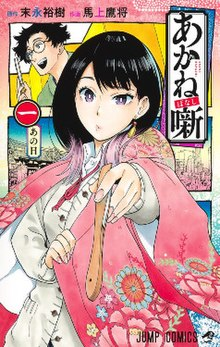
Sometime last year while browsing the Viz website, the debut chapter of a manga known as Akane-banashi was released. The series about the titular character, Akane Osaki, and her journey to become a rakugoka. Rakugo is a type of Japanese storytelling. Practitioners known as rakugoka tell long and ridiculous comedic stories in the seiza sitting position with a paper fan and different tones of voice to denote multiple characters in the story. It’s like standup comedy if you remove the standing.

From what I understand, these stories most often consist of old Japanese legends, myths and folktales, largely influenced by the culture that developed in Japan over the millennia. Quick research tells me that Akane-banashi isn’t the first manga to feature the art of rakugo, the others like Descending Stories were just geared toward older readers or were drawn decades ago and would thus be hard to find outside of an antique shop.

I don’t have a solid answer for how Akane-banashi took off the way it did a year and change later, but I have a few theories: the protagonist is a young woman just learning the ropes instead of a middle-aged or old man who’s already an expert/master; it runs concurrent with some other solid manga that debuted recently so there’s a healthy lineup to thumb through. These are my theories and I expect them to be wrong or inaccurate as I hadn’t taken an interest in rakugo until I stumbled upon Akane-banashi.

In a further demonstration of my limited exposure to rakugo manga (perhaps highlighted by how so few of them there are available for my research), the introductions to rakugo are lacking or brief. The manga explains the ranks of the rakugoka, select stories that a rakugoka is likely to tell (potentially first-time viewers have an idea of what to expect when they go see a performance in real life), and the different ways a story can be told in the rakugo form. This all sounds like a lot, but it’s all so brief by virtue of manga being a visual medium that all things considered Akane-banashi could be taken as a pick-up-and-read style manga. Part of me is curious if a kabuki manga would do the same thing.

Regarding the depiction of exceptionally niche topics in media, the shallow pool of practitioners within a given medium make it hard for outsiders looking in to judge the translation from real life to print, despite their best efforts to research it by any means. In the case of the wider performing arts, in the west and westernized countries with a healthy performing arts/entertainment industry, everyone and their grandmother at least knows one or a few people who’ve tried their hand at it from stage plays to big budget multimillion dollar silver screen productions to varying degrees of success. You don’t even need to be an A-list actor to know what it’s like or what to expect. Well-read individuals can educate themselves from true stories and popular rumors about what goes on in the film industry, especially in Hollywood where most of the movies are made, often to varying degrees of success. As a result, the lay person outside that world probably knows what obstacles a performer faces–but it takes sitting down with a performer or becoming one yourself to know about another layer that’s not as often exposed.

Consider this: actors don’t typically work a traditional 9-5 job. They would often be on-call and working with talent managers and/or companies who can help them land a role of some kind. For filming, almost anything goes. Filming at night? In traffic? On a mountain? With dangerous animals? Is the director denying you sleep for a certain scene? All of these may be extreme examples varying depending on the creativity of the actor or director, but all in all, circumstances like these would be seen as unnatural to those of us who aren’t performers, but largely run-of-the-mill shenanigans in the long run. Methodical madness and all that.

If Akane-banashi is even partly true to life, then accordingly, there’s no real wrong way to tell a story. A testament to a writer’s ability would be if historical events could be reworded to be even more interesting than what actually happened without resorting to exaggerations or outright lies. One such example that comes to mind for me would be Baz Luhrmann’s take on Romeo and Juliet. The original play was set in Renaissance Italy, but Luhrmann sets it in modern-day SoCal with the Montagues and Capulets being warring gangs instead of noble families.

Anything is possible.

Akane-banashi seems to be veering towards the direction of reinventing the wheel on rakugo as a whole and the stories that can be told in this style. All in all, it appears to be flipping the tradition of rakugo on its head, and while I’m slacking on the manga itself, whenever I get the chance I hope to be able to follow up on where it goes from here.

Boruto Manga/Anime Timeskip Prospects Update

I intended for this week’s post to be about the rakugo manga Akane-banashi, but I guess that’ll be saved for next week, which works for me as I still need to do my research on the manga. About a month ago, I made a post talking about what could be expected of a timeskip in the Boruto series. I said that after Boruto gets his scar from Kawaki in a misguided attempt to protect his new hero Naruto from the threat of the Ohtsutsuki, Kawaki will be closely monitored while Boruto gets more intensive training from Sasuke and most likely Kakashi who also suffered a similar fate: losing an eye while protecting an Uchiha and gaining a dojutsu afterwards. Kakashi got Obito’s Sharingan; Boruto got the Jougan, which is explained in the wiki as a combination between the Hyuga clan’s Byakugan and Naruto’s ability to detect malice, which explains why it was so prominent in the early episodes when Sumire’s summon, Nue, started eating chakra for power.

But when the threat was neutralized, Boruto’s Jougan fell dormant, occasionally glitching awake for the rest of the series for the eagle eyed fans to catch until the Ohtsutsuki threat reemerged to ruin the Chunin Exams as had happened in the movie and the manga.

Momoshiki Ohtsutsuki is the one who implants a Karma seal on Boruto’s palm. The Karma seal is a type of curse mark that enhances the abilities of the owner (Boruto, Kawaki, Jigen/Isshiki) while also holding the biological information of the Ohtsutsuki in question. If the holder of the Karma seal dies, their body undergoes an Ohtsutsukification which can rob them of their original identity while the Ohtsutsuki member takes over. In Jigen’s case, he was a monk who was possessed by Isshiki Ohtsutsuki; and when Kawaki tried to eliminate Momoshiki’s presence in Boruto, the process to Ohtsutsukification sped up rapidly that by technicality, Boruto’s not human anymore.

Additionally, when his chakra runs low, Momoshiki takes over his mind and his body goes on autopilot. The crux of the Boruto series is to show that the Ohtsutsuki threat wasn’t as absent as the shinobi of the previous generation thought. The OG Team 7 had difficulty fighting Kaguya, and now that for them a decade-and-a-half of peace have passed, while the Kage and S-level shinobi can still body major threats, but the Ohtsutsuki prove that, whether alone or in numbers, even the best shinobi would struggle.

The reason I bring Boruto up for a second time and so soon after the first one is because it was publicly announced that episode 293 of the anime is where Part 1 will end. Last month, we were given rumors and glimpses of a possible indefinite hiatus with not a lot of information following on why that was. The most popular reasons being to let the animators rest and also that TV Tokyo’s license to distribute series was ending this summer.

https://www.sportskeeda.com/anime/rumor-boruto-anime-rumoured-go-indefinite-hiatus-march-april#:~:text=So%20Boruto%20is%20rumored%20to,year%20too%20as%20per%20leaks.

But now we know that the Boruto Timeskip or Shippuden (or realistically Raiden if we note what it would look like in kanji characters) is on the horizon. The manga alluded to such when Kawaki sent Boruto’s parents away and gave Boruto himself the scar. I have to admit that I’m abysmally slow on the anime itself, but recent episodes have shown that the Eida and Daemon have been summoned by Code to track down Kawaki and Boruto for the purpose of becoming a real Ohtsutsuki while getting revenge on the Leaf for what happened to the Ohtsutsuki-led Kara organization and Isshiki.

Between Boruto getting scarred by Kawaki and the destruction of the Leaf as alluded to in the first episode, over the course of the series we’ve learned that Kawaki and Code aren’t working together. They both hate each other, surely, though there’s still no way to tell who or what destroys the Leaf village like that. Maybe the blame falls on one, both, or all three in the heat of battle, but again we’ll have to wait and see what comes up.

I know that my predictions for what might happen during a timeskip it focused only on Boruto and his training. Following up on that, there’s a few things I can expect while others can be said to be speculation.

Boruto’s teammates: During the Chunin exams, Sarada got the promotion and her vest, which makes the new Team 7 eligible for middling C-rank and low B-rank missions, with her as team captain. Mitsuki may follow suit and advance the difficulty of their missions, though this may leave Boruto in the dust as a Genin much like what happened to the previous generation of shinobi when Naruto was training with Jiraiya before his grand return to the village. The rest of Boruto’s graduating class with exceptions might also follow suit with some overachievers making it to Jonin or going on to be ANBU shinobi in the process, but with the boosts Boruto and characters like Sumire, Mitsuki, and Tsubaki all have, whether Boruto or other characters advance or not doesn’t really matter, when you don’t need a high rank to sleep your opponent with minimal movement. The main changes are responsibilities and pay, which is not dissimilar from real-life military ranks. The U.S. military for example expects the junior enlisted to do a lot of the heavy lifting while high-ranking sergeants and above are gradually put into administrative roles. Medal of Honor recipients and servicemembers awarded similarly high awards get a totally different treatment, rank notwithstanding. In similarity to the Naruto franchise, neither Naruto nor Sasuke made it to Chunin, but wound up being the most powerful shinobi in the lands.

Family: Naruto and Hinata are still missing at the time of writing this post and will likely be stuck there until Boruto brings them back or Kawaki is forced to return them to the real world from custody. Likewise, the anime also has an arc where Kawaki and Himawari are attending the Ninja Academy. Initially, I was given the impression that she wouldn’t have the mentality or drive to become a shinobi all her own, but the anime proves that notion incorrect. Not to mention, she’s the one who has the Byakugan and when she activates it, she exhibits the shinobi’s killing intent, and has done so several times in the series.

Furthermore, one of the more recent chapters (Spoilers) shows Daemon attempting to confront Himawari while she’s walking home with groceries in hand. Daemon was confused as to why she didn’t strike, as he sensed an untapped power coming from her. This could be the Byakugan, though it still remains to be seen what he saw in her specifically. What is known is that she is still an academy student and while her brother is off training, she most likely becomes a shinobi herself as well, becoming a Genin or Genin Promotable, not unlike the promotable positions of U.S. servicemembers who are scheduled to attend a promotion board. However, with the direction Kawaki has gone, she and the rest of the class will be one student short, which is also a parallel to that of the original Naruto series.

Deaths: The ninja world lives and dies by the sword. Before, during, and after the establishment of the ninja villages every shinobi was on the battlefield, including child soldiers like the young sons of the Senju and Uchiha clans. This many bodies on the field of battle brought the average life expectancy down to just 30 years with so many children dying in wars alongside their older veteran counterparts. The Third Shinobi War brought these dangers back as Kakashi, Obito, and Rin barely survived unscathed. Even in these relatively peaceful times, the life of the shinobi benefits from technological enhancements while also suffering the same kind of dangers from yesteryear. The more things change and all that. Shinobi dying on the field of battle or on a mission or by any other means is a fact of life that everyone expects to face, though specific character trajectories are left to some conjecture. I have no way to tell who will die or how; predictions aren’t 100%, and characters fans believed were marked for death wound up surviving, while the least likely death wound up happening. Reception to X character’s death/disappearance/etc. will depend on how well written they were. The only thing that can be said with certainty is that fan-favorite characters like Naruto or Sasuke might be one of the few on the chopping block, and fans would likely sooner see them incapacitated than dead, myself included. As for shinobi who preceded them but are now senior citizens in the Boruto era, they could also be up for death or incapacitation, though ideally it’s done in a way that doesn’t make a joke out of them. No promises, though.

Miscellaneous/Free space: Most of what I’ve said so far in this post might be suited for a light novel or an OVA in the future: Ino-Shika-Cho diverging even slightly from their respective parents; Team 15 having a more important role going forward; other ninja teams getting their time of day; the Hyuga clan’s response to Hinata’s and Naruto’s disappearance; and most likely Shikamaru behaving as the interim Hokage if Sasuke does go on to hasten Boruto’s training, after he likely gets healed by Sakura and/or Tsunade. All of this is up in the air, but at least with the short hiatus, I can play catch-ups.

Undead Unluck Anime Adaptation Confirmed?

An obscure manga may be due for an obscure anime adaptation.

Currently on vacation so this might be a quick post with little detail. The end summary will make all the difference.

In January of 2020 whilst browsing the Shonen Jump section of viz.com, I was introduced to that month’s debut manga called Undead Unluck. It opens with our character Fuuko Izumo finishing a romance manga and then declaring to the public that she will end her own life. Dramatic? Yes, but she does have an explanation for this. When she physically interacts with people, the person who touched her suffers a proportional amount of misfortune depending on how long, how she was touched, and with what. Brushing up against someone while navigating a crowded train might delay service; prolonged skin-to-skin contact meanwhile means unimaginably bad luck from an injury to a life-altering injury to sometimes death. And it can range from coincidentally realistic to balls to deez nuts ridiculous.

During this confrontation, the second of the titular duo, named Andy, strikes up a conversation and is initially repelled by Fuuko with the same hostility she showed to the others in the vicinity. He falls onto an incoming train and his body cracks the window, but he legit walks it off. Yep. Remember in Naruto when the Leaf ninja were sent to dispose of Hidan, but were continually baffled by his refusal to keel over? It was kind of like that, only Andy hasn’t seen the light of Jashin yet.

And this is how the manga begins. Fuuko begins it wishing to end her life and so does Andy, but his problem is he’s basically Hidan or Deadpool with different rules. As the manga goes along, it’s revealed piecemeal that Andy has a lot of baggage from his life, and he hopes to reach his goal of sweet death by wooing Fuuko along the way. The proportionality is no joke. If intimate contact can topple a building without warning, then according to Andy, rounding third base especially with no condoms should bring about the intensity of Fimbulwinter. Basically, they’re both hoping to go out with a bang. No pun intended.

Fuuko’s and Andy’s abilities of misfortune and immortality surprisingly don’t make them all that special as there are others with similar supernatural abilities that are described as a single word but with the prefix Un- in front of it. Undead, unluck, unbreakable, unjust, untruth, unknown, that sort of thing. It’s a bizarre, indescribable manga that’s best experienced by reading it. I recall going to the Viz Media website to read a chapter weekly that year as the pandemic intensified. In the summer of 2021, this became unachievable as my brief experience with Army basic training by nature limited my access to technology, and keeping up with the outside world doesn’t happen during basic training. After returning from that experience, I found trouble keeping up with the manga as I’d missed so much. These days, I tune in a few times to see what’s going on. I’ll be missing context from one or five or an entire volume’s worth of chapters, but it’s still good reading and reading between the lines as well as a summary from the wiki can help.

Fast-forward to January of this year, and I learn that along the horizon, an anime adaptation is on the table.

Normally, when it comes to burgeoning manga that I lay my eyes on, I’m a historically terrible judge of character. Some manga I wanted to succeed get cancelled twenty chapters in, and others I don’t pay much attention to seem to blow up overnight. Everyone knows who Loid, Yor, and Anya all are because Spy x Family is a massive hit with a solid adaptation to boot, but I’m pretty sure only seven people will have ever heard of Black Torch or Time Paradox Ghostwriter, and I’m one of those seven.

It’s one thing to misjudge the success of something, but this one seems to be completely out of left field until you see what studio is said to be captaining the ship. It’s the same one that fixed with A.P.P.P. broke in the 1990s, the one that got a legendary underground manga to go mainstream for the first time in almost 25 years, the same one that copied Hokuto no Ken‘s homework. You know the one.

Yes, if things go as planned and Undead Unluck goes from print to animation cel to pirate streaming site, David Production will take full responsibility for converting more anime onlies to another underground manga. David Pro has a set standard for adaptations. JoJo’s shown above and Fire Force are the only two anime that I know they worked on, but the quality of both speaks for themselves. The adaptation of Part 6 Stone Ocean can be seen as controversial within the JoJo community over the amount of CG in select episodes coupled with Netflix’s outdated batch release formula that may or may not have influenced the direction of the adaptation. The same can be said about Fire Force’s fanservice, but above all, save for a few tweaks and changes from manga panel to animation cel is nearly 1 to 1. And there’s normally an explanation for a change anyway.

Actually, changes in continuity aren’t all that uncommon or interesting when it comes to an adaptation of anything. It mostly only matters if the adaptation and the source material are on different wavelengths. For Undead Unluck, I can expect the anime to be as faithful to the manga as possible with a few changes here and there. As of writing this, YouTube and Google feed me articles and teasers with short scenes and demos of the anime to come with no real word on the adaptation to speak of in any significant detail. This can be understandable or suspicious depending on several factors. In the gaming-sphere, all the scrutiny goes to the studio and its leadership if all their hard work is shown in a pre-rendered trailer that fakes the intensity of an upcoming video game.

But anime is more or less forgiven considering how dungeon-esque working conditions can look for animators, as well as studios being notoriously tightlipped about the quality of scenes who draws them all. It’s no secret that the folks at Wit, SHAFT, Aniplex, MAPPA, Pierrot, et al outsource some of their work to Good Korea, China, Thailand, and Vietnam, but whether your favorite arc is being drawn by Saigonese Gustav Klimt or the water buffalo filling in for him while he battles a case of ligma is up in the air. r/Boruto just found out why the anime’s been getting a glow up in recent episodes and it’s not just because Eida is a sexy she-devil. If what they say is true, then the Boruto anime might’ve been used for trainees from other studios.

But as I stated before, David Pro is on the case and living up to their goal of being like their biblical namesake, I don’t expect them to miss a beat. I’ll try my best to keep an eye out for more news on Unkillable + Unfortunate.

Boruto: Timeskip Prospects

The sequel series with a ginormous precedent to live up to

I was originally going to speculate on what the timeskip in the Boruto series would entail, but thanks to leaks provided by Twitter user @Abdul_S17, which have also been passed onto r/Boruto on reddit, this may be a brief post with not as much to say about what happens going forward, or rather, the unpredictable nature of the series makes this very hard, so I’ll try my best with the informaton given. Though I think there’s a few elephants to address regarding the Boruto series. In support of the sequel to Naruto, there’s loads of details that Naruto fans often forget or throw by the wayside. When the Boruto anime debuted in 2017, I recalled a detail that was mentioned in passing, but nonetheless mentioned the death of a major character, and so when it came to it, binging all of Naruto and Shippuden up until that point provided as much context as I could need to make sense of this seemingly unimportant line. This probably gives me the best understanding of the Narutoverse as a whole, the internal politics therein, etc., etc.

That being said, it’s not like Boruto doesn’t have it’s criticisms, and picking apart the worthless drivel from the valid points, Talk no Jutsu or not, if it was Naruto becoming Hokage instead of Konohamaru under the hood of a Transformation Jutsu, rest assured the Orange Hokage would’ve had a way more heartfelt ceremony. Also, regardless of all the money that comes with being affiliated with Naruto, if the Boruto manga was planned better, there probably would’ve been less filler even if the writers can magic it into the plot all the same. The showrunners seem to have fallen for one of the few things that can happen when a manga and anime run concurrent, as explained by a genius in the link below:

A problem inherited by Naruto and other anime adaptations beginning in the early to mid-2000s. And the worst case scenario would be what happened with the Fate franchise, but at least the Big Three have a consistent timeline.

Anyway, the Boruto manga’s next chapter is scheduled for release on February 20, and the leaks tell us how Boruto got the scar that his older self will have in the big brawl against Kawaki. All that’s missing now is the cloak and the sword. If you’ve been reading or watching or both, you know that Boruto has become Sasuke’s pupil and over time gets his old scratched headband as a memento. During the story, a mission to transport a Leaf village scientist to a research facility changes halfway and the new Team 7 is rerouted to assist with a zeppelin crash in the forest transporting autonomous puppets. As it turns out, this was the property of the dangerous group known as Kara and a couple members were sent to intercept.

A familiar face shows himself to keep the secrets from getting out. When that fails, Boruto, Sarada, and Mitsuki, learn that amongst the precious cargo was a boy known as Kawaki whom Kara planned on using as a vital tool. Now that he’s in Leaf Village hands, he’s under the sworn protection of the Hokage, and the troubled kid becomes utterly attached to Naruto, enough that the immediate threat of the Ohtsutsuki clan and its still living members is still felt even close to home.

Multiple attempts and failures to retrieve Kawaki become progressively destructive. Meanwhile, the karma seal on both Kawaki’s and Boruto’s palms begins to resonate and even strengthen at imprecise moments. The flashback in the beginning show that they can both activate it on command, but Boruto as a kid isn’t there yet. The more recent chapters show that whenever Boruto spends most of his chakra or loses control, his karma seal which has the memories of the Ohtsutsuki that Boruto defeated, Momoshiki, activates and Momo’s memories take over his body. Kawaki attempted to remedy this condition with entropy, but Momo, not content on losing his vessel, repairs Boruto’s body.

A cryptic message he gave to Hokage’s son about his blue eyes taking everything he cherished from him starts to come true. At the same time, one of Kara’s worst members, Code, is hellbent on living up to the Ohtsutsuki name by carrying on the will of its old leader Jigen, who was really the vessel of Isshiki Ohtsutsuki. So to summarize it: Code is in one corner hoping to become an Ohtsutsuki with all that comes with it, Kawaki seeks to destroy all Ohtsutsuki, and Boruto wants to get rid of the karma seal on his hand, and these goals all stand in the way of each other with progressively destructive consequences to boot.

I remember being floored by the destruction showcased in the first episode flashforward scene. Until we see the extent of the damage, it’s likely not on the same level as Pain’s Almighty Push.

Then again, them being the only two in the scene on the destroyed Hokage faces says quite a lot doesn’t it.

Now that the scene is set, I want to get a few predictions for what might happen. Spoiler for the leaks shared online, Kawaki gifts Boruto the scar, and is apprehended by Sasuke, Mitsuki, and Konohamaru. After that, I can expect Kakashi to come by as he too lost his eye in his youth and was given a teammate’s notorious Kekkei Genkai lost in the aftermath of the Fourth Ninja War.

In this case, the same may be true for Boruto as he has an ability known as the Jougan. It was originally meant to be the Byakugan, but Kishimoto forgot about that even though there’s a sketch of him with the Hyuga clan’s signature eyes. In the world of Naruto, when a nonmember of a specific clan’s Kekkei Genkai, it’s active for good. There’s no way to turn it off whatsoever, else Kakashi and Danzo wouldn’t have had to make use of eyepatches when they both had theirs.

The jougan activates immediately and the last page shows a glimpse of Momo taking another W for his predictions coming true. Going forward, extra training from Sasuke with some of Kakashi’s input can be expected as both do or used to live with only one normal functioning eye. One thing I didn’t mention was Kawaki trapping Naruto and Hinata in another dimension so that they don’t stand in his way when goes for Boruto again. Soon after being placed under the strictest detention possible, most likely at the behest of Shikamaru, the Leaf Village is gonna demand he release Naruto and Hinata and then keep him under wraps while they deal with Code, and two more Kara members, Eida and her brother Daemon.

As for Boruto, if Kawaki doesn’t comply, then it might fall on Boruto to do so and with less experience than his adoptive brother. The extra training might be signs of a timeskip, but with Kara showing off it’s most overpowered members and keeping them around for a fair bit, it might result in something different. Maybe another flashforward is in order, but again, can’t really tell all that well.

That aside, I recall that Boruto claimed he wanted to be a ninja like Sasuke is in the sense that he protects the village from afar while the Hokage spot goes to Sarada in the future. He seems to be turning into his idol though of course not precisely. Scarred headband, special eye jutsu, currently missing his parents, bearing a curse mark awarded by a pale-skinned enemy, and also under his possession at times, and set to gain a cloak and sword. Holy shit, Boruto is becoming his idol. Let’s have a look.

Of course, Boruto will still have both of his arms, but my point stands: Boruto, by accident or intent, is going to turn into Sasuke, a different type of Shippuden Sasuke. At least that’s what I see, and if it turns out to be true, then awesome. If not, then I’ll wait for Ikemoto and Kishimoto to keep going while I eat a bag of Ligma.

This week’s channel recommendation is TheAlmightyLoli. If you’re looking for a pop culture reviewer with a slice of edge coupled with a passioned understanding of the material at hand look no further. Loli’s style of reviewing and comedy can hit you in the mouth, and his style is an acquired taste, but for those who stick by, there’s never a dull moment. This channel dedicated hours of content to recounting Berserk in honor of Kentaro Miura who sadly died before he could finish the work, though one of his assistant’s, Koji Mori, is picking up where Miura left off at.

If you can sit through days’ worth of content on a single dark fantasy manga that continues to influence the industry to this day, sprinkled in with some other stuff, TheAlmightyLoli’s YouTube channel is linked down below along with the ways to support him on his about section.

https://www.youtube.com/@TheAlmightyLoli/featured