
*gunshots*
This series needs no introduction. It’s famous in the animanga circle for its name, its reputation, its characters, its violence and most of all its f[Boost mobile chirp]ng swear count.
It’s mostly famous by its anime, but it started off as a manga by Rei Hiroe in April 2002 and has run ever since in the Seinen manga magazine Gene-X, for far, far longer than the anime and its OVA ever did. The clip above (which is understandably though unfortunately age-restricted) is one I will see sometimes on YouTube or Reddit because of course. It’s badass, it’s f[monkey screeches]ng awesome, but around the gratuitous gory action is an appropriately mature story.
I don’t remember when or how I learned of Black Lagoon, but I think it was through some WatchMojo clips about anime gunslingers that introduced me to the series, and it wasn’t until I was in the middle of college that I got around to watching it properly. Before we begin describing the series, no matter your opinion on subs or dubs, I heavily implore you to watch it however you can in English. I mean zero disrespect or offense to the original Japanese VAs, but the writing of the dub makes all the swearing necessary. F[gun cocking]k hits far harder in this anime when accompanied by the sounds of a firing range in comparison.
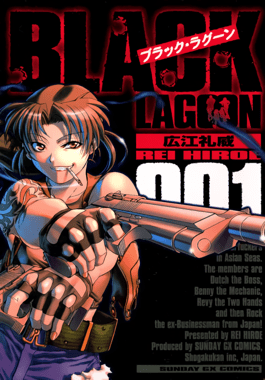
The premise is this: in the mid-1990s, Tokyo-based salaryman 25-year-old Rokuro “Rock” Okajima and a department chief are hijacked in the South China Sea by a trio of pirates onboard the Black Lagoon PT boat and calling themselves Lagoon Company. The chief leaves Rock to his fate and he joins up with Lagoon Company’s members consisting of Vietnam vet Dutch, Chinese-American gunslinger Rebecca “Revy” Lee, and South Florida computer programmer, Benny.
As the fourth face of Lagoon Company, Rock is the glorified diplomat if Dutch is unavailable, especially since there’s an equal or greater amount of time on land than on sea, mostly in the fictional border city of Roanapur, Thailand. This base of theirs is also home to many more organized crime syndicates the world over including but not limited to Colombian cartels, Russian and Sicilian mobs, the Triads, and the Yakuza.
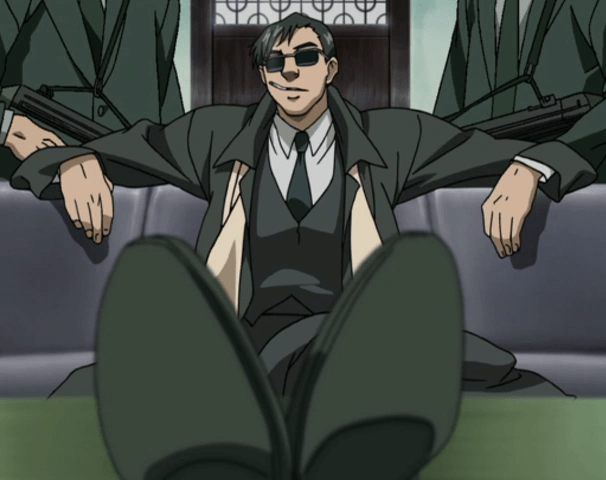
As for the cast of characters Lagoon Company faces, it’s quite a mixed bag. Just about everyone in the story is motivated by coin, though there’s a fair few who have their own ideals and tenets, not all of them savory or agreeable. Criminals, extremist organizations, drug lords, and general psychopaths are drawn like moths to flame.
Hiroe’s inspiration for Black Lagoon was inspired in triplicate: news reports about piracy in the South China Sea from the 1990s (hence the setting), the writing drew from a variety of influence like Stephen King and James Ellroy, filmmakers like Quentin Tarantino and John Woo, and overall crime noir and Hong Kong action cinema, and other mangaka like Kenichi Sonoda who created Gunsmith Cats (another series I wish to cover one day) and Akihiro Ito who created Geobreeders.
The characters and setting are all diverse in appearance and in skillset, especially protagonist Rock who skirts by on a lack of battle sense with the powers of negotiation and diplomacy. The setting of Roanapur among other places would make the guy an ill fit since he’s not really seen as bloodthirsty as the others, but then again, the wider cast of characters is exactly that unpredictable, or (spoiler incoming) you wouldn’t really expect a guy like this to be an arsonist, would you?

Speaking of which, this speaks to the creativity of Hiroe, understanding that there’s no bog-standard look for a criminal. Some dress in suits, others are tattered, and the rest are casually dressed. The same goes for some of the child characters in the show. Conceptually, almost everything is thrown into the kitchen sink when designing a character and putting them in the story.
As for the chapters themselves, Hiroe has stated in interviews that unlike mangaka who release weekly chapters, he employs a slower approach, often taking as long as a month to release a new chapter, and normally for two reasons: to avoid burnout experienced by mangaka of several popular series still running, and also for mental health reasons. For what its worth, if the research for the series has him glued to news screens and snippets combing over crime on international waters, then it can get daunting keeping it plausible yet exciting. Or if its a series of other things that see him taking multiple hiatuses from Black Lagoon, then whatever happens, the series already gets high praise online and in real life from Japanese and western audiences alike, and not to sign a Death Note of sorts, but even in the worst case scenario, his flagship series will progress toward an ending, even if it isn’t him specifically who will finish it.

Someone will be there to finish it, with him or for him. And no matter what, Black Lagoon started with a bang and I sure hope that when it eventually ends, it ends with a f[swords clanging]ng bang.
This week’s recommendation is the YouTube channel RunJDRun.
https://www.youtube.com/@runJDrun/about
RunJDRun is the gaming channel of John David “JD” Witherspoon, son of late comedian John Witherspoon. Beginning in June 2009, he hosts Let’s Plays primarily on this channel either by himself or with friends, but also has commentary videos on video games or just in general. JD also has a podcast that he co-hosts with his friend Paul. He normally uploads daily, and like his father, he also has TV appearances and performs stand-up from time to time in the Los Angeles area.




 Opinions on Entertainment