
Or Cute Girls Doing Cute Things Cutely
Animanga came to the western Anglophone world in the early 1960s with Osamu Tezuka’s magnum opus Astro Boy, and about 20 years later came Dragon Ball and its more famous successor Dragon Ball Z, both penned by Akira Toriyama. Since then, the floodgates have introduced not only more anime to follow, but also different ways in which one defines a certain era.

If you’re a weeb/otaku like myself, you can probably point to pivotal series of each decade. Dragon Ball in the 1980s; Ghost in the Shell, Yu Yu Hakusho, and Cowboy Bebop of the ’90s; Clannad, Azumanga Daioh, Lucky Star, and K-On! across the 2000s; Sword Art Online, Attack on Titan, Date A Live, Kill la Kill and Is it Wrong to Try to Pick Up Girls in a Dungeon? of the 2010s; and finally this decade, we’ve had Keep Your Hands off Eizouken, Oshi no Ko, Bocchi the Rock, Jujutsu Kaisen and several more slated for release this decade.
Basically what I’m saying is that different anime define a decade. The 2000s in anime was defined by the moeblob, where many animanga series ascribed to a cutesy art-style and theme. Not just in character design, the characters themselves did things “cutely” too. Or rather, they did normal things in a cute way. They didn’t fight monsters or go on fantastical journeys or acquire magic relics. Often they attended their daily lives which overwhelmingly revolved around high school. Joining the moe trifecta of Azumanga Daioh and Lucky Star comes K-On! A series about an extracurricular club centered around light music.
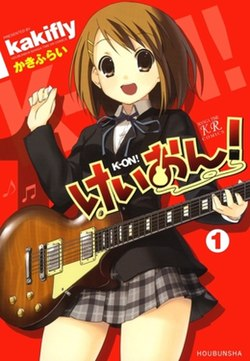
It starts in a nonspecific part of Japan (since the mangaka Kakifly is from Kyoto, I’m gonna imagine it’s somewhere in Kansai), four high school girls become a part of an after school music club in order to save it from disbandment. The four main leads are Yui Hirasawa, the ditsiest, silliest guitarist in the series; Mio Akiyama, the lead guitarist afflicted with stage fright; Ritsu Tainaka, the loudest girl even without a drum kit; and Tsumugi “Mugi” Kotobuki, the rich and physically strong one on keyboard.

For a series dedicated to light music, the actual musicmaking takes a backseat to the girls simply goofing off after school. There is musicmaking but a given estimate would put it at somewhere near 35 to 40% of the actual screentime, across both seasons. Not to mention, this is still a series that debuted in the 2000s, so music players like the iPod and digital song downloading wouldn’t be as popular and prominent as opposed to cassette tapes, Walkmans and the like. Even then, keep in mind, these then-new devices wouldn’t look like anything what we have nowadays. Touchscreens and smart devices have come a long way.
From what I’ve seen though, analog tech is one of the few ways the series shows its age and that’s merely 16 years old, in line with the corresponding ages of the characters at the beginning. Come the second season, they gain a fifth member, the pigtailed rhythm guitarist, Azusa “Azunyan” Nakano, who takes her role as guitarist more seriously than Yui or even Ritsu does with her drums. You’ll notice that at this point in this post, I haven’t mentioned plot and this ties in with including the likes of Lucky Star and AzuDaioh in that all three have the same basic plot: f[guitar riff]k and all.
Gigguk, at the time, was less forgiving of the anime as a whole, with most episodes in some manner boiling down to goofing off with a cup of tea, something that didn’t really jive with him, which may be in some way related to his musical past.

In contrast, Gigguk’s good buddy Joey “The Anime Man” Bizinger favors K-On! over Bocchi the Rock, and that’s an opinion I hold though not for the same reasons as Joey. I don’t doubt the existence of people that stiflingly shy; part of it has to do with everyone praising it at the first hurdle. Perhaps for Gigguk, there’s more realism to Bocchi than K-On! and I can’t do much with either man’s opinions on the show.
For what it’s worth, he did warm up to it after a few years have passed though not by much. For me, ignoring outside influences and the layman’s opinion on one or the other, I haven’t seen Bocchi yet and I don’t think I will, at least not this year. I had trouble wading through the first episode of WataMote, but at least Bocchi’s not a sleep-deprived femcel.

For me, this puts Tomoko one flight of stairs lower than Bocchi, at least in the beginning. I’m not really one for cringe humor.
On its own, K-On! gives me the impression that it’s not trying to take itself seriously in the slightest. It’s not exactly a comedy like AzuDaioh or Lucky Star and fortunately for it, the jokes aren’t subject to translation mishaps like the former. I humbly accept it as a show about high school friends goofing off outside their club activities and their studies.
Is this why I like it? Well, call it a palate cleanser from all the one-piece finding, dragon-ball hunting, Hokage-aspiring, soul-reaping action of most Shonen series. I don’t always want action, sometimes I just wanna kick back, grab a drink of my choosing, and watch people somewhat like me just screw around. If this isn’t a convincing argument to at least check out some of the first season, consider the uncommon music scenes. Adding music or musical anything as a genre type to a series means adding some original scores and music to the series beyond the opening and ending music, both of which are impressive in their own right. Select scenes in the anime dazzle with the change in lighting and art aesthetic giving it an animated music video feel which is not necessarily the same as an AMV, though it does set itself up for that. I did some quick googling and there are some AMVs with K-On! as the main animation piece, and the series has produced some original songs, so it’s not the most devoid of music, but it could’ve benefitted from a few more scenes at the end of a few episodes.
You can still enjoy the series for being all warm and fuzzy but for those of you who want a series dedicated to musicmaking, my recommendation there goes into Beat & Motion. It’s coupled with a look in animation so it feels more like an AMV-centric manga.

No word yet on whether it’s been slated for an anime, but if it is, yes please. I want more.
 Opinions on Entertainment
[…] this week is a classic one that’s roughly about schoolgirls doing otaku things rather than cute things with music or just silly things goofily. Damn, I’m not making a good case for myself […]
LikeLike