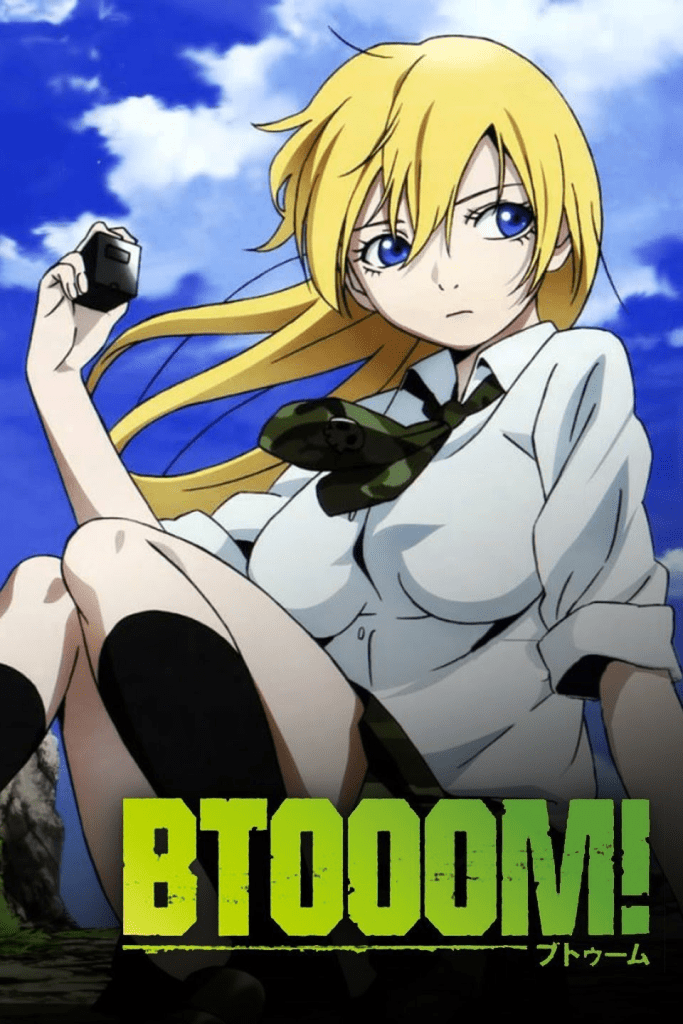
Stumbling Blind into Btoom!

I didn’t know what to expect from this one

My discovery of this series was quite an interesting one. I couldn’t remember where I first heard of it, but after watching more of it I realized I’d seen bits and pieces of it in WatchMojo.com’s anime top 10 lists. So not as blind as advertised.

Still, all I remembered from it was the name of the series and on a whim, I found that someone was pirating it for their viewing pleasure on YouTube. In the time between when I saw the first two episodes and completed Army basic training, I found that the channel had been taken down, though as of writing, there’s still a video of all 12 episodes in a 4+ hour marathon, so if you wanna game the system without risking malware Trojan horsing into your devices, have a looksee. Otherwise, go in with a shield and beware the spam on your hard drive.

I talked briefly about Btooom! at the end of December when I wanted to speedrun the topics I had on my mind at the time before I stepped off to new adventures, but I didn’t have enough time to properly explore my thoughts on the series, especially since it only has 12 episodes to boast compared to similar series like SAO that have franchises and can simultaneously earn the praise of some and the ire of others. So let’s give Btooom! some love it should have by now.

As of writing I’m only six episodes deep into Btooom! which I’d say is good enough to fully write about what I’ve witnessed thus far. From what I remember of the first two episodes I watched in December, as a Seinen series, it’s not the type of series to highlight the good in everyone. It knows its characters are bastards and scoundrels in some shape or form. The protagonists are definitely antiheroes. We’ve got three of them: Sakamoto, Himiko, and Taira. Each of them have at least something to balance out their negative qualities.

Sakamoto was a 20-something NEET with no passion or future in anything more productive than just lazing in front of the screen and keeping his high scores. This part is understandable since not everyone is required to behave like the heroes and crusaders they might be raised to believe, but what makes Sakamoto quite s[fart noises]t is that he’s that kind of toxic gamer. Abusive to his mother, refuses to find a stable job or training and move out of the house, no affection even for his stepdad (honestly this fits a lot of toxic gamer tropes that even I myself fell into as a teen at one point), and really hot-tempered. All those jokesters and mouth-breathers who argued that video games caused violence probably would’ve been onto something if Btooom! was used as an example.

Himiko’s the second character we see in the anime and her flaw was being a bit two-faced. Prior to being sent to the island to play the game IRL, she and some school friends were going to be the groupies for some musicians, but when the band mass molested them, she was the only one to book it and leave her friends to their fate. Now they don’t want anything to do with her seeing as she abandoned them when they needed help, but it wouldn’t be long before, in their eyes, she’d get a taste of her own medicine. I talked before about the molestation scene and I don’t want to elaborate further on that aspect as it was harrowing to watch only once, but to catch you up to speed: the one decent person who helped her got rejected, physically assaults and rapes her, she pulls out a bomb and explodes him to the seventh circle of hell.

You might begin to cheer her on for defending herself, but down the road she appears to be killing men left and right as a trauma response. And I think that’s one of Btooom!’s highlights. Trauma in western media tends to be hit or miss with more strike outs than home runs to speak of, which would be why so few of them handle it very well and with the maturity the subject matter demands.

I heard this show handles trauma pretty well. I haven’t seen it myself yet. I might…

For Himiko as a rape survivor, the reactions sound valid but get less and less rational as the series goes on, which may be the point. She narrowly dodges an assault, is the victim of one, and is motivated to never, ever be the victim of such an act again, even if it means a series of pre-emptive strikes that could easily be mistaken for Unabomber attacks, especially considering this series.

Finally, there was Taira, a middle-aged convenience store manager who meant well to his friends and family, but according to himself, was a great bastard to his subordinates. Allegedly, he’s the type of guy you’d talk about in order to not be like him. The example of what toxicity at work looks like, so to speak.

Now that I think about it, the series felt like the Saw franchise but anime and with bombs instead of overelaborate traps. Also, few people are genuine do-gooders in the series. The characters are either believable or wickedly f[power tool noises]d in the head. Each of these characters are ripped from their familiar surroundings and dropped into a real-life version of the Btooom! video game, only it’s more like The Most Dangerous Game with more evidence left behind for a forensics team to analyze.

The game Btooom! is pretty much a battle royale, deathmatch style video game similar to Call of Duty’s or Halo’s multiplayers, though more Halo style since everyone is kitted up in sci-fi looking armor and in place of guns and small arms, it’s all bombs of different types, from incapacitation to full-on lethality, and seeing the types of characters running around in only six episodes thus far, a lawless, free-for-all for keeps is exactly what would attract more than a handful of psychopaths who just felt like killing. Some of the nobodies who get gunned down in Black Lagoon would feel right at home in a series like this.

Sounds like an exciting watch, right? Well, I and whoever ran that now-deleted channel and whoever is still uploading clips of the anime to this day all thought so, but at only 12 episodes with the manga lasting far longer than that, I’d at least want to know why the anime died off while a similar yet comparatively lighthearted series like Sword Art Online became an overnight global success. Well, I came across one video that pretty much explains the reason behind Btooom!’s faults and failures.

Channel: thisvthattv

In short, the series was a sufferer of a vintage anime bugbear where the anime releases before the manga is even halfway done. For the most part, up to two or three chapters of a manga can make one episode while depending on the style, that’s one or more volumes making a full arc, and it looks like there wasn’t enough time given between the first episode and the release of the 9th volume in January of 2013, which sounds like time constraints or nonexistent timetables made a mess of things anime-wise.

The manga at least finished all the way up until 2018 with creator Junya Inoue’s assistant Hiroki Ito releasing a spinoff series called Btooom! U-18 the same year as the manga’s conclusions. Yes, plural. There’s a light ending and a dark ending; U-18 follows the former. But even with an interesting premise, the biggest culprit is that the manga was never financially successful, almost forever doomed to cult status. This fate followed the home releases of the anime with only a few collectors having it on Blu-Ray and DVD in Japan at least. Japanese publishers notoriously ignore foreign data and market share so there’s no way to know for certain if they know that the show had an audience overseas. My best guess for why this is for a lot of studios at least is that they agree to let western studios and voice actors dub it over and immediately call it a day. That, or they go straight to work either on the rest of the series or something else until another season is announced.

Speaking of which, a second season was promised under the condition that the tie-in online mobile game stay within the top 5 in Japan for a set amount of time. In 2016, the mobile game developer Asobimo developed a mobile game based on the series as a bit of a glorified promotion and also as an early pioneer in the battle royale genre which in turn was based on the manga which itself was based on the series that gave the genre its name.

Holy Christopher Nolan, Batman. We’re discovering fractal layers left and right!

So all of these conditions needed to be met before an animator could get to work on a second season of the show, but alas it wasn’t meant to be. The success of the game was short-lived and it lost its high marks and status after a month and change. It wasn’t even in the top 100 in Japan anymore and I don’t think Asobimo was doing much to help promote or maintain it. It’s last updates were in the Spring of 2017 and it lost support two years later. A second season is a long shot, and a well-done second season is aiming at a gas station sign from five miles away. With only one arrow.

It can be done, we’ve seen more unlikelier series come back for a second season even years later…

…but assuming that of every series is like assuming every coffeehouse makes joe the same way, like they follow an industry standard. It just doesn’t work that way. Maybe we’ll get more Btooom!, maybe we won’t. My crystal ball is looking kinda gray, but if there’s a silver lining, it’s this. It’s finished. The manga’s done, so an extended continuation is in no way off the table if the cards are played well and the season is properly formatted. I just hope it doesn’t go the way of Rising of the Shield Hero season 2 or The Promised Neverland’s season 2.

My First Blog Deserves to be Forgotten

Granted, I’ve grown since, but still

A while ago before stepping off for my new adventures in the Army, I mentioned briefly that I had a blog on Google’s Blogger that ran continuously from February to August of 2021 until a break due to that first attempt at Army life. The summary I made in that little speedrun was that it was crap and should be forgotten at all costs, but in a show of reverse psychology, it’s got me going back to it if only for the sake of this post, and then it’ll be forgotten forever more like the Macarena from the 1990s.

Channel: LosDelRioVEVO

Feeling your age yet, gramps? Well, move aside, we’re peers now.

The origins of the blog were born from a time of both desperation and interest. I had graduated during the emotionally charged year of 2020, a.k.a. the Second Long Hot Summer (after 1967’s many race riots), a.k.a. The Pandemic/COVID-19 Era, a.k.a.; I’ll stop with the references now, I don’t wanna remember that year either.

I may have mentioned it before, but during that year right after I graduated from college and some change during the protests or riots depending on who you were talking to, I decided to phone up an Army National Guard recruiter. Here’s one of the first problems I ran into here: the waiting. Being in the Army now, I understand the concept of “Hurry Up and Wait,” but a civilian attempting to understand the concept with no other point of reference would be left watching and waiting for something amazing to happen.

For reasons that make sense only to recruiters and journalists who focus on the military, the reason for the wait time — at least for recruiting — has to deal with bureaucracy. A bunch of moving parts are considered before a candidate is moved onto the next step, and yes this does include fitness and health. Decades ago, you could be very physically fit with the body of the next super-soldier but unable to join because you had asthma at five. The standards have been reduced since at least 2004 in that specific case, but asthma and other life-altering maladies do require a waiver… which was what kept me from signing the paper and shipping out the same day.

My medical history was far from perfect, but then again, so were a lot of people going into support roles in the Army. Also, before this, there were loads of (now outdated, but still relevant) statistics on obesity rates in the U.S., so how different was I from the average potential recruit?

Still, I was determined to at least try for the Guard that year, but with all that was going on, including my city refusing to let anyone go outside save for emergencies, and there was no chance in hell I was gonna get into the National Guard that year. I didn’t even have faith in my pulmonary functions test until my doctor rang me up and said it was positive.

And I was ecstatic! The one malady that kept me down all my life had been defeated! But by this point I was so disappointed in the recruiting that I tried looking at getting a work in my college major: writing and literature. Impossible? Or just very difficult? Well, up until that point I was so tunnel-visioned that when it came to writing, my original goal of getting published blinded me to other possibilities, both in becoming a published author and wherever else writers could flex their skills.

The difference between traditional or even self-publishing was the barrier to entry. More experienced writers can give me different stories based on their own experience, but being a poor kid with a lot of dreams, the route of manuscript to editor to agent to publisher was more a matter of money than time. I could definitely wait on this; it took me ten years to get the damn thing published. Side note: if you’re wondering why I didn’t like waiting for the recruiter, but had more patience for the manuscript it was because I was more involved with the manuscript considering I was writing it while the National Guard recruiter was more a luck of the draw. I was dying to beat the odds on this one. Part of the reason I wanted to go NG before throwing all my chips in active was to use the cash there to fund this hobby and eventually use the benefits for a VA home loan. Biased opinion or not, I firmly believe a two-bedroom, one bathroom apartment is not where a family should be raised.

That excursion with the NG recruiter lasted from August to November of 2020. Between the last correspondence with the guy and the beginning of the first blog, I contemplated learning new skills with the Job Corps, but I blew them off for a bunch of personal reasons, the biggest one being my immediate area. The nicest way I can put it is that there are swaths of the Bronx that remind me of these important lessons from The Boondocks.

Channel: BOKC headhuncho901_

Parodical or not, where I grew up, very few people turned into responsible adults. There were only three things a black or Hispanic (or in my case, both) kid could see in their future: basketball, rap, or drug dealing, a secret fourth outcome, all of these combined. And I wanted more options. The Army would mean saying goodbye to my family to potentially defend the nation from terrorists and/or near-peer adversaries, but I just saw an excuse to see more of the world that I was missing. Remember, poor kid who wants to see the world, but won’t be able to without money for bus, plane, or train tickets.

Writing, on the other hand, was a much slower process that would have me hone my skills for better results, but there’d still be pitfalls all the same. And I’d be ready for what those could look like. That said, more research and patience to know what to expect and possible steps would’ve helped me plenty. Writing is a passion of mine, as these past blogs show. The bull crap I grew up seeing was really tired and really overdone with all these new people showing up in sports and music. Allow me to be the boomer and say that the classics beat these new folks any day.

Tear me off this hill all you want, I’ll never recant this statement!

So yeah, I was concerned about potentially sharing a workspace and probably a dormitory with a bunch of kids who essentially thought the same, spoke the same, and all that. I went to school with people like that; some diversity of thought would be a huge breath of fresh air at least.

I still had my friends from before, but we were all drifting apart over time. Hell, my best friend is a father now, which essentially makes me an uncle. Writing wouldn’t net me any new friends, but it would put some money in my bank account so that I could travel and make friends the old fashioned way.

Or so I thought. Just like this blog, the old one was supposed to be primarily entertainment, but with a larger focus on anime and video games. Somewhere along the way, my time on YouTube bled into the blog posts and s[horse neighing]t went wild. Going off the rails and everything. I’ve been careful to keep my political opinions to myself, but on that other one, it was like watching someone go mad with cabin fever. And this was 2021. We had the vaccine by that point. Maybe the maturity wasn’t there yet. I was only 22 then and at least in this blog, I put some kind of research into my topics instead of just bashing my head on the keyboard like a somehow more inept Invader Zim.

A few months later, I went all in on active duty. I’d spent the last year of high school till that point convincing my mom that the military was a smart decision for me personally, but she had her reasons for imploring me to explore different options, not all of them related to my health. I graduated high school in 2016 at the age of 17. In the U.S. at least, if you’re out of school by 17 and you want to join the military, you need parental consent and my mom was in zero rush to see me in a military uniform at that point. We were also still seeing active combat deployments to Afghanistan and potentially becoming a statistic was completely off the table for her. So it was off to community college for me.

Fast-forward to 2021, and we’re set to leave Afghanistan and transition into a peace-time Army and my mother finally tells me that if I want to I can go active duty Army, so I did. The time between talking with the recruiter literally down the street from me and shipping out was about 3.5 months, enough time for me to scramble my incoherent thoughts in a piss poor blog. I’ve linked to that blog right before I shipped out in January for basic training, but to save you all the trouble, it’s right here again.

Once again, I’d like y’all to be nice. The first attempt is almost always the worst attempt. It’s not like Einstein was born with a brain that big and heavy. Then I started this blog in 2023 after being told by another recruiter that based on my previous performance at Fort Jackson, I wouldn’t have another chance in the Army. But again, my tunnel vision, or rather my determination, kept me from quitting just yet. I’d keep looking for ways to beat the odds.

It still took some doing and a year of mostly sitting at the computer and occasionally jogging wasn’t worth anything. Literally. My folks were wondering why I wouldn’t get even a retail job and my excuse was that even though experience is different from anecdotes, too many retail worker horror stories kept me from taking that plunge. I was desperate for work too, but not that desperate.

A third recruiter bailed on me, leading me to find a remote one on Reddit (beating the odds once again), and in between then and now 2023 was just me filling up this blog with better though still imperfect content. I know I said that I’d like that first blog to be forgotten for good, but as an archive of how I used to think and feel about XYZ, it’s good to have something to remind me of how not to do something. Yay!

I know it’s a month divisible by 2, but this time I wanna try something different. No recommendation this time, but next time I want to see if I can make biweekly recommendations at least until June to get everything back on track. My notes from before still have old dates written on them and they’re pretty much invalid. Once that’s cleared up, then I’m good to give you another YouTuber to eye. Gonna step out into the wider world next time.

What Was Lost from L.A. Noire

It was underbaked all along

I’ve brought up L.A. Noire before as an example of what went wrong with it on the developer’s side. To not repeat myself a third time, here’s the short version: Australian developer and programmer Brendan McNamara used his experiences working on the 2002 video game The Getaway to open his own studio in Sydney called Team Bondi with the goal of developing their only game L.A. Noire, based on old noir films from the 1940s and 50s. The problems that arose came from McNamara’s corrosive personality, crunch, and, according to ex-developers under his wing, explicit approval of sweatshop hours. Numerous people quit or got sick either physically or mentally of his open berating of “slackers” and loads of people who contributed to the project were omitted from the credits, especially if they didn’t see it to its May 2011 release. Keep in mind, Team Bondi started working on the game in 2004.

Over the course of nearly eight years, Team Bondi lost a lot of people and with a high turnover rate and new people not knowing what their predecessor was specifically working on, lots of stuff was scrapped. It wasn’t until Rockstar themselves made a personal investment in the game’s release, but by the time it released, it never broke even and Team Bondi’s assets were sold off in October 2011. The studio was said to have spent over $50 million on the game, making it one of the most expensive video games at the time, but it only made back less than half, even with all the marketing in the years prior to release.

After 12 years and a series of remasters and graphical upgrades especially on newer consoles, Rockstar clearly has a place in its heart for the game. As for what would’ve been different if more level heads were allowed to direct or manage the project, it’s difficult to say. Maybe someone could’ve reined in McNamara or fired him from his own studio for the toxic sludge he spewed from his mouth. Maybe the game would still be in development with graphics and physics engines changing over time. Maybe it’ll get cancelled and all we’ll have are numb, carpal tunnel afflicted hands to show for it. No one can say for certain at least not until we master interdimensional travel.

As for what should’ve made it into the game, it’s clear to see that some content was missing. Select characters seem to know the protagonist Cole Phelps without a proper introduction for the audience, especially on the game’s ad vice desk which handles drug crimes. Spoilers incoming, there’s also a subplot in the latter quarter of the game tying together (though haphazardly) the fate’s of the characters Cole Phelps, an ex-Marine who fought with him in the Pacific Jack Kelso, and a German immigrant jazz singer Elsa Lichtmann. Part of the subplot is meant to hint at Cole becoming smitten with Elsa and beginning a love affair with her despite him being married with children.

Following this revelation, his partner on the vice desk rats him out due to personal reasons (he lost out on a boxing match and Cole pretty much ruined the fun for him by promising one of the potential victims a ticket to catch a ferry from New York), and he’s demoted for adultery. The scandal makes the headlines and left with no one but Elsa, after a few cases on the arson desk, Cole looks into a personal conflict Elsa’s been looking into for a while: the most likely (read: confirmed) fraudulent death of her friend. This is where Kelso comes in as an investigator for the California Fire and Life insurance company. Elsa’s friend was a construction worker who was contracted in the development of new homes for returning G.I.’s but the house he was working on collapsed and killed him. It’s revealed from Kelso’s investigation that most of the houses were build with subpar wood and brickwork, some of it from shut down silent-era film sets.

I bring all this up because the adultery subplot comes in quite apropos of nothing. Call it subtlety or a hint at the rushed development cycle, but the closest we get to a build up of Cole’s and Elsa’s relationship is him visiting the club that she sings at most nights. The scenes where they get even somewhat intimate are rare and in the last few cases in the game. It also seems that much of Cole’s character development is absent. Throughout the patrolman cases and going to the traffic and homicide desks, he’s portrayed as levelheaded and quite straightlaced, even chiding fellow officers for not sticking to his personal definition of justice no matter how slight, though keeping to himself for some other officers’ personalities.

By the time he’s on the arson desk, he’s back to his old professional ways and he’s still the type to chase a victory, even with the power of slippery slopes, but I personally never saw him as the type of guy to think himself as a hypocrite, nor did I think that his preaching morality was in some way a shield for his own personal conduct. Some moments do stand out, but don’t have that much of an effect on the story, such as his pride in his own job as a cop while his first partner, Stefan Bekowsky, complains about aspects of his tenure on the traffic desk; or his taking the homicides more seriously on that desk while his partner there, Rusty, is busy drinking half the time, and several others.

Still, if the devs weren’t dodging an interpretive clock or a nasty boss, it could’ve seen a lower turnover rate and some of the original ideas that were cut could’ve been added back, if not in the game itself than as an expansion pack or DLC. The finer points of this implementation can be better explored elsewhere if they haven’t been already, but of the ideas that were scrapped, there were two crime desks that were abandoned: the fraud desk and the burglary desk.

According to McNamara himself, the desks were exactly as described: burglary dealing in thefts and robberies, stuff going missing, and all that entails; fraud would’ve dealt with scams, conmen, forgeries and everything in between. We don’t know who would’ve been the officer in charge of dispatching detectives to investigate these cases, but we have one clue as to who would’ve been partnered with Cole at least on the burglary department: a minor character named Harold Caldwell.

Caldwell was seen getting along famously with Cole. During the final case on the vice desk, he lends a hand to Cole and his vice desk partner, the sleazeball Roy Earle. Caldwell was suggested to have been Cole’s partner on the burglary desk which would’ve had around 11 cases to play, which is the closest explanation for how he has such a good chemistry with Cole at this point in the game. Because the game skips forward six months between the traffic and homicide desks, it’s suggested that the timeskip was supposed to be the burglary desk, but the reason for its omission comes down to formatting and storage.

The PS3 version has the benefit of a large capacity Blu-Ray disc, but there’s no equivalent feature for the Xbox 360 version. Having played it myself after getting it loaned to me by a friend, I remember the game case having a total of three discs. Leaving extra content in the game would’ve necessitated a fourth disc and to my knowledge, few, if any, games would’ve come with so many discs. Without the cut content, L.A. Noire clocked in at a 20 hour campaign depending on your playstyle, but with 11 more cases focused on burglary, who knows how many more hours and gigs would’ve been dedicated to the game?

As for the fraud desk, we know even less. All we have is speculation based on what probably would’ve counted as fraud in the late 1940s since this game was also released in a time before the Miranda rights afforded criminal suspects protection while in police custody along with a defense attorney. It might not be obvious playing it, but if you ever look at gameplay of L.A. Noire or play it yourself, you’ll notice that Cole never reads the suspects their rights. The landmark Miranda rights case was argued in Arizona in 1966, less than 20 years after the events of L.A. Noire, so a lot of what the LAPD could’ve been implied to play fast and loose with in 1947 would’ve largely ceased by then.

Regarding people involved in the fraud desk, that’s also not well known. Who would’ve been the dispatcher? Cole’s partner? Is there a desk that challenges Cole’s lawman philosophy and awaken him to the shades of gray in law enforcement? All of this is up for interpretation. McNamara claimed to have had some levels and concept art for the burglary at least, but I couldn’t find any screenshots of these to verify. Not that I’m calling McNamara a liar, but he was the only public face during the development of the game.

The attitudes and accounts of the disgraced ex-employees of Team Bondi (especially those who left before the game released) may suggest that McNamara had all the cards, so unless an artist or designer snuck away a copy of a potential level, this cut content exists as lost media. Instances of both still exist in the game, but you would only be able to see it in the game’s free roam mode, looking at fliers and ledgers and whatnot.

Would the cut content have made the game any better than what we got? Well, I doubt it would make as big an impact as expected, though it could still change a lot of things. Like what? Probably an in-depth look at how theft was prosecuted post-war or what defined fraud. The examples I listed above are clearly not exhaustive and people smarter and more experienced than me in those fields may have more to add to those, but those would be the more obvious ones to me as I’d never investigated a missing object in any capacity, nor have I investigated fraud. Certainly, Caldwell would join the list of partners Cole has had over the course of the game and likely one of the more respectable ones compared to Roy Earle who takes home loads of allegations of racism and misconduct, even for an America pre-integration.

For formatting and storage, if Team Bondi was able to commit as much as possible to leaving everything in undisturbed, then the game case may look more like a binder or folder with well over four discs dedicated to each case on the Xbox 360 and probably two or three Blu-Rays for the PS3. Subsequent re-releases for PCs would occupy more storage than can possibly fit on an unmodified computer. If I was a part of that alternate reality, I could easily see myself budgeting for more than one high capacity hard drive for just one game or even a series.

On that note, there’s also a part of me that sees this as being a series given the same treatment as the multiple expansions for The Sims franchise or Battlefield and Medal of Honor, which probably says a lot about how EA’s design philosophy compared to what was inherited from Team Bondi into the Rockstar family.

The only notable changes for later releases of L.A. Noire is the interrogation going from Truth, Doubt, and Lie to Good Cop, Bad Cop, and Accuse. All things considered, what counts as speculation for a different game solely exists in criticisms for what didn’t work or go far enough in the version we got. Then again, it takes a game with enough hard work going into it to spark debates and discussion years after the original developer went under and the closest thing we had to DLC or a sequel was seemingly shelved forever. This video by Real Pixels explains all the faults in L.A. Noire. Based on what I wrote, there’s a lot so take this as a brass tacks examination of L.A. Noire.

Channel: Real Pixels

Finally, is L.A. Noire even good? It clearly doesn’t live up to its purported expectations and as I’ve explained there’s a lot under the hood that’s missing or what’s left over isn’t perfectly aligned, but considering I’ve dedicated one post to the game and sections within two separate blog posts to the game, I have a relatively high opinion of the game, and so do others given how many people dream about there being a better version of L.A. Noire or even a Whore of the Orient.

We end 2023 with a YouTube recommendation for the channels Business Basics and Geopolitics Daily.

https://www.youtube.com/@BusinessBasicsYT

https://www.youtube.com/@GeopoliticsDaily247

The twin channels cover news coverage and geopolitics across the world keeping viewers up to date on major issues that affect us directly or indirectly, typically from a consequences of conflict standpoint especially in the case of territorial disputes like those of Russia, Israel, and China among other places across the world. Both channels began as business and investment guides before the shift to global events, but do still offer tips and guides for business and investing.

My Opinions on Visual Novels

Lots of engagement? Or hardly any?

I chose the topics for the year many months ago. In the case of visual novels, I didn’t think I’d have a lot to say about them, but when I got one for free this summer on Steam, it initially got me thinking about how I feel about them… for a bit. Then I stopped largely due to my play style. I do get absorbed in video game narratives — I felt compelled by MK: Shaolin Monks enough to try to fix the narrative like a weekly anime a la Dragon Ball — but my play style successfully blends dialogue with button pressing. Mortal Kombat, God of War, Call of Duty, the Naruto games, Midnight Club, Need for Speed; indicting myself here, the action is the selling point.

But I still decided to give that free VN a chance, specifically this one:

The goal of Find Love or Die Trying is to romance one of the five girls on a televised game show not dissimilar from The Bachelor/ette. If you fail to get even one of them to fall for you, you die. So specifically it’s a dating sim game. I recall tuning into DashieGames in the latter part of high school when he was playing that one dating sim puzzle match game HuniePop, where that game’s goal is to score with all the girls.

I know what visual novels are, and there’s a chance you’ve come across some yourself or even their most famous anime adaptations (Fate, Clannad, Danganronpa, etc.), and I was about to say that they’re not for me, but that’s just not true. I just forgot because I have way more memories of being very involved in other video games not limited to the ones listed above. The truth is more that I’m a bit torn on VNs somewhat. I’ve run into several in my childhood, especially on the practically defunct Stickpage, and while not VNs themselves, the Choose Your Own Adventure template of Telltale Games’ video game adaptations of popular properties as well as Don’t Nod Entertainment’s Life is Strange series served as something of an introduction to VNs or something close to a VN.

I still have my copies of Minecraft: Story Mode Seasons 1 and 2, I’ve watched gameplay of Life is Strange 1, Before the Storm, and 2, along with criticisms of each (for more information on LiS, see GCN, Dumbsville, or uricksaladbar on YouTube for more details), and if you’re familiar with games like these you might see the path I’m walking down here. Diet VNs or not, these tended to have more player involvement than something like Doki Doki Literature Club or literally Highschool Romance. Clearly, I’ve got a preference for one type of game over the other, but it’s not like I won’t give a VN the time of day. I did stick around Find Love long enough to reach at least one ending, and a few years ago I watched an old playthrough of The Anime Man playing Highschool Romance; I watched all the endings on his channel. This is what it looks like.

So why are VNs toward the middle of my tier list? Is the limited involvement that it comes with, prioritizing the reading and storytelling over the action? I doubt it… if that were the case I probably wouldn’t have seen the Telltale Games through to the end or bothered watching that Anime Man gameplay of it. I think it’s effort necessary to get through a VN. Don’t get me wrong, I think VNs can tell great stories with the right kind of writing, setup, and characters. The 4chan sponsored VN Katawa Shoujo about romancing girls with disabilities is said to be one such example of amazing storytelling, but I think part of what keeps me from exploring more further has to do with length.

This may sound weird for me since I’ve stuck around some long running anime and have several novels in my possession right now as well as a published novel out available for purchase, but part of the difference between a physical book or a graphic novel or even a webcomic would probably be the visible page count. With the exception of Choose Your Own Adventure, few books or other such media have branching paths. Sometimes what I do when looking at a book in Barnes and Noble or any other bookstore or even with books I own, I count the pages of the chapters. I don’t always have the time to just read for fun and in those instances I count how many pages a chapter has and whether there’s page breaks for me to stop on just in case I need to put it down and divert my attention elsewhere. They’ve become to me what most mobile games are for someone on public transit.

Visual novels on the other hand feel more deceptive. Because so many have branching paths and multiple choices affecting the narrative, a single run could theoretically take moments of your life away, especially if you plan on going back to unlock different endings. This might come from the side of me that wants to experience a lot of things at different moments or it might be something else, but seeing how long some VNs can be can get pretty daunting. I could do it, but seeing the progress bar move at the speed of sleep might motivate me to try another look for speedrun to watch on YouTube or try one myself to juxtapose.

More popular VNs like Fate also notoriously ridiculous launching points. Gigguk took the piss out of this a few years ago with his video on getting into Fate, but it touches on another problem with some VNs: starting point.

Channel: Gigguk

To be fair, I’ve heard from Fate fans that the memes of where to start getting into Fate take it overboard at times, and I like to believe there’s some truth to that, but other times VNs can run on for very long and seemingly have no clear path to walk on. From the outside looking in, they can look like they’re all over the place narratively. I don’t always like taking notes when I’m reading, but a labyrinthine writing style can make that look like a National Guard deployment to an approaching disaster.

I’ve called my own levels of patience into question before, but it looks like I draw the line at really long VNs, though more of a dotted line than a solid one. I could see myself getting into more VNs if I knew where to look for more, and ideally none that are years long or seconds short. The Highschool Romance dating sim gives me an idea and I may go back to Find Love in the future (especially since I started a second run and didn’t finish), but until then I’m probably gonna keep VNs towards the middle of my personal list. I recognize the appeal and I could see myself getting absorbed in them one day, but it’ll take a while for that to happen. For an in-depth look at what a visual novel is and what most of them consist of, see this video from Get in the Robot for more details:

Channel: Get in the Robot

This week’s channel recommendation is Company Man.

https://www.youtube.com/@companyman114

Company Man is a channel dedicated to exploring the businesses and markets that have since become household names in the U.S. and abroad. Restaurant chains, pizzerias, candy companies, grocers, and numerous others. Often in my writing, I’ll make obscure references to famous products or companies and whatnot and I like that Company Man offers a lot of insight on the history and success or sometimes failures of many of the brands we grew up with or heard about. It may not sound as ecstatic or exciting, but I think it’s interesting to explore these different brands.

GTA VI Launch Trailer Arrives Early

A really long time coming

Citizens of the internet will know that fake trailers make the rounds several years or so after a popular franchise entry is on the market. I recall looking at fake videos of what GTA V would look like shortly after announcement in the middle of 2012. Me and my friends were hyped for the latter half of that year and 2013 waiting for the game to come out and when it did, in a nutshell it broke records back to back.

A few weeks after initial release, GTA Online debuted and despite an initial hiccup for those who were there (I was one of them), Online alone probably counted for lifetime revenue for the game. The most expensive piece of media in history made back all of its money and then some. If Rockstar was feeling philanthropic, every employee could probably retire and have enough savings for their descendants.

Over the years, critics have popped up questioning Rockstar’s design philosophy and direction. GTA V was said to have a DLC that was functionally stolen by GTA Online, which has enough DLC on its own to be released as a standalone semi-RPG (an idea that Rockstar could capitalize on if done more honestly), and even after the release of the phenomenally made, if overdone Red Dead Redemption 2, players often defaulted to GTA. Answering to the money (read: gold) found in the criminal funhouse that GTA Online was and still is, Red Dead Online suffered as a result and some haven’t forgiven Rockstar for it.

Nevertheless, Rockstar’s reputation as a more patient company has paid off. Gone are the days where they were a small team of British programmers asset flipping successful titles with only a year in difference. Projects have gotten bigger and bigger since at least 2007 coming to fruition with the following year’s GTA IV.

I think I have a theory on why the games have taken a more contemporary approach as opposed to the older unnumbered titles like Vice City or Liberty City Stories, and that theory starts with “it’s easier to capture what is than thumb through records looking at what was.” Maybe there’ll come a day when I elaborate further, but today we’re talking about a very long, very awaited installment in the GTA franchise.

On December 1, Rockstar announced the trailer would release on December 5, at 9:00 AM but the full trailer was leaked 15 hours ahead of schedule, racking up a record breaking view-count in minutes.

Channel: Rockstar Games

The internet has been demanding a follow-up to GTA V for a number of reasons, the most popular of them being criticism over the gluttonous mass that is GTA Online. I can’t say with certainty if these are the same people who default to GTA Online, but if there is some of that overlap, then it’s true what they say about a view from a glasshouse.

So following up on GTAs IV and V, GTA VI is yet another entry into the contemporary setting of modern-day Miami/South Florida. After looking myself, commenters who are from or have been to Florida have applauded the downright authentic portrayal of life as a Florida man or woman. Exploration of the Everglades and Keys, run ins with alligators, regular folks putting bizarre twists on normal activities and other easter eggs to the unpredictable nature of Florida man. Here’s a fun game you can play: google your birthday and put Florida man in and see what comes up.

Unlike the portrayal of South Florida from Vice City, where it takes home the allegations of a copy of 1983’s Scarface with a few references to Miami Vice, this time the game incorporates pretty much any given report on life in Florida. Much of the in-game footage captured seems to be recorded on Rockstar’s as of yet released parody of TikTok. Allow me to repeat a similar soundbite when I say that the graphics have never looked so amazing. YongYea recorded a video on this the previous night speaking similarly about the graphics and there’s no hyperbole when I say that minor things like hair and clothing affected by the wind, or facial rendering right down to the muscles, or even the local wildlife all come alive in just the trailer.

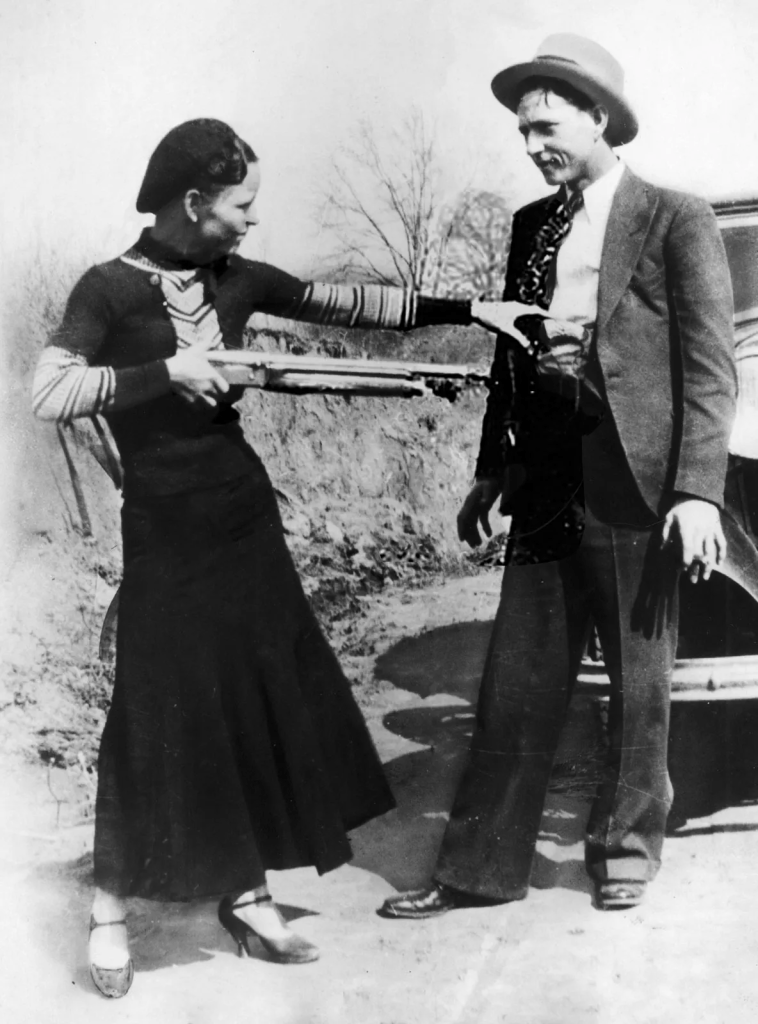
As for the plot, I’m personally saving my viewing eyes for later trailers to follow in 2024 and ’25, but from what we’ve heard and seen, it’s heavily inspired by the 1930s outlaw pairing of Bonnie and Clyde.

Also a first for GTA is a female protagonist. Rather than make your own in Online (as I have), the female lead is named Lucia and the male lead is named Jason. Plot details are obviously scarce and I intend to keep myself surprised until release even though select details have leaked yonks ago. From what I can gather from the trailer, it begins not dissimilar from JoJo’s Bizarre Adventure: Stone Ocean.

Think about it: young Florida woman begins in the prison system; Lucia herself most likely dodging worse versions of what Jolyne was forced to share a detention complex with during her own incarceration; a boyfriend with an equally sketchy history… and again without anymore information from that, I can’t say where else the story goes, but it clearly doesn’t take place in a prison, though the prison is likely to play a role in the story in some capacity. By the way, the initial comparisons weren’t lost on the JoJo community.

Credit: u/klydex210, r/ShitPostCrusaders

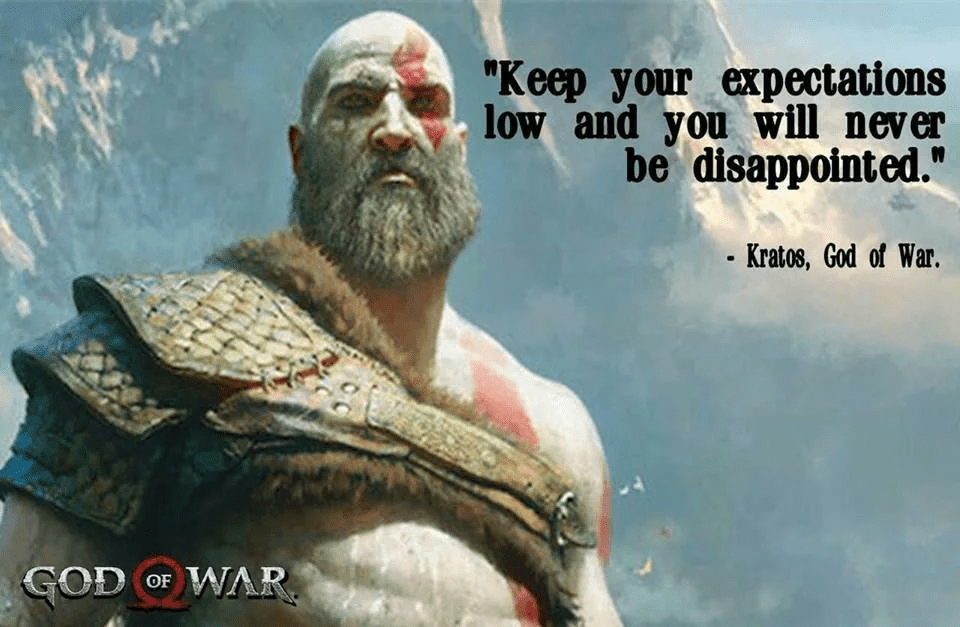
I honestly thought, as did others, that the release window would be, say, Q4 2024, but the trailer ends with a vague 2025 release window. As of writing this, in-depth analyses of the trailer are releasing on YouTube and more will follow with more trailers in 2024. All that time cooking up a five-course meal, so many people have been waiting for the main dish and it looks like whatever trailers are releasing next year and after until release will hold us all over as appetizers. I’m excited, but all throughout this post, I’ve been keeping a level and realistic outlook on this. As exciting as this reveal trailer was, I’ve learned from past mistakes and disappointments to wait for as much information to be made available. Remember Kratos’s words:

Credit: u/Shaho99, r/GodofWar

Open your mind to the possibilities and all that. Now have some analysis videos to hold you over until the next trailer.

Channel: WatchMojo.com

You’ll have to watch this one on YouTube itself.

Channel: TheProfessional
Channel: YongYea

The Mortal Kombat Game that Never Was

Growing pains

Mortal Kombat 1 released on September 19, 2023 and continues with the new continuity left over from the last game MK11. For a recap, MK 2011 (MK9) retold the story of the first three arcade games but with twists. MK X can be considered a divergent timeline than what was seen in Mortal Kombat 4 and Deadly Alliance. MK 11 is what I personally consider a joining together of Deception and Armageddon, and the new game goes full circle.

I had the pleasure of watching the YouTube channel MKIceAndFire play the game from start to finish, I believe with a review copy. I won’t spoil too much for the game, but continuing the trend of reboots, rehashes, and retcons like a late 2010s Marvel or DC Comic there are some changes that I welcome and some I think could’ve been done better. Of those I won’t change: Fire God Liu Kang.

From 1992 to 2023, seeing this franchise evolve over the years is amazing as a fan, so in celebration, I thought today I’d take a look at the franchise’s attempts at spinoffs; and I exclusively mean spinoffs, so updates like Ultimate MK3, Mortal Kombat Gold, or MK vs DC don’t count as most of these are laid out the same as their main contemporaries and don’t do anything different from the others or if they do, not enough.

Video games spawning spinoffs and spiritual successors is a time-honored tradition. Sleeping Dogs succeeds True Crime, the BioShock series to System Shock, and several others. Generally focusing on individual characters or inventing something new comes easy to video games and Mortal Kombat does that in spades, many times over. The first success coming from 2004’s Deception.

By himself, Shujinko’s journey across the realms to gather the Kamidogu though (spoiler) under false pretenses is a solid and interesting story to follow. The boy who dreamt of great things. As an addition to the MK franchise, his story definitely stands out while also adhering to age-old kung fu cinema tropes like that of the wise old foolish master. A combining of the old and new, though he’s currently limited to the 3D era with few references beyond that.

Fortunately, there’s a spinoff that by all accounts is considered perfect. Fluidic combat, leveling abilities, a reimagining of the characters, and a great big tournament with traversable realms, along with a co-operative mode. It’s MK: Shaolin Monks.

With all that had occurred in the franchise’s history, I like to think of this game itself along with the Konquest modes of Deception and Armageddon as culminations of what worked in the past coupled with new ideas that carried these games in particular to new heights. Having said that and considering the title of this post, it’s not hard to see the struggles endured by the franchise.

With even some main games struggling at the first hurdle, some of the updated versions helped somewhat to pick up the slack and can thus be forgiven for their faults. Few games age as well as some others. For spinoffs, though, Ed Boon and John Tobias seemingly had a desire to branch out beyond the main Mortal Kombat tournament or reimagine it somehow. The ideas they had were interesting, but the execution wasn’t what it could’ve been.

Starting with the first of these, the 1997 spinoff featuring the failed Mythologies series.

The Development section of the game’s Wikipedia page states that John Tobias wanted Mythologies to be a separate series, not dissimilar from the multiple series within the Sonic or Mario franchises. The reason for this was to better flesh out and develop the individual stories of the characters far exceeding the limits of the character endings and bios. The people at Midway chose Sub-Zero as their candidate and went with a side-scrolling platformer, also not unlike the more family friendlier video games of the era, or even Castlevania.

Unfortunately for Midway, the results of these efforts were executed poorly. If they were perfect, then the shape of the Mortal Kombat franchise as of now would be different. For their efforts, Mythologies failed at what it set out to do. Awful graphics for the time (and even now), frustrating controls, confusing layout, and uninspired enemy designs, and a difficult loop instead of a curve put this game below the bottom of the barrel.

Probably would’ve been better to spend more time in the oven. That same development section of the Wikipedia article explained that the team working on this game was much smaller and the techniques used a whole bunch of green screen and overlays. Not saying that more cooks in the kitchen would’ve produced a better meal, but if the size of the dev team was the culprit than a few more hands would’ve helped. Or if not that, then the old ways that worked for the other games were still available.

Could Mythologies have been made better? Perhaps. Whatever the defining factor is that gave us the Mythologies of this timeline than whatever another timeline got, I can’t say with certainty. As a positive for that game though, the costumes and set design were true to the original character designs and it’s cool to see someone loved Quan Chi’s appearance in MK4 enough to make that his alternate costume going forward. Observe.

Not to be deterred by one failure, the alchemists of Midway sought to try again some three years later with a worse attempt at a spinoff: Mortal Kombat: Special Forces. The specter of video game development hell would have it out for Midway at this stage it seemed. The moderately-sized dev team behind MK Mythologies was unlucky, but according to this game’s Wikipedia article and this article by Gaming Bolt, the development of the game was way more trouble for subpar returns.

Comparing MK4 from 1997 to Deadly Alliance from 2002 shows that for the former, the transition to 3D was neither easy nor pretty while the latter made use of what was learned the first time around to produce a better looking product. But MK4 is a game the old heads of Midway are at least somewhat proud of for not breaking too much and experimenting with a new trend at the time. Special Forces is infamous for being so maligned that Ed Boon hasn’t acknowledged it since its 2000 release on the almost retired PlayStation and for good reasons.

The technology at the time was well outside the dev team’s scope and experience, given how much of a chore it was just to get MK4 and the subsequent Gold up and running. As for what gameplay consisted of, it was quite ambitious at the time. An action-adventure beat ’em up with a revolving door of abilities and even weapons at the player’s disposal sounded way too good to be true for a 2000 game and it unfortunately was. These difficulties mounted with distressed developers jumping ship and leaving new folks with a mess to sort through.

Of these departures was John Tobias himself. One of the two men who brought us this franchise needed to dip out and take a much needed breather, and with news of this during the dev cycle, rumors abound that Special Forces was set to be cancelled soon. But the remaining devs continued forth in this perilous journey to bring the game out and their efforts sadly did go to waste.

Never mind cooking with a missing number of cooks; this is what happens when some of the cooks leave and new cooks fill their shoes without filling them in on what they’re finishing. Needless to say, ugly graphics, bad controls, a convoluted story, and last-minute changes to who the protagonist was supposed to be, the wider MK community has little love for this game and those who are joining but don’t know about this game, take it from those who do, you’re not missing much. Deadly Alliance has more bang for your buck.

I’d already said above that Shaolin Monks was perfection as far as spinoffs go and for a while I didn’t realize that it was also supposed to have a sequel. I tried looking into this more and for games that get canned for XYZ, many of those that don’t see the light of day at least have footage for the public to gaze upon. Like Eight Days, or Sonic X-Treme or Scalebound to name a few. In my research, I’d found that a developer known as Paradox Studios (not the makers of Europa Universalis or Hearts of Iron) were supposed to spearhead a sequel focusing on Scorpion and Sub-Zero with the working subtitle of Fire & Ice.

It would’ve been loosely based on the Mortal Kombat II ending to Scorpion’s arcade run where to atone for killing Sub-Zero’s brother, he vows to protect him as a savior and guardian. If you’ve played any of the recent Mortal Kombat games, there are several nods to this in a few select endings. My personal favorite being guest character Spawn’s from MK11.

Credit: MKIceAndFire

All things considered, the great focus paid to Sub-Zero and Scorpion culminating in an almost game that was canned on the drawing board makes it seem as though Fire & Ice was the one that got away. The reasons behind the cancellation had to do with Paradox Studios suffering from financial woes, as explained in this article from Game Informer. The most they could do was a concept level and character design before the project was tossed out with the bath water.

Still, the concept resonated enough for Ed Boon et al to keep referencing it some 15 years after the project’s premature death and for fans to produce a bevy of fanart and fanfics over what the story could’ve been about. Perhaps it could’ve been something like what Mythologies would’ve been with the fleshing out of other character stories; maybe the two would combine to beat down on Quan Chi only for him to be saved by one of the Brothers of Shadow or even Shinnok himself. The sky was the limit back then, and it still is. For all its faults, Armageddon was onto something with the character customization, something that made a comeback in MK11 with the different loadouts for each character.

Since the reboot in 2011, NetherRealm Studios (probably with insistence from WB Games) has been focusing on the main plot with nothing to show for a side plot to explore aside from the associated comics that most folks probably won’t realize are being released until they do some more digging. I’m hesitant to say that WB Games won’t allow a new Fire & Ice; while backwards compatibility is off the table for them, it’d help me greatly if I knew what their game plans were before I say anything. And with studios so tightlipped about projects and pitches, speculation is the best we can do until a statement is made.

My Real Favorite Video Game

It’s about time I got to something more personal

Since this blog’s inception, its mission has been to provide interesting opinions, takes, predictions, and whatnot on different parts of entertainment. I think it’s safe to say that as of September 1, 2023, I’ve achieved that and then some, but most of the opinions expressed have ironically not been as personal as advertised. So to address that, I’m going to help expand the shortlist of video games I enjoy by bringing you all to a game that I can return to 100% of the time without fault.

Yes, unquestionably, the game that ropes me in like a pest in a snare is that of the hard-boiled ex-NYPD detective Max Payne. In a bit of a contrast to the video games I’ve talked about before, my introduction to MP was late. Very late, and at the end of the series’ ropes. It was an advert for the third game in Spring 2012 that caught my eye and a local brick and mortar game store near me had a sale on the other two video games.

I pulled a genius move and began with a first-time experience with the PS2 version of MP1, and interesting features of the game make it many times more memorable than anything put out by RockStar, Midway/NetherRealm, or any other developer from the era. I popped the disc into the console and got to playing the tutorial. Games these days have a nasty habit of holding your hand very tightly, so something like MP1 giving this much slack on the choke chain was a breath of fresh air for a start. If the tutorial is necessary, I say they adopt this model, or since we’re fast moving away from that era, we should bring it back.

The titular protagonist is as I described before, an ex-detective who accepts a transfer to the DEA after a tragedy breaks into his house and murders his family. That’s how the first game starts actually. There’s a part of me that simultaneously wants to recount the plot of the games, and avoid all spoilers and instead direct you to your online marketplace of choice so you can wish list it for a sale or pirate it if that’s not applicable, so to compromise we’ll summarize the main points of the games, introduce some of the characters, and layout some features that I’ve yet to see repeated anywhere else.

Credit: u/postalesgames, https://www.reddit.com/r/maxpayne/comments/fuslxa/sam_lake_playing_max_payne_the_year_is_2001/

The first game begins with titular Max Payne talking to a colleague about a transfer to the DEA, which Max declines to stay close and safe with his family. Unfortunately, a tragedy barges in, murders his family, and purely for vengeance, he accepts the transfer into the DEA. It takes a few years but by the early winter of 2001, Max reaches the source of his pain. Buried deep within the wall of mobsters and junkies is a complicated plot spearheaded by a secret conspiracy that on reflection stands on par with something along the lines of 9/11, JFK, and moon landing conspiracies.

Set two years after the first game’s events, Max returns to the NYPD cleared of anything he did the last time with connections to powerful people. In this game, it’s learned that despite all their work and collaborating, the secret society that gets him out of dodge in this game isn’t the most loyal. They serve themselves first and the collaboration between themselves and Max was pure happenstance. The stars wouldn’t align that way again. Not to mention, another man who aided Max the first time was serving his own ends separate from the society.

Based on the characters you meet the first time around, you could probably take a bet or two on who would stick around and who would put a bullet in your head. Well, get ready to go broke because the circumstances flip like an overactive light switch. At times, it makes The Romance of the Three Kingdoms look like a schoolyard brawl, and Three Kingdoms is an appropriate comparison since most of the same enemies and then some come back for round two.

Now for something completely different. After almost a decade in hibernation, Max Payne 3 came to the shelves in 2012 and we’re far divorced from the setting of the first two games. Closing off the trilogy, MP3 gives us a protagonist with a severe drinking and painkiller dependency deep in Sao Paulo as a private contractor for an aristocratic family. Disaster follows Max like a wet dog and brings harm to the family he’s meant to protect.

A trophy wife gets abducted and Max has to fight tooth and nail to bring her back safe and sound. Following a bullet ridden trail through a river, Max investigates a favela, or Brazilian slum, for answers and finds out firsthand how cutthroat and unpredictable the arms trade can get. In the end, he learns that the family he’d been working for had been sold out by one of their own to corrupt officers and a militia involved in the human trafficking trade.

Yeah, the tone grew darker and darker with this final installment. Makes for some neat action, though.

The action tends to take a bigger focus than the story, as with most games. For the Max Payne series, the perfection lies in the shootdodging/bullet time mechanic.

Based on the video above, the way the mechanic works is that when Max dodges a hail of bullets, time slows down allowing the player to aim the weapon precisely at the enemies. Time stops when everyone is down or when the player lands on the other side of the room, whichever comes first.

Alternatively, there’s a manual slow-down that functions the same as the shootdodge, but without the dodging. Time just slows down and allows Max the freedom of movement to gun down everything from the dandelions on upwards. Yahtzee Croshaw of Zero Punctuation fame makes a point as well for the mechanic being a double-edged sword. It’s mostly effective when every enemy is down. If any are missed, just pop back up, finish the job, and to the next area you go.

The manual slowing of time is marginally better since you can toggle it on command and execute a plan to eradicate everyone in sight. One flaw with this would be the weapons in the enemy’s arsenal. Generally, the enemy’s are armed with pistols, machine pistols, and shotguns, but occasionally the one special enemy has something like a rifle or a grenade launcher that can send you into orbit in three seconds flat. Without clairvoyance, you’re left with trial and error to solve this problem and you’d better hope you’re allotted enough time to grab enemy weapons and ammo because the bosses can take hits like Senator Armstrong in Metal Gear Rising.

Across the games, there’s been a healthy cast of characters. I’ve already explained the man whose name is on the box art and newspapers, but there’s more. Such as the female counterpart to, and potential love interest of Max Payne: Mona Sax.

Mona Sax is a gun for hire, found to be chasing many of the same enemies that are also after Max. What also sets her apart is that unlike the typical assassin seen in media like, for example, Agent 47, Mona is shown to have a sly personality. As for her contracts, for the most part, it’s all business. If the target is competing for the devil’s position in hell, then she’s guaranteed to set her sights on you, especially for the money. But if the target is someone she happens to like or tolerate, then I can bet money myself that she can fake the target’s death.

The love angle comes into swing in the second game, but the circumstances going on in the background complicate things tremendously. They still have a lot of the same enemies, but not all of them. Sometimes Max’s enemies are Mona’s convenient allies and vice versa.

A head of the Russian mob, Vladimir Lem is a convenient ally in the first game. When he’s first introduced, he can be seen from afar eyeing Max’s exploits undercover within the mob, so his actual introduction is a long-time coming. When he finally shows his face, he lives up to many of the mobster movie stereotypes of old.

His first lines are a Corleone-style proposal to help Max get to the truth while Max solves a problem for him. Fast-forward two years, and there was more to Vlad than he was willing let on. Just goes to show that this isn’t business where people trust easily.

Alfred Woden is the mysterious one-eyed man drip feeding Max information on those who caused his pain years ago. You’d think he’d give it to him within first contact, but the details of the game keep him in his position of trickle down note-taking. But once everything is revealed in full, it’s go time.

This all goes well until the second game where the whole concept of trust experiences another Ring of Fire tremor.

The only supporting character to appear in the third game, Raul Passos fits the role of helping to isolate both Max and the player from a familiar environment, even though the lore explains that the two were coworkers in the NYPD before. Passos was the one who helped Max relocate to Brazil to start working as a contractor for the family, but even with a helping hand, things go terribly wrong.

Unlike the others, Passos doesn’t have anything else under the hood that royally screws Max over. Well, there is (minor spoiler), but it’s handily resolved rather quickly. Passos doesn’t betray Max and makes it long enough to escape without any scratches. If you’re looking for more details on the games, the Wikipedia, associated wiki pages, and reviews from back then are all available. And of course if you can afford to do so, Steam or similar online game stores are at your disposal and to my knowledge, RockStar hasn’t delisted the game from Steam. But on the off chance they choose to do so in their infinite wisdom, there’s another way to experience the series for yourself:

Call of Duty’s Troubles

There are many

Normally, my blog posts tend to shed light on the obscure, the niche, the hardly known or talked about entertainment products that probably have only two “articles” dedicated to them, and by articles I mean something along the lines of a vague Wikipedia article or a social media post. This time, I want to talk about something that grabs headlines every holiday season and has done so reliably since around 2007.

What brought about a post like this? Well, in another episode of Piracy is the Best Policy, I emulated the PC version of Call of Duty: Black Ops for old times’ sake. I played it and its sequels yonks ago on console and I kept going back to gameplay of the mission where US Navy and Marines patrol the Mekong in the dead of night to the Rolling Stones so I thought I’d hype myself up. During gameplay, I realized a lot of things that caught my eye having briefly been a part of US Army basic training. Wrong uniforms, anachronistic weaponry, and confusion of the military branches were some of the worst headscratchers, but looking at the plot it reminded me of this article and subsequent video by WatchMojo.com about confusing video game plotlines.

https://www.watchmojo.com/articles/top-10-confusing-video-game-plots

https://www.watchmojo.com/video/id/13961

Disclaimer: the video and article are both from mid 2015 and Black Ops was saved for an Honorable Mention, but all things considered, I think it still holds up even if the game specifically isn’t mentioned. So for a recap, the plot of Black Ops is that Marine officer and CIA Operative Alex Mason is being interrogated by unknown entities in the late 1960s about his extensive service record in the clandestine government office.

His prime objective in Black Ops is to thwart an incoming Soviet threat, but due to Soviet mind games involving a mysterious sequence of numbers, he gets turned around each time. Faulty intelligence in Vietnam, a failed assassination in Cuba (one of hundreds), brainwashing programs in a Russian prison, and a series of mounting catastrophes approaching the US motivate the CIA’s actions throughout the 1960s.

From that description alone, you’d get the impression that the espionage angle is front and center, but one thing the CoD franchise didn’t realize until the 2020 reboot was that there’s more to espionage than donning a uniform. Studying the target areas, polyglotism, and mirroring the customs and cultures of an area all go to that, but what Black Ops lacked was any use of gadgets. Concealed cameras, hidden compartments, hidden weapons, and other such gizmos were all a part of an operative’s arsenal and unless they were going to a warzone, operatives were casually dressed. You only ever get that in the first mission of the game. The rest of the time, it’s an Olympic swimming pool of action and adrenaline.

Not the first time something like this would be used as a slight against CoD. Modern Warfare 2 walked through a controversy concerning the “No Russian” mission.

A jumping the shark moment in the series, some argued that violence was hitting too close to home — keep in mind, that the annoyances of post-9/11 aviation and air safety were fresh. 9/11 internet memes would be years away. Others claimed that CoD could’ve and should’ve done better to shock the public if they were going for a gut punch. Speaking of which, the terrorist attack on London in Modern Warfare 3 was also seen by some as one of several ridiculous moments in that game.

To my knowledge, the plot of Black Ops II didn’t have many controversies from the media or the audience, but there was one from Zero Punctuation, notably about most of the good guys being white Americans in contrast to the predominantly Latino villains. Personally, this criticism holds some water, but not a lot. Admittedly, there’d be more mileage in the decision to interrogate a terrorist on an aircraft carrier while said terrorist hacks into the ship’s computer and turns its weapons on civilian targets. It’s also worth noting that this terrorist was personally connected to the protagonist Navy SEAL David Mason, Alex Mason’s son. My knowledge is limited on this, but since he surrendered to the Navy here, shouldn’t the NCIS have performed an investigation on him or something? I know in the campaign he asks for David personally, but why would the Navy honor that request? Seems like a lapse in judgment, developer ignorance, or both.

Well, all was well and good for CoD until the release of 2013’s Ghosts after which everyone who held a grudge against the franchise lobbied their complaints to any passerby who’d listen. The games after that would focus on a futuristic element until massive backlash to 2016’s Infinite Warfare, coupled with a “gun to head” marketing tactic of tacking a MW remaster to the reviled game caused Activision-Blizzard to focus on 2017’s World War II roots in a callback to the franchise’s beginnings in the early 2000s.

Was this a good move? Well, Black Ops 4 the following year would make it seem like a one off until Modern Warfare was fully rebooted in 2019 while Black Ops Cold War put more emphasis on the espionage in juxtaposition with the standard military campaign. Matter of fact, the lack of juxtaposition was a valid criticism Zero Punctuation had against Black Ops in 2010. You know a game is nuts when an earlier game has more stealth missions than the game built around clandestine operations.

As I was playing my pirated version of Black Ops, I kept finding all the stuff that would turn off anyone who’s served in the military or even military historians, the uniforms and anachronistic weapons being one of them. Also the overloaded action as noted by Yahtzee Croshaw led me to an old video on the CoD franchise and one pivotal moment in the franchise’s history came from the development side.

In the middle of the development of Modern Warfare 2009, Infinity Ward founders Jason West and Vincent Zampella were booted for conflicts of interest and insubordination. These vague accusations have never been elaborated on as of this writing, but according to the video, Activision-Blizzard CEO Bobby Kotick reneged on a promise to divvy up the revenue generated by Modern Warfare 2, leading to a mass resignation soon after.

In the end, West and Zampella settled the matter out of court in 2012 for an undisclosed amount of money. Whether this had a direct influence on the series for the next decade until Modern Warfare 2019, I can’t say with confidence, but indirectly it opened the door to industry-wide wage theft and abuse in this medium. Coincidentally, the controversy surrounding the working conditions at Team Bondi, the Australian developer of L.A. Noire, were made public by former employees, including those who never saw the game through to its end, and what is known of the fallout between Infinity Ward and Activision was enhanced by the studio-wide mismanagement of Team Bondi, and their subsequent bankruptcy. All the punishing work to make one game, nothing to show for it, and worst of all it didn’t live up to its hype, forever designating it to cult classic status.

Team Bondi and L.A. Noire is an extreme example, but it’s nowhere near unheard of. Any old Google search will reveal a plethora of games that were victims of meddling from publishers, tyrannical studio heads, unreasonable hours, or anything else known to hinder development, even to the point of cancellation. Former Escapist Magazine journalist Jim Sterling has multiple videos detailing the industry-wide abuses, and they’ve made Bobby Kotick a feature on their show, The Jimquisition.

Being relatively late to the CoD scene, I wouldn’t have known about this otherwise but most fans didn’t pay much attention to the legal troubles or several canceled video games due in part or in whole because of the Infinity Ward fallout, but it’s worth noting the narrative differences between them and the devs of Modern Warfare 3, Sledgehammer Games. Across the trilogy, the spectacle of the games crosses over into cartoonish levels of action to the point where it might as well be a parody, like In the Army Now pretending to be Saving Private Ryan but wound up like The Hurt Locker. If you don’t know, the veteran and military communities hate The Hurt Locker for many reasons.

For what it’s worth, CoD is at least trying to refine its story campaign even if the hardcore demographic is stuck in multiplayer scoring killstreaks with death machine or UAVs, but personally I think the Modern Warfare and Black Ops reboots are doing a good job with the juxtaposition. It remains to be seen if Modern Warfare III can continue that trend. If so, great. If not, then the best we’ve got is the upcoming Six Days in Fallujah which as of writing is in early access. And one day I’ll play all of these, ideally after buying them and installing them on a disk drive larger than two terabytes.

This week’s recommended channel is TrueUnderDawgGaming.

https://www.youtube.com/@TrueUnderDawgGaming/about

This channel is dedicated to news, lore, updates, and everything else concerning fighting games, most notably the Mortal Kombat franchise. With Mortal Kombat 1 releasing in the next month, TrueUnderDawgGaming and other such YouTubers have been keeping tabs on the upcoming characters for the game, making individual videos on the characters and their updated appearances as Ed Boon and NetherRealm Studios put the finishing touches on the game.

The channel’s runner is very familiar with the 3D Mortal Kombat era as well, with videos on select characters or even events from those games and showcasing move sets of characters from this era as well. Die hard MK fan? Fighting game enthusiast? Looking for fighting games to try out and learn about? Look no further than TrueUnderDawgGaming.

By the way, I have a surprise coming up. Between the time of this posting and next week’s topics, I’m going to post an update on a manga returning after August 21. Those of you who’ve been keeping up with the series may know what I’m talking about, but for those looking for a sneak peek, look to the post from July 28.

My Slow Journey from Console to PC Gaming

It took a while

Here at Opinions on Entertainment, I’ve made clear where I stand on several forms of media, most notably video games. One of my earliest blogs talked about my experiences with PCSX2, the PS2 emulator. The games listed then compared to what I’ve played recently is significantly different, but to recap, I had some of the 3D Mortal Kombat games, both God of War games for that system, a pair of racing games, and several Naruto games. As of writing this, I’ve been both GoW games twice on normal and hard, beat Midnight Club and progressed as far as I could with NFS: Hot Pursuit 2, unlocked every ending in Mortal Kombat: Deadly Alliance, in Prince of Persia: The Two Thrones I believe I’m a few parkour sessions away from obliterating the Vizier.

For that last part, my exposure to the Prince of Persia series is limited to the PSP ports and the DS game as well as the ham-fisted attempt at a movie adaptation so I can’t definitely speak on what I think on the series as a whole without a well-rounded picture. But between Farah from The Two Thrones, Casca from Berserk, and most recently My Adventures with Superman’s take on Lois Lane, the tan tomboy waifu trough is never empty.

I doubt she fits the bill to a T, but from what I’ve seen in The Two Thrones, I’m beyond impressed.

The aforementioned games above cover only a swath of games I had on the real life PS2 and only the ones I remember sinking as many memory points towards. There are the GTA games that kid me never finished in any capacity, the Mortal Kombat games that I finished many times over spanning several years, all three of the Max Payne games on the consoles that I actually finished backwards compatibility on the Xbox 360, three of the Uncharted games, and so on. Since I started my gaming journey from the young age of four years, I’ve had several consoles and handhelds. The PS1 crawled so my PS2 could eventually sprint for a solid decade on my family’s old TV; the PS3 and Xbox 360 were last minute additions before their successors were made available the same year I picked them up, 2013; the Wii, though a gimmick honestly speaking, was a successful gimmick nonetheless; and due in part to outside expenses and the pandemic, if I wanted either an Xbox Series X or PS5, getting one for a good price was the best joke ever told since Peter Parker asked for advance pay.

And don’t even hedge your bets on Black Friday like I did when I got the Xbox One in 2014. That was a collaborative effort and now that I’m an adult, I’m on my own.

All that cataloguing of video game console history from about 2002 to the present, what about my history with PC games? Before we dive headfirst into that, I want to clarify what that could mean. Compared to console games, from my POV, PC games and their development is several levels more creative than what could be put on a console. Those of us who are old enough to remember, browser games tended to be powered by the magic of Adobe Flash and hosted on such sites like MiniClip, Y8 and Newgrounds. The schlock we convinced ourselves of being video games at the time aren’t all that hot anymore but trust me when I say that those were the groundbreakers that gave us the PC games of today. The same goes for games that came with Windows OSs like 3D Pinball and Minesweeper or even their Google recreations. Speaking of which, they’ve also broken some ground in that field with select Google Doodles.

All that said, including all of these as PC games meets technical definitions, but to me seems a bit like overkill, especially when a bunch of these are either point-and-click or keyboard function with only a few of them allowing for a switch or incorporating both in the settings. They’re also less likely to be counted as PC games by other entertainment-based outlets. I don’t know about you, but I’ve never seen Sift Heads or Warfare 1917 get announced during my time as a subscriber to Game Informer magazine. So to keep things conservative, browser and operating system-included games will have to get the boot. Sorry, Snake.

It’s probably no secret that computers of most varieties are used in video game development and have been since the first ones were in the conceptual stage as early as 1958.

From there things rose, then fell thanks to E.T.’s boning by Atari, then rose again when Nintendo Man crossed to the U.S. to save us in the 1980s. After all, you need to develop with something and sock puppets don’t really get a lot done. By the early 90s, while Sega and Nintendo were engaged in the most intense session of Punch-Out since Mike Tyson fought Evander Holyfield, PC games have mostly been doing their own thing with 1992’s Wolfenstein and the following year’s Doom. id Software’s fleet of computer games, spearheaded by a pair of Johns named Carmack and Romero, paved the way for first-person shooters as they churned them all out across the 90s and early 2000s. If you weren’t paying attention, you might not have noticed that this new genre of games was once known as a Doom clone until you played the game that demanded you to take revenge on demons on Mars.

By the 2000s, it was MOBAs like World of Warcraft and Elder Scrolls and simulators like The Sims and its admittedly chibi counterpart My Sims.

So, when did I first get into PC gaming as I’ve defined it? I can’t really remember with precision, but I know it started with the aforementioned browser and Windows games from when I was in middle school and even a bit earlier at home. Since my mom was a huge fan of the puzzle and tile sliding games, she managed to install games like Zuma’s Revenge or similar on our home PC when I was around seven years old. So, by the definition I’ve listed, I started out with PC games not too long after I got my PS2. Though I’ve dedicated a section of my childhood to the latter.

For the longest time, PC gaming was lost in the backseat while my attachment to console gaming carried me well into high school, even if the machinery I was using was starting to show its age. I have no idea if dusting off the PS2 despite it being in active use would’ve made any difference, but the TV it was hooked up to was from the 1980s and ran for nearly 30 years before we replaced it with a flatscreen.

In the PC gaming realm, I’ve had to replace my computers. The first PC I got was a 2004 Sony Vaio that I got as an elementary school graduation gift that lasted me three years. I hardly played games on that as that’s not what it was primarily designed to do. In gaming terms, it was a lemon that would probably struggle to run Doom, and according to WatchMojo.com, anything can run Doom.

After that was an Acer Aspire from 2012 that I also struggled to run at times for various hardware reasons. I mostly played YouTube or watched movies on pirate sites, but the one game that kept me was The Sims 4 which I’ve been playing ever since, even on the computer I’m typing this on — and falling into the same trap of leaving saves unfinished in favor of new ones. What can I say? Like Lego, it’s fun to build and destroy and play, but maintenance sort of sucks the fun out of that unless it’s part of play, like a little Lego maintenance worker.

By the time, I was in college, the Acer was also on it’s last legs with the hinges on the screen giving out, though I managed to nab Civilization VI before switching to something more stable to keep up with my studies in college in 2017. Along with the new computer, I put more of my eggs into Civ, The Sims, and Origin, which previously launched The Sims let me play a trial version of Battlefield 1. Side note: I preordered it a few weeks before release in 2016 shortly after getting Mafia III for the Xbox One, and all-in-all while Mafia had a stronger story and killer soundtrack, BF1 had better gameplay variety and didn’t crash like a fleet of Hindenburgs. Weird that soldiers from the 1910s had more semi- and full-automatic SMGs for primary weapons as opposed to the bolt-action, breechloading, and self-loading rifles that they actually did.

There was also the Doom collection of video games I got at a discount. I don’t remember what specific model my previous laptop was, just that it was time for me to get a new one because the old one had the same problems as the one it replaced, but worse. Here, I’ll indict myself as fairly messy. If I’m not accidentally spilling a sugary drink on the keyboard, I’m just letting the keyboard and screen get dusty. I know, I should take better care of my equipment.

In a nutshell, the hinge failed, the battery degraded, the games were prone to slow down, and just like Mafia III on launch day, it also crashed like a fleet of Hindenburgs. Then came the computer I use today, the Acer Nitro 5 in May of 2021. Of course, the library carried over, except for the saves, and it felt like a true upgrade. The last computer could boast all it wanted about its touchscreen capabilities, but when you keep your promise to let me play as Vietnam in 1080p and lead me to a win, then you’ve really got no competition. Maybe this is how you become a member of the PC Gaming Master Race.

In my short time dedicating most of my points toward the PC gaming market as of late, I’ve found something that was probably well-known to PC gamers for decades now; it’s more convenient at times to be a PC gamer than a console gamer.

WatchMojo.com has another video on this:

https://www.watchmojo.com/video/id/19109

But in general, PC games are mod friendly as my Sims 4 mods folder can attest; if you need more storage, a disk drive can help you out most of the time; without a real competition, PC gaming is the sole dominator of online games; and when it comes to customization, the sky’s the limit. You could keep your machine as simple as can be, or give it all the bells and whistles that your little heart desires. And there’s really no stopping you from having a relic of a video game. Before their delisting on Steam, gamers could get the original GTA 3D games and compared to their console versions, they never took up as much space, perhaps as a reminder of the days when online capabilities were trickier to develop for so 20-year-old games were comparatively smaller. I’m 98% certain that if I wanted to, I could fill my steam library with the top sellers from the 90s until the early-to-mid 2000s and have space left over for GTA 5, one of the modern Call of Duty games, or a gacha game like Genshin Impact or one of the Honkai games. And then I’d need to consider whether to get myself more storage.

Having since transitioned from console to PC gaming a majority of the time since around 2017, it’d be easy to say I wouldn’t go back, but I don’t see that happening. My Xbox One sits on top of the entertainment center while working on an impressive dust collection, but it still functions decently well. Some of the games I have on that have PC versions or can be emulated, though with a lot of them prone to padding or having high difficulties by design, the time spent grinding my way through long or hard games is still saved on the Xbox and I’ve had more fun starting new games in PCSX2 than knowing my data from the last save on console got corrupted and I had to start from scratch. I suck enough at Sekiro and I’d like to pick up where I left off than start from square one.

Still, my death grip on game progression has loosened so much as I’ve been able to breeze through games like a shinobi on an assassination mission, so single-player progress has lost all its importance on me especially since I can look for a gameplay video or a summary on the associated wiki if I care so much about that. Moreover, some games are cross platform so if I screwed up because of a flaw on mobile, I can rectify that on PC or console. Multiplayer though proves a different matter altogether, so while I’m not gonna fuss too much about starting GTA 5 from scratch, the grinding mechanics of GTA Online are reciprocally so. Levels 1-12 go by relatively fast, but once my friends and I on console got into the hundreds, it stopped mattering. Level 120 was what we were gunning for anyway because it unlocked the Minigun.

I’d be willing to go to a hybrid style of gaming in the right conditions, but until then, I’ll keep things on PC. Fingers crossed the stuff I listed here that works for PC translates to consoles in the future.

This week’s YouTube recommendation is GTASeriesVideos.

https://www.youtube.com/@GTASeriesVideos/about

A fan channel dedicated to RockStar games, news, and announcements, this channel occupies the same role as Clownfish TV, along with gameplay videos of anything developed or published by RockStar as a whole, to include guides, lore explanations, exposition, and for a time theories on the GTA series for example, as well as a look into cut content. For fans of the series who have had burning questions about XYZ, it’s worth checking this channel out to hear what conclusions they’ve drawn from all their hard work researching. Or if you want to look at guides and get a 100% completion, you’re welcome to view that too.

My Favorite Podcasts

How I found my favorite series to listen to

Before I start off proper, I want to say that I had a draft lined up for a hypothetical compare and contrast post between God of War’s Kratos and Grand Theft Auto V’s Michael DeSanta/Townley, based on some throwaway lines that I looked too into, specifically Thor lamenting that Kratos wasn’t the same as the Ghost of Sparta that physically deconstructed Mt. Olympus the hard way; and Trevor refusing to let Michael forget that he was a bank robber, a thief, a career criminal like he is and trying tooth and nail to bring him back into the fold. As you would expect, the comparison was very apples to oranges. RockStar doesn’t hang onto most of their cast from previous games. There’s a balance there between old nostalgia and new characters, and RockStar has a rotating body of protagonists compared to SCE Santa Monica. As a result, most RockStar characters have self-contained arcs while Kratos spent the better part of about nine games growing from pride to mournful to determined to vengeful in a manner of writing that whether by accident or on purpose mirrors the story structure of ancient Greek epics and recently Norse epics. One is a parody of American pop culture and the other is loosely inspired by Greco-Roman tales of adventure. If there’s a grain of truth to something like infinite monkey theorem, then I could probably produce a Shakespearean comparison between these convincingly, but until then I’ll keep it on the backburner.

So let’s get to the topic of podcasts.

I’m writing this from the perspective of a listener, not a seasoned podcaster. But I’ve spent a pretty long time listening to several so I figured I’d throw some pennies into that fountain. How I started was with Rooster Teeth Productions’ namesake podcast. It began around 2009 as the Drunk Tank, but at the time needed to switch names at a later date if it hoped to attract sponsors. I think, after a few years, Drunk Tank as a name would’ve been great for a podcast.

I found this out a few years ago on YouTube thumbing through the old videos because I wanted to see how much they’ve grown over the years. The first episode of the Rooster Teeth Podcast/Drunk Tank was much, much shorter than anything that had been produced after nearly a decade as an active podcast. An hour and ten minutes in 2009 compared to about three hours or more after 2014. Incidentally, the podcast wasn’t what made me an active subscriber of Rooster Teeth’s website or their YT channel. There were honestly different opportunities for me to become a subscriber early on that were brushed off. The first time was in 2013 around the Halloween season when I was 20 videos deep into a Dead Space 3 Let’s Play video, and RT’s gaming division, Achievement Hunter, bought ad space for an admittedly creative Halloween costume to show off. Almost fifteen-year-old me wanted to get back to the sci-fi action horror. I subbed to RT in 2018 after catching clips of their anime-style show RWBY in a WatchMojo.com video, and have since discovered their network of content in the Rooster Teeth podcast and Achievement Hunter’s Off Topic podcast, both of which I listened to while in college and during the pandemic.

As of writing this, they have several more podcasts that they produce, including Red Web, Black Box Down, F**kface (yes, really), and a few others, some of which I’ve listened to or are still listening to to this day. Halfway through the pandemic and in the leadup to my enlistment in the Army, I was somewhat spoiled for choice and bounced around podcasts like I bounce around YouTube channels.

A podcast I was tuned into briefly was the Joe Rogan Experience podcast. Weird story for that one, select media outlets had mentioned Joe Rogan’s name before but in a negative light. Naturally, I took to listening to some episodes myself and the context of the conversation about Rogan was out of a concern that he’d been inadvertently promoting then-unproven COVID-19 precautions as cure-alls by allowing controversial practitioners to speak on his show. When I thumbed through his episodes, I found that as an entertainer and commentator by trade, there’s no shortage of eccentric people. Rogan knows this and going back to WatchMojo.com, they have different videos detailing Rogan’s many different guests, some of which have gotten “interesting.” Here’s one video:

The sensationalism seen in modern media tends to lift firebrand personalities and ideologues to a point where a full story isn’t guaranteed. Personally, I put the blame on sensationalism around horror stories and reports, but an unintended benefit of that is wherever I see this type of outrage media, I’m at least patient enough to keep an ear to the ground and wait for every detail to be discovered before I pass judgment.

For the JRE itself, I like to think of it as a catch-all type of podcast. There’s no single point of focus; every guest is unique and brings many individual takes and opinions with them. This rotating body of personalities makes for a unique experience for each episode. Political outlets would make me believe that he’s made his platform a home for fringe ideals and beliefs, but that’s not what I found. Individuals of this stride do come on the JRE but so do many others. All in all, my conclusion is that outrage bait in modern media is very ineffective as expressed in this video:

For Joe Rogan, it’s also very misleading. Talking heads in American media can make you believe the wrong thing about a person, but then you see more of what they have to show for themselves and in my experience I’ve shaken my fists at demagogic rhetoric for lying to me and I’ll continue to do so. For more obviously political podcasts, Tim Pool is more consistent in that field, among others who were also guests on the JRE. I also think he was dealt a bad hand, especially during the height of the pandemic. All things considered, the U.S. at the time had a frustrating response to the pandemic, and I think some journalists really wanted to vent at the time. I’ve no horse in that race, so I won’t comment further on that.

As for the rest of the podcasts I’ve listened to or subscribe to regularly, the ones under the RT umbrella do have a singular focus most of the time. Red Web is hosted by Achievement Hunter personalities Trevor Collins and Alfredo Diaz and delves into unsolved mysteries, some of which have a criminal element, others tend to be centered around modern phenomena like cryptocurrency or strangely placed architecture or local abnormalities and cryptids. I emailed them once in 2021 to see if they had plans on doing an episode about the Toynbee tiles which I have seen in Lower Manhattan when I was in college.

They do have an episode on these mysterious tiles, though I can’t claim to have been the inspiration for that episode. Black Box Down is all about aviation incidents throughout history. From the early days of Wilbur and Orville Wright to modern airline industries and carriers, there’s always a story surrounding an aviation mishap of some sort. One thing I’ve noticed during a filler episode (don’t remember which one) was that most of the audience had either never flown, rarely flown, or held some irrational fear of flying in some capacity. But when they learn more about aviation and planes, the fears are alleviated somewhat.

Personally, we never made enough to fly continuously growing up. Other family members have taken me flying twice to Miami and Orlando for Disney World and Universal Studios theme park respectively, so I never had a fear of flying or aviation. Nor have I really had as much of an interest in flying. So what’s the draw for me? Well, I also wanted to know the secrets behind why planes fall out of the sky and whatever you think that may be, a lot of times it comes down to luck. It may have something to do with terrorism in a post-9/11 world, but flashy articles about aviation are likely to be older than that. You’d be shocked to learn that air hijackings were common during the Cold War era and most of the time the planes landed safely.

BBD’s hosts are also Rooster Teeth personalities, Gus Sorola and Chris Demarais. To my knowledge, this podcast is going to cease production soon as one of the hosts, Gus, has plans elsewhere, but if you want to catch up, the Rooster Teeth website and podcast apps have all the episodes.

F**kface is hosted by three more RT personalities, Geoff Ramsey, Gavin Free and Andrew Panton. The premise behind this podcast is a series of personal stories of the three guys being idiots. Funny and embarrassing stories from childhood, school, work, etc. It’s the podcast equivalent of “if you ever feel like an idiot, remember [insert overlooked example of stupidity here].” F**kface is one of my favorite podcasts, partly because its relatable and also because I’m not always in a learning mood like with Red Web and BBD. Sometimes I wanna turn my brain off.

Speaking of which:

Trash Taste Podcast is the crown jewel podcast that I subscribed to back in 2020 during the pandemic and haven’t looked back ever since. Of all the podcasts I’ve looked at (and they aren’t that numerous honestly), TT is the one that I could forget about for a while and come back to, which was what happened after I was medically separated from the Army.

Trash Taste started off with the goal of being the prime anime podcast and has gradually morphed into a slice of life experience about living in Japan, specifically the Tokyo Metro area which might itself be a city-state like Singapore. Just sayin’, I’d love a manga series at least that took place in Matsuyama or Fukuoka or something. I won’t stop ’til I find that series.

If the name is familiar to readers, then you may recall that I recommended Trash Taste and the three hosts’ YouTube channels all the way back in February of this year. The three hosts are the anime YouTubers, British-based Connor Colquhoun or CDawgVA and Garnt Maneetapho or Gigguk, and Australian-based Joey Bizinger or The Anime Man. All three of them began their journeys on YouTube mostly independent of each other, but with a soft spot for anime.

Garnt’s first videos were reuploads from 2007 reviews he did of series like Bleach, FLCL, Lucky Star, and K-On! as examples. Early on, the inspiration of Zero Punctuation was strong, but similar to what befalls many creators, Garnt eventually found his footing and got to reviewing anime his way. So if the first video is titled “Bleach Review,” a review of Chainsaw Man or Call of the Night would be something along the lines of “Manga’s Newest Best Boy,” with Pochita in the thumbnail somewhere. Additionally, with many anime getting slated for adaptations in a year, a smart move on Gigguk’s part was to quickly summarize the anime of the season.

Connor’s early videos were made up of prank calls while impersonating the star character of the Black Butler anime. He also briefly hosted a podcast based around voice acting, which is what the VA in his online handle stands for. Connor’s content doesn’t really separate himself from his hobbies; he makes himself quite clear that he’s a gamer, a JoJo fan, a Hunter x Hunter fan, a Black Butler enjoyer, and a voice actor. As an added bonus, he mentioned a few times on his channel, in collabs and on the podcast itself that initially, his audience was 93% female, hence the moniker on the associated subreddit “The 93%.”

Finally, Joey. Unlike the other two, Joey the Anime Man has a closer connection to Japanese pop culture being half-white, half-Japanese, or in Japanese law, a hafu. He’s very in tune with his Japanese side to the point where his articulation is better than most Japanese people in Japan. Much of his older content, from my point of view, was rather short form. He started off with anime-centered content (read: hot takes), but was also doing a bunch of other stuff as well. Anime news, manga recommendations, and also gameplay videos, which he has long since moved away from.

All three do still make content on their individual channels, stream on Twitch and upload the VODs for those who are unable to tune in on Twitch live. All of these are recommendations all their own if you’re capable of supporting their content.

The reasons for choice in podcasts are all complex and varied, but I remember listening more closely to the Rooster Teeth and Off Topic podcasts so that I could have non-distracting background noise for homework assignments. I had the radio in the background tuned to my city’s classic rock radio station perpetually since around middle school. It relaxes me. But around the time I was in college, I wanted more. So I turned to podcasts, which admittedly was rough around the edges in the beginning. Only now have I realized after trial and error that you don’t exactly need to put all of your undivided attention into a podcast episode 100% of the time. You can, but all in all, I like to think most podcasters expect a healthy mix of active and passive listeners.

I should also mention that years before Trash Taste debuted in 2020, Gigguk had an anime podcast on his own channel known as Podtaku, a portmanteau of Podcast and Otaku, but as explained in this video, that podcast ran into a whole host of problems surrounding direction and timing:

I’m certain there are OGs who remember these days, and thanks to these experiences, the anime community arguably has one of the best podcasts to date, even if it’s more about living in Japan then just anime alone. And I think that’s for the best — Podtaku practically walked so Trash Taste could run.