
Even Midway can take a break from fighting games
What I’m about to bring you is a video game series that is completely out of season and extraordinary mainly because of the team that developed it: The Suffering and its sequel Ties That Bind.

Yeah, I wasn’t kidding about it being a Midway game.
Released in 2004, The Suffering is set on a former POW island, now a regular civilian-operated prison under the control of the Maryland state prison system, and one with a nasty history. Think of the reputation of Andersonville prison camp or a few historical British or continental European prisons; the age-old “scrubbing a turd doesn’t make it not a turd” approach to refurbishing a place as accursed as this.
The protagonist is Torque and he’s on death row for brutally murdering his wife and two sons. Just one problem, he can’t recall ever doing such a thing, but not much can be done as he’s set to walk the green mile… or he would be if s[metal clanging]t didn’t turn sideways. Not ten minutes into his cell with fellow death row inmates–an Aryan Nations member, a pedophile, and a man convicted of an unspecified heinous crime (for giggles, let’s say he’s perma-banned from 15 states)–the prison island releases the Devil’s cologne and a legion of monsters, possibly created from the mummified remains of those who were executed return to exact their revenge on everything and everyone on the island, because no one can have s[gunshots]t in Baltimore. Not even The Wire.

These supernatural hybrid undead creatures hastily held together by nails, duct tape, and rusty scalpels prances about killing anything that breathes, doesn’t even have to move. The first victims are the prison guards, whom we see in the game don’t have the prisoners’ best interests at heart. Even those with a slated release date get stepped on. Next are the prisoners, and all of Torque’s cellies get sashimied. The rest of the prisoners aren’t as lucky but with law and order sliced and stabbed and even shot at, there’s a chance for the inmates to make their escape and Torque is of the same mindset, though he also spends his escape piecing together the course of events that put him on death row.
The horror elements of the game do wonders for the action and action is how the game was advertised. Critics at the time tried to compare it to Silent Hill or Resident Evil and the Wikipedia page states that that doesn’t work because the game is more “action-horror” than “survival-horror.” I’m not above making the comparison considering the game sets itself up for it, releasing at or around the same time as some of these; then again, the game’s reputation and comparison to other games weren’t why I chose to emulate it.
Its sequel, Ties That Bind, has a demo in the game Mortal Kombat: Shaolin Monks, following on from Deception’s Area 51 demo.

Maybe I’ll emulate this one. Maybe not. Who knows?
The game’s designer, Richard Rouse III, made it clear as crystal in interviews that survival isn’t the focus of the game. Action is, since Torque, despite being a silent protagonist, feels like a twisted version of Ashley J. Williams from the Evil Dead movies. I haven’t finished the first game and I’ve only played the demo for the sequel (many years ago, I might add so what I’m about to say next may be inaccurate), but I believe both games give you a variety of weapons to use. So far, I’ve got a shiv and a revolver in my current run through of the first game. Different weapons will work on different enemies and truth be told, looking at the enemy variety necessitates a semi-strategic approach.
The lore plays a huge part in the enemies that pop up. Contributing to this carnval of carnage and misery, the fictional history of the prison reveals a diverse range of creative execution methods from hanging to firing squad to even lethal injection. The enemies’ appearance is a reflection of many of these and I’ve found that fighting them with the most applicable weapons in accordance to how they died. The ones who died by firing squad are weakest against a gun. What kind? The revolver you pick up off a prison guard is sufficient enough. Sorta like how in Max Payne 1 every cutscene shows Max with his work weapon, even if you shot everyone with the Dual Ingrams.

Interestingly enough, Torque shares the same healing method as Max Payne, the painkiller.
The game also features a moral choice system that gives way to three openings, each influenced by player actions and a trio of spirits who haunt the prison. The three Ghosts of Prison’s Past are a doctor named Killjoy, a former executioner named Hermes Haight, and an executed prisoner named Horace Gauge. Killjoy ran the insane asylum in the 1920s and naturally his ghost wants to comb through Torque’s quirks, discover why he does what he does. Hermes the executioner has killed a handful of inmates in his nearly 30 years at the prison before taking his last victim: himself. To him, Torque is gonna free the beast and he is gonna like it! Lastly, Horace, is himself a prisoner who was also put to death for killing his lover during a conjugal visit, something he blamed on the evil atmosphere of the island. He maintained the regret and professed his innocence up until boarding the Ol’ Sparky Express, and from beyond the grave he believes he has a kinship with Torque, spending his afterlife convincing Torque that he’s not a bad guy. All three work together to influence Torque from within his mind and even drive him to transform into a grotesque Lovecraftian creature, though this transformation is wholly psychological.
The themes exhibited by these three ghosts harkens to a brief health lesson I got from my high school English class on personality traits as explained by famous psychoanalyst Sigmund Freud: the id, the ego, and the superego. The shortest explanation of that is the id is the force behind your desires, no matter how wicked; the superego is the force that houses your principles, even the naïve thoughts you had as a child; and the ego where reality keeps these ambitions and ideals in your head where they belong. Gauge is the closest to the superego, Hermes is the literal id, and Dr. Killjoy is the ego.
Not a bad video game overall, it did a lot of neat things, some new things and even makes good use of its moral choice system. It screws with canon a little though I’ve yet to discover by how much come the second game. Now that all the good is out the way, let’s discuss the bad.
The 2000s weren’t a good era for Midway. The YouTube channel Matt McMuscles explains in his Wha Happun? series that the good idea fairy invaded the Midway offices and greenlit yearly releases, ramping up in 2004 with this game and Mortal Kombat: Deception and ending around 2008 when the bankruptcy rumors were turning into reality. Here’s a video he did on The Suffering:
Channel: Matt McMuscles
Focusing on Midway’s darling franchise of Mortal Kombat, the magnum opus became a cultural phenomenon in the early 1990s when those arcade cabinets were first hooked up and internal troubles had been slowly boiling since at least 1997 when MK4 didn’t live up to it’s proposed potential. Coupled with that specific game’s subpar induction of 3D technology and it would take a while for Midway to recover from such an embarrassment. Failed spinoffs from Ed Boon and John Tobias’ side, the company drowning in debt to pay off pre-existing debt, and a few small gems buried under layers of s[cow moos]t, it was reported that Midway’s prestige as one of the Top 5 video game developers in 2000 dropped to Top 20 in just a few years. But as we know, it came back like a phoenix with help from Warner Bros. and is f[pimp slap]king with timelines once again.

The anonymous editors of the Wikipedia page for the 1992 game must not have been happy to specify which game having been rebooted a second time.
For what it’s worth, The Suffering is a victim of time, in that better timing could’ve helped it escape cult status, same for the second game. Executive shenanigans also hurt it severely as a yearly release was Midway’s answer to its financial woes. The “Band-Aid on a gunshot wound” approach to solving the issue, and one that if rumors are true, are looking to roost in Ubisoft’s nest. Whether that’s a good or bad thing is up to you–I haven’t played a Ubisoft game in years and I know I’m sleeping on a library of peak.
Let’s rewrite history a bit: The Suffering releases to such fanfare in 2004 and gets a sequel in 2005. Does it escape cult status? From within Midway, sure. From within the horror genre, not really. It would still have to fight against Konami, Capcom, and Tecmo’s Fatal Frame for attention, and what Raccoon City, New England and Project Zero do that The Suffering didn’t (or probably couldn’t) was have a voiced protagonist. This is what tears me up a bit; on the one hand, a silent protagonist can have character without a tongue, if analyses of Claude from GTA III can attest, but on the other hand, the era the game released in would’ve had more reverence for a protagonist who can voice their opinions. Midway may not have been as ambitious with casting at the time like RockStar was, but even an up and coming voice actor with an impressive range or future could’ve done wonders to guide us further into Torque’s mind.
Don’t get me wrong, I like that the lore of the island speaks for the game itself, but a silent protagonist with a backstory this heavy sells itself so depressingly short that it would need to wait some time before it can ride anything worth its salt at Disney World or Six Flags.
You could argue that it would rob the game of the mystery of the fate of Torque’s family, but it’s not like we’ve never had amnesiac protagonists before and a lot of them are pretty bad ass. Lest we forget:
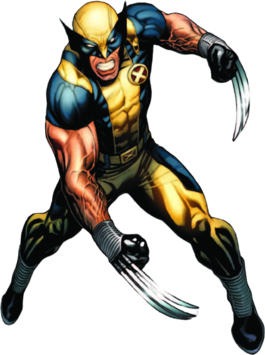
And his animated forms have always had a beautifully raspy voice to carry those raw, unfiltered emotions. Sure, the cartoons have to be censored because the real Wolverine reeks of other people’s blood, but I’ll take the sacrifice for peak storytelling.
We don’t necessarily need a remake of The Suffering, but a game that does something similar or perfects what it did could be bless us in the future.
If I have time to do so, before the New Year, I’ll do something I’ve never done before and breakdown a 3×3 of my favorite anime characters. I’m still on leave as of writing so I’ll have time to push that out and even a New Year’s Day review of this blog. Anime was king for me this year.
 Opinions on Entertainment