That Time I Sped-ran the Terminator Movies

And developed a skepticism of A.I.

Regular viewers will know that in the animanga space, I’m fairly okay with keeping up with series, especially when they merchandise and franchise out like Naruto or Dragon Ball. In the west, however, this gets trickier and more challenging for a number of reasons. Reboots/remakes/retcons, etc., screw with canon so much that it starts to look like a hentai doujin with some of the most accursed tags. Franchising itself, I highlighted just now, but it’s not always done neatly or with a solid plan. For example, Star Wars is the champion and great-grandfather of all references. People are insane enough to catalog every single reference to George Lucas’ brainchild, but what makes this an insane task specifically for this franchise is George Lucas getting in the way of his own vision by constantly remaking everything. Creatives tend to be this way, as I would know, but I’d probably not be this uptight about my own projects.

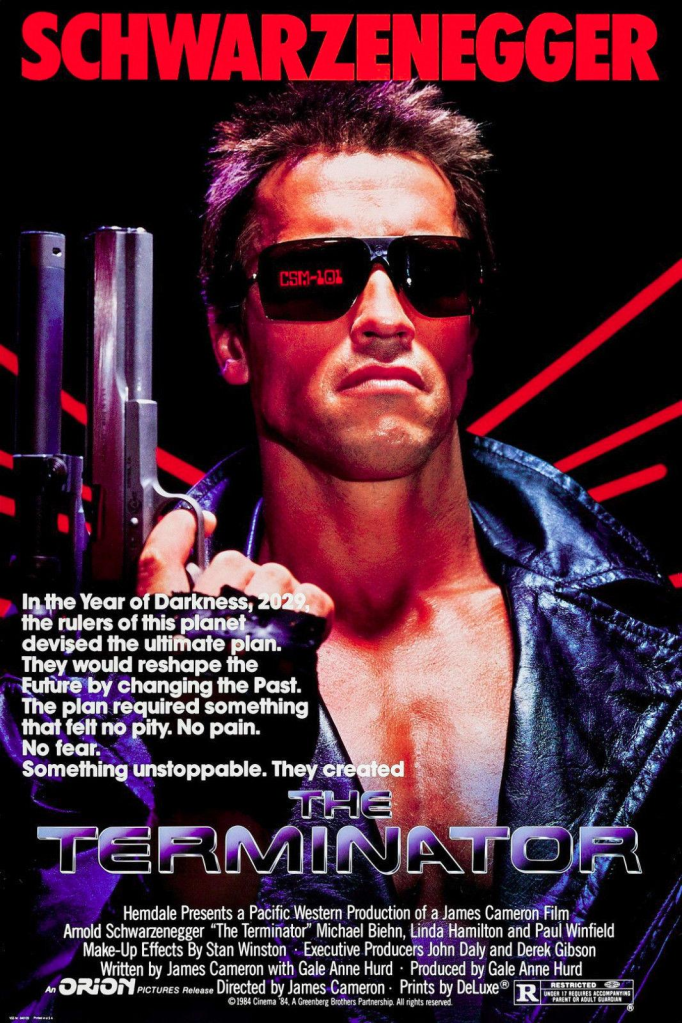
There are a few series whose franchises I’ve followed with full or near-consistency to say that I approach expert level knowledge. Those three are Deadpool, the reboot Planet of the Apes trilogy, and the topic of this post, Terminator. But while Merc with a Mouth and Upright Apes were more gradual, I started to follow the Terminator franchise more closely around 2014.
I don’t recall specifically what brought this on, but I think it might have been a rumor of sorts of an upcoming movie at the time, the fifth one in the franchise and on reflection one of the least warmly received sequels probably since 2009’s Salvation, Terminator: Genisys.
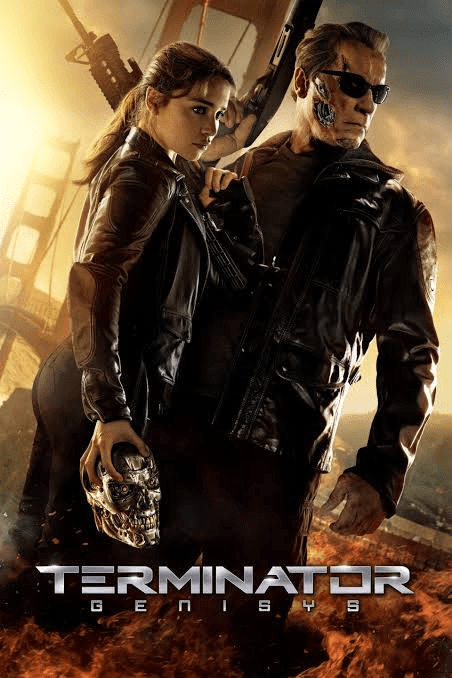
If I was a cynical asshole, I’d probably write up a snarky review about how the franchise only exists because Arnold made it so in the 1980s, his absence in Salvation proves that he was the adhesive holding it all together, and his return in this one is both a proof of concept while also reminding us that glue eventually ages too. Both harsh and what it would look like if not written by a fan but a critic looking to get paid for every character in their document. But I’m vaulting over the USS Theodore Roosevelt on this one.

The sudden confirmation of another movie made me want to play catch-ups, hold the mustard, on the franchise and I did so in an era prior to my current methods of pirating. Pre-adpocalypse, YouTube let you get away with nearly anything visual media-wise though some artists’ estates and family were hook-deep into the copyright claim booth (or I’d remember being able to listen to Jimi Hendrix’s Little Wing at the time), but my first way to look into the franchise was on YouTube, right next to a now deleted channel that had the full length version of Saving Private Ryan. It’s still possible even now to find channels daring to upload full- or seemingly full-length versions of the original 1984 movie, but be careful. Sometimes editing tricks are used to get past the censorship and burn away minutes of your life.

Terminator 2: Judgment Day couldn’t be found on YouTube so I went to a now-defunct torrenting site to watch it. The fate of that site is one shared by several, taken down in a global effort to crack down on piracy. Did it lead to arrests? I didn’t care honestly. Watching movies without spending the pennies to do so was still a challenge for me personally, but I kept trying. I did it with 300 and would nonetheless keep doing it until I discovered services like Tubi and was able to pay for Netflix.

Then of course there was Terminator 3: Rise of the Machines which came out when I was about 4 years old. So technically, this was my introduction to the series, considering I watched it at a babysitter’s house at the time. Rewatching it at 16 and comparing it to the last two films, it was a decent addition to the series as a whole, but not as good as 1 or Judgment Day.

All things considered, I think the third film is looked on two harshly. Dark Fate tried to rewrite it starting here and personally I don’t think Rise of the Machines deserved that. Salvation, however…

I’m exaggerating, but if I had to use a metaphor, if Terminators 1 and 2 were the exciting points, 3 is the midpoint before Salvation starts going down hill, and gradually. I admit that I’m a bit biased here largely because I was watching them all in rapid succession in the lead up to Genisys. Hell, I’d caught up to all the movies long before it was ready for a theatrical release and by the time it released, I once again relied on the dark powers of piracy.

I saw it the following year when I was 17. I don’t remember the trailers spoiling it for me as much, but putting the major plot points, twist included, is almost never a good sign. But I pushed on through and to recap all the movies (spoilers, but it shouldn’t matter anymore):

  1. Terminator 1: cyborg is sent back to kill the mother of the resistance. The resistance has the same idea and sends an agent back to save the mother (and also father the leader of the resistance)
  2. Terminator 2: cyborg is captured and reprogrammed by the resistance to save the leader as a child when the same thing is tried again with an even deadlier model. Mom is also there, in an asylum, “why are you booing me, I’m right” style.
  3. Terminator 3: leader of the resistance afflicted with trauma at the killer cyborgs trying to kill him all his life, another one is his guardian and they try to destroy SkyNet at the source. Love story subplot, chased by Terminatrix, Terminatrix fails, but SkyNet lives on in backup hard drives (I can’t remember it that well)
  4. Terminator 4: full-blown war, leader of resistance sees to combat meanwhile death row inmate is lethal injectioned and transformed unknowingly into a cyborg to get close to the leader but deviates from its mission purpose, leader almost dies but the deviant cyborg/ex-death row inmate saves him at the eleventh hour, SkyNet is disturbingly patient
  5. Terminator 5: resistance ongoing, SkyNet’s next trick is to kill the leader and make a cyborg of him, meanwhile father of the resistance goes back to 1984 as usual (fanservice detected) to find that the timeline’s been f[dial-up modem]ked very thoroughly, they go back to the present (2017) to fight with better weaponry (I think), the Golden Gate Bridge falls for the millionth time in history (it happens a lot in action movies for some reason), cyborg leader of the resistance is defeated, SkyNet still operates…

…and thus was born an effort to rewrite the damn movies. Or at least that’s what the media thought at the time. Dark Fate was the franchise’s last ditch effort at recapturing the magic and to do the third movie justice since it doesn’t fit as neatly into canon as one would’ve hoped pre-release, but the efforts were in vain.

As a fan of the series, Genisys was the let-down that keeps on letting down. It started out well but the grave got so deep, Satan needed to come up and tell the funeral directors that that’s not how grave digging works. I don’t wanna be harsh on the Terminator franchise, the concept does still play on a lot of fears and anxieties, many of which are becoming true 40 years later, but to see where it is now is disappointing. The only thing I have to show for it now is an uncanny apprehension for anything A.I. It took me longer than normal to even try using chatbots and I treat them like Wikipedia or r/AskReddit most of the time. I guess I’m just still testing it. For what it’s worth, if you’re going to go into the franchise yourself, watch the first 3 movies and then maybe go watch the Sarah Connor Chronicles TV series.

And then finish it off with the R-rated uncut version of Robocop 1 and 2 for more sci-fi action gore.
FLCL: New Seasons?

A beloved, obscure anime with a bizarre lack of fanfare

The subtitle might seem a bit misleading, and it is in some manner. Thing is, I found out about this last week, but it seems that Adult Swim released a teaser in March of 2022 advertising two new seasons subtitled Grunge and Shoegaze.

Yeah, I used the same video as I teased in last week’s post. And that’s the point, this was all the evidence I could find of the new seasons. Normally, my posts are long-form, even if I do on-the-fly research (which tends to be most of the time, honestly speaking), but with so little news about the new seasons of FLCL, I couldn’t help but wonder if it did fly under the radar, which is a shame honestly. It premiered on Toonami in 2001 a short time after the original six episodes were made in Japan, and came back in 2018, during the April Fool’s joke as a promotional piece for FLCL: Alternative and Progressive later that year. The most I could find on it were a few articles and some extra videos providing analysis on the ten-second teaser.

That said, FLCL original, Alternative, and Progressive still give me something to work with. So the most I can do is write about what the other three seasons entailed, fan reception, and perhaps I’ll try my best to speculate on what Shoegaze and Grunge are meant to be, though considering the nature of the property, those names may not mean anything.

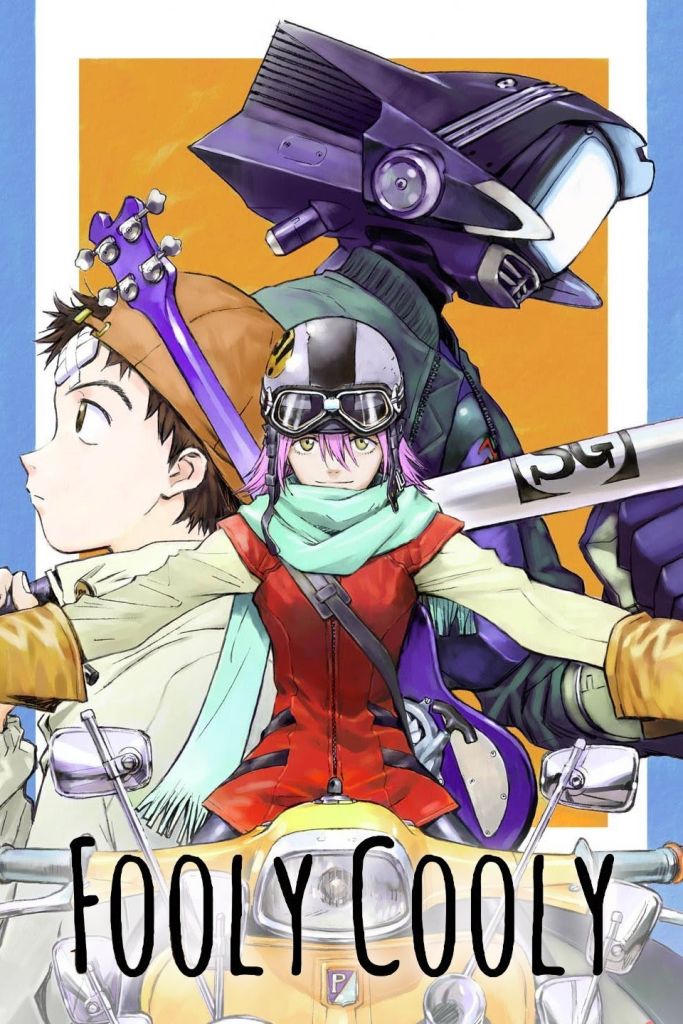
Starting with the original, FLCL (read as Fooly Cooly) was launched in Spring 2000 and is remarkably short at six episodes. On the surface, it looks like wacky nonsense that not even JoJo’s Bizarre Adventure would touch with a Stand holding a 5-meter barge pole, but fans of the series recommend watching the entire thing multiple times with a notepad nearby for some homework.

Depending on what you’re focusing on — which is its own feat because there’s a lot that goes on in just this show — you may be looking at the main character, Naota Nandaba, learn what it means to be mature while trying to speedrun childhood or you may be looking at the highlighted character, Haruko Haruhara, prepare to face off against organizations known as Medical Mechanica and the Fraternity so she can steal ultimate power from the pirate king Atomsk.

Just kidding!

Now maybe it’s me, but I’ve heard people focus on one or the other without considering that they run concurrent. Most often, I hear people focus on one or the other, likely because Naota has nothing to do with Atomsk or Medical Mechanica… except that the connecting piece between them is Haruko herself, who introduces herself to the scene by speeding on a Vespa and braining the boy with a bass guitar. The impact gives him a ginormous bump that morphs into a horn that acts as a portal for which a robot emerges from his forehead. Even if Naota isn’t directly involved with these intergalactic shenanigans, it doesn’t stop Haruko from pulling him along while some of the other people in his life come along for the ride. Hell, looking at the rest of the townsfolk, Naota might as well be out of place, which is part of the point of FLCL’s meaning as the plot goes along. I’m not saying it’s bad to focus on one aspect over the other, there’s no wrong way to interpret something, even if the conclusions you come across are different from the general consensus, but thinking one is more important than the other is a bit misleading, even if the two don’t connect directly. As an example, William Shakespeare’s play King Lear was said to be performed on Boxing Day in 1606 and a few months later the Kingdom of England successfully set up the Virginia colony after failing the first two times twenty years earlier, yet there’s no connection between them aside from the country because Shakespeare’s contributions to geopolitics and colonialism are nonexistent.

On the whole though, most fans of FLCL original have lots of love for it. The points of divergence are sharp and clear between that of Progressive and Alternative. Progressive is about a girl named Hidomi Hibajiri whose personality is a match with that if Naota, except she’s most defined by her cat-ear headphones and unlike Naota, she chooses to ignore everything. The boy at least interacted with people; this girl would honestly be mistaken as a “relatable character” by some. Off topic, but I hate how relatable has come to equal jaded and gloomy. Is it hard to relate to a smily, joyful character? I haven’t seen it in full, but the clips of Tomo-chan is a Girl that feature Carol Olston specifically are some of my favorite, and we are nothing alike.

Anyway, like Naota, Hidomi was hit by a weird woman in a weird vehicle who goes on to live with her and her mother, Hinae, as the maid and of course Medical Mechanica returns to bear its fangs. But where’s Haruko in this? Well, she’s the teacher and this time she goes by the name Haruha Raharu. Now based on that description, this sounds like a skeleton wearing the skin of FLCL, and to some, it is. It’s not the same FLCL with a hidden meaning about growing up and boyhood; the original meaning is lost without Naota anywhere to be seen. Then again, I say that this is a fallacy from a fallacy, which draws the conclusion that Naota’s story is the only thing worth focusing on while all that other tomfoolery is going on in the background. This is true, but I’m hard-pressed to say that it should be isolated as much as it is. I’m more of the belief that it’s a coming-of-age story with a challenge for the boy to overcome as opposed to two separate things that barely interact with each other.

The widespread attachment to Naota at the cost of the rest of the plot might be an attribution to the general weirdness of anime being taken as normal and so the plot with Haruko and Atomsk and Medical Mechanica and what not isn’t seen as important as a jaded young boy growing up with unreliable relationships, and I understand that argument, but I also don’t like that. Not that I think it’s a bad faith argument to emphasize the boy’s importance, but to me, it’s more that Naota Nandaba’s story, while as important to the meaning of the show, isn’t what I would call the be-all, end-all.

I also don’t think the Haruko-Atomsk plot is meant to be the main focus of the show either. A video by akidearest on YouTube explains that the director, Kazuya Tsurumaki, wanted to break the rules as much as possible when making the show.

For Alternative, it’s got a wider cast and a more sociable protagonist, Kana Koumoto, and her friends, Mossan, Pets, and Hijiri, all of whom are in the latter half of high school and all of whom are also said to lead unremarkable lives until the giant monster jellyfish shows up and incinerates everything… oh, my mistake, that’s SpongeBob. Same as before: Haruko, bass guitar, Atomsk, the whole shebang.

If you’ve been following along, you’ll notice that as we progress, the protagonists get older and older. Naota is 12 years old, Hidomi is 14, and Kana et al are around 17-18. So for the most part, everyone is growing up and whatever we can expect from Grunge and Shoegaze, slated for release later this year might follow this path or do something completely different.

Across all three of them, FLCL at least maintains the relationships theme, whether it highlights how unreliable they can be as we age, learning to soften up to people, or how hard it can be to maintain them over time. Akidearest’s video linked above shows that FLCL’s plot is a complicated mess of many things and my research on the show and this blog reflect how hard it is to understand. It’s not just a distraction, it’s a fractal distraction, or at least that’s the frame that it’s wearing.

Part of the intention of this specific blog was to look at why a lot of fans of OG FLCL don’t give Progressive and Alternative as much of a chance with a lot of them seeing clones that wear the name as a mask while also questioning the necessity of a double-sequel after seventeen or so years in naptime, but for me, this highlights a number of false conclusions about FLCL and the coming-of-age genre. I didn’t get it at the time, but when I read Catcher in the Rye in high school, I just wrote Holden Caulfield off as a spoiled brat. While I still think that, I’ve come to realize that sometimes he has a point and it’s not all about misunderstanding the world from the mind of an adolescent.

All things considered, Progressive and Alternative follow the coming-of-age model quite nicely, even in the piecemeal fashion as presented. Do I think any one of them are better than the other? That’s a loaded question for me as I think there’s an audience for each type of animation style within the confines of any given animation and specifically FLCL, but as far as plot goes, I can’t really find one I prefer to the other. I feel about all of FLCL the same way I feel about JoJo’s Bizarre Adventure. Everyone has criticisms for and against some aspect of it, and I’m not above that, but the connecting element for JJBA is the family legacy of the Joestar clan’s fight against Dio and his cronies or just fate itself. I don’t have a part I dislike, but I do have some that I lean more towards than most.

Similarly, there’s a lot to examine about all three seasons of FLCL so far. In isolation or association, they all do their job well enough while following different stages in life. But that doesn’t answer if I think one of them is superior. To that I say–

Cop out answer incoming: declaring preference for one over the other is complicated for me. I tend to do it selectively, and with full expectations that what I like now will be different in the next few years. So not superior to anything else, but circling back to my point about relatable characters being gloomy and dejected, I like FLCL: Alternative because of the extra cast of characters to work with than just what I see in the others as a textbook case of how not to communicate. The others are still good in their own right, though.