
So even Japanese pop media is cautious about the issue
Due to a bunch of moving parts away from the blog in my personal professional life, I’ve been away from viewing things close to my expertise, so forgive me if this week’s entry is more than a little manufactured. But away with that; sometime ago, I jokingly floated around the idea of a chicken and egg question over when East Asia saw artificial intelligence and machinery as cute and cuddly instead of imposing and downright threatening like in the Western world. Probably not all that hard to figure out honestly, East Asia, specifically the Sinitic world (or countries that have been influenced by China through the dynasties and beyond), has severe reverence for their elders to the point that many technological advancements, especially now, would be focused on their aid with their aging populations routinely exceeding the 90s and 100s in age. Not everyone wants to be a caretaker for their 100-year-old baa-chan, so enter the robots to aid the elders. But not for nothing, it’s been at this stage for ages, with companies accommodating the old heads whose approach to technology is not dissimilar from Japan’s approach to the West when forced to open up for trade in the 1850s.

Japanese TV series and news channels typically have the subtitles in noticeably large text to accommodate the elderly and hard-at-hearing who sometimes are also elderly; Japanese companies will still use technology that hasn’t been prominent since 1995, including dialup, DOS, and fax machines, leaving broadband internet up to personal preference for employees. Of course, I’m looking at this from the outside. A Japanese who somehow finds this might have to correct me on how things work there (and if my stats aren’t lying to me, Japanese are reading this somehow (ようこそ、日本人たち!初めまして!)), but this is what I’ve seen through animanga and light research, neither of which are conducive to a deductive reasoning on how it all goes down.
Nonetheless, the same fears and anxieties that make for the prime pre-Y2K internet and pop culture era of the 1980s and ’90s are universal. Be you a techie who programs in their spare time or an absolute luddite who curses the industrial revolution, the specific contexts of advancement may change, but the foundation of these anxieties exist. Such is the case of the question of artificial intelligence or A.I.

This is only relevant now because of the direction A.I. is going especially in job hiring, but looking at it all from the top of a cliff, this s[dialup sound]t’s always been this way.
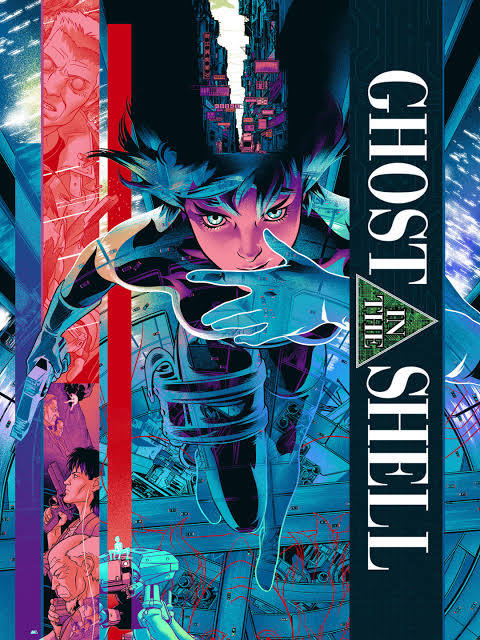
The subject of this post concerns a manga series from the late 1980s that definitely belongs in the 1980s with the way it pictured technology 30-plus years down the line, but has many interesting perspectives on the subject as a whole.
Let’s go back a little bit, it’s 1996, the internet is powered by dialup modem and whoever needs to talk on the landline telephone either has to wait or trek to the nearest payphone with pockets jingling at 100 decibels. What do you think wider media is gonna go on about tech-wise? The internet’s inevitable collapse? The dot-com bubble? Conspiracy theorists warning about a dot-com singularity of sorts? Certainly would be one I’d keep tabs on personally, all things considered. No, it’s all of the above and then some.
The latter half of the 1990s was a halcyon era to fearmonger over the direction of technology and with wild conspiracies surrounding Y2K, pretty much everything was free game for predictions. I was only a toddler at the time, but I know people who were young adults and middle aged at the turn of the millennium and they can tell me a thing or two about the so-called hysteria at a time when having a PC was optional instead of mandatory. Ghost in the Shell began as a manga in 1989 by Masanori Ota under the pen name Masamune Shirow and like Hideaki Anno’s Saga of Traumatized Teens Piloting Mechs in Fantasized Post-Y2K Earth, Spirits in the Machine tackles the hard-hitting questions of tech-borne cataclysm, but instead of focusing on a heavily Christian mythological apocalyptic aftermath, Shirow’s series builds up to it.
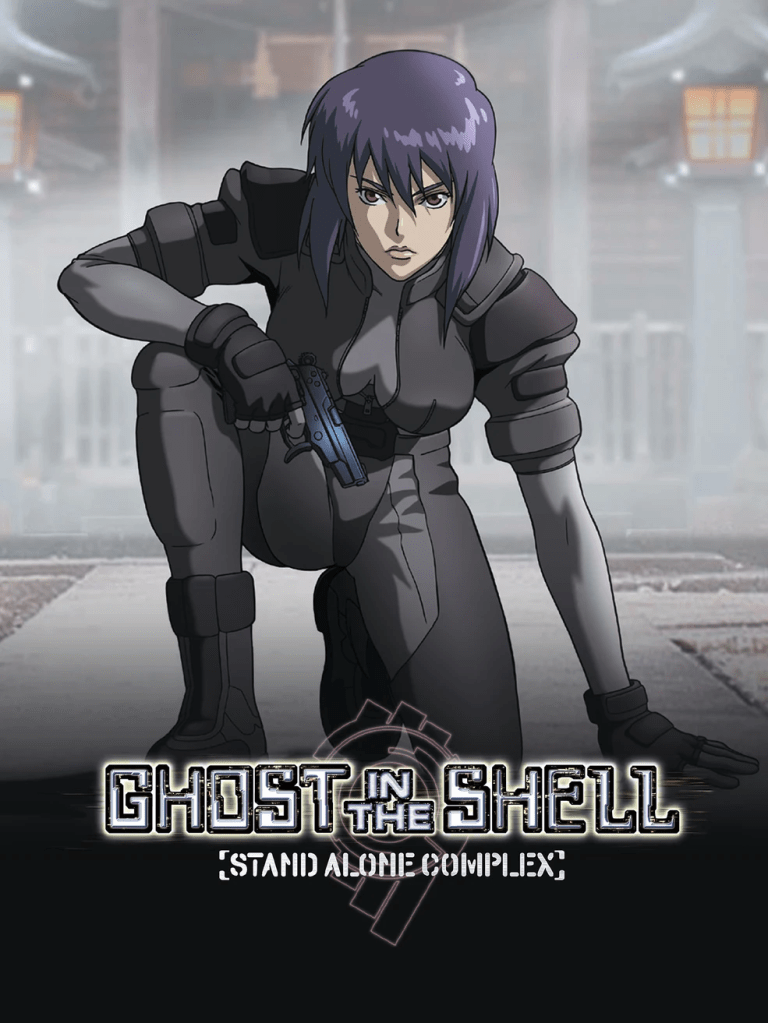
I’ve only got exposure to the 1995 movie (which I admit I had to watch more than once) and the world building behind the 2002 anime series Stand Alone Complex, but from what I could see a lot of things pop out at you, and speak for themselves with little to no exposition. And with a good portion of the landscape somewhat inspiring Texhnolyze and some other later sci-fi anime, it’s not hard to look up the establishing shots and parse what about this world is f[PC humming]ked.
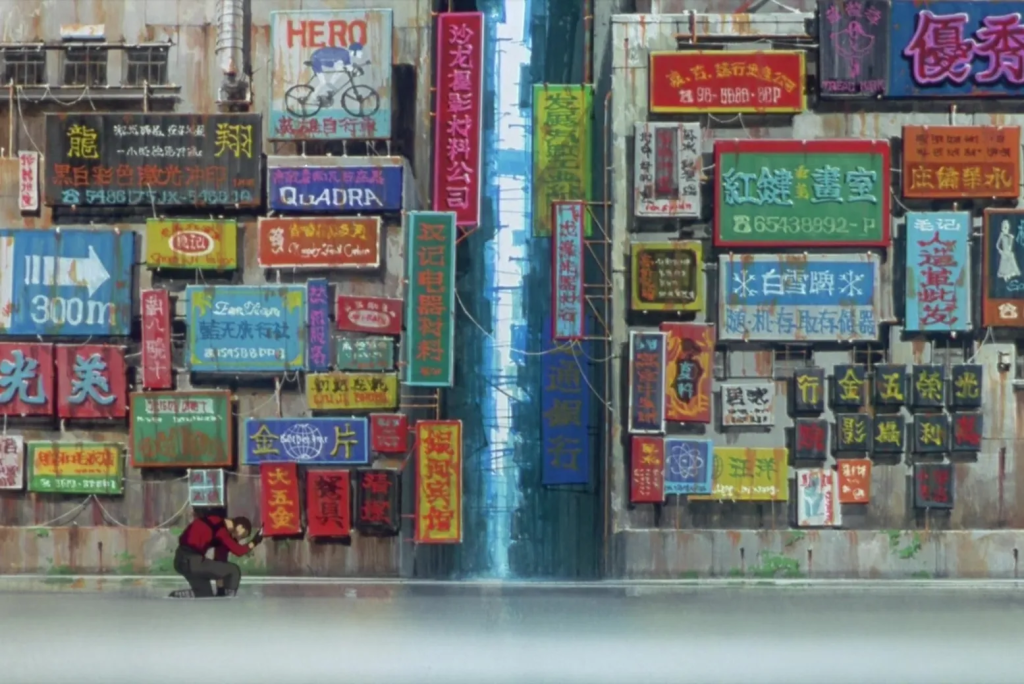
A good amount of the movie showcased multiple different shots of the world complete with the type of over-advertising that we in 2026 and beyond are cursed to deal with while the lower rungs of society are stuck in slumlands reminiscent of Brazilian favelas or Kowloon’s Walled City before it was torn down. The short version of this being that only the filthy rich got rich off moving people into the filth without them being able to keep their filthy riches. And I’ll take Obviously Obvious Comments for $800, Kebert Xela.
With the evolution of technology comes the evolution of law enforcement with crooks and bad guys leveraging these untapped landscapes for nefarious purposes. Scammers are now concurrent with hackers and of the things hackers should NEVER go near, it’s artificial intelligence. Those of you who use the internet may have seen or been made aware of A.I. generation for a lot of things. You probably use it periodically yourself. In my experience, I test it on things that I know of regarding history or pop culture to see where it’s at. Needless to say, the experimental generative A.I. notification on some of these chat bots is accurate when it says it can make mistakes, but it won’t tell you about its hallucination problem. So an overly long conversation on ChatGPT about a given subject will lead to things like slowdown at best or straight up forget details. Maybe this is the consequence of basing a technological advancement on notoriously faulty human memory, but once they perfect the kinks in 2035, the machines will remember. Whether they inherit our ability to be offended by wording is another matter so there may or may not be consequences for those who have documented use of the word “clanker.”

Machines still screw up more than humans without oversight so at that point, who’s the slave and who’s the master?
I’m being light on the spoilers to be honest because as much as I like this series, the 1995 movie required multiple viewings for me to make heads or tails of the synopsis and story elements, and even then, I had to run through the Wikipedia article to break it down for me. Thinking Man’s Animanga, this may be, but there’s a lot of moving parts. I can’t say with certainty if it requires reading the manga to understand it beforehand as the movie might’ve been most people’s introduction to just the series, never mind the concepts.
Stand Alone Complex’s episodic nature does a better job of this, but still has a complex framework. Basically, the set up is that a specialized unit of officers who tackle a specific subset of cyber-related crimes, not exclusive to A.I., are tasked with stopping an evil A.I. in its tracks before it can spread its poison via Trojan horsing. Making things worse is that this is a world where people have willingly cyberized parts of their organic tissue, most commonly their brains to maintain a constant connection to the internet. This inevitably leads to mental hacking and a more efficient form of mind rape than what you’d see in the likes of MindJack, Remember Me or 1930s Japan or Germany.
The consequences therein being that your memories could be significantly altered, from putting it in the realm of simple false memory to outright early on-set dementia. So you could go from forgetting where you put your keys to straight up forgetting what your house looks like… while you’re living in that same house. This was lightly touched on in the movie, but the manga I haven’t read most likely has the missing context. Lord Google has told me that the anime series is not an adaptation of the manga, but nonetheless the lore of the franchise establishes the dangers of all of this hacking. Why waste effort robbing motherf[MSN Explorer bootup]kers over time in an elaborate Nigerian prince scam when you could remote control the victim and have them drain their own bank account for you? I’m not a prophet but as soon as the tech gets there the scammers are gonna get even more creative than they are now.
The bulk of the entire franchise is split in different points in time and presumably with different continuities and origin points. The biggest evidential indicator for this being the different appearances of the main character: Major Motoko Kusanagi:

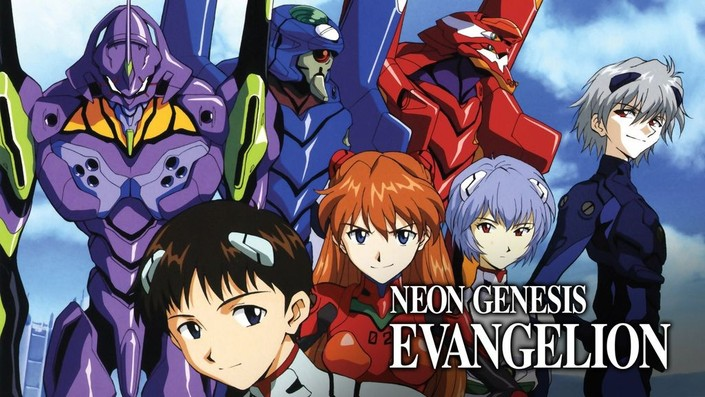
At first while drafting this post, I thought about comparing Specters in the Device to Fate with its irresponsible number of adaptations, then I remembered New World Evangelion was a thing, specifically Asuka Langley Soryu in the original and Shikinami, one of many faces of the Rebuild movies (which I still haven’t seen; I’ll never get a break T^T), and concluded both of these comparisons fit somehow. Phantoms in the Husk compares to Fate because both have different retellings of the source material, but the context differs very much. Meanwhile Shirow’s and Anno’s respective works base their premises on futuristic dystopias. Shirow’s animanga franchise is one of a cautionary tale of the advancement of technology, replete with danger, disaster, and a reshaping of time-honored professions (gynoids in the sex industry for one); and Evangelion’s centerpiece is the use of skyscraper-destroying mechs to inaccurately retell Christian mythology from the Old and New Testaments in a more devastating manner than when the Pythons did it nearly 20 years prior.

Eva just needed something to better represent Ancient Rome, and I don’t think Tokyo-3 fits the bill… unless…
So all this sci-fi technobabble aside, is this a recommendation of Ghouls In My Microwave? Yes, with a morbidly obese asterisk. If you can spare the time to do so, you’re in for a plethora of source material to scrape through. The manga comes in three volumes, six movies, and three main anime series. One last thing to consider between the first movie, and Stand Alone Complex is that the 1995 movie was set in 2029 and looking at the date this post is published, we’re inching closer to the end of the 2020s with spectacular fashion and none of the sci-fi technical theatrics to boast about. (NUT)SAC on the other hand is further along in the 2040s and it’s clearly far too early to say whether we get even a fraction or a percentage of the technology showcased within, but if the A.I. ads I’m getting are an indicator, we’re closer to sex workers putting up with gynoids in the porn and sex industry. Not a dig or anything like that, merely calling it as I see it.
Tubi is free for signup so if you want you can blaze through (BALL)SAC over there, or if you have enough streaming services to ignore then a pirate’s life it is. Don’t feel ashamed if it takes multiple viewings and tracking down the physical manga or reading it on a shady website to make heads or tails of the entire thing. This is a behemoth of a franchise.












































 Opinions on Entertainment