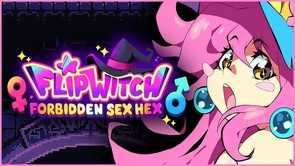
Earlier this year in February, I wrote about an Adults Only game called Scarlet Maiden, about a scantily clad heroine on a quest to defeat the Prime Evil one lewdening at a time. Once again, under the Critical Bliss publishing flag, I’ve found another AO-rated 16-bit game about slashing mooks and exposing boobs but with an emphasis on magic. The game in question: FlipWitch – Forbidden Sex Hex:
Should’ve known there’d be a bunch of fanart when looking for the title screen for this game, short of booting it up for the screenshot…
As the Flip Witch under the tutelage of a great witch named Beatrix, you’re main objective is to defeat the Chaos Witch, an Egypt-themed triclops witch messing with you and all the creatures of the land from her very own castle behind a door with six unique pyramid-shaped locks. To get them all, you have to traverse different realms and defeat the bosses to get the keys. Depending on your level, you’ll either eat dirt and be shown a game over screen where the monsters of a specific realm have their way with you, or you’ll blaze through relatively unscathed. This time, I’m torn over whether to conclude that this game uses permadeath as a feature since it doesn’t have a lives’ system, but on the other hand, there’s designated save points where you gain everything you used during your playthrough, crystal teleporters to fast travel between places you’ve been and a health restoration-like system in the form of a peach that gets upgraded with each quest you complete.
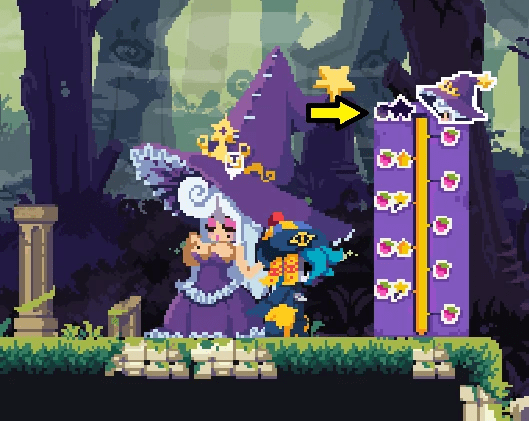
Speaking of quests, Beatrix’s secondary focus is to partake in such quests for health and magic upgrades. Some of these are found interspersed across the game enlarging your health and magic bars so that you can use more, to include the more taxing magic items, and others are gained by completing a certain number of quests. Reaching said number adds a little notification in the form of Beatrix’s sprite in the upper righthand corner to let you know that upgrades are available.
More quests mean more upgrades until you max everything out and steamroll the monsters like a one-man army. Or more like one man and one woman, both of which are you. The “flip” in FlipWitch refers to your ability to switch genders at will, an acquired skill that factors both into the quests and the game over screens, so male or female, something is gonna rise and ain’t gonna be a shield hero.
Didn’t even have to censor this one.
Combat this time around doesn’t give you the option to sex up a monster for upgrade points like Sin in Scarlet Maiden or even to add to the bestiary. For the most part, the monsters are more or less segregated to their own designated parts of the game map. For instance, only goblins roam the woodlands, demons stay in the demon realm of Jigoku, mermaids are in Umi Umi, etc., etc. and they all have their own unique game over screens for when you die and for what gender you were when you died.
The weapon variety is also limited to just your wand as opposed to any number of swords and other fantasy weapons like in Scarlet Maiden. Not to mention, the only enemy-types that do show genitalia are the female enemy types. The males do show d[spurt!]k, but often after the game over screen. So unlike Scarlet Maiden, the BDSM term “switch” has a different context. A more literal context. Where the game lacks weapon variety, it makes up for it in magic variety, by giving you more magical powers to use against enemies. The wand is capable of firing projectiles and select characters of different types that don’t give you quests give you different magic powers to use which require short tutorials to get the hang of.
As for the quests, the standard format they use is go to place, get quest, deliver thing to X, get sexy rewards. Like so:
The one twist these types of quests use is that specific costumes need to be bought with the coins you acquire through gameplay. Different costumes unlock different quests for different variations of a similar reward (sexy times), which ties into the whole Metroidvania aspect the game advertises. Nonlinear gameplay allowing for backtracking to important locations with new knowledge and more rewards and potential upgrades to finally defeat the Chao Witch…!
…which I’m very close to doing as of this writing. I’m so close!!
Recommendations? Give it a go. There’s keyboard controls like in Scarlet Maiden, but unless you’ve got the fingers for it, plug in a controller. Do what I did and program a PS3 controller to read like an Xbox controller; it’ll work the same. The fact that I’m very close to 100% completion and very close to defeating the Chaos Witch should all the recommendation needed for this game. The controls will feel slightly more sluggish at the beginning, but once you get used to it, especially after Scarlet Maiden’s fluidity and — for lack of a better term — bounciness, it’s pretty much a breeze. Currently on sale for the Summer Steam sales, but even not, $15 is a pretty good deal.
I’ve made it a point several times that I don’t default to isekai, but I don’t remember clarifying what that means. I make a beeline for shows I find interesting, that some of them are isekai is pure coincidence. I’m not an isekai junkie like Gigguk or an isekai avoider like The Anime Man. I’m in the middle of it, all things considered. Of course, I’ve made it clear that I don’t always find contemporary anime to watch, but the subject of this week’s blog was all the rage when it was airing.
Alternatively titled Okaasan Online, Do You Love Your Mom and Her Two-Hit Multi-Target attacks began life as yet another light novel but from the late 2010s rather than the early 2010s, complete with a manga adaptation as a companion piece running concurrently with the light novel. Shame it was subject to a simple 13-episode series, though this might be par for the course for series that only run for the same length of time as a single US presidential term. The unofficial name for this series is called MILF-sekai and the reasons below explain it better than the cover for the light novel:
The MMORPG parody is strong with this one.
The gist of the story is an ungrateful, angsty teenage boy named Masato Osuki tries to push his clingy mother, Mamako, away. Both of them are suckered into an isekai video game and go on an adventure together, interacting with other characters who have fallen for the same trap. The best joke this series tells is that it plays coy with the incestuous, MILF-y tropes that accompany the genres without exploring them on purpose. The most the anime will do is strip Mamako naked and have her son comedically fall on top of her in the second episode. Damn, I’ve read NTR doujins and felt less cucked there than in this series. That’s pretty much the height of the MILF antics, but the OVA has more to show in that regard.
As far as actual plot goes, Masato’s relatability comes in the form of wishing he were someone else with a doting mother whom he wishes was a different person, at the outset. Then he meets the future members of his party and their mothers and annoying as it may be to have a mom, let alone parents, who embarass you at every turn, it’s better than one with godly expectations or one who can’t help but let their vices enslave them. In the former example, one party member, Medhi, has a mother who’ll chastise her in private for not being perfect like a Cell after losing a competition, leading to feelings of doubt and self-loathing in the poor girl. For the latter example, party member Wise and her own mother, had a frought relationship in real life and used the game as a means to better bond, but when Wise’s mother learned that she could make a harem of men at her beck and call, she made a beeline for that and never went back. At least it beats what this girl was going through:
I’m almost tempted to catalogue some of the worst mother’s in media, but I don’t wanna abandon my faith in humanity just yet.
The show’s ecchi-leaning comedy make it the butt of a few jokes, but it’s not like it doesn’t know what its talking about. It’s different from a thinking man’s anime, but has a lot of the same story beats as one. Between the JRPG satire and the ecchi satire, it tries its best to split them evenly, though lacks in some other areas. I want to blame this on the anime for cramming so much into so little time, but on the whole that does nothing to specify which anime I’m talking about, for this series specifically, that’s an inaccurate and misleading conclusion to draw seeing as the light novel and manga were still running when the anime was airing in 2019, putting it in the category of yet another anime promoting the source material. And as a manga reader, I’d rather explore manga naturally than be given homework. At least not every series does that to me:
I’ll put this one in the timeline somewhere.
So how does Okaasan Online work as a series? Fine… it knocks out the important points like Kazuma at the batting cages, and generally speeds through them in about one or two episodes. But it also doesn’t really explore anything in much detail beyond “here’s a trope, give me my laughs.” Funny enough, the anime doesn’t do this as perfectly as presented. Two characters’ origins with their own mothers are explored, but one such character, Porta, is a one-off. No such relationship status between her and her own mother are revealed in the source material or the anime; she’s simply the little mage that behaves the most like a little sister to Masato and young daughter to Mamako.
Now that I’ve written that, Porta behaves the most like a little puppy or a kitten. The party leader status is shared between mother and son and awkward as it seems to point this out, they’re like the parents to the other three girls even though Masato and Mamako are mother and son. F[Nyan]k, even I couldn’t avoid the incest trope. Again, not explicit or even acted upon in any media, but it’s there.
So, Tiberius, do you recommend it? Eh, I’m indifferent. I watched it all the way through and 20-year-old me felt naughty things thanks in no small part to the visuals. Fast-forward five-and-a-half years later and looking back, it may have served as a gateway to lewder and racier things without meaning to. Basically, what I’m saying is, before, during, and after its run, the series has been outdone. I won’t persuade you to watch it or dissuade you from doing so, just know that while you could sit down and spare some time to give this one a watch, it co-exists with better shows, so don’t expect me to show up at your door at 3AM like this:
Add it to your isekai library if you feel like it.
The Sega division, Ryu ga Gotoku Studio 「龍が如く」, exclusively works on the Yakuza/Like a Dragon series and has done so for the last 20 years.
An urban modern-day RPG-lite with a gangster skin, Yakuza features characters that are a part of a connected web of Tokyo-based Yakuza groups with the main character, Kazuma Kiryu, AKA the Dragon of Dojima, so called for his dragon tattoo and association with the Dojima family Yakuza group. From what I’ve gathered, the early games have a serious tone coupled with areas of humor and, in the long run, satire. The primary inspiration comes from decades of yakuza media with each game being something of a movie with a nuanced plot populated with characters of shifting motives.
Kazuma is a primary protagonist across the first few games, but since the series follows him throughout his life from his youth to middle-age, some of the later games feature a character-switching mechanic before Kazuma himself is retired in favor of the new face of the franchise: Ichiban Kasuga.
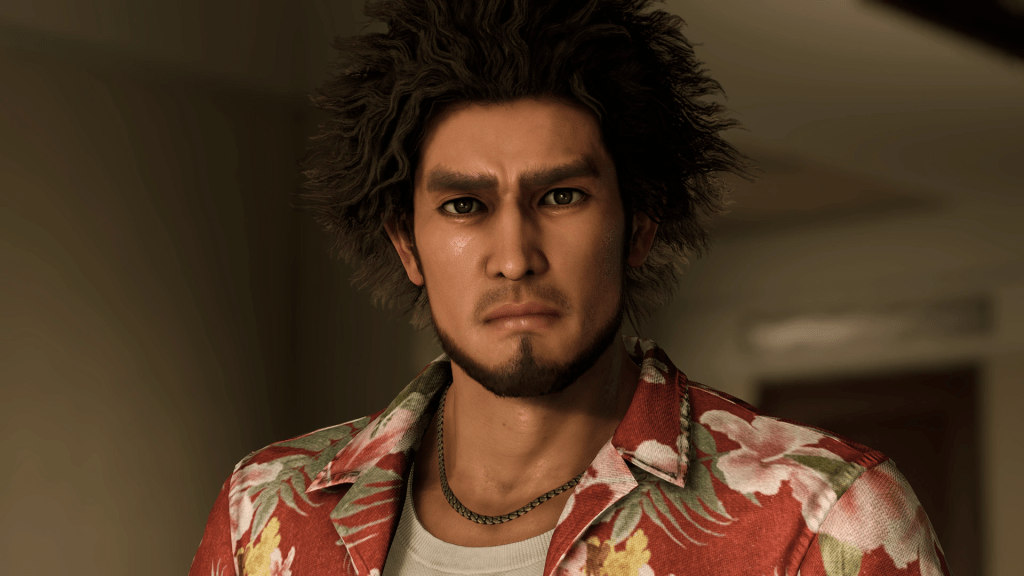
Less complex than Kazuma-san, Ichi-kun is introduced as a sillier character but with a heart of gold, so not at all dissimilar from Kazuma. Full disclosure, I’m still in the process of exploring the series, having emulated the 2005 game on PCSX2 back in 2023. So far, I’ve explored one of its spinoffs, Ishin, a fictional retelling of the life of Sakamoto Ryoma with our beloved Kazuma filling the role of the Bakumatsu-era samurai. Seems Sega really loves to reuse its characters.
I’d explain more about the series from game to game, but the games, though long, are worth the experiences they give you. Even if I was that involved in the games, I’d know better than to spoil them. So instead, the rest of this post will be about the gameplay features between the old games and something fairly recent.
Perhaps its because I started with emulating the first game in the series, I didn’t realize how clunky the controls could get until I bought and loaded up Ishin for the first time. Comparing the two shows how far the series has come since debut gameplay-wise. The first game has a fixed camera when moving that fixes itself closer to Kazuma when in combat. The right analog stick merely moves the minimap in the corner of the screen. The face buttons are all different combat attacks and interactive buttons in exploration and work fine on their own, but the movement in combat coupled with the block/evade functions defaulted to the shoulder buttons makes combat more than a little bit stiff and awkward.
Thankfully, 2005 and the 2006 sequel, Yakuza 2, were given the reboot treatment a decade later, thus revamping, among other things, the combat system. I’d say, the beat ’em up formula was in its prime in this era of video games seeing as Yakuza debuted at the same time the west was gifted God of War and Mortal Kombat: Shaolin Monks. You can’t really go wrong with either the original or the remake, but if you value sturdier controls and a more fluid combat system, I and other Yakuza players implore you to buy the Kiwami games. They’re near-mirrors of the original games with extra bells and whistles to keep it modern along with the textures and graphics while staying true to the original.
Speaking of modern games, the latest installment in the Yakuza series was last year’s Infinite Wealth coupled with yesterday’s spin-off Pirate Yakuza in Hawaii.
Before you speculate, this was a coincidence. Nothing more.
The most recent modern release I played is a spin-off, the aforementioned Ishin. I can’t say whether its framework and UI are similar to the main games, but for what its worth, Ishin, being a retelling of sorts of the life of Sakamoto Ryoma, incorporates multiple combat styles from hand-to-hand to swordplay to even gunplay. In real life, Sakamoto was a samurai who adopted several western styles and customs. Western-style loafers, a revolver he used to try to escape the attempt on his life, and light dabbling with western tech like the telegram with hopes that it would change the face of Japan… and it did! Approximately 20 years after his death, so influence still counts.
In Ishin, the character of Sakamoto Ryoma doesn’t change just because he’s wearing Kazuma-san’s face like some Japanese parody of Face/Off.
Insert Spongebob licking meme.
Kazuma’s Bakumatsu fever dream plays like its modern contemporary games with all the modern settings and defaults found in the games, so it plays much better than the PS2 games, but doesn’t sacrifice the difficulty curve. In fact, since the first game’s release, the Yakuza series has always incorporated RPG mechanics, notably upgrading, collecting, potions, and skills; between this and last week’s RPG adventure with tits and ass, I really can’t get away from RPG and RPG-likes. Maybe I’ll put it in the pipeline in the future for review.
Obviously the modern games look prettier with the facelift and play better with the new tools that have defined gaming since debut–what does this mean for me and my enjoyment of the series? Well, I do plan on exploring them all further in some capacity. The pandemic may have ruined console gaming for me with all the scalpers reselling the newer consoles at f[dial-up]k you prices, but I probably might return to console. I’m already emulating my favorites on a console (RPCS3 has more kinks to iron out), which may speak volumes about what I remember as a great era in gaming.
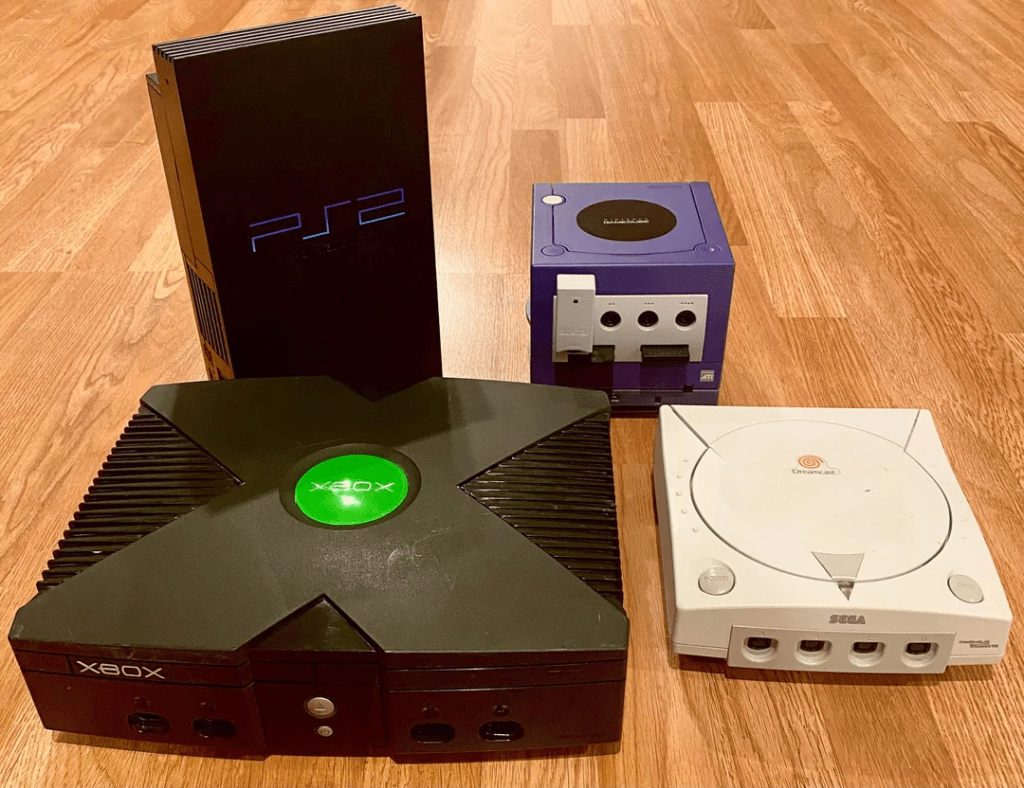
Credit: u/TheUndeadGunslinger, r/gaming
F[button mashing]k modern gaming, these are hard to find in the US these days. As a result, that Xbox is now $800. Well, I’m exaggerating, but these things being collector’s items now, I don’t think I’m that far off from what they’d go for now. Whether you can run them on a modern monitor is another story. At least the Yakuza series is fully available on Steam as of this writing… ‘Scuse me, I have a series to blaze through.
Last week, I talked about different anime series that have crossed my radar. Popular series that everyone but me has seen. Some of them I was avoiding due to the reputation of their fandoms or a disinterest in the content of the show.
I don’t know if the person who posted this is the same person who made the meme format. Exaggerated or not, I never had an interest in idol culture. I find it too poisonous an industry to support or even look into. No industry is perfect (and anime and video games both have their controversies), but East Asian idol culture (Japan and Korea especially) is the only industry I’ve heard of where the idol has been lambasted for having a normal life or worse driven to suicide or been the victim of assault, deadly or sexually. I admit, these are cherry-picked but my point still stands.
Back to gaming, I’ve been around long enough to recall gaming’s most pivotal moments. The release of GTA: San Andreas 20 years ago (if you didn’t feel old already, here you go); Sonic steadily one-upping the Hindenburg as a 3D series; Lara Croft’s second return in a more grounded approach (as grounded as a series about a British archaeologist can get when thrown against the supernatural); and the first of two Mortal Kombat reboots where smashing together the first three arcade games worked surprisingly well.
But there’s still a few gaps in my library that I haven’t filled yet. Gaps I’ll be sharing in this post. Like last time, the list is not exhaustive; and there are more I’d like to talk about, but won’t be able to for brevity’s sake.
A series of reputations, one negative one that it managed to break, thanks in no small part to the Netflix series, but another one that it traded in return through no fault of its own. If Konami was in the hands of better people, the series would either have a better send-off or at least a more recent reboot that honors its legacy while roping in new players… like MK9.
My exposure to the series comes from Castlevania: Lords of Shadow on the PS3 and a pirated version of Aria of Sorrow for the PAL region on a bootleg PSP. That’s it, so far. Based on my observations, there’s an old love for the 2D games compared to 3D. Yahtzee Croshaw and the Angry Video Game Nerd both tackled Castlevania games with both wondering what went wrong with the series. Aria of Sorrow and Symphony of the Night get praise compared to something as ridiculous as Castlevania 64, and at least by that time we had over 15 years to iron out good games from bad.
To give credit to Castlevania’s 3D/HD ventures, it’s not like all of them are bad. Enough can be said about the 2D games, but from what I recall of Lords of Shadow, it’s a solid 6/10 game. To pull from Yahtzee Croshaw’s 2010 review of the game, it combines elements of God of War, Shadow of the Colossus, and Dante’s Inferno from weapons to enemies to character design. Hell, it starts off with the main character Gabriel Belmont, a holy knight in the 11th century, who goes on a journey to rid the world of all evil in search of a way to return his wife to the land of the living. Servant of a god fights monsters with a chained weapon as penance for the death of loved ones — God of War comparison made. Some of the bosses are huge hulking monsters you have to climb on whilst pecking away at glowing weakspots — Shadow of the Colossus. And Satan’s appearance draws comparison to his appearance in the Dante’s Inferno games.
Channel: The Escapist
But the main draw of the series back in the 1980s was Dracula as well as open-ended level designs and exploration encouraging multiple runs of the same levels and therefore birthing the concept of the Metroidvania (more on that later). As such, my desire to look into the Castlevania series will have to go to the older games. Symphony of the Night may get all the praise for being one of the best games of all time, but to this end, I’d rather judge it by itself than where it stands in the series or with its contemporaries.
Another historic series getting f[bombs]ked by its Konami Overlords because pachinko and claw machines make a lot of money, as a certain Welsh monkey can attest.
Playlist by: Kim Kalliope, Videos by: CDawgVA, ConnorDawg
Still, Metal Gear is still releasing games to this day with another entry set for release later this year, tarnished as the series may be, thanks to Konami. A strategic stealth game that lampoons the s[blyat]t out of the Cold War, long after the joke died. Though, considering Metal Gear is still doing that, is the joke really dead or is it just on life support?
The best excuse I have for why I never played Metal Gear would probably be due to lack of interest. Sort of like what kept me away from Yu-Gi-Oh! or Pokémon for so many years. What ties these three together for me is that there wasn’t anything physically keeping me from collecting a few of the games. Metal Gear Solid was on the PS2, which I had; Pokémon Red or Green were on the GameBoy, of which I had several (they were fragile or we kept losing them amongst our other stuff in the house); and Yu-Gi-Oh! is a card game. Cards are inexpensive, and they have been for years. But leave it to me to stand out and not get lost in the shuffle back then. Average oddball behavior.
But of course, Metal Gear is neither Pokémon nor Yu-Gi-Oh! It didn’t begin with collectible cards (but might have them as part of a collector’s edition of sorts) and I didn’t know a lot of people playing the games growing up, though I wouldn’t be surprised if I was friends with a long time Metal Gear fan but didn’t know it at the time. Pokémon and Yu-Gi-Oh! were just more visible at school by the nature of the games. With my experiences in games like Outlast, or Sekiro, or the hackneyed stealth sections in numerous action-games, I want to say that it’s in my corner, but I know different games do stealth differently. Sekiro’s stealth isn’t Outlasts and neither compare to the sometimes stealth of Max Payne 3. Metal Gear is a legacy series ripe for the emulating; PCSX2 still works for me and I’ve been getting remarkably lucky with the likes of RPCS3 on another machine that I own (though I’ve still got a bit to learn about extracting games on it).
RPGs and JRPGs
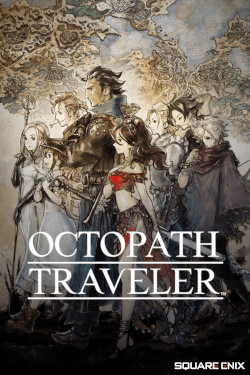
As far as genres go, I have a decent amount of exposure to some RPGs and JRPGs, more so the latter, but largely due to some western games having semi-RPG elements in them. GTA: San Andreas has more of it with the ability to let CJ’s waist expand or shrink; same thing with his muscles which was the approach I took the last time I played it two years ago. It’s more muted in GTA V, but still there even in GTA Online. JRPGs, on the other hand, are another blind spot I hope to fill. How I achieve that will need to be more finely detailed, but for the most part a look through of time-honored series as well as more recent releases can help me out. Octopath Traveler, for instance, is one that’s currently on my radar.
During Army AIT, a few of my classmates played around a bit in a Final Fantasy 14 RPG (and stopped after making a dedicated Minecraft server). I played some of the Naruto turn-based RPGs as a kid as well as a Dragon Ball-themed one. Fun fact, my exposure to Dragon Ball started with the PS2 games. The anime (specifically the Kai dub) came way later. And I feel like I’m selling myself short experience-wise without more JRPGs to call from. I’m starting to rectify this by way of some of the Souls’ games, which are developed by a Japanese studio, but Japan liking medieval Europe for a fantasy setting undercuts the experience aesthetics-wise. Dark Souls is still enjoyable, I’ll never debate that, but I don’t think it’s enough to fill the void. I’d like more to experience, Soulslike or not be damned.
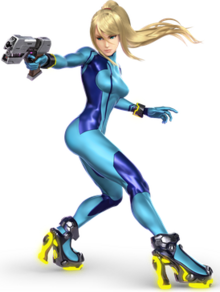
The first-half of the Metroidvania genre, the fact that major elements from both Metroid and Castlevania combined to form a new genre is remarkable. It was a groundbreaking game when it debuted in the mid-1980s, and is still going strong with its star character, the tall, beautiful, kick-ass Samus Aran.
Practically, Ellen Ripley’s disciple, both women are space adventurers blasting away at evil aliens. Couple that concept with a Mega Man-esque arm-blaster, the core of Metroid has been a blend of its contemporaries with a few things to make it stand out. Early example of female video game character (though probably not the grandmother of female protagonists in games), sci-fi setting, nonlinear game structure and retraversable levels, different weapons; it’s a great game series that I have limited exposure to.
All my knowledge comes from Wikipedia and I’d rather not have to go to a third party for my education. My s[splash]tbag college days allowed for this absolutely, but I’m not in college anymore. I may not be guaranteed more time to do it, but whatever excuse there is to keep avoiding it is no longer valid. Emulators for the older games (because no one is crazy enough to track down a still working NES/Famicom in 2025) and I can get a Nintendo Switch or wait for the Switch 2 to release and hook it up to my monitor, if that’s allowed.
Interestingly, I’m hard at work fixing this gap with a series of Adults Only roguelike Metroidvanias made possible through Steam. Especially one I’ve discovered with permadeath elements in it. But before I cross it off the list, I do still have more to say about these types of games. I really love my narrative driven Max Paynes, Mafias, Spec Ops, CoDs, etc., etc., BUT! A huge but.
Sometimes, I just want to push buttons and make the enemy collapse into a puff of smoke. You don’t need to convince me to boot up a game of Kirby; that itself is the oil. Need I any reason to play it? If it can be accessed by any means necessary, there’s no need for me to avoid it. As for Metroidvanias themselves, never mind games that make you think through their narrative; games that make you think through their gameplay are another favorite of mine. Puzzle games used to get lambasted for being “girl games,” but I still like them as well as physical jigsaw puzzles for helping to prepare me for visual puzzles. Nonlinear gameplay structures meanwhile have their place and depending on the Metroidvania in question, the puzzle elements and level design can be really innovative and creative or boring and uninspired. Or worse, convoluted. But I’ve seen a separate category of randomly generated levels with each separate run. Sometimes this leads to perpetual recycling, but it can still feel fresh if the enemies themselves are varied, especially within the level itself.
Well, now that I’m rereading this before publishing, I think this could apply to any old adventure puzzle platformer, but the distinction between those and Metroidvanias relates to going back with new abilities to get more items, powerful items especially. So while your first run will be predictably terrible (unless you’re a based Metroidvania titan), a few more runs and experience points later, you should be able to get through to the final boss largely unassisted, like a true gamer.
That’s an admittedly short list of all the games and game types I’d like to get into more in the future. Not exhaustive, certainly and not the end, as there are more games I could mention, some of which are on my Steam library for example but I haven’t touched yet (I’m a damn hoarder). The Senran Kagura games, more of the Yakuza series (GOATed series by the way), unconventional shooters (The Suffering is a start even though its a hybrid), horror games, Resident Evil, and even more to follow. F[slurp]k me, my Discord description is too profound when I said my anime and gaming list was an expanding castle…
I might make another list about those games in the future. I filled up the list in my notes for half of this year, but not the rest so I have a backlog of free space to fill. Maybe I’ll bring back the YouTube channel recs, but I’ve been watching mostly Vtubers and I don’t want to only recommend those.
If it releases before GTA 6 does (and some outletsseem to suggestthis as the case), the opening joke will become more prophetic than I meant it to. Anime and the Grand Theft Auto series aren’t too things that always mix themselves, but talking to any gamer or anime fan, you may find that they’re the same people. One of them is writing this blog right now! Matter of fact, GTA Online has a few cars that can be customized with anime liveries. You can have your very own Itasha of the GTA anime parody Princess Robot Bubblegum.
For some reason, I was more embarrassed of this than I was of High School DxD, and that series proudly shows boobs and ass in nearly every scene!
But to get away from a parody of an East Asian medium present in a game developed by Northern Englishmen and Scots, let’s go to an upcoming game whose development team is in East Asia and is drawing comparisons to a game developed by Northern Brits.
Announced in August 2023 under the working title Project Mugen, Ananta is described as a fantasy urban RPG open-world, not dissimilar from Zenless Zone Zero but with much more to do gameplay-wise. Driving, city exploration, minigames, and Spider-Man’s wrists.
Not much is known about the plot as of writing, but the associated Wikipedia page (which will definitely be updated post-release and interviews) explains that its protagonists are paranormal investigators with some kind of extrasensory perception (ESP). These abilities are being used to fight against the main antagonistic force known as Chaos.
Channel: Mugen Official
I haven’t the slightest idea who specifically asked for this, but I want to buy them a present. A six-foot tall cake with a stripper or porn star of their choosing.
It’ll be hard to see this as a gacha game with how it looks and what it’s supposed to have, being an amalgamation of GTA, Honkai: Star Rail, Spider-Man for PS4, and Zenless Zone Zero, with a dash of Mob Psycho 100. Write what you know, learn more so you can know more, write even more. It’s also worth making the distinction between the devs of this game and Mihoyo. They’re another Chinese company based in Hangzhou called Naked Rain. Due to the whales that coalesce around paid DLC and many gacha games, they most likely do have the capacity and resources to make a game like this, but they’re not. ZZZ comes close and it’s still not a 1 to 1.
Ananta’s trailer seems to promise the ability to drive around the city, or, according to the Wikipedia, cities with planned updates. A game with multiple cities. It might be due to the resources needed to include multiple cities, but I would love it if more games had more maps to explore without locking it behind an expansion pack, DLC, or any other paywall. Even a loading screen would be serviceable, to me at least. It’s what made Midnight Club 3 and the old Need for Speed games so memorable and exciting.
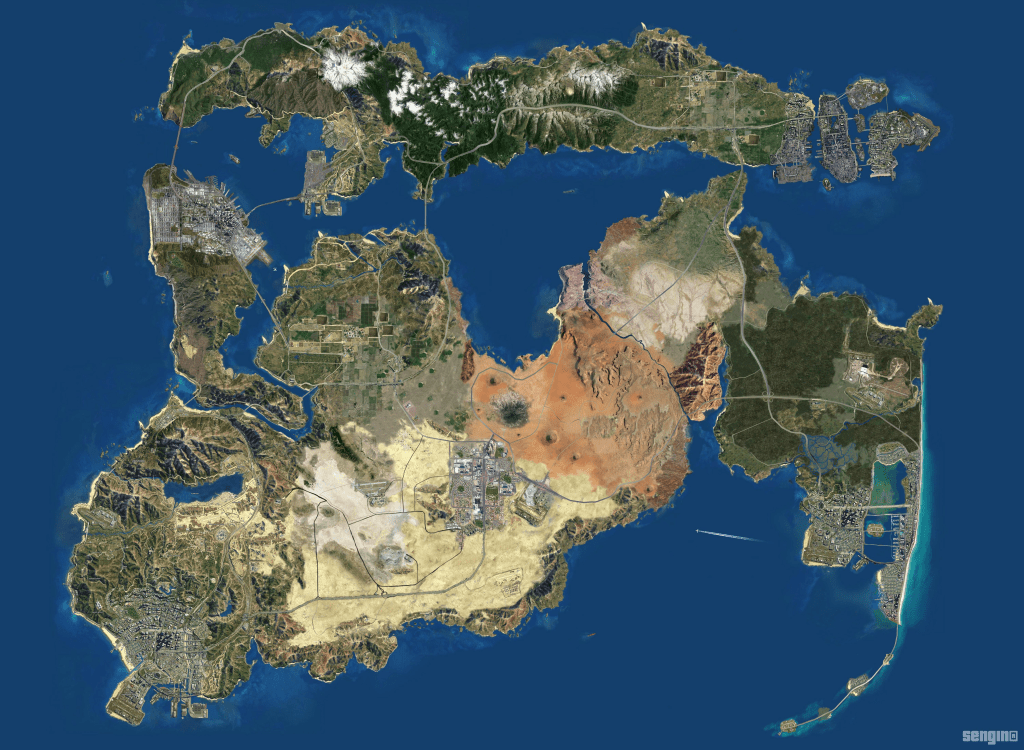
Also, I have to circle back to GTA for a rant. Liberty City, Vice City, Los Santos: the big three stand-ins for NYC, Miami, and Los Angeles and victims of the RockStar game design of “take well-known big city and make it an island.” There’s a few theories floating around that the reason for this is a great big satire on the old “self-absorbed Americans live in their own world” stereotype and to be honest, I’d say the joke is quite old. It may have worked before, but with GTA: San Andreas having stand-ins for Vegas and Frisco as Las Venturas and San Fierro respectively as well as an area that can be viewed as the rural part of NorCal, there’s evidence from RockStar that they can and could (read: should) make a multi-city game. Or frankenstein their three cities together. Multiple fan artists have done it in the years since.
Source: sengin*
* The source for that map is hard to find seeing as it’s nearly 10 years old. Nevertheless, we have a good base, even if conceptual in design. There was also Ubisoft’s The Crew which had a truncated map of the lower 48, and most MMORPGs to go off of for a true open-world GTA-esque game. Come on, RockStar, give us what we really want.
Sorry, back on topic. Ananta is available for pre-registration so you can be among the first get it once it’s available. And you can bet you’re bottom dollar, I’ve already pre-registered and I’ll definitely be one of the first to play it as soon as I acquire the yottabytes necessary to house them all. Maybe I should make a rant of modern gaming, there’s enough material online for me to use as examples… as well as anecdotes and memes of people moving files around for storage; a story I know all too well.
It’s easy to say that I’m excited for Ananta and want it to succeed. That kind of goes without saying, gacha games are plenty successful as shown by Mihoyo’s output and I don’t just mean the whales funding it better than any Wall Street investor. But I’m going to take a page from the Det. Cole Phelps Institute and match that excitement with some skepticism. No assumptions, wait for more trailers and information to be revealed, look into some theories, and most importantly, prioritize the facts. To quote the God of War:
Expect the worst;
Assume nothing, and;
Always anticipate [danger]
Credit: alexloai64
A series of great quotes to follow, not just in a hack-n-slash god-pulverizing simulator, and something I’ll keep in mind whilst eagerly awaiting more updates on Ananta/Mugen.













 Opinions on Entertainment