
Seems there’s a manga for everything
I remember long ago writing about searching high and low for obscure series to read or watch. Unknown, underappreciated, undersold series that have very little audience, very little fanfare, very little recognition of any kind out there. And I believe I have another one that not only is largely unheard of by the layman, but is also on the subject of an individual who lived and died in obscurity, forever doomed to posthumous recognition for his talents… or curse depending on how you look at it. But I’m jumping the gun. What I’m talking about is this:
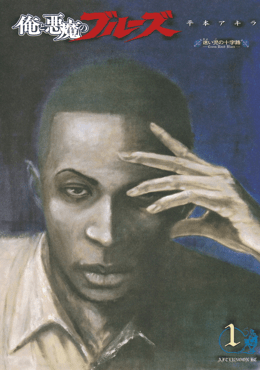
An unknown artist and blues pioneer of the early 20th century, Robert Johnson lived a life familiar to many black Americans at the time. Born and raised in the Deep South on a sharecrop with an almost predetermined future. Brief history lesson: post-Civil War America and Reconstruction came with a wave of new changes for the formerly enslaved, but not all of it implemented unanimously, cleanly, or with regard to the realities of the situation. Between ex-Confederates skipping country, finding their way back into the U.S. political machine, or in some uglier cases, becoming the first members, if not, founders of the first Ku Klux Klan, there was a lot of infighting in the Reconstruction era. A lot was promised for black Americans, but so little was implemented with the recently reunited government figuring out how to kill two birds with one stone at the time.
The reason I include that brief history lesson is to show how long the system actually lasted. It was not too long after the Civil War ended that these sharecrops became so prevalent and it wasn’t until midway through the 20th century that they were on their way out, and Johnson’s early childhood as well as that of his family was in the middle of that. What separates sharecropping from full-on slavery was how someone found themselves in the sharecropping system. It was basically like debt on steroids. You’d agree to live on and tend to a farm, with roughly everything stacked against you. Negotiations are virtually nonexistent and you hardly ever get to live off your hard work. Someone else enjoys themselves while you literally bend over backwards to pay off a HUGE amount of debt.
For Johnson, there’s evidence that he started off like this, but major details of his life are missing from the historical record, and that’s largely on him allegedly vanishing and showing up back home or around home with large gaps of time in between them. You were lucky if you could sit down with him for five minutes as a researcher to write his story, and whether what he or others told you was true was all up in the air.

Getting concrete proof of what this guy did outside of music was one of the toughest things historians and researchers could do, and the ones who tried should be applauded for their efforts. You think you can do some investigative reporting while chasing shadows at the same time? What’re the odds there was a rumor he never even existed to begin with? (Actually, in my research, I found out that the few surviving photos of him available were discovered decades after his death, so this certainly adds to the legend/conspiracy theory/rumor, etc. of Robert Johnson. What are the odds?) Me bringing this up is probably the first time you’ve ever heard of him. I only found out about him a few years ago, and I can’t remember where; nevermind where the mangaka Akira Hiramoto learned. That all said, the fact that Hiramoto wrote about an obscure blues pioneer from Nowhere, Mississippi is proof that America continues to fascinate Japan to odd degrees. It would be the equivalent of a westerner (read: American) writing a novel about the samurai Sakanoue no Tamuramaro… well, I think I fit that bill somewhat considering what the last few posts have been about.
Back to the subject at hand, owing to the name of the manga which is also the name of an album recorded by Johnson, part of his biography claims that he became an expert guitarist in little over a few days, which is impossible for seasoned guitarists who spend years learning to strum and pick before choosing what suits them best personally. How he even learned to do so and claim to in such a short amount of time is questionable and a huge part of the legend. Johnson was said to have heard from the grapevine that playing a tune of any sort at a crossroads is how one acquires the gift of music… from the devil.
In all likelihood, all that time spent traveling alone or with peers would’ve allowed for a hell of a lot of time to practice the guitar and pick up lessons from musicians like Son House or Lead Belly or any other blues musician who was alive at the time. So the poor guy from the Deep South pours his heart and soul into the guitar and becomes a local legend. One could reasonably chalk up the black codes and segregation especially in the Deep South for the reason he had almost little fame, but I see it as a combination of factors for why he was only destined for posthumous success.
Keep in mind, he never stayed in one place for very long. Historians did have a hard time finding and even writing about him, or if they did it was more often from a secondary source. Music is definitely a way to gain fame and riches, but only if you can stay long enough to record the song and see the royalties rolling in. Johnson’s behavior was quite atypical. He was often in a juke joint strumming for s[guitar twangs]s and giggles. Not a very stable way to grab some cash, but it surely earned him women’s affection. Most often married women’s affection, and this would lead to conflict. The last one being fatal.
His life and his death are a riddle wrapped in a mystery inside an enigma. He never had an autopsy done on him, presumably due to the circumstances of the period, but adding to the deal with the devil legend, once his flame was out, it was time for him to cash his check. It’s said that an irate husband of one of the women enamored by his skills slipped him some beer laced with poison and it killed him in a matter of days.

Less interesting, but still serious was the possibility that he may have had congenital syphilis which offers a better explanation of his unusual behavioral patterns. For a very long time, and even now, the medical sciences didn’t treat black Americans with a modicum of respect, so if the syphilis theory checks out, whoever passed it on likely died as terribly as Johnson did.
Whatever happened is all up in the air. What is a true blue(s) fact is that he and others of his time had a massive impact on music and rock n roll for generations to come. And the manga is proof that he didn’t just inspire westerners or musicians. As one of the pioneers of the blues genre, specifically Delta blues, a lot of effort was put into researching the man, with many researchers spending decades compiling enough information about his life to open the Robert Johnson Blues Foundation museum in Mississippi.
This might be where the author of Prison School found his inspiration. Yes, this Prison School:

I honestly didn’t believe it either. From a manga about a 27 Club inductee to one about pervy highschoolers getting the crap kicked out of them by a cadre of all-female sadistic school wardens. Should I bother making sense of that? Probably not.
The manga largely retells what we know about Robert Johnson along with some conjecture. I’m not even 100% sure about the historicity of some of the events I looked up considering what I’ve seen of the manga or read in my research, but all things considered, I can only assume that this is probably one of the best things we have to a historical record next to the aforementioned museum in his name. As for what I think about the manga itself, Hiramoto seems to be quite well-learned of the Deep South to know what life would’ve been like for the average black American in the 1910s and ’20s. I like that it’s as honest and realistic about life back then while also acknowledging the myths and legends around the musician.
For criticisms though, it’s hard to think of any. Semilegendary figures seldom have anything to disprove especially if it isn’t recorded anywhere, so all we’re left with is the guesswork put together by the historians of yesteryear. It could even be claimed that we don’t even have all of his songs. Another victim of lost media, possibly.
I’m still reading the manga as of writing this, and last I checked it was still ongoing even after a seven-year hiatus. Certainly worth the read, especially if you want to see in manga form how legends are born.
For this week’s YouTube recommendation, look no further than That Japanese Man Yuta.
https://www.youtube.com/channel/UCn7LyBvG5LEBXK9I4W5dGdA
Run by YouTuber, blogger, and polyglottal language teacher Yuta Aoki, That Japanese Man Yuta is a channel dedicated to uncovering all the little bits and pieces that have come to construct the Japanese language. He stands as one of a handful of Japanese YouTubers who can and has crossed over to a western/English-speaking audience. A majority of his videos are about dissecting the Japanese language wherever it appears from his own videos, to interviews, to manga and of course anime.
They also end with the same message: an offer to learn from him personally about how to speak Japanese in a way that most natives would believe you’d been living there all your life. I personally haven’t signed up for that due to time constraints, but if you see yourself brushing up on your Japanese, learning for the first time, or wanting to test a different method, especially if you’re going to Japan sooner or later, perhaps Mr. Aoki can tutor you in the language. He’s definitely confident with how often he mentions it and structures his channel around it.



 Opinions on Entertainment