
Her braincell is always out to lunch
Multiple times on this blog, I’ve explained that I don’t make a beeline for the Isekai genre. My tastes are varied and, if I had to look at it objectively, inconsistent. But if it wasn’t me being lazy, it was life reminding me that the big picture exists.

Thank god for stock imagery
With the case of Isekai, recently I’ve had a look at some of the shows I’ve been watching, some of which have appeared on this blog before, and I don’t think the statement holds up anymore. Matter of fact, some earlier anime I watched as a kid technically count as Isekai by the slimmest margins and the loosest definitions. Similar to when I watched Shield Bro Loli Pokemon, I came across the subject of this post on Crunchyroll sometime in 2020. It’s not in my watch history for some reason, but I did see the entire first season and part of the second season, so I definitely remember the plot beats going on for this series.

This series is an otome harem Isekai that would become more and more commonplace after 2020 for some s[piano]ing reason. As I recall, the anime skips over the Isekai-ing action, and drops the protagonist into the shoes of the villainess/antagonist, Catarina Claes, who is known to the Japanese audience as Bakarina for having an IQ level as big as her shoe size. The full English title doesn’t really do the series any favors, as the point of the game she’s isekai-ed into is to avoid all the doom flags. The game, known as Fortune Lover, has a series of different paths for the player to follow given specific conditions. One ending sees the villainess exiled, another puts her behind bars, and the third sees her killed in a crime of passion.
When the protagonist takes command of Bakarina’s braincell, the roles are reversed in even the design. Robbing the game of the villainess irreversibly changes the flow of the game to the point that the game semi-acknowledges the takeover, although the major consequences of this aren’t even that punishing, given the English translation of the Japanese title being “I Reincarnated into an Otome Game as a Villainess with only Destruction Flags” as opposed to the subtitle All Routes Lead to doom. A distinction I make seeing as the former explains the concept of and subsequent obsession with doom flags as opposed to the latter that leaves it largely vague. Couldn’t help but get pedantic about that…
Be it the villainess or the actual protagonist of the video game (to distinguish from the Female MC), the opportunity to romance any of the archetypes characters is, on the surface, divvied between the two, but with Bakarina being the queen of this series, that’s a decision largely left to her. Bakarina’s definitely different from how the original Catarina behaves, being more charitable than selfish, all to avoid the death flags. In so doing, she unlocks a secret ending that most games won’t give you until you 100% it once at the minimum.
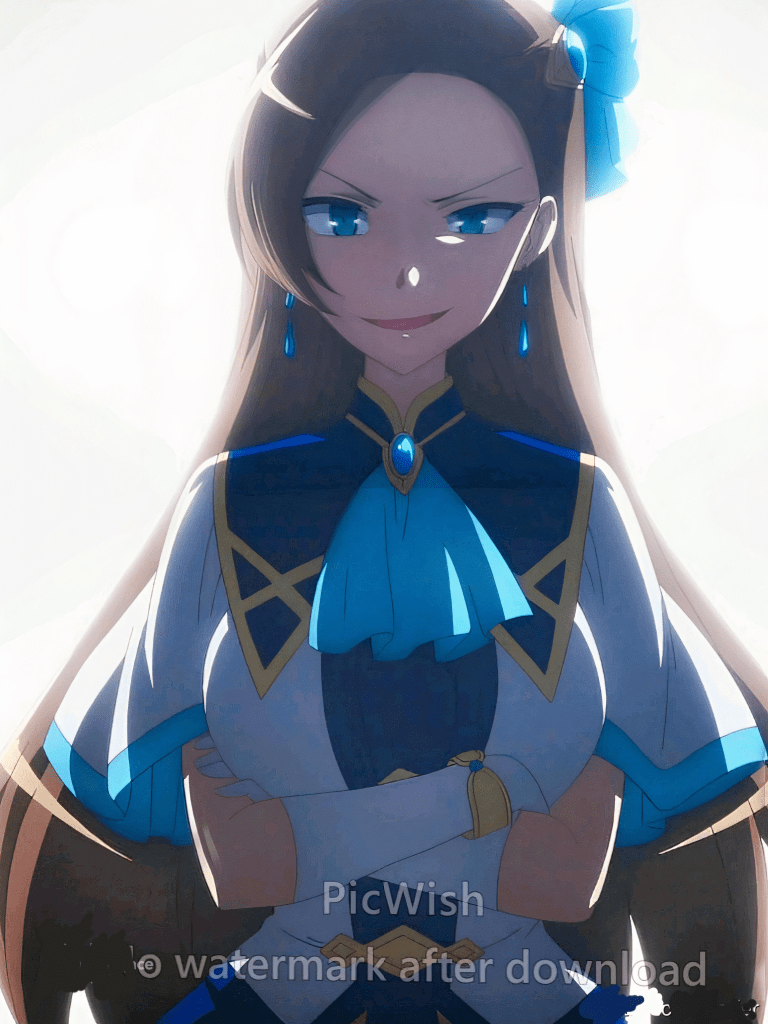
Without a real window into the game before Catarina’s mind was taken over, all we the audience have to go off is what Bakarina claims she was. To be fair, there’s a few scenes that show what would happen to Catarina if she was the same as she was before the plot of the series kicked off. Now, as for concrete proof that this is an Isekai, again, the anime never shows the action, but it does have a flashback to what the pilot of the Catarina mech-suit looks like, all without ever giving her an actual name.
Another thing done differently is a semi-timeskip. The first five or so episodes start off in Bakarina’s childhood before transitioning to her and the rest of the cast as first- or second-years in high school. And although they’re all adolescents going forward, the recurring gag is that before a major life-altering decision is made, Bakarina retreats to an inner council within her own mind where five younger-somehow chibi-er versions of her debate the pros and cons of a certain path before moving forward with the decision.
And to put the cherry on top, the reason she’s referred to as Bakarina has to do with a variety of weird and idiotic moves prior she’d become famous for. I guess I would also find it difficult to explain that the world is an otome game from a different world, but with death acting as a portal from one world to another, the most I can do is reflect on my previous life before pulling a “when in Rome.” While Bakarina acknowledges the doom flags and bends over backwards to avoid them, she brings mannerisms and habits from her old world into this one.

Funny enough, I did a quick Google search and found this Reddit post that posits, with evidence, that she’s on the spectrum. It’s credible, but medical and mental health professionals make the distinction between autism, ADHD, and simply having those symptoms without fitting into either category. But their is also evidence that she is simply braindead. A lot of it having to do with her being clueless to a lot of things going on in the lives of the romancibles, notably their feelings towards her.
The show is entertaining enough and deserving of its second season when you keep in mind that Bakarina is a moron, though not completely. She does have her moments, though the plot doesn’t give much in the way of character development for Bakarina. She stays mostly the same from beginning to end, even after realizing how much of the plot of the game she’d changed. This isn’t necessarily a bad thing, but it’s a noticeable thing to keep in mind, especially for puzzles, such as one episode where everyone else was in despair while Bakarina kept stuffing her face.
But on the subject of idiocy, a distinction needs to be made between intelligence and wisdom. There’s overlap between the two concepts and some believe that they’re merely interchangeable. But that’s false. In layman’s terms, it’s merely the book smart VS street smart debate. A professor can tell you all about physics and maths, but will probably be lost in the worst parts of the Bronx. On the other end of the spectrum for wisdom, someone may be unable to do complex maths, but they can still learn you a thing or two about life.

The anime’s has two seasons with 12 episodes each plus an OVA. It was adapted from a 2017 manga which in turn was adapted from a 2014 light novel.
Need I elaborate?
Before I go, I have plans for a post concerning the corruption subplots of the video games, Max Payne 3, Sleeping Dogs, and Spec Ops: The Line, with all three handling it all differently. I can’t say for sure when it’ll be done, especially since Spec Ops had been delisted in most online retailers, leaving me the only option to pirate over it. Once I’ve finished at least the last two games (having finished MP3 before), I’ll have the full context of all three ready.


 Opinions on Entertainment