Boruto: Timeskip Update 2

Two Blue Vortex

As much as I’ve written about not wanting to be the Boruto guy, I honestly don’t mind such a connotation just as long as I’m allowed more topics to cover and in that regard on this blog, I’ve succeeded. But to circle back to the topic of this week’s post, Boruto’s timeskip arc has an update. Last week, third party sources brought news to the Boruto community concerning the upcoming timeskip arc. The next chapter is expected to release on August 21 under the new subtitle, Two Blue Vortex, and joining Kawaki and Boruto who both have future redesigns is Sarada Uchiha.
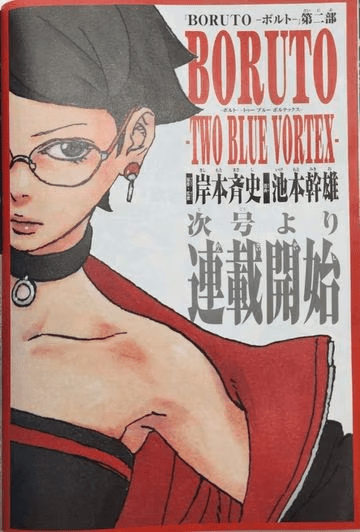
Consistent with trends, there’s already fan art of the new design. Here’s a personal favorite of mine:
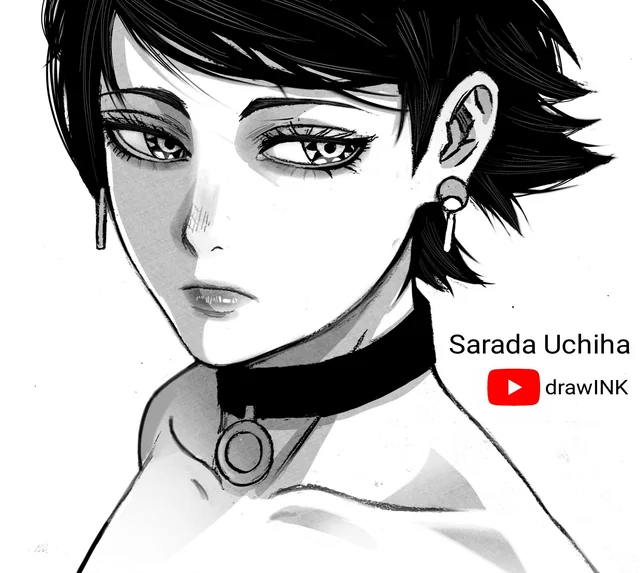
And no, the Bayonetta comparisons aren’t lost on the community. Simultaneously, the reveal debunks previous predictions made years prior while also shedding some light on existing concepts. For starters, rather than follow the Naruto convention of the subtitle Shippuden with Raiden and the associated kanji for lightning (雷), Two Blue Vortex deviates significantly from the formula used to craft Naruto and Naruto Shippuden as further proof that Boruto is simply not that kind of guy. Naruto had Sage Mode, was a Jinchuriki, shunned by the village for being the host of the Nine-tailed fox and fought tooth and nail to be seen as more than just the sum of his parts. Boruto, in contrast, was designed with nearly everything handed to him on a silver platter, largely because his parents either had none of it or weren’t allowed all that much to enjoy what they got. And seemingly overnight, he eventually loses it all.
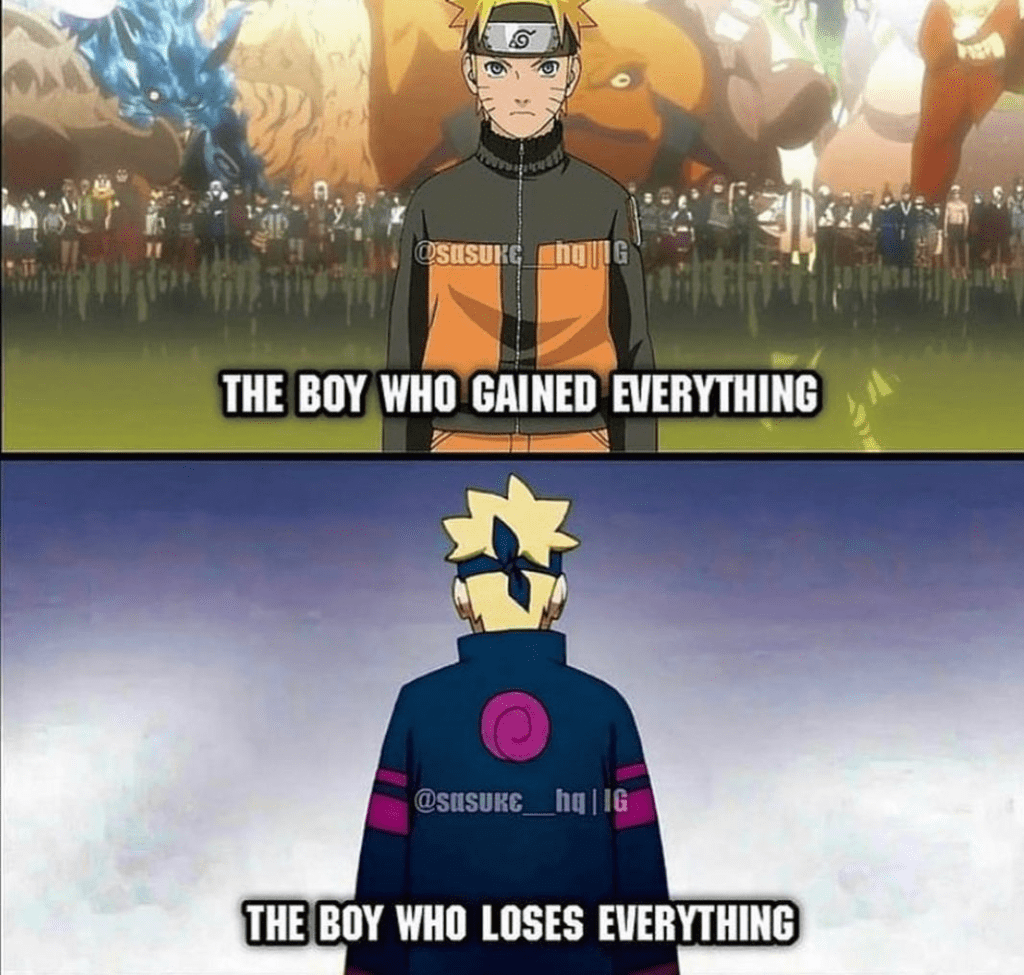
When the story starts proper, Boruto is pretty much a spoiled little brat with a legacy over his head. Naruto was inaugurated as the Seventh Hokage, following a lifelong dream that everyone said was impossible, and his grandfather Minato Namikaze, had the distinction of being the Leaf Village’s shortest serving Fourth Hokage. Considering the negative connotations associated with the number four in East Asia, the Four is Death trope is a time-honored tradition. Guido Mista was right to worry.

Boruto being spoiled is a direct consequence of the shaping of the Ninja World in both his father’s and grandfather’s times. From Minato’s time period, it was expected and tacitly accepted that ninja would have enemies. Constant warfare meant friends were made as fast as they were lost and often from a young age. Minato’s ninja cell were the equivalent of child soldiers during the Third Shinobi War. Even after becoming Fourth Hokage, the peace was tenuous at best, and the ninja villages would essentially shift from fighting organized militaries to disorganized terror cells. This problem didn’t really begin because of anything Minato did, but Naruto’s adolescence was where it got worse.

The Akatsuki, close to achieving its’ goal under false pretenses, and with only a few members left, outright started the Fourth Shinobi War, by way of necromancy and cloning. Initially, through desperation and gradually through teamwork, the ninja villages set aside all differences to combat a worse threat: Madara, Obito, and soon Kaguya Ohtsutsuki. After their defeat, it was a time to rebuild a better world for the future. Naruto’s tenure as the seventh led to many gifted children, some of them directly from the old Konoha 12 of before. They essentially lived so that Boruto’s generation would have it easy, but the down side to that is they don’t see what others are lacking in until it’s missing from them. Which does happen to Boruto gradually. Starting with the seal on his hand and the control that Momoshiki is always threatening to take away, though for the most part he doesn’t have to as long as he leaves things up to Kara, Isshiki, or Kawaki.

With Kara in tatters and Isshiki soundly defeated, Kawaki and Code are the last enemies Boruto has to face in the timeskip. How that comes to pass will be revealed after August 21 when TBV debuts properly so for now, here’s what I know and what I see from the reveal. It’s been confirmed from years prior how Kawaki and Boruto would look. Kawaki would wield a staff/rod-like weapon in the future, and aside from a change in attire, he wouldn’t differ all that much from the Chapter/Episode 1 teaser. In the redesign, he sports longer hair and a tunic and haori that bears a striking resemblance to what Isshiki had.

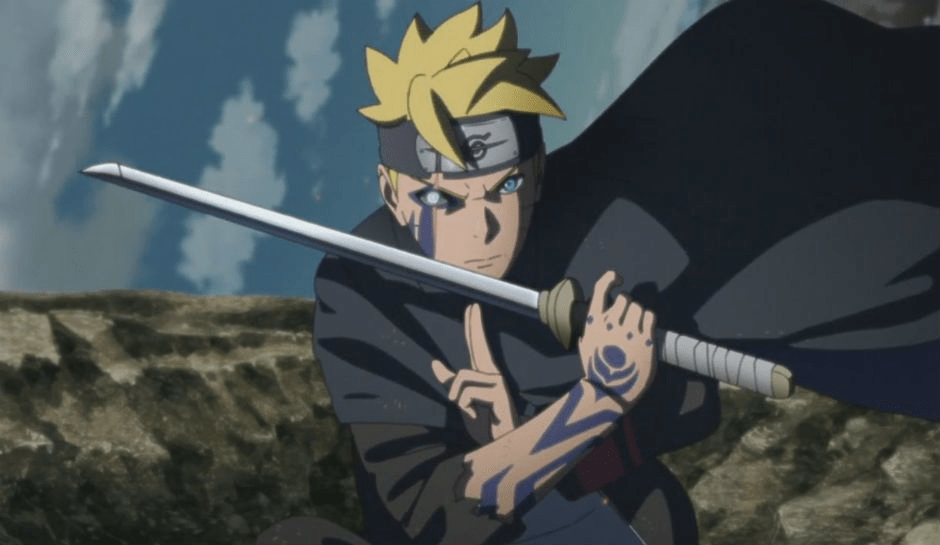
Boruto meanwhile had a scar over his eye, a headband with two perpendicular scratches, slightly longer hair, a cloak, a sword, and better control of his Jougan. The updated design stays true to what was seen in the manga in 2017, but with a few noticeable changes. The cloak is similar to how Sasuke wears his, the scar is shorter, and the hair is almost the same if not shorter than his current look. We haven’t seen the sword yet, so it’s not known if he’s using one of his own or if Sasuke has an arsenal and let him have an old relic.

From what we saw of Sarada’s design, with all the talks and fanart depicting her with longer hair and a longer tunic similar to what Sakura had in Shippuden, but the Bayonetta-style design immediately tosses that out of the window and calls back to when fans of Naruto thought or expected Naruto himself to have longer hair as he aged.

Additionally, Sarada’s presence on the cover may suggest that the new chapter will include her somewhere in it. As I recall, a beginning scene in Shippuden shows now-genin Konohamaru running into Teuchi. We’ve already made clear that Boruto as a character and as a manga is not the same as Naruto so the tone may be a bit more sullen or serious compared to this classic Shonen slapstick.

Some on the Boruto subreddit also noticed the symbolism in this preliminary design for Sarada, with Uchiha clan earrings, the ring on the choker, and the cloak she seems to be donning. If it’s a cloak she’s wearing, then it may be paying homage to Sasuke. If it’s a jacket, then it could be an homage to Boruto. Or both, but with everyone under the shinjutsu and believing Boruto to be the traitor, everyone’ll think it’s only to remember Sasuke who seemingly abandoned the village once again.

Speaking of shinjutsu, Eida, love her or not, still has a critical role to play in the plot. The shinjutsu she subconsciously used to reverse Kawaki’s and Boruto’s lives has yet to be fully explained. The same goes for her Senrigan.

All we have on both are what was shown in the manga and Amado’s exposition. According to Amado, shinjutsu, like omnipotence, essentially make facts out of fiction and as Amado has surmised, all ninjutsu are humans’ best attempt at recreating the shinjutsu. If that’s the case, then the Omnipotence that kicked off this predicament would function at an even higher level than that of Madara’s or Kaguya’s Rinnegan/Rinnesharingan. Whatever has been the most powerful genjutsu shown in canon or in filler, Omnipotence is even more broken than that.

As for the Senrigan, since it literally translates to “clairvoyance” Eida essentially knows everything that’s going on anywhere in the world and what has happened. Like a very powerful librarian or historian.

As powerful as the Senrigan, it’s not like Eida will know what’s going to happen next in general or to individual people. Again, it’s more like reaching into the past than it is about the future. So far, it’s served as a means of communication between Eida and Shikamaru, her and Amado, and whoever else she likes or can tolerate. Circling briefly back to the Omnipotence, of all the people affected, Sarada remains unchanged which appears to be linked to how much Eida liked being with her and Sumire. As such, it was also shown that Sumire was unaffected by the shinjutsu.

I can’t promise anything on accuracy for this next chapter as shown by my track record thus far. Any predictions I make are going to play it fast and loose until the chapter proper comes out. Having said that, there are some things I can’t see with any degree of accuracy. There are three that are, as of writing this, anyone’s guess: Sumire, Himawari, and Daemon.

Starting with the most significant one plot-wise:
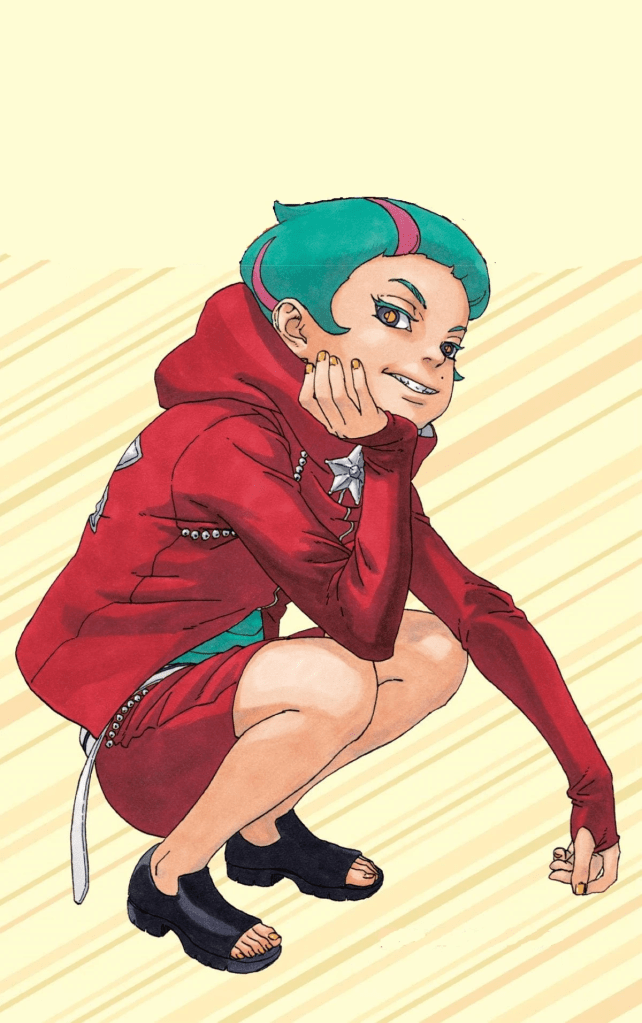
The extent of Daemon’s abilities are that just thinking about harming him is reflected in real time back at the would-be attacker. For instance, there’s a panel where Boruto and Kawaki both think about teaching the little runt a lesson only for it to literally backfire. So they both need to put up with his silliness to keep Eida from running off until further notice. For what can be said about him going forward, the only level of development seen was that he sensed an energy from Himawari, and we don’t know for certain how well the manga will follow up on that until then. Speaking of which:

The latter episodes of the anime put her in an academic setting with Kawaki going in as well on an undercover mission. For Himawari’s abilities, the Byakugan emerged in her the same day as Naruto’s inauguration and she’s shown to attack with the signature killing intent that each ninja knows about in battle. But for the most part, it’s been depicted as subconscious and while she was shown to be effective during this late anime arc, it remains to be seen if it even gets a reference in the manga if not an accompanying light novel.

Finally, there’s Sumire Kakei, who admittedly got a more generous treatment in the show, despite her starting out as a spawn of a former member of Danzo Shimura’s Foundation within the ANBU Black Ops. The show and the children accepted her with open arms and since the students graduated, she took on an apprenticeship with Dr. Katasuke Tohno. As far as a prediction, this will likely continue unabated, save for the subject area of their study being Boruto instead of Kawaki, but on the side she might be keeping in touch with Sarada on her progress to the best of her ability. And this is just the Hidden Leaf Village. The anime might bring the Sand Ninja back into the fold, but for what or how I can’t foresee. Even if it feels like Shinki et al don’t impact the story much, they’re not unaffected by the events thus far, and are at the mercy of the Sand Village’s moves as shinobi as well. Even a short filler or catch up for the audience to remind us they exist would be acceptable to me.

No matter what happens, Code is still a problem and it’s all up in the air how they choose to address that. Either way, I’m eagerly awaiting the manga’s and anime’s return.


What Happened to the Naruto: Ultimate Ninja series?

The series that had to be soft rebooted

Before we start, I just want to say that I think I meant for last week’s post to be about rewriting the God of War Greek Era narrative in a more cohesive manner considering all the silliness that unearths its plot holes. I’ve defended some overarching stuff since most ancient myths have multiple retellings due to oral tradition, but some specific details are hard to ignore. So, I’ll save that for a future post. This time, we’re gonna talk about the Naruto franchise, more importantly a series of video games based on the franchise that sort of went through a soft reboot about halfway through.

Masashi Kishimoto’s magnum opus, the Naruto franchise, had grown to be a smash hit since its first chapter debuted in 1999. Manga/anime fans hold it in high regard, and it’s part of that generation’s Big Three with the others being Bleach by Tite Kubo and One Piece by Eiichiro Oda. Both of which have gotten their own video games, accessories, figures and more.

With Naruto, part of me wants to say the ninja/shinobi aesthetic was what helped it explode when it began to make waves in the west, so much so that when the anime began dubbing it in English in 2005, the Japanese video games were getting the same treatment soon after. Generally, anime adaptations in Japan are promotional material for the manga, as are the manga’s associated figures, light novels, and other materials. Hence why some of us in the west are still waiting on a second seasons to anime that may never come.

The benefit of releasing in an era where shinobi were the coolest thing since an arctic winter might have heavily tipped the scales in Naruto’s favor, thus explaining the numerous video games associated with it. Specifically, the Ultimate Ninja series. Five main games following the timeline of the manga were released in Japan from October 2003 to December 2007, and ported to the west from June 2006 to November 2009. Likely due to the release of the anime and its western dub, the games loosely follow the events of the manga until they cut off and each successive game adds to the cast of characters to play as.

Ultimate Ninja 1, for instance, starts off with a small cast because it follows the story from the Land of Waves arc until the Destruction of the Leaf/Konoha Crush arc. Many of the important characters are assisting characters during fights, and mostly follow them individually as opposed to staying consistent with the manga, such as the changing around of one or more outcomes of certain battles. The Naruto wiki claims that as far as a presentation goes, critics felt that it left a lot to be desired. Personally, I was introduced to the series through a friend who had the second installment on his PS2 and later I went to buy the first game. From what I’d seen, I agreed with those critics’ statements that more could’ve been done at the outset, and the players and critics got that wish in Ultimate Ninja 2.

In 2004 in Japan and 2007 in the west, the second installment followed up on what the first game brought to the table. Continuing with the rest of the Konoha Crush arc and ending narratively with the Search for Tsunade arc. What became a bit of a trend for the series starting with this game was a game-exclusive arc that can be compared to filler or something along the lines of an OVA. Spoilers to follow: get ready.

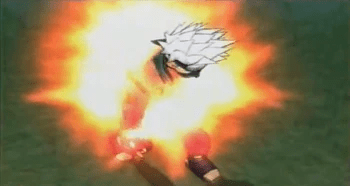
After Tsunade is returned to the village to serve as the Fifth Hokage, Orochimaru who didn’t learn his lesson the first time he tried this malarkey has another go at swaying Tsunade’s decision. This time he as an ace in the hole. He and Kabuto were intercepted at the Training Grounds by Kakashi. At this time, Orochimaru’s arms have been sealed and so he needs Kabuto to use his chakra and perform ninjutsu. One such jutsu, is known as the Forbidden Jutsu: Gedo Mark and its main purpose is to limit its opponents.

There’s better pictures for this, I’m sure. Actually, I think it’s better to see it in action.

Sidenote, the YouTube channel in question has a full playthrough of this game among others. I recommend giving it a look.

This next arc sees Orochimaru and Kabuto to try multiple avenues at once to coerce Tsunade into reconsidering releasing Orochimaru’s arms. First, he cripples the more troublesome ninja, namely Kakashi and Naruto, then he uses Reanimation to revive Zabuza Momochi, Haku, and the Third Hokage. After the Leaf ninja find a way to release the Gedo Mark, they soundly defeat Orochimaru and Kabuto and the game ends. Seems even your video games aren’t free from filler. For my take, it’s an interesting story with a lot of stuff that doesn’t make sense. I don’t doubt that Orochimaru’s hunt for the greatest Jutsu ever would lead him to unethical methods, we see this all the way until Boruto confirms that he’s been under lifelong house arrest, but even if he could inhabit another body, the risk to his health in his current state would have even him rethinking his decisions to use ninjutsu willy-nilly like that. Kabuto even says as much. Still enjoyable, and as an added bonus: Taijutsu Naruto.

The Japanese release had characters from the Ninja Clash in the Land of Snow movie.

There’s also a free-roaming mode where players explore the world of Naruto, though considering it stops at the Tsunade Search arc in canon, only a few locations are available. Nonetheless, there’s different activities that can be done with other characters or solo and some of my best memories of the game come from playing with friends at their houses, even if my skills were subpar. Now that the developers were seeing gold, they expanded on this even further in Ultimate Ninja 3.

Released around Christmas 2005 in Japan and in March of 2008 in the west, Ultimate Ninja 3 covers the entirety of Part I from the Land of Waves to the Sasuke Retrieval Mission albeit with some notable omissions, chief among them the Chunin Exam Preliminary Rounds. There might not have been a way get those into the game since the main focus is fighting, but it’s a not insignificant difference that could potentially shape the way someone views the anime if this was their first exposure to the series.

Still, there’s more characters to use, more minigames with the characters, and just like its predecessor there’s an exclusive arc that interestingly got its own OVA for promotional purposes.

Titled “Finally a Clash! Jonin vs. Genin,” the main gist of the OVA is that the Leaf Village in association with the Sand Village puts together a tournament based on a points system. Genin and lower start with one blue crystal worth one point while Chunin and up start with one red crystal worth five points each. Passing a threshold of points advances the ninja to the next round, and passing that threshold allows the victor to pass a regulation that the two villages would follow for a week straight.

It’s initially suggested that battling was the only way to earn crystals but these being physical points you can hold in your hand, you’re not necessarily limited to that kind of all-out battle. Select characters trade them as currency for favors or use them in wagers. There’s also simply looking for the crystals on the ground as they fall out of people’s pockets like change. As for the free-roaming open world element, there’s now jumping and double jumping and the exploration isn’t limited to a few locales, but it’s not the same open world that you’d see in the later Ultimate Ninja Storm series.

This one does a lot more, though I think the limitations of the hardware still did a number on this game since it compresses large arcs into a few battles. I’m not saying I want all the battles and dialogue to be redone in the game, just that a few of the important, plot battles be given theirs. Additionally, it was quite clever of them to hide the Fourth Hokage’s name as simply his nickname in the manga: Yellow Flash, but I’m not sure why he has no speaking role in the game. Something I forgot to mention when talking about Ultimate Ninja 2, that game had a notoriously difficult substitution/rebound system that made it near impossible to properly counter attacks. UN3 and up dumbed that down significantly and I praise the change.

Japanese release: April 2007, and Western release: March 2009, UN4 as seen on the cover starts in the Shippuden era and like its predecessors it has an exclusive arc that is separate from the canon manga arcs and its own open-world RPG-type game mode. This time around, Naruto is still training with Jiraiya. To conclude this round of training, he’s given prayer beads to wrap around each limb and Jiraiya uses a weighting Jutsu to alter the weight of the beads. They change color with experience and when Naruto’s beads glow red, he’s instructed to find Jiraiya who’ll take them off to conclude his training.

In the meantime, the two head to the Tree Felling Village where a girl, Aoi, is to be used as human sacrifice to satisfy a demon known as Black Shadow who lives in the caves. Naruto’s disgust with the practice results in him chasing after the girl who’s determined to go deeper into the cave. Black Shadow physically stops the shinobi, though by now his beads turn red and he’s eager to get them off so he can come back and break down the barrier Black Shadow had summoned earlier.

Before that though, he and Jiraiya gather some information on Aoi and her path as a sacrifice. As it turns out, Aoi was using a desperate though dangerous method to help her ailing mother, Tsubaki, who’s introduced at around the same time Naruto and Jiraiya make it to the Tree Felling Village. The village’s namesake is derived from a tree that blossomed flowers with healing properties. As a bonus, these flowers were a barrier keeping Black Shadow at bay, but when it was chopped down by the villagers and subsequently consumed by Black Shadow all hell broke loose. The villagers then offered an annual sacrifice to the demon to keep him satisfied.

As for Tsubaki’s and Aoi’s lineage, their ancestors were closely linked to the tree and their connects to the tree are limited to a charm with the flower petals inside it since the tree was felled. Aoi’s father died of illness and Tsubaki was on the same path; this culminated in her decision to feign sacrifice as a means of getting close to the tree within Black Shadow and using it as some sort of cure.

After the demon reveals its true form, Naruto fights it, aided by Aoi, and soundly defeats Black Shadow. Unfortunately, the leaves from the tree have long since wilted, save for one that Aoi picks up and I presume is used in tea. Then Naruto falls into a weeklong coma and at awaking, he finds that Tsubaki made a full recovery and Naruto and Jiraiya return to the Leaf Village having made a difference in this family’s life.

Afterwards, the game starts in the Kazekage Rescue arc, but ends halfway through before the Kazekage proper has been saved. I don’t have evidence to support this, but I think the game released as Shippuden was beginning. The only evidence I see is the release date being consistent with the beginning of Shippuden’s anime adaptation.

It’s pretty much the same as the other games, but with more characters, more movement, etc. But even though, the Shippuden arc leaves a lot to be desired, fortunately in the open-world game mode, there are coins known as Pieces of Memory where you can view the story of all of Part I from the Land of Waves arc to the Sasuke Retrieval Mission, so it’s not a total loss.

Naturally, you could assume that a fifth game was on the horizon to restart the first arc of Shippuden and keep it going to at least the end of the Tenchi Bridge Arc where we see Shippuden Sasuke. This was what I thought too at the time and I found out as recently as a few years ago that there was a fifth game that never made it to North America.

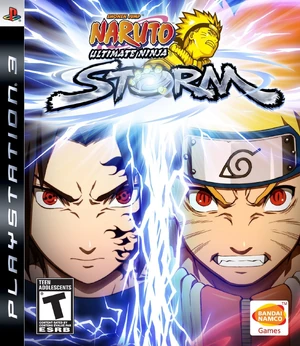
In the UN series by itself this is the last of the main Ultimate Ninja games until Ultimate Ninja Storm on the next generation of consoles. Do note that I’m not saying it has no English language release. When the UK was still an EU country, it was eligible for most EU ports of certain games, this being one of them, so while I managed to find an emulated version of the EU release, this game doesn’t exist outside of Japan or Europe and I don’t think my preschool level Japanese is gonna help me if I play with Japanese subtitles and audio.

This game actually is what motivated this post. Four games bear the Ultimate Ninja tag all released on the PS2 and the fifth one was never made for fans from the Americas. What’s the reason for this? My closest source again comes from the Naruto wiki and it can be boiled down to time constraints and dubbing issues. I can’t say with certainty as I have no evidence that this is the case, but I’m at least somewhat positive that the release dates and the evidence in the games is enough of a clue to work with.

Almost all of them released concurrent with the anime adaptation, but several years after the manga was a few arcs ahead of what was depicted, which explains why UN4’s main story is so short compared to the others. Episode 15 was the most recent episode when that game came out. As for time constraints, with the other games coming out as fast as they did, of course time was Namco’s enemy here. I only made it to the title screen as I wanted to finish the UN games before making it to five, but from what I saw even the EU release was botched with only Japanese audio with the selected nation’s language for subtitles.

From what I can gather, they were going to keep up with this trend of releasing the games around the same week as a new arc, but it seems fate forced the devs to rethink things a bit. I could see a UN6 continuing from the emergence of the Akatsuki’s Zombie Combo up until Sasuke’s formation of Team Hebi (later Taka) to finally exact revenge on Itachi for the Uchiha Clan Downfall all those years ago. And follow that trend until the manga concluded with some extra ideas for other exclusive/filler arcs.

Realistically, the problems with keeping this up grew to be untenable. At the same time some of these games were being made, the similar graphics were being used for most of the spin-off and mobile/handheld titles like the Ultimate Ninja Heroes series on the PSP and Ultimate Ninja Impact. It’s not like the Japan-only games that weren’t meant for the west; bad luck essentially forced them to hit the reset button and try again with a better series.

Better graphics, new engine, more characters, more to do with the environment and make it feel as though the player is playing the anime, the UN Storm series is in all aspects a technical upgrade. However, there’s a bunch of from the previous series that several gamers may be disappointed to learn were done away with. It took some getting used to to learn that UN3 onwards discarded the multiple screens for an ultimate jutsu as well as different ultimate jutsu in gameplay, and the RPG-esque text reading at least felt like it was advancing faster because the characters would always voice the lines so you did more than read and listen to the background music.

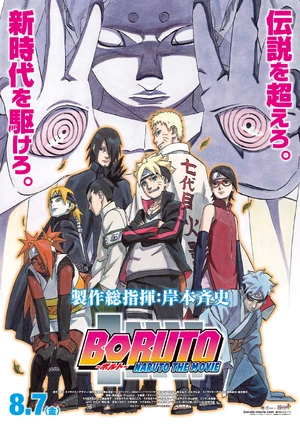
My exposure only comes in the last game Ultimate Ninja 4 which wraps the story up admittedly more beautifully than the anime. At least they did something with the Boruto movie adaptation. And since this was the last of Naruto’s story, if this game was using the Boruto plot to promote the movie then cool!

Though now that I think about it, it’s possible that the reputation of Naruto was what made loads of people expect better from the Boruto series. As much as I’ve been cheerleading Boruto, I also wish it would improve in some areas, though it looks like I’ll get my wish when both the manga and anime return later this year, along with a new game set for release soon.

For this week, I recommend the YouTube channel Alternate History Hub.

https://www.youtube.com/@AlternateHistoryHub/about

This channel specializes mostly in what’s on the tin: alternate history. What if the US stayed out of both world wars? What if Spain stayed Muslim? What if Japan went Catholic? What if the Ottomans colonized the Americas? and other such topics that explore what would happen if history took a different path than what happened in our timeline.

Just like my Trash Taste recommendation from a few months ago, there’s other associated channels with Alternate History Hub. Cody Franklin oversees this channel, he used to oversee the channel Knowledge Hub which is now Knowledge Husk until he gave it to his brother Tyler, and recently, Cody launched the channel Pointless Hub which looks more at entertainment media than something along the lines of geopolitics. You can even support him and his channels through the associated Patreon links.

If alternate history seems right up your alley, give him a follow. If not, then there’s other stuff of his to view.