When Personal Guilt Is Made Manifest

If you don’t deal with your demons, they will deal with you

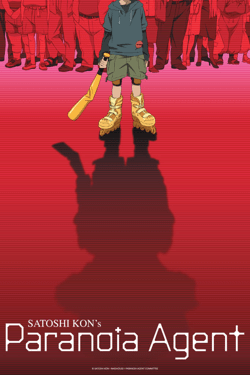
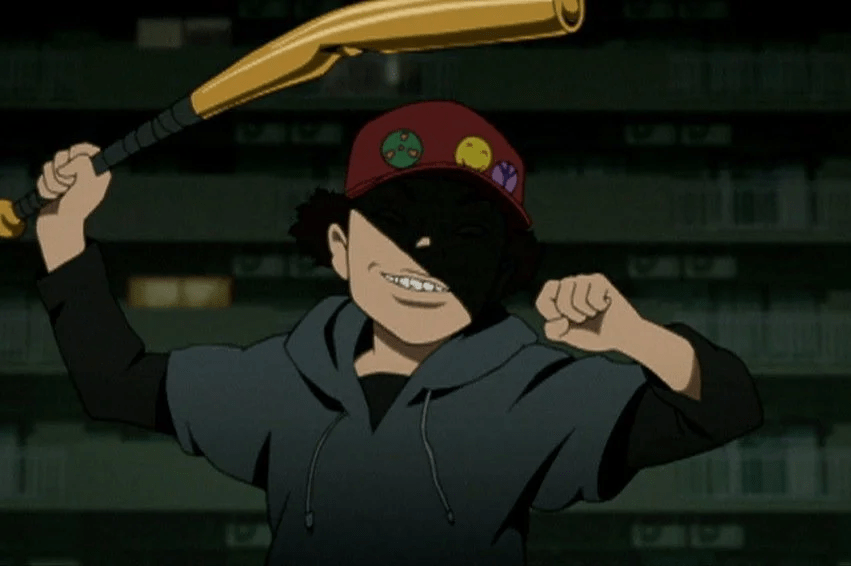
Late anime director Satoshi Kon created and directed the 2004 anime series Paranoia Agent. In 2020, Toonami picked up the series for broadcast for my viewing pleasure. It follows a timid character designer known as Tsukiko Sagi who gains fame from a pink dog mascot known as Maromi. Under pressure from higher-ups to imitate and essentially mass produce her prior success, she finds herself knocked unconscious by a mysterious boy on golden skates wielding a crooked gold bat. The detectives on the scene, Keiichi Ikari and Mitsuhiro Maniwa, don’t fully buy the story until another victim shows up and after that come more and more victims of the attacks. Every victim has essentially the same description of the perp: young buy with inline skates, a crooked bat, and a baseball cap. There’s two names for the kid in sub and dub: the sub refers to him as Golden Bat; and the dub refers to him as Lil’ Slugger. The dub name for the “antagonist” might be some holdover from times past, but I prefer Golden Bat because it’s one of the most identifiable objects on the antagonist’s person.

From a plot standpoint, Kon’s creation is a mystery thriller with some psychological horror blended into this cocktail. You don’t know who the antagonist is beyond the victim’s descriptions so that nails down the mystery. He’s a serial assaulter who attacks without warning, which adds to the thriller elements. And the psychological horror element has to do with the nature of the attacks. Post-assault all of the characters can consistently describe what was going on when they were attacked and what the assailant looked like or was wielding, but prior to that just about every one of them has some sort of mental health condition that makes them somewhat unreliable. That, or they’re some kind of opportunist with an ulterior motive or they’re hiding a deep, dark secret that they’d rather bring with them to the grave than make peace with.
For character design, knowing Japanese kinda spoils the main plot, which I’ll get to momentarily, but only if you know what kanji is being used and how. The main element to them all is animal based and is also based on their nature with a double entendre to boot for some characters, notably those with a mental disorder of some kind. From what I recall of the anime when Toonami broadcast it, it starts with the victims of Golden Bat before transitioning to detectives Ikari and Maniwa, but doesn’t want you to forget that Tsukiko and her creation, Maromi, are the first people who’re introduced in the series, despite transitioning to other characters.

It also has something of a supernatural element to Golden Bat. We’re gonna venture into spoiler territory right about now, so if you wanna open another tab and blaze through the series, you’re welcome to do so. Interspersed with the genuine attacks against them, there was a copycat perpetrator who personally singled out some of the victims while the real culprit was still at large and incidentally the real culprit was the one who killed the copycat while the copycat was in police custody, thereby ruining Ikari’s and Maniwa’s careers as detectives.

Disgraced and kicked to the curb, Ikari and Maniwa handle expulsion for f[metal clanking]ng up the case so royally in different ways. Ikari finds himself as extra help at a construction site that seemingly scoops up what society tosses out not the least of which was an ex-convict that Ikari himself arrested ages ago. Maniwa, meanwhile, doesn’t necessarily quit working on the case just because he no longer has a badge.
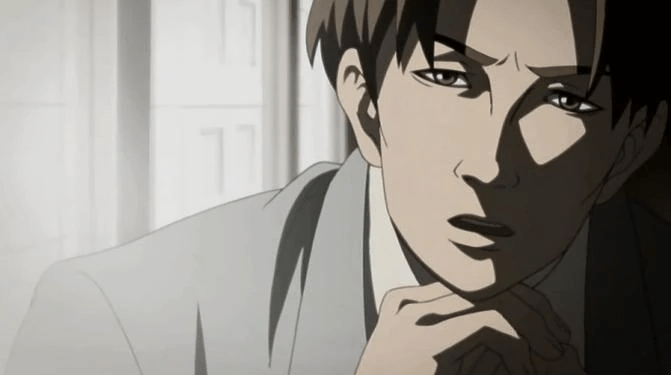
Ikari and Maniwa fill the buddy cop dynamic that I haven’t really seen since Rush Hour and wouldn’t again until Taiho Shichauzo. Ikari is the gruff, older, experienced cop who doesn’t have room for surprises anymore. His belief in the supernatural is as tight as the victims’ grips on reality and what especially makes the gears grind against each other is that his family’s future was torn apart. His wife, Misae, was expecting a child, but due either to a mishap or medical condition, she miscarried. Worse still, her health deteriorated significantly toward the end of the series.

Based on that description, she would be a prime target for the likes of Golden Bat to strike, considering he had an affinity for striking the mentally or even physically unwell throughout the series. But Misae in her final hours proved to be an indestructible show of force, refusing to let this manifestation of everyone’s darkest insecurities destroy her, even if her body is failing her.

Maniwa is Ikari’s counterpart. Young, bright, and more flexible than his older partner who’d rather stick to tradition than explore nifty and novel ideas to crime-stopping and problem-solving. While on the case, Ikari doesn’t even bother to explore the paranormal elements, writing them off as unintelligible drivel, but Maniwa examines these more closely, sometimes letting his own sanity get violently abused just to reach a conclusive answer. If it gets results I suppose… but I’m not so sure this would be advised outside of undercover work. Max Payne pushed it with his vigilantism while undercover in the Punchinello family, and the Valkyr trips were done to him than him doing it himself. Maniwa chooses to dance with the devil for a bit to parse what separates most of these cases.
Now the series does return to Sagi at the end to reveal that the pink dog mascot, Maromi, was in fact based on Sagi’s pet dog when she was a child who was run over by a car. Fearing reprisal for being an irresponsible dog owner, she makes up a false story that a random bat-wielding psycho clubbed the dog to death, and has lived with the lie for ages until she finally confronts the truth and confesses that she let the dog go. Clearly, this isn’t the series that deals with right or wrong, nor does it roll the die on its setup. Kon’s work on this was based on a bunch of ideas that were drafted during the production of some of his other movies, Perfect Blue, Millennium Actress, and Tokyo Godfathers. I’m really not well versed in anime movies, in fact, rare magmatic take: most anime movies disappoint me greatly, and that extends to modern day films like the Chainsaw Man: Reze movie. I read the manga already and as much as I wanna see it animated, when it comes to movie adaptations of manga arcs, it felt to me that a lot needed to be sacrificed to truncate it to a specific runtime. And that’s only of manga to movie adaptations; Kon’s original movies might be different, but who knows?

Anyway, Kon stated at the time that working on movies required his undivided attention from beginning to end whereas a TV series, least of all a semi-anthology series like Paranoia Agent allowed for more creativity from episode to episode. And I get that, similar to how I get some of the logic behind most anthology series, or back when they actually mattered video game DLCs and expansion packs. Nothing wrong with linear series, in fact, doing them right leaves players and in the case of film, moviegoers, with a lasting experience, but sometimes you wanna do something different.
The director of this series was promptly sacked for being 0.2 seconds late. .·°՞(˃ ᗜ ˂)՞°·.

I admit that this is the only Satoshi Kon production I can name that I’ve seen, partially or fully, but I recommend it nonetheless for the mystery thriller angle by itself. Especially if you enjoy series like Taiho Shichauzo/You’re Under Arrest or Columbo. Roughly all the details are there for you to see in real time, but to uncover each one requires close examination of each detail to a Maniwa-like level. Perhaps even re-examining the same scenes once or twice to see what is missed or will come back later in the episode or the next one. Also, red herrings. Red herrings everywhere.

Haibane Renmei and Mysterious Disappearances: Mystery Double Bill

The long-awaited two-in-one special

I put this off for a week so I could do some more research on both, by which I mean reading the Wikipedia page for one and advancing in the manga for the other. Haibane Renmei is but a short 1-cour anime series from 2002. I found out about it from the same article that introduced me to House of Five Leaves a few years ago (along with another one), and without delving into details, a friend of mine challenged me to recommend him some anime he’s never heard of. Well, he didn’t challenge me per se, but I took it as such and I figured I might as well put another brick in this anime wall I chose to build. No, it still ain’t finished.

Japanese for Charcoal Feather Federation, Haibane Renmei starts with a young girl experiencing a very vivid dream about falling from the sky. This being the only memory she has, the theme of the series is that the Haibane–angel-like beings–are named after the dream they had. Shortly after that, their wings grow from their back and they’re given halos to wear above their heads.

It was based on an unfinished manuscript by the same mind responsible for the surprisingly well-aged Serial Experiments Lain, which when it comes to trying to label it, makes it difficult, at least for me. There’s anime that are adapted from manga, which is the most common adaptation style; anime that are adapted from light novels, which is probably the second most common adaptation style; sometimes anime are home grown originals (a.k.a. anime originals), proof that the studios animating them can make something special from thin air; and sometimes anime are adapted from novels:

It’s definitely irregular for a rough draft to get a green light for an adaptation, but it’s not like it’s unheard of. Stranger things have happened in media.

Part of my research for Haibane Renmei involved looking over this blog post from 2017. The writer explains that the cult-classic series has been the topic of such fierce debate over the meaning of the series, not helped by Yoshitoshi Abe’s notoriously enigmatic writing style. As a mystery series, this can be viewed as a double entendre both due to the cryptic writing and because the only source available lies with the writer and short of booking a flight to Japan to ask him directly, I highly doubt he’s ready to share the raw words with a wider audience so the anime adaptation had to make do.

That said, this isn’t the type of Scooby-Doo, CSI, Columbo type mystery series where you’re given a puzzle to solve. It leaves a lot open to interpretation and according to that post I linked above, a lot of it tends to be incorrect. From a writer’s perspective, there’s a fine line between treating the audience like they’re five years old and throwing them out of a plane and expecting them to catch the parachute on the way down.

Is this me being too harsh? Perhaps, but the creative world is pretty cutthroat in a manner of speaking. We criticize ourselves in a much harsher tone than any other critic, yet both the critic and the artist are given a near equal amount of outside exposure so doesn’t that mean we’re both talented groups of people?

Something, something pot calls the kettle black…

I like to think of it as an art house project. I believe the late 90s to late 2000s was the era of moe and this series does something different from most shows of the era. It was the equivalent of taking an extended museum tour and filling out a survey at the end before being released to the gift shop. It’s for thinkers; the door is open enough for observers to take a peek but is neither too wide nor too narrow. If it were too wide, important stuff goes missing, but if it were too narrow then you wouldn’t be able to see the contents very well. It sits neatly in the middle and once you’re done with the series you can walk away with your own interpretations of what you think the series is about. Here’s a link to the playlist. Enjoy it while it lasts:

Channel: Jesse M

From a series you probably never heard of before now to a series you still probably haven’t heard of unless you eat anime memes like black beans: Mysterious Disappearances.

Before I elaborate on this series, I want to get this out of the way right now: giant boobs.

Alright, we’re done with that. Well, I’m done with that aspect. Explaining the fanservice in this series will honestly get redundant especially since both the anime and the manga do that in spades. The first chapter especially ends with an uncensored shower scene (spoiler alert).

As for the rest of the series, Mysterious Disappearances is a blending together of urban legend and centuries-old Japanese folktales. The name doesn’t do the series enough justice. Looking to legends and myths for inspiration, Mysterious Disappearances has it all in droves. The first episode actually drops hints from an old urban legend about the fictional haunted Kisaragi Station. Akidearest explains it further in this video below:

Channel: akidearest

Basically, a few years ago, a Japanese vocaloid YouTuber’s videos spread by way of the recommendation system and the one thing that stood out was that their username and videos were mostly untitled, making use of zero width non-joiners or “invisible characters” read only by the computer. Anyway, the video referenced an old urban legend/creepypasta that only existed at the time on Japanese forums, namely 2chan in 2004. The urban legend in question was Kisaragi Station and was about a woman who noticed the train continued on for longer than usual. She gets off at the namesake station which was left unmapped and catalogs all of her interactions and findings at the phantom station, even wandering the tunnels until she was eventually picked up by a mysterious man who quickly dropped his helpful demeanor once she took the bait. Forums posters eagerly awaited for updates that never came after that.

This was one of several references to Japanese urban legend in the anime. Many more follow as the series progresses. Unlike The Society of Gray Feathers, Dangerous and Disturbing Puzzles has more exposition baked into it. Both the manga and the anime explore the phenomena as they happen. Part of the appeal for me is the urban legend side of things. Fictional or not, these ghost stories tend to be somewhat credible even if they don’t match beat for beat. They’re the fun little stories about things that go bump in the night. The supernatural element keeps me engaged, much like when I was first introduced to The Adventures of Shigeo Kageyama: Boy ESPer.

The protagonist is the big breasted woman we saw earlier, Sumireko Ogawa, a novelist working in a bookstore. Aided by her coworker Ren Adashino and his sister Oto, the trio investigate and confront the sources of the mysteries personally, unraveling their secrets along the way.

One of the main plot devices is a droplifted book picked up by the bookstore owner himself and gifted to Ogawa on her birthday. The anonymous writer catalogued ancient poems from the real-life Manyoshu, a collection of anonymously written Japanese poems going all the way back to the Nara period (circa 750s C.E.). If read aloud, the poems act as a spell cast on the reader themselves provided certain conditions are met. The “spell” can be broken by way of reading the poem backwards, but as shown in the series, when Ogawa does so, she’s able to control the effects of the poems on herself at will.

Other important plot devices are the siblings themselves and the signs that only they can see: yellow diamonds with exclamation points in the middle. They appear whenever a supernatural event has occurred. Once the event has been solved, the siblings are shown to use anything recovered from their findings as payment for tickets back to their own home through–you’ll never guess–Kisaragi station! It all comes together! There’s a lot more to this, though I haven’t gotten that far yet and the manga is still ongoing so it’ll be years before we see where the author, Nujima, is taking this series.

What is certain though is that for those who like creepypasta fanservice and closeup shot style fanservice are going to be intrigued by the blend here. It seems quite ridiculous to highlight Ogawa’s body as the connecting element when Ogawa herself is the protagonist, but the series finds a way to make it work. Rather than fall into the age-old trap of “damsel in distress,” Ogawa being the adult amongst the children here gives her more of a leg up as the woman in charge here. You could argue that she’s technically the mother figure based on this description, but the counterargument to that is that while the three do work together, they’re not inseparable.

Scenes exist with all of them together or just one of them alone or with other minor characters. All of them are well-written with their own goals and desires and none of them feels as though they’re held up by the other. That it’s mainly psychological horror is another plus for me. Honestly, I would’ve been turned off by anything horror as a kid, but now that I’m an adult and I’ve watched a few of the classic horror movies before they were ruined by their own franchising (Friday the 13th, Halloween, Scream, etc.), I realized that there’s still better ways to horror and thriller and Mysterious Disappearances is a better example of that.

All 12 episodes are available on Crunchyroll, but if you don’t feel like watching 12 of the same old advertisements, then you already know what I’m gonna say.

Because I’m behind schedule, I doubt I can guarantee a full review of Undead Unluck season 1 by the 30th, not to mention another topic lined up was pushed back due to the research I did for these two series in this post, so instead I’ll try to get back on track either the 29th (tomorrow) or sometime during the 4th of July weekend. The next topic I have concerns a manga that never got off the ground. Here’s a sneak-peek:

Also, the recommendations should return too.