MHA Vigilantes Anime So Far

Been a while since we’ve done one of these

Out-of-schedule topics haven’t been a thing on this blog in over two months since I wrote about BLACK TORCH rising from the grave. The next topic will cover an anime I was really on the fence about watching, so take this one as a calm before the storm, so to speak. And thankfully one I’d been looking forward to for years.
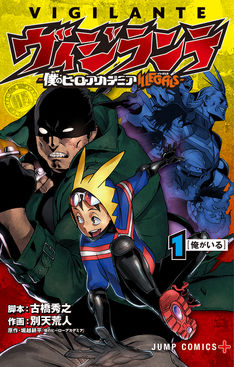
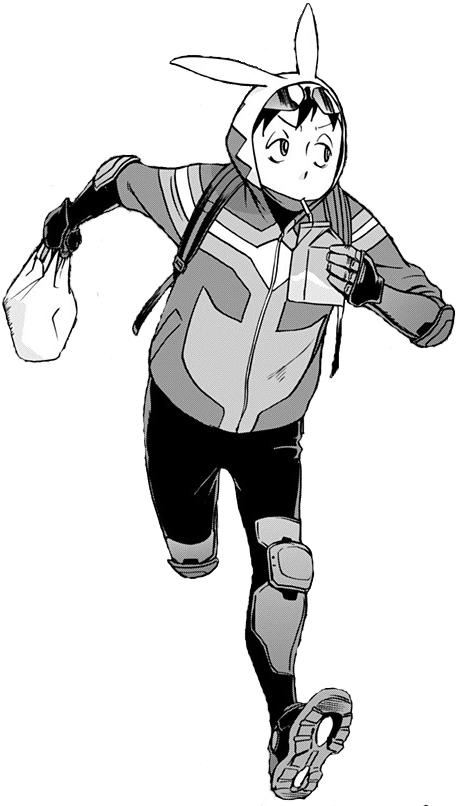
I’ve written about this manga before in the past, so here’s the cliffnotes version: college student Koichi Haimawari doesn’t fit the bill to be an officially licensed hero and so moonlights as Nice Guy in his neighborhood, as a sort of friendly neighborhood Spider-Man sans the tragic death of a popular brand of rice. One night, he and wannabe popstar idol, Pop-Step get jumped by a roving band of misfits and saved by this universe’s answer to Batman with a dash of Frank Castle sprinkled in.

Keep in mind, that that’s how the manga begins. The rest of the story covers a pivotal plot detail in the main storyline involving the Shie Hassaikai Yakuza’s use of an experimental Quirk-altering drug called Trigger, used to boost an individual’s Quirk to often disastrous results. The main tell that someone’s been using it is through their tongues, leaving them stained black from overuse. The main structure of Vigilantes is that the Pro-Heroes often can’t or (according to Stain) won’t stop smaller slice-of-life crimes as they’re expected to, so vigilantes tend to pick up the slack though under the cloak of darkness because vigilantism is illegal.

The hero system in this universe is used to denote what makes a villain, not a hero. Strict boundaries are put on heroes to stay within the law and legal limits, but villains and vigilantes aren’t bound by the same obligation. Even though a vigilante can cover a hero’s blindspots, not all of them subscribe to the same heroic ethos that binds most ordinary Pros so the legal system sees them as villains too, even though vigilantism birthed this same system. This is explained by one of Koichi’s senpai, Makoto Tsukauchi.

I’d highlight these as spoilers, but they’re more an explanation of the hero system as portrayed in all MHA media, adding nuance to a picture portrayed as black and white. Obligatory, honorable thieves, untrustworthy law enforcement; we’ve seen it all before, but to apply to superheroes tilts the picture significantly. The anime debuted last month and as of writing this is currently at eight episodes.

I cannot say for certain how many episodes or seasons it will have, but considering the cultural phenomenon MHA has become as a franchise in the last decade, it’s more than just a welcome addition to the franchise as a whole. It also fills in a few missing plot points from the original as a prequel set two years before Midoriya and Bakugo step off for UA High.

Going off the first episode, the anime opening follows the art style of the manga sticking closer to its western comic inspiration than the original does. Observe below:

Channel: TOHO Animation チャンネル

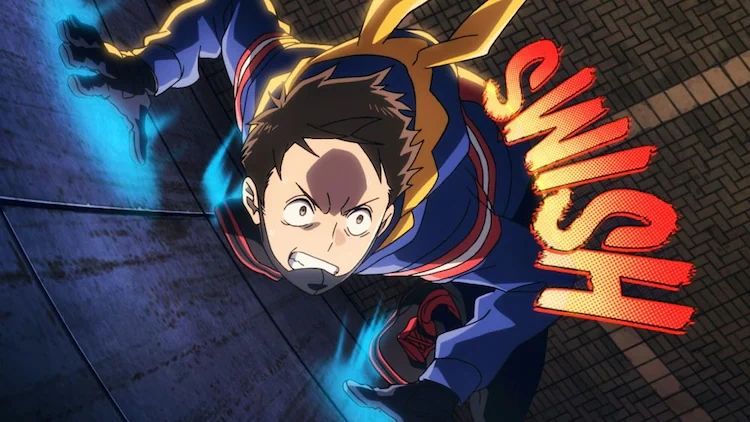
Studio BONES doesn’t miss a beat. Establishing shots of all the characters present, stylistic choices and art direction to fit them all with their appropriate themes – Koichi is shown using his Slide and Glide Quirk with the animation beginning with All Might and ending with Knuckleduster to show he’s gonna be different than his idol; Pop-Step dancing first with silhouettes of herself before they’re supplanted with fans who take heavy inspiration from Cyclops and Wolverine especially; and Knucklduster appropriately left an enigma for an upcoming reveal that manga readers already know. I made a promise not to spoil anything until we get there, so my lips are sealed and I will not ruin the surprise. The internet’s gonna lose it, I swear on it.

It sets up the anime well and I once again have to come to terms with simuldub. Growing up, most anime would take years to dub in English, let alone a different language from Japanese. Nowadays, thanks to social media, budding voice actors can contact dubbing studios, showcase their talents and through some other methods the public won’t see, they may be considered for certain roles. Voice actors have more insight into how this works, so don’t look to me for gospel in this aspect. I’m not a voice actor.

For what it’s worth though, the English VAs get the tone of voice really well. Kudos to their director. Confession: I was imagining the voices of Koichi, Pop, and Knuckleduster to be some variation of Todd Haberkorn, Kari Wahlgren, and Christopher Sabat respectively, though that may just be my own fantasy. Natsu Dragneel, Haruko Haruhara, and Piccolo walk into a bar… well, that’s just a fanfic now, but the manga gave a lot of leeway to imagine their voices until they were confirmed. Instead of legacy, the industry is giving rise to new faces. They don’t exactly have any household recognition yet like the aforementioned, but the grind of voice acting should put them on the map for future projects.

Credit: u/LolyHumter, r/TrashTaste

Characters this time are more varied and complex being on the older side. In the case of Koichi, with him being in college as opposed to high school, he’s shown to be much less insecure of his Quirk than Deku was. Granted, he wasn’t Quirkless at the outset, but we see the differences in a protagonist with a recently acquired Quirk and a protagonist who was born with one. Also being older makes him somewhat more humble in my eyes. Deku still has admirable goals, but I recall in the first episode how foolish several people thought he was wanting to be a Quirkless hero, until All Might saw him in action. I like underdog stories as much as the next guy, but there’s something refreshing about a character who doesn’t think about their powers all that much, merely using it as another tool in their arsenal.

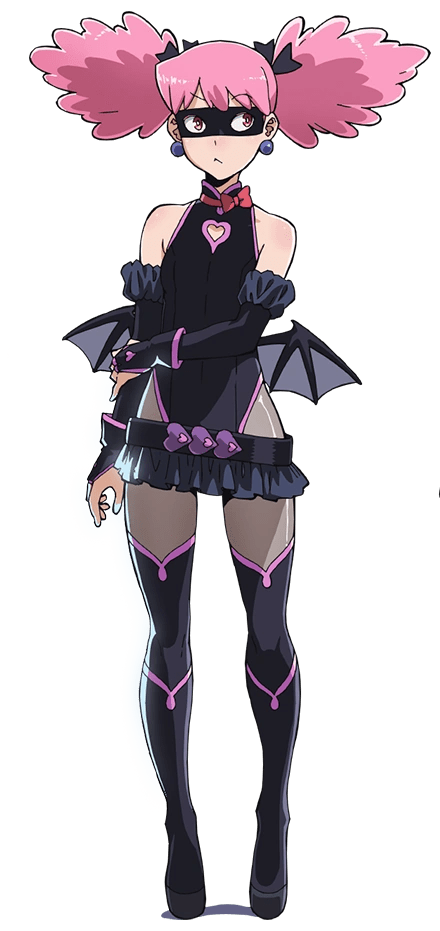
Pop-Step is written completely differently than Uraraka. Not wanting to be a hero for the sake of her family or thinking that much about heroics on the whole. She already uses her Quirk for impromptu concerts so it’d be a bit ridiculous of her to try, although in the Vigilantes storyline, she technically is one by proxy. As the youngest one, she’s in high school being hinted at being around 16 or 17 years old (despite what some online have been saying, especially concerning her choice of costume).
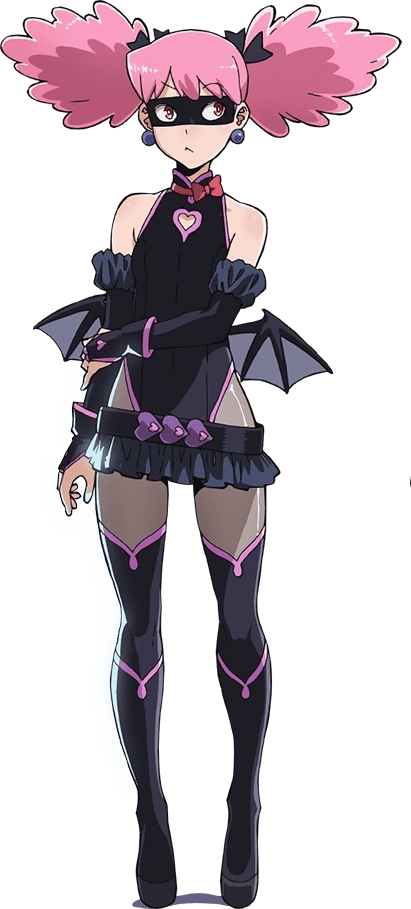
Those tights are an anime addition. Beneath that in the manga it’s all skin. The manga art shows more funny enough.
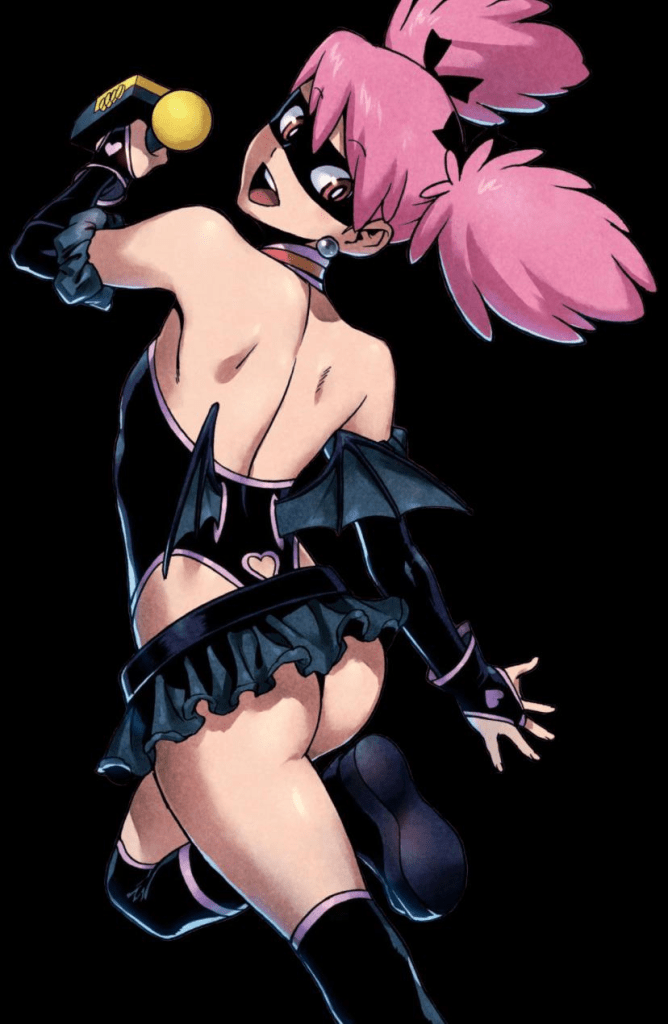
Lore-wise, this was her choice, but character design-wise, sometimes you gotta look at the writers and wonder…

But why get anal (no pun intended) about character designs? Manga readers know that Midnight used to look like this:

This costume design caused lawmakers to rewrite acceptable costume laws. If it wasn’t for that, a good portion of her career would be even more scandalous than it probably already is.

Kazuho Haneyama is instead very tsundere-coded. She’ll lend a helping hand and use her online influence to implore her loyal fans to keep a keen eye for Trigger users and encourage them to stay away from it. I’ve talked before briefly about my thoughts on East Asian idol culture, but if there’s an argument in favor of it, it can positively influence followers of a certain idol to raise awareness where it’s necessary. So Kazuho means well, but the tsuntsun comes out a lot when in close proximity to Koichi who unfortunately falls for a lot of the same traps that most would in his position when next to a tsundere. But she at least didn’t become the same type of Shonen female the genre’s been stuck with for decades.

I’m not as hostile to her as others have been, but Part I left a lot to be desired.

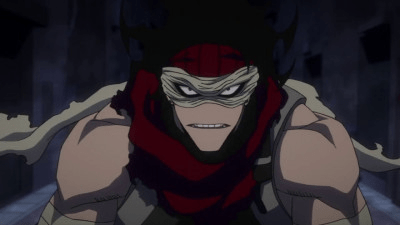
Finally, there’s Knuckleduster whose backstory is so heavy it needs to be shipped on a transpacific cargo ship. So keeping in line with where the anime is, he’s a dark gray character who lives up to the Batman comparisons even more than he lets on. Not to mention his first encounter with Shota Aizawa – better known as Erasure Hero: Eraserhead – shows that even pure adrenaline and energy can leave even the Pros tapping out for a breath of air. Coupled with the rest of his screen time and that brief encounter with just Aizawa reveals a few things about them. 1. Next to his first encounter with Koichi and Soga Kugisaki, you get more clues that he’s done this type of thing before, most likely in a past life; 2. The Pros shouldn’t rely so much on their Quirks for work, because they’ll eventually meet a villain or worse who’ll give them a run for their money (see the Paranormal Liberation War arc for more details); 3. Without endorsing his methods, Stain has a point about the Pros. Save for All Might, far too many heroes never know what they’re up against until they meet a Sisyphean endeavor, like the War arc in the main series.

On a final note, this post should be even more persuasion to check out the series in whatever medium you see fit. It’s still airing on Crunchyroll as I write this, so if you have the means to do so, check out it there. Or if you can’t or won’t for personal reasons (I won’t judge, and I can’t considering what I’ve been talking about for the better part of two-and-a-half years), you already know what I’m gonna say.

My Hero Academia: Vigilantes Adaptation Confirmed

At last!

This week’s post was gonna be about more webcomics, but I kinda already talked about that last week. Country of origin be damned, there’s distinction between manhwa/hua and western webcomics, but there’s not a lot of difference. So instead, we’re following up on a nearly 2-year-old newspiece:

Funny enough, when the original ended a few months ago, many felt more cucked than the central character of an NTR hentai; part of this has to do with the gap in Japanese culture and western culture as well as the assumption that My Hero Academia was a western-style superhero-themed manga. To be fair, it presented itself as such playing homage to DC and Marvel, but the application of Japanese characteristics explains why most western readers were let down by the ending. What I mean is, (spoiler) Deku becoming a teacher instead of staying as a Pro-Hero feels like a slap in the face to over a decade of build-up and promise due to the punching bag most teachers in the west are compared to East Asian teachers who are held in the same regard as historical figures and heroes. Teachers in the east are seen with the same reverence as, say, George Washington or Winston Churchill.

That said, much of the MHA fandom was conflicted over how it ended. Personally, I initially gave it praise for not falling into the same traps as DC and Marvel have in the past (re- everything, f[gasp]ing hell), but over time it became a bit too much to follow. I lost track and playing catch-ups made me feel like Samurai Jack being sent to Aku’s future.

Vigilantes, on the other hand, had a tighter focus. Smaller cast, more mature atmosphere, a deceptively loose connection to the main series through characters, concepts, and/or key items, and a darker tone than the original’s high school setting. Summarizing s[neighs]t I said two years ago, college student Koichi Haimawari starts off as a friendly, neighborhood Spider-Man-like archetype doing it because it’s the right thing to do; he meets wannabe pop-star and tsundere-in-training Kazuho Haneyama and before the pair are nearly violently assaulted by a trio of anti-villainous thugs, Japanese Batman-like Knuckleduster knocks their skulls out of place in search of an illegal Quirk enhancer and offers (read: practically threatens) to tutor Koichi in the art of vigilantism. Much appreciated, but a date with a neck brace initially feels better than Peter Parker becoming angsty again.

I jest, it doesn’t get to this level, but it does explore themes that the original doesn’t delve very far into. It wrapped up its story with a neat and tidy ending, and is an interesting addition to MHA on the whole, along with the light novels, and spin-off, yonkoma parody. Yeah, it’s become a franchise since debut.

It was in 2023 where the rumors of an adaptation first circulated and I did report on it at the time, letting it sleep until I got official news from the horse’s mouth. Fast-forward to mid-January 2025, and the rumors are facts: My Hero Academia: Vigilantes is set for a spring 2025 release.

As far as reputations go, the fandom coupled with the writing of the last two quarters of the manga seem to have colored many people’s outside interpretations of the series. Not that it had a good leg to stand on initially; for all the praise it gets for helping to popularize new Shonen tropes, if you just got off a binge of the big 3 anime of yesteryear and expected badassery on every corner, then I can’t blame you if you were ever disappointed. Then again, the original’s deconstruction of Shonen tropes was what made it seem so fresh at the time. Deku doesn’t start off as a badass–instead he’s proof that heroes are made, not born. He’s basically what happens if you tell someone in the past that this scrawny weakling would become the best of the best in ten years time before being laughed out the room.

And that was an easy sell at launch. It and Demon Slayer have broken the mold with more empathetic protagonists, and as such have garnered their own opinions on such a trope. Koichi, on the other hand, doesn’t exactly have the most unrealistic goals imaginable: college student by day, local helper by night. At the risk of burying Deku under the cemetery, Koichi’s no starry-eyed kid with his head in the clouds. Being an All Might otaku, he does secretly dream of being a hero, but is content with being anything but the hero.

Over the course of the manga, this begins to morph into something more complicated tan what was originally stated. More characters, more intrigue, more mysteries unraveled; it makes the L.A. Noire plot look like a retelling of the Three Little Pigs. And out of respect for you, the reader, I refuse to spoil the main plot of the manga.

But what about the upcoming anime? Well, the manga fell into a bit of controversy over the depiction and treatment of select female characters, namely Kazuho Haneyama, alias Pop-Step. Notably her vigilante costume.

As you can see, Kazuho, who’s around 16 years old in chapter 1, wears this as her costume. The Pop-Step persona is meant to be a cutesy imp-like creature which, on reflection, makes me think of Ironmouse in a lot of ways. The original series had people crying foul over Horikoshi’s decision to have Momo show so much skin for her quirk to work, but in a weak defense, that was one of a few ways to get it down. (Some headcanons depict her as a shy exhibitionist unlike Midnight, IYKYK.)

Pop-Step has less reason to show her butt here. I had brushed it off as “animanga tropes” while I was reading it, but after some thought (and time), this doesn’t look very good. Couple that with the initial panels of her about to face a nasty assault or harassment and the criticism is as solid as Snake. Trust me, though, it does get better as the manga progresses, and to answer to an upcoming backlash, the animators have considered the following for a redesign of her costume:

Tights! Will it work for the anime? Time will tell. Does it work for me? I turned my brain off and let the story guide me each time I read another chapter so I didn’t put much thought into it until way later when the manga ended. For my recommendation, you’re better off letting the manga do the same and speak to you then go in with any expectations whatsoever. Even what you know about the original series is gonna get tossed out the window at the first panel. You know my shtick by now. Manga hosting pirate sites, physical volumes, etc., etc., though the former may help you get up to speed considering it has significantly less volumes and chapters — 126 spread across 15 volumes VS the originals 431 spread across 42. I have yet to see a box set of the whole franchise, but it’s only a matter of time before it gets a Naruto-like 3-in-1 omnibus manga treatment.

YouTube recommendations! I’ve been struggling to find some channels to have you all check out largely because what I watch these days is incredibly varied and I don’t like throwing people in at the deep end. I do still want to keep sending stuff your way and my crystal ball sees me recommending a series of sorts whether its on YouTube or not. Some candidates have had to axe their channels due to unwanted outside attention, others have simply moved on. And that makes this difficult.

This time, I thought I’d share what I’ve been watching. I’ve only got a few lined up for February now, but as time goes on I may do what I did in 2023 and do a bi-monthly recommendation system compared to what I had going on last year.

A channel that has my eyes is Stiff Lip Supplements. A series of humorous Army MOS ads masquerading as a satire, it’s a company whose videos are short form Zyn advertisements. You don’t necessarily have to be a servicemember or Zyn/snu user to get the gist of their humor. They know damn well that what they’re selling isn’t a miracle cure for the usual daily bollocks, but do offer to alleviate the headache only slightly. If you need a quick chuckle or you’re thinking about buying some of their merch (which does include apparel), the link is in the first line of this paragraph.

My Hero Academia: Vigilantes Might Get an Adaptation

An overlooked spin-off may finally get some attention

In my notes, the topic of this spin-off was in the pipeline for at least a few months now, but thanks to recent rumors, it’s possible that the fabled adaptation may be entering its production stage. And as a follower of the series for a time, this has been a long time coming.

The original My Hero Academia launched in 2014 by mangaka Kohei Horikoshi, and was given an adaptation about two years later which, as of writing this, has wrapped up its sixth season a few months ago. Additionally, it’s had a series of light novels, video games, associated apparel and other accessories, and a pair of spin-offs in the form of the aforementioned Vigilantes and a chibi four-panel comic, both of which are much shorter than the original MHA manga which, as of writing this, is nearing 400 chapters and over 30 volumes. All things considered, since Horikoshi was a fan of Naruto growing up, I think it’s safe to say that if part of the dream was to have the same impact that Naruto had in the early 2000s then on that front, he’s succeeded.

The Vigilantes manga meanwhile sat in the back, being released in April 2016 and running up until May 2022, concluding its story in 15 volumes, so it can be cleared at a faster rate than it would take to catch up to the original manga from the beginning. The protagonists are Koichi Haimawari, a college student and part-time vigilante who mostly patrols a single area of Tokyo under the alter ego of the Crawler, jokingly mispronounced “Cruller”; Kazuho Haneyama, the trademark, pink-haired tsundere high school student who moonlights as an impromptu pop-star under the guise of Pop-Step; and Knuckleduster, a crusty Batman-like archetype, who embraces his quirklessness and dishes out justice the old-fashioned way.

At the outset, you can see the differences between the original’s Izuku Midoriya and this one’s Koichi Haimawari. Izuku, or Deku, began the story quirkless and with zero prospects to become a world-class professional hero until his idol, the world’s Number 1 superhero All Might, observed a hallmark of bravery and allowed him to prepare enough to inherit his quirk One For All, which has been handed down through generations of world-class heroes. Koichi, on the other hand, has a quirk called Slide n’ Glide which allows him to glide around and connect to flat surfaces with three points of contact. Kazuho’s quirk is leap which allows her to jump at great distances; this allows her to live out the idol persona she puts on.

Not just limited to these unofficial heroes, pros from the original series also make an appearance to include, the big man himself All Might, Shota Aizawa, Midnight, Present Mic, Detective Tsukauchi and several more, most of these folks being pros before teaching at UA Hero Academy. Most notably, the tone of Vigilantes is darker and a bit more mature than that of the original as it focuses on a college student this time around than a high school class. As I wrote above, All Might is there, but his presence is more of a backdrop than as a prominence. Koichi’s part-time hobby as a vigilante puts him in a tough spot legally. The original manga introduces the pro heroes who are licensed to step in alongside the proper authorities like the police and courts, and the villains are their polar opposite, but the Vigilantes manga clarifies what this means.

When quirks were first discovered in the MHA world, the laws were nonexistent. Vigilantes were the original unlicensed heroes who stepped up to answer to the rampant chaos borne from the emerging quirk era. The law eventually came up, not to explain the makings of a hero but to classify villains. The first place to have laws written on heroism or villainy was the U.S. state of Rhode Island. Of 189 vigilantes whose candidacy for heroism was up for review, only seven were allowed to continue on as the U.S.’s first pro heroes. The issue for the other 182 candidates was that they didn’t have the qualities that made the trademark hero and either continued on as vigilantes or villains. Ironically, the law’s adherence to licensing puts vigilantes in the same spot as villains despite vigilantes being the origins of the laws and most vigilantes running counter to full-blown villainy. The causal loop is definitely not lost on the manga though.

Burgeoning heroes who find themselves in vigilante limbo though aren’t hopeless thankfully; there’s a program that allows pro heroes to recruit vigilantes as sidekicks and incidentally, some big name pros in the original began as sidekicks before finding their own paths in the hero world. Vigilantes also has a sort of slice of life element to it as well. If Koichi was up for hero candidacy, there’s no shortage of witnesses to his do-gooding in the immediate neighborhood, as well as some pro heroes who can give him a leg up if he needs it. There’s glimpses of him aiding people with minor inconveniences just as he assists his fellow vigilantes and pros in stopping villains in any capacity.

There are also several plot points in the original that have origins in the spin-off series. Another notable difference between Deku and the Crawler were how they both deal with their lots in life: Deku’s aspirations would’ve been impossible even if he had a relatively worthless quirk; meanwhile Crawler’s initial poor handling of his own quirk didn’t really stop him from attempting to help, even if it was with a stray dog (that’s sort of a joke, there is a dog in trouble later in the manga; not so much of a spoiler since it gets resolved in about five panels). Deku obviously starts off in high school with his head in the clouds; Koichi tends to keep it realistic and is more in it for the good of the locals, so if he went the pro hero route, the money wouldn’t be his main motivation, though the same would apply to Deku.

The Vigilantes manga’s place in canon can be interpreted as a sort of foil for the checkerboard presentation of the main plot. Vigilantes as unlicensed, illegal heroes are shown to be a necessary evil in the law’s eyes, and a digestible aid from a practical standpoint. With pro heroes, there’s laws that rein a hero in from overstepping the established boundaries, but vigilantes being unregulated could go a step further to prevent an escalation before it becomes a problem for the pros, which turns out to be Knuckleduster’s own philosophy in the manga.

Personally, I welcome Vigilantes as a bit more grounded in its approach to what the original is doing. It’s still a Shonen series at heart, but in practice it takes things a bit further with an older, more mature protagonist who is still optimistic about his future even though he’s buried pretty deep in the gray muck of hero laws. It also has a bit of an edgier portrayal that would really challenge the cast of the original MHA, but not grotesquely or irreverently as Amazon’s The Boys. In the MHA world, Homelander and A-Train would be high on hero killer Stain’s crap list.

If the rumors are to be true, then a notable rarity in anime production would be the adaptation of a complete manga. The only other case that comes to mind would be that of JoJo’s Bizarre Adventure reaching a successful adaptation in 2012, one year after the eighth arc of the manga was being written. That said, all we have are the rumors, so it might not be true until an animator or someone else in the industry has more concrete evidence of an adaptation in the pipeline.

For now, the chapters are available on Viz Media and Shueisha, and its 126 chapters are spread across 15 volumes. To my knowledge there’s no collection or box set to speak of for the lesser known Vigilantes arc, but don’t let that stop you from making your own. For my take, it’s a B+. Avoiding spoilers, there are minor instances that could’ve been reworked or omitted, but the rest of the time it’s a solid manga.

To go along with this overlong recommendation wearing the mask of a blog post is the last YouTube recommendation for the month of June. Adding onto the cadre of Trash Taste affiliates and allies is the YouTube channel Abroad in Japan.

https://www.youtube.com/@AbroadinJapan/about

The channel and other associated Abroad channels are run by British grammar educator and YouTuber Chris Broad who first moved to Japan in 2010. Ever since, he’s made video after video on daily life in Japan going by prefecture, sights to be seen, activities to perform, and generally places to visit. While not a full-blown weeb, his guest appearances on Trash Taste have introduced him to several anime series and he has revealed to the TT boys that his favorites included most of Studio Ghibli’s lineup and anything directed by Hayao Miyazaki or Satoshi Kon or even Kenichiro Watanabe to name a few directors. Normally, when it comes to Japan-based YouTubers, one of the first people to go to is someone who’s native, but spending over a decade and change in Japan should put him in the same room as other Japan-based YouTubers, especially since he’s been up and down the country.

If you’re still looking for a slice of Japan, but you’ve had your fill of anime, Chris Broad’s always got a video or series up, to include the likes of Dr. Jelly as part of a collaboration with The Anime Man, and Wacky Weekends and Journey Across Japan done mostly in collaboration with CDawgVA.