
The story of one of the best demon hunters with a supplement
Making another breakthrough in legacy video game franchises this time with Devil May Cry, the story of Dante, a supernatural gun for hire who hunts down every paranormal entity on earth to keep these forces from invasion and conquest. In his arsenal are a pair of handguns lovingly dubbed Ebony and Ivory to reflect their coloring, one blued and one chromed, so if you were in the market for a pair of collector’s items, you’ve gotta make sure Dante’s dead enough to pilfer his weapons. A sword is also attached to his back and seems to do roughly the same amount of damage as the buster sword from Final Fantasy VII.
The series debuted in 2001, spearheaded by Capcom when they were still respectable and didn’t pimp out the Resident Evil series over the course of the 2000s. Now let me see if I’ve got this right: a man named Dante ventures through hellish conditions to bring the light of the lord to humanity. Yes, the independent game wiki and associated Wikipedia page both mention the Divine Comedy as a source of inspiration, but unlike Dante Alighieri’s satire of the Holy See, Capcom’s crack adds 2000s edginess that’d be replicated in the likes of God of War and Max Payne, adds a skills-based combat system mostly based on your ability to move and shoot (though less balletic John Woo/Matrix-like than Max Payne, and more Soul Eater’s Death the Kid sans the strong pinky action).

Kid must do push-ups with his pinkies to be able to pull this off
To add on to the God of War aspect that would define its Greek Saga (and to a lesser extent Norse), the game features light puzzle-solving, as well as the fixed camera angles that were a staple of Resident Evil until at least 2005’s Resident Evil 4. And not dissimilar from God of War, the fixed camera can sometimes be a little uncooperative especially in combat. At least it’s not enough to make you wish you could go back in time and heavily scrutinize the dev-team for this. And whatever complaints there were at the time were addressed when the games were remastered in HD by 2018. So rest assured, the franchise is still kicking.
Funny enough, I recall a cardboard advert of Devil May Cry 4 back in 2008 featuring deuteragonist, Nero…

I’m still new, as I thought this was Vergil at first
…and sadly I was way too broke at the time to get it. My PS2 was still marching on and I wouldn’t see a seventh-generation console until 2013… when it was ending. Coupled with console exclusivity and DMC would enter my life yonks later by way of PCSX2. Similar to my introduction to the Yakuza series which I wrote about here.
As of writing, my interpretation of the series is more browsing the Wikipedia page for reference as I just started exploring the game. I at least wanna get through 80% of the first game though before I start lore dumping, just so that I know I understand the plot. Still a recommendation—that goes without saying. It’s old enough and developed enough to garner new players, myself included, after many years. Maybe a future post could compare the original and the remaster, something I have an idea for regarding Yakuza and the Kiwami games.
So until I learn more about the children of Sparda, let’s move onto Flash games.

I’ve waxed poetic in the past about my lovely childhood with Flash games and directed you viewers to an archive of most of the games that were sacrificed the same day Flash died. Be it CQ or staff duty in the Army, when it comes to graveyard hours, I’ve got as much time as can be spared, plus the weekend and recovery to rediscover what all those hours on the computer were dedicated to in between my scheduled assignments during school and what was allowed during day camp depending on what days had the fun counselors and what days had the wet blankets. The fun ones literally said, “Anything but a chat room,” and the wet blankets opposed violent video games and looking at what I was playing, many of them were slightly north of bloody and viscous, but thankfully for them not bloody enough for Mortal Kombat.
So, Tiberius, what did you rediscover? Several things I’ve played before on the functionally vegetative Stickpage among some others. The one that a friend introduced me to when we were around nine years old was the Sift Heads series.

This was peak at one point in time
I’ve mentioned this in passing before on this blog, but now to unpack it in detail. By now, it’s a franchise accessible on any device that allows you to game from the beefiest, sexiest computer Best Buy or other stores like JB Hi-Fi can give you, but it didn’t begin like that. If the Flash Games Archive or the developers are honest about the game’s history, the series of stick-figure shooter games debuted in March 2006, featuring protagonist Vinnie, an ex-mafioso taking scores in the Windy City by way of lightspeed boring machines for your brain. $5,000 please.
Performing a series of contracts for the highest bidder, Vinnie shows himself an effective killer, and when he’s offered a chance to become a full-time mafioso, he declines, declaring to work solely for himself. Freelancing gives him the flexibility to choose his contracts. As a downside, this means that turning down the wrong people makes him popular with the wrong people, like Max Payne, only there isn’t a cemetery plot dedicated to his dead family because his wife got a dossier from a morally absent pharmaceutical company, so Vinnie can still call Chiraq home and travel the world in search of heads to sift.
The third and fourth installments add more lore to Vinnie to go along with the plot progression, but the prequel, creatively numbered 0, goes into his past. The short version is that he was born in 1975 and had been killing things from day 1. A cat that mauled his favorite teddy (funny how he remembered that considering memories don’t usually start developing until the age of four or so, unless his mother told him), a toddler who played with his favorite toy car, and an annoying seventh grade teacher who was killed falling out of a two-story window. Tried to fix the AC, should’ve called the repairman; they still had them by 1987. By 1993, 18-year-old Vinnie, driving in a Plymouth Barracuda with an open bottle, is pulled over in a roadside stop. Speeding off irks the Chicago PD who tragically lost their lives in a car crash. Yeah, happened a lot back then. Now all of that silliness out of the way, the late 1990s sees Vinnie accept his first contract. The son of a crooked cop is kidnapped by a major drug smuggler and Vinnie needs to pop the guy and free the son. By 1998, the smuggler is no more and the dirty cop’s dirty son is free as a bird.
New millennium, 2005. Another major contract is taken and Vinnie, now 30, has gotten more creative with his hits.
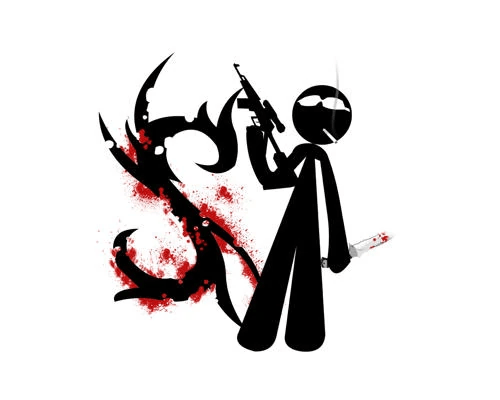
Probably the best bounty hunter in Chicago
The next series of games sees a few chickens come home to roost, with a relative of a contract in Japan tracking him down and attempting to kill him. This character is known as Kiro, which doesn’t sound like a name that would be found in Japanese, more so a romanization of “kiroguramu,” but I’ve not got any influence over the series, so we’re rolling with it. An ex-yakuza on the run from his own family plus the triads for a misunderstanding that got a lot of people killed.
Vinnie has the opportunity to kill this guy but instead spares him. No one put a price on his head, so he’s not worth the trouble. Guess we know now where his priorities are. If there ain’t no money, this s[guns]t ain’t funny.
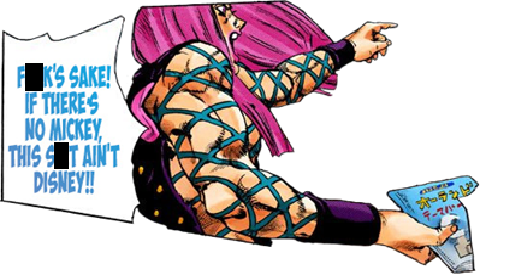
Spoiler for Stone Ocean: the anime wasn’t able to include this scene. Disney’s lawyers are too strong.
AFAIK, every game with “Sift” in the title is archived on this site, so feel free to explore what makes these stick figures so compelling. And on that note: Johnny Rocketfingers.

Seems this was re-released on Steam, I didn’t know that ¯\_(ツ)_/¯
Crack-smoking, swears-using, drug-dealing, beer-swigging, cigarette-smoking; Johnny Rocketfingers doesn’t play games despite being the protagonist of one. An older game from 2003 (I didn’t realize it was that old either), Johnny boy is asked by a screeching harlot to recover her daughter from hoodlums for a price, enough to buy him a truckload of crack. That’s not a joke, by the way.
The game has branching dialogue paths, but only one path is canon while the rest are there for s[lighter]ts and giggles. Illusion of choice? To an extent, but you can explore the non-canon choices if you’re curious.
So, Johnny agrees to get the girl back for a price and goes on an adventure knocking down hoodrat after hoodrat in creative ways. A cat to maul a bouncer, a doll to distract a guard, a can to distract two more guards and an action sequence that results in Johnny getting held captive and tied to a chair.
But that’s all malarkey after busting out and delivering a “child” to the woman in exchange for that sweet, sweet crack money. But the gang catches up to him and I guess Chiraq starts to resemble Iraq post-insurgency with bodies littering a city street.
And wouldn’t you know it, Johnny Rocketfingers has a sequel with more to the point-and-click Choose Your Own Adventure style of gameplay. There’s more interactions, more people to interact with, things to collect and more. What’s more, it’s in color as well so we see more and more how ridiculous this simply-drawn character looks next to more detailed NPCs.

Being in a game doesn’t mean Johnny plays them
Lover of puzzles and the crack epidemic’s immediate effects Johnny may be, he can’t stop messing with the wrong ones. Everyone knows better than to rip off a dealer, but leave it to this guy to straight up rob and try to stiff the guy. Consequences come a-knocking when Johnny mid-swig is surrounded on all sides by three Knicks rejects. With a broken bottle in one hand and ashes in the other, all three litter the floor of the bar and Johnny drives off while the drug dealer’s henchman calls the boss in a phonebooth, which simultaneously dates the game and adds to the character of the environment. Side note, I always wanted to call someone on a payphone, but there were obsolete by the time I was grown.
The next morning, Johnny gets a knock on the door of his rundown apartment in the projects (my, the memories of my childhood flood at the mention of that) and the drug dealer’s goons aren’t playing. The rest of the game is spent gathering information on these guys through roundabout favors, or favor, for there is only one that matters. Talk to the hooded dude hanging out on the corner and he’ll tell you what he knows—vaguely—if you recover his Zippo lighter.
While doing that, Johnny commits random acts of theft, vandalism and robbery of a parking meter (the old-style ones for individual parking spaces on the curb), force-feeding seltzer to a pigeon to get into its nest, boozing up a bum to take his pocket change; this all sounds random the way I’ve written it, but it all adds up in action.
Getting the Zippo is the interesting part because it’s in a storm drain guarded by a sewer gator. Yes, that’s merely the projects in Brooklyn or the Bronx, but home pride refuses to let me take the piss out of NYC, even if it could use it. Johnny arms himself with a rusty pipe in an attempt to get the gator to f[roar]k off, but the leather-headed bastard is a stubborn bitch. It corners Johnny in a drainage pipe, but finagling with tools dug out of the rubbish bins of the city get him some trinkets to try to open the drainpipe and send the gator flying.
Patient or foolish enough to toy with his food, but anyway, the gator is out, and we find that this dragon was guarding a treasure trove that Johnny would never get his hands on. And looking at where he lives and how he lives, that much weight in gold doesn’t know how to shut up; the boy’d get clipped if he had even a dollar on hand, never mind valuable Civil War bonds. The real prize is the Zippo, which, when recovered, is the price to pay for information on the main antagonist faction, Thug Inc. If you think it sounds dumb to name an organization like that, this article about Murder Inc. begs to differ.
Budget Slim Shady doesn’t reveal much about the organization. For the most part, their location is a well-guarded secret, but one of their spots is in a certain part of the city. The coins collected from the parking meter are used to pay for bus fare and before Johnny disappears to knock some skulls around, Dollar Store Eminem is revealed to be a Thug Inc. member by way of the ring on his finger.

Something, something insider threats and all that s[sparks]t
To cap it off, this game’s sense of humor has you walk into an obvious trap, pointed out by—and I’m not making this up—a giant, glowing sign that reads: “This way to gang hideout.” Luckily, this is a game or the cops would be all over it, but then again if the dealer is as powerful as portrayed then he’s probably this universe’s Big Smoke, with a section of local PD in his pocket… or just confident no officer would look too heavily into the slums. Johnny walks into the alley, playing it Bogart, when he’s surrounded by similar looking thugs to when he was at the bar the other night. He survives the onslaught until the big boss comes back with a gun in hand. This time, the boss doesn’t survive and gets himself capped, knee capped that is. Then at the end, Johnny’s at the bar again and another chicken returns to roost. The same woman who got the circus freak in the last game hires a real PI (should’ve done that in the first place, dumb ho) to beat the f[knuckles]k outta Johnny and the credits roll.

Unstoppable
He was found dead at 32 from a crack and speedball overdose. The bartender barely missed him. /j
The last Flash game that I wanna close off with is based on another Flash game featuring a semi-famous character. Called Andre’s Adventure: The Quest for the Hammer is based on a similar beat ‘em up game called Combo Factory, and I recall Andre being a central character in that game in mid-2010, though he’s appeared in different games and animations at the time.

Standard fare, pointy-clicky, attack-y the baddie; Andre’s trademark hammer has grown legs and walked away, and he goes through some kind of supernatural militia to get it. The enemies themselves aren’t fully supernatural; they’re all regular dudes with guns. The supernatural element comes in the form of zombies and Andre’s dark clone: Erdna. If you’ve played Combo Factory, you might notice that the moves used against Dark Andre are not at all dissimilar from those in that game, suggesting either some of the programmers who made that game also helped develop this one, or the devs, while different people, were paying homage to a stick figure icon of sorts. Either way, it seemed to have been a collaborative effort back then. The impact of this orange supernatural crime-fighting stickman are definitely lost on today’s internet, but until I get those mind control Chum Bucket helmets from the SpongeBob movie, I can’t speak for anyone but myself when I say that this one was a classic.
They’re all available on the Flash Archive site and function as they did back when computers were cathode rays and bulky motherf[typing]kers, so those of you who weren’t around or were too young or just old enough to experience these in their halcyon days and want a hit of nostalgia, give it a go when you’re able.
The end of the year is on the horizon and the last few posts before 2026 will be a review of some animanga I’ve viewed and video games I’ve played this year. Not all of them having released this year, just things that I didn’t play until this year if that.
 Opinions on Entertainment