Genshiken: A Full Review*

Well, more episodes to cover at least

Gonna have to be entirely honest here, the timeline I gave myself to fully watch Genshiken couldn’t be adhered to. Life got in the way. C’est la vie. But now that I think about it, having covered series before only partly, halfway, or most of the way through, it got me thinking that I don’t necessarily have to complete a series to review it. I think I get more mileage if I watch enough to understand without necessarily having to complete the series. Completion does help, but to quote Jack Torrance, “All work and no play makes [Tiberius] a dull boy.” Now to the review.

It wasn’t long ago that I caught this anime by way of one of the anime subreddits and in that clip, four otaku speak wildly to a normie about the beauties of a niche Japanese rape game.

Not necessarily a turn off for weebs, if the Redo of Healer’s overwhelmingly female fanbase is any indicator and certainly not one for me as I ventured into this anime expecting more off-the-cuff conversations and it’s a lot more mellow than that clip would lead anyone to believe. As I’ve said before, it’s an anime about a quartet of otaku, sometimes joined by the sometimes Y otaku who has himself a girlfriend hellbent on shaming them into being normal. As a weeb, I take offense, but knowing what I know about the internet when this anime was on air in 2004, she wasn’t the only one yelling this from the heavens.

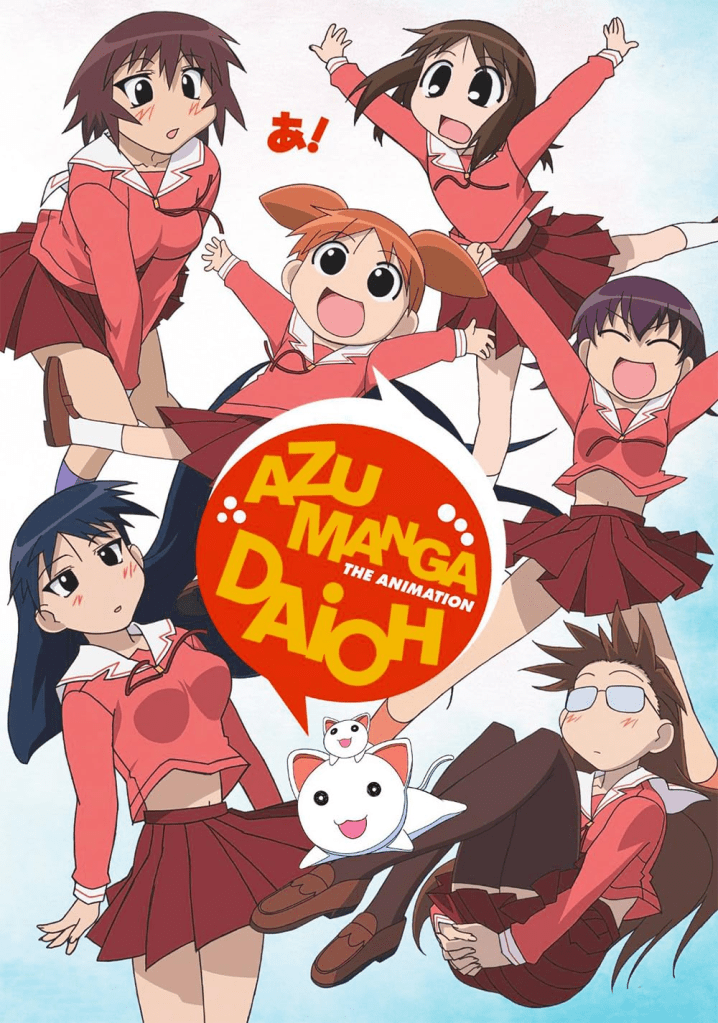
Further, even I have my limits on my own hobbies, though limit doesn’t necessarily mean quit. Moderation is the key. So as I watched more of Genshiken, the more I saw of the slice of life aspects, similar to shows like Azumanga Daioh, Lucky Star, and K-On!, but instead of a multitude of cute girls doing cute things cutely, it’s a bunch of college dudes taking half the share of the oppression shared by gamers because they were brave enough to say no to the rat race by engaging in their hobbies. But it does share a similarity with the aforementioned series, namely progression. Azumanga follows the girls throughout high school; Lucky Star does the same even if it’s famous for talking about nothing, and K-On! adds to the roster in the form of Azunyan, weak to the power of the headpat.

Credit: r/HeadPats, u/BTN099

The slice of life genre has its detractors who balk at the idea of a show about f[pages flipping]k and all, but as someone who enjoys many genres SoL being one of them, it’s a nice break from all the methamphetamine fueled action found in Shonen or the isekai singularity. I like beating up ghosts or searching for the One Piece or defeating space Hitler as much as the next guy, but I don’t always want to see that. Something something variety, something something slice of life.

Besides, Genshiken is a series that speaks to weebs because it’s about weebs. You definitely have nerd friends and may yourself be a nerd in some aspect, especially if you’re subscribed to this blog or check in every week. We all have that circle of friends who geeks out over the same things. I had mine in middle and high school and I met mine both times I was in basic training and when I was in AIT, and that passion turned from video games to anime (but of course, games are still a major part of my life; I’m currently building a gaming PC).
Credit: Naumovski

The passion is what speaks to me, this collection of nerds coming together to discuss the important things in life, such as Oppai, Medium or Flat — which is a trick debate because all size makes the wood rise, especially when paired with thicc thighs that save lives. I do recall that rant on the character of Saki Kasukabe and her intense criticism of the medium of animanga as a whole. Watching further was the right choice and I do recommend continuing the series in whichever form you find best as further episodes see her eating her own words every time she gets humbled.

No one can be this dedicated to animanga, you say? Well, conventions beg to differ. Childish, you say? Well, yesterday’s weebs are parents now — see Latin America’s love of Dragon Ball for more details. Women are definitely not interested, you say? Well, not only does my comment about Redo of Healer having a massive female fanbase stand tall, but so does a new character introduced in Season 1: Kanako Ono:

Makes me think of Tomoko Kuroki from WataMote.

Beyond that, Genshiken is a chronicle of passionate animanga geeks whose love of the medium is not tempered by naysayers and is surprisingly large to newcomers and tourists. Once again, for those who wish to view the series, I implore you to find whatever piracy site works best for you. Most anime streaming sites (read: Crunchyroll) aren’t guaranteed to have the full series.
Genshiken: First Impressions of the Otaku Anime

Before…

I’m still hard at work at doing the research necessary before I fully write about Genshiken as I’ve only watched two episodes so far. By the time I’m done (ballpark estimate: mid-October at the very least, god willing), I hope to have completed most of the first season. For now, allow me to supplement you with a general impression based on the first two episodes.

The manga started publication in Monthly Afternoon magazine in 2002 in Japan before getting licensed by the Kodansha library for release in English. In online discussion, otaku has fallen out of favor in recent years mostly supplanted by the word weeb but for the time frame we’re observing, otaku would make sense for the series as anime was breaking ground in the U.S. and U.K., but not nearly enough to get the worldwide traction it has right now. It was an underground niche back then; otaku (country of origin notwithstanding) were to the general populace what JoJo’s Bizarre Adventure were to otaku.

Genshiken gives a somewhat appropriate insight into this by way of multiple perspectives: the hardcore otaku who can boast to have the original Astro-Boy manga and the outsiders who believe everyone grows out of their hobbies eventually. Side note: if that were true, then we wouldn’t know people who’re still reading Harry Potter or watching Star Wars. Source: me, emulating the older Mortal Kombat, God of War, and Naruto games.

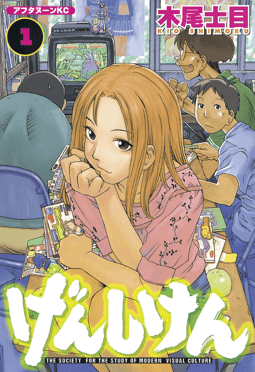
The name in Japanese is a shortening of the full title: Gendai Shikaku Bunka Kenkyukai or “The Society for the Study of Modern Visual Culture.” If reddit was around when the manga debuted, these guys would be gods on the anime subreddits. Speaking of which, a clip of the second episode was how I found the series. Going over the English translation of the name, you get the impression almost that the runners of this animanga club think themselves high and mighty when they’re just another flavor of nerd. And as a nerd, they kinda stopped being special around the early-to-mid 2010s.

It’s easy to say that now since anime has gotten pitifully easy to access, but going back to the late 1990s and early 2000s, your best bet was the VCR or somehow knowing the guy who makes regular excursions to Shinjuku’s and Akihabara’s electronics zone. So I can excuse the elitism in that regard. The central characters in this club mostly fit common stereotype of the era: Harunobu Madarame, the eccentric leader who will defend his tastes to the ends of the earth no matter what; Soichiro Tanaka, the less eccentric, but still enthusiastic one; Mitsunori Kugayama, the gentle giant who speaks with a stutter; joined by newcomers to the club, Kanji Sasahara, Makoto Kosaka, and begrudgingly Saki Kasukabe.

You know, it’s a 2000s anime if a girl is on the cover, even if thematically she’s an improper fit, which was why I claimed that Saki reluctantly joined Genshiken. Slight spoiler: the first episode shows her having a smoke in a train station (something I believe Japan illegalized over time) and telling some dude to get bent before getting all giddy after seeing her childhood friend, now love interest Kosaka. Where things diverge is when Kosaka reveals that he has since become a weeb and encourages Saki to accompany him to the Genshiken club, learning about anime in general and some of Madarame’s tastes as a whole.

Madarame is who I best describe as anime Twitter’s unacknowledged/ignored id. Western anime Twitter has a giant beef to roast about fanservice in anime, but to hear it straight from the horse’s mouth, there is nothing better than fanservice.

Yes, I know the context behind both of these characters. This isn’t a criticism or anything, I just thought it was funny.

It does illustrate what Saki takes issue with the most in the anime community, and it’s a bit of zombie problem that from the outside looking in you’d think had largely disappeared in the online discourse, but has been eternally mummified and immortalized in several online spaces. Fanservice around women also gets a bad rap because of this.

So at the outset you know that Saki is not the target demographic for what these guys like but puts up with it because her love interest is heavily into it. Not to the extent that Madarame is, but he doesn’t feel out of place in Akihabara or the other popular anime hangout spots. With discourse surrounding the series itself being light (at least in the west, Japanese social media might give me more insight if the weblinks still work), the most I have to go on are the anime itself, its manga, and the accompanying Wikipedia page. It’s described as a Seinen series, which makes a lot of sense as none of what the characters like would be suited for a Shonen demographic.

From what I can gather, 21 volumes released between 2002 and 2016, at least three seasons, a spinoff and an OVA all tell me that it was popular enough for all of that as well as foreign dubbing and licensing by Kodansha themselves even though it has a lot of the hallmarks present in something like Azumanga Daioh.

A slice of life series about a group of friends and they’re daily lives in a school setting, it’s original Japanese name largely untranslated or unaltered, but what splits the two series apart is that as a slice of life series, Azudaioh is very easy to take out of context and make the most baked memes and jokes about as any YouTube compilation shows evidence of, whereas Genshiken takes itself more seriously. Far from the “cute girls doing cute things cutely” subgenre of slice of life, Genshiken is more about the subject of… itself if you think about it. You or someone you know belongs to a group of weebs who talk about this regularly–why not have a series that’s a mirror of your hobbies?

As it stands, I don’t know enough yet to speak definitively on the design philosophy of the show, but the Wikipedia article explains that it’s about the characters moreso than what they do. An assertion I’ll hold it to once I’m done with the first season. For now, short of tracking down the physical media and the means to play it, 9animetv.to and Hianime are my new methods of watching the series and you’d be a fool to not use these reliable resources.