Fat Otaku Today, 10/10 Girl Tomorrow

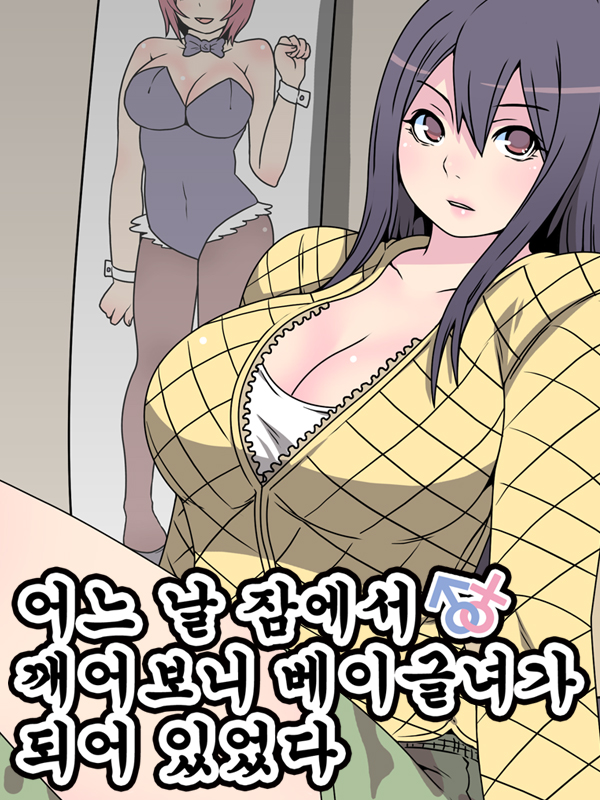
Who’s this chick in the mirror? Is that… me?!

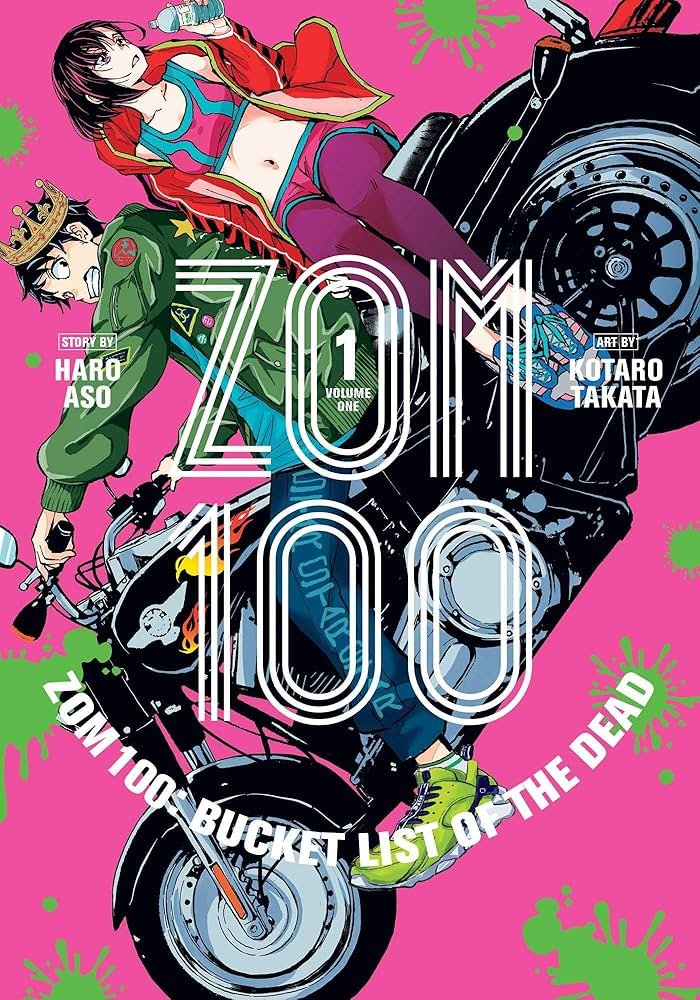
You may remember in January when I wrote about my Korean manhwa arc of which a high number of the series put out was pornographic in art. Several series I remember fondly not just for the tits and ass on the page (read: my phone/computer screen), but because of some of the unique premises they played around with. Even some of the very Korean drama-esque stories had something interesting to keep me coming back. Observe:
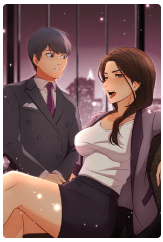
This one, for instance, called Lady Long Legs, is about a man who pays a debt owed to a businesswoman by becoming her man-servant. There is porn in this one, but slight spoilers, it comes later than you’d think.

Circling back to my post on manhwa, the topic of this post is about a manhwa adaptation I watched in Spring of 2021, a few months out from my first excursion in the Army.
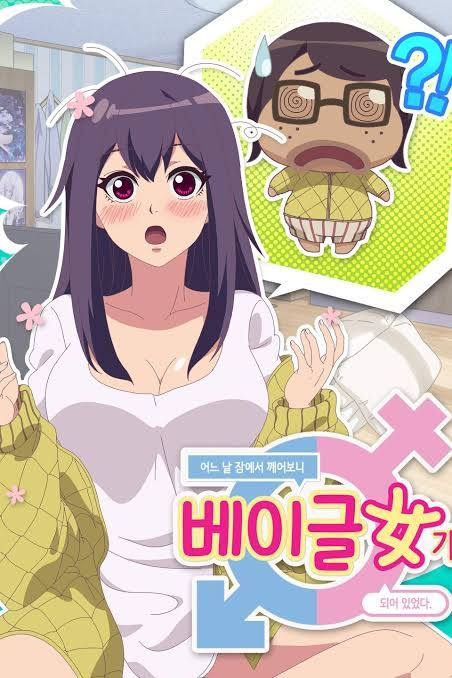
The series is called When I Woke Up, I Became a Bagel Girl and with a title like that, we already have to do a little bit of homework on Korean culture. The term “bagel girl” has nothing to do with bagels, so those of you who were looking out for that, I’m sorry. The best I can do is direct you to the closest bakery or Wawa if you live near one. The term is a play on words of sorts, where bagel girl is a Korean portmanteau of “baby face, glamorous body;” think of it like old cartoons where a smokin’ hot babe is referred to as “babe” or just “dollface.”

The protagonist is a 26-year-old virgin otaku named Bong-gi. No ladies that aren’t plastic or standing in dynamic poses on his shelf, no looks aside from those that cause onions to cry, no hope for the future seeing as he’s in a dead end job, and no confidence unless it’s on a screen in the dead of night. Alright, enough about myself, let’s talk about Bong-gi. Well, a lot of that is true of Bong-gi, so I’m definitely not one to judge. After a s[PS2 bootup]ty day at work, Bong-gi makes a beeline for his PC and games all night, snacking in the process. I mean no hyperbole when I say that’s extremely relatable, at least for me recently.

The next morning, he awakens in his waifu-splashed one-bedroom apartment, clutching his body pillow to answer the door only to discover that there are two large protrusions coming from his chest. He swears on best girl Hestia that he was a man the day before. What happened? Thankfully, he’s also curious or there wouldn’t be a series. An immediate comparison to make for “guy becomes girl” is either Gonna Be the Twintail or Ranma 1/2, but unlike those two series, Bong-gi can’t change gender at will, nor does he have any memory of it happening seeing as it happened in the dead of night while he was fast asleep. It’s also not an action series, but it’s not a pornhwa either, though it does have fun with the genderbend concept.
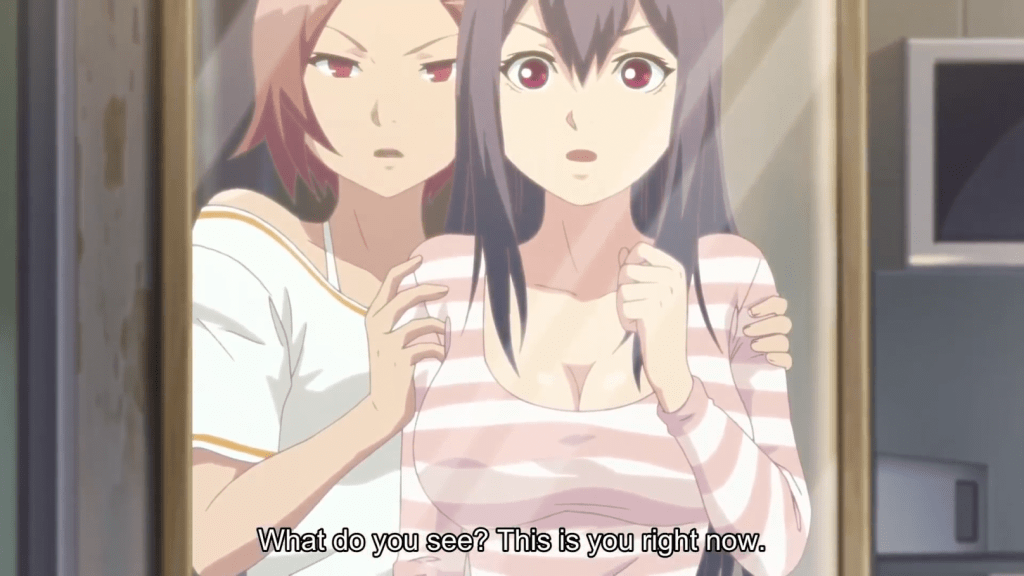
Just like its concept, the central plot of the series can be considered a bait and switch of sorts. If you went in thinking it was going to be a slice of life, think again. It’s more of a detective series with more beneath the surface than meets the eye. Without spoiling too much of the plot, the entirety of the series is based on this mystery plot with different twists and turns that give it a distinct thriller feel. I’m compelled to compare it to a telenovela or a soap opera.

Now to judge it on non-spoiler-y elements. I read many manga series and watch many anime series, as evidenced by this very blog. Manhwa is still a bit of a blind spot of sorts. As I mentioned above, I had a whole arc dedicated to this medium all through community college, however, but with the animanga scene exploding on its own home turf and abroad, whatever I wanted to watch or read from the Korean side of things has been a struggle. Either there’s not enough of it or it gets buried under a wave of other series from Japan. Tying back to my post on the history of manhwa, local Korean politics may or may not be responsible for this.

The youngest Koreans born under Japanese rule may at best be in their mid-to-late 80s, but the generations following still grew up under a military dictatorship hellbent on warning its citizens of what would happen if they bent the knee to the North in particular and the communists on the whole. As a result, in Korea (and by extension Taiwan), creative minds in both countries have been apprehensive about including anything remotely satirical. Some of the manhwa I’ve read (to include Lady Long Legs) have some reference to a real life Korean concept or even law. I’m a bit ashamed to admit that this was how I learned that the country still has conscription; just goes to show that the true opposite of love isn’t hate, but indifference. There wouldn’t be conscription there if they didn’t care about their wacky neighbor (but to be fair, neighboring the hermit kingdom isn’t easy).
I bring that up once again to highlight why manhwa seems to be getting the spotlight only recently. It could simply be Korean politics overpolicing media as a consequence of Cold War politicking; it could be viewers running out of material during the pandemic and reading whatever’s available; it could be a more subtle form of Korean pop culture spreading, sitting side-by-side with K-dramas, movies, and music; it might be all of these or none of these.

For me, it’s along the lines of adding to my fortress of consumable content. I have so many shows and movies in my watchlist that I barely get through all of them. I can watch a few episodes no problem, but I’m not 19 and my days of watching content ’til 2:30 AM are long behind me. Even if I didn’t have the responsibilities demanded of me by the military, I wouldn’t be able to sit there and browse anime to watch anymore. I’ve done it before, and while I haven’t exactly seen it all, the 24-hour binge is far from ideal or even recommended. I don’t even like 24-hour news cycles; you think I wanna watch the same specific series uninterrupted? For this reason, I adopted a method employed by Adult Swim ten years ago: the Double Shot method. It’s a reference to an old Adult Swim promo from the time.

I can’t find any evidence of it online, but as I recall, the programming block aired two consecutive episodes of a certain show for the hour and continue to the next show in it’s line up. For example, King of the Hill would air Episode 15 at 9 and then Episode 16 later at 9:30. The same for American Dad at 10 and 10:30, then Family Guy or Rick and Morty or China, IL at 11 and 11:30, and so on. So far, it’s a sound method that only fails when I feel lazy. Otherwise, it works. This being the second time, I’ve mentioned manhwa, my crystal ball doesn’t say with certainty whether it’ll come up again this year — I only have the first half of this year filled with blog topics — but it does highly recommend the series. As of writing, it’s available for free on Tubi and there’s generally no pressure to sign up if you haven’t already. As for the manhwa, most manhwa hosting sites are gonna be flooded with pop-up ads on the side for a crappy mobile game or porn site, even if you’re not reading a pornhwa. There’s no shortage of them, but I highly advise you be careful where you choose to read this if that’s more your angle.

Also, this series clues you in to how strict Korean beauty standards can be. Most places tend to be like this, but the cultural shock will give you a headache.

My Korean Manhwa Arc

70% of it Was Porn

Of all the media I’ve covered since this blog’s creation, animanga takes center stage followed by video games, TV, and to a lesser extent, music. And with all that content there’s still a blind spot that not only affects my coverage but also coverage of several other creators. Name any anituber and they’ve covered some of the most popular animanga series to debut in recent or even living memory. Bonus points if they’ve also promoted series that few people ever paid attention to.

I was recommended this on Reddit once when I put the manga Rokudenashi Blues in a 3×3 post. Here’s a video review of it.

Obviously, Japanese manga solos the graphic novel charts overtaking western comics roughly 95% of the time, but Japan’s not the only country producing graphic novels of its own. China has manhua and Korea has manhwa; same concept, different spelling when Romanized. There was a point in my life during the second half of community college that I took in an extensive amount of manhwa along with my manga intake. I remember browsing a porn site late into the night and next to the generic “Hot MILFs in Your Area” pop up ads, there was one that stood out. An ad (or in this case: promotion) of a manhwa hosting site called Toomics.com

I joined it back in 2018, before it put up some fancy new paywalls. Not working at the time, my best way around it for the series I was reading was the age-old “find a manhwa pirate site and hope it isn’t hiding malware in its ads.” On mobile, at least. I was careful not to try anything with my laptop because my mom would occasionally borrow it to complete important work. She did respect my privacy but you can never be too careful.

Toomics was what I’d call a gateway site as far as manhwa. The ad in question was for a manhwa called My Stepmom, interestingly enough. If it wasn’t obvious yet, it was one of the several manhwa series that was porn. I did see it on a porn site, after all. With that came several more manhwa, adult content notwithstanding, and speaking of adult content, a feature of the website is the NSFW filter, so you don’t have to worry about being the subject of a popular copypasta.

I wasn’t joking when I said a majority of my readership was pornographic. For the 30% wholesome, safe for work series, they bounced around between action and dramady, but for some of these, while not explicitly pornographic in nature, they were still intended for mature audiences by covering complicated topics from war to illegal trades to gambling to alcoholism and drug abuse among numerous others.

Then there’s the purely wholesome romcom manhwa where “are they dating? worse they’re stupid” has a full dormitory. Pick your favorites: mine has to be one called Annoying Alice; about office workers starting off with playful teasing only to come together towards the end. Hopefully, that was vague enough to not warrant a spoiler alert. I briefly took a pause from manhwa around the same time as my first go at the Army in 2021. But like with manga, I did come back though I don’t read as much manhwa as I would like.

All that aside, a question I have regarding manhwa is about why I don’t hear more about it. The genre has a dedicated subreddit some 1.1 million members strong, there are numerous legitimate and underground websites hosting the chapters with an untold number of teams hard at work localizing them for the broke and hungry populace, as well as those bringing us the raw scans for those who want a better grasp of Hangul.

Further, this is an argument in favor of Korean culture’s spread throughout the world. Next to K-Pop and K-drama, I believe manhwa is another instance of the Korean Wave or Hallyu spreading, but it gets less attention than the aforementioned, and circling back to Chinese culture spreading–without demeaning or scolding–can you, the reader name at least one C-drama or Chinese manhua? It’s okay if you can’t because neither can I.

This was an interesting find during the 2020 election season.

I only have hypotheses for why manhwa seems so unsung and underground compared to its Japanese counterpart. One hypothesis I have is in some manner connected to how some people find it, or how it finds audiences. I can’t speak for everyone, but with the adage of “sex sells,” a bold (or desperate depending on how you see it) move is to advertise the site and/or a series on a porn site in between the rest of the dreck on the sidebar getting in the way of some scripted T ‘n A. Another I have may be due to the proliferation of manga compared to manhwa/hua, and the history behind adaptations of famous manga. Even since before the Tezuka and Ishinomori days, manga has been a thing and so has anime; and it’s become expected of manga to eventually become anime. Sometimes there’s even a pipeline of light novel to manga to anime. Even movies.

Speaking of history, you’ll notice that Osamu Tezuka’s days were the mid-1940s up until his death in 1989, inspiring future mangaka in the years since. Araki, Toriyama, Kishimoto, Arakawa, Oda, and far too many to list.

The tragedy of his magnum opus was that it took so long to properly adapt it, leaving behind years of lost media in its trail.

Even if a manga is adapted after years in slumber, it’s still more likely to get a wide reach through a faster-paced medium like animation, but most Korean manhwa aren’t as lucky, from what I’ve seen. There’s a few coming out in recent memory like Solo Leveling, Tower of God, and God of Highschool in the last few years, but manhwa is far older than that. I think it may have something to do with the history of Korean politics and its government. Post-war Japan is extremely sedated, and the dismantling of the Japanese Empire meant the ad hoc independence of its former territories, repatriation of its non-Japanese subject, and/or the transfer of its territories to the Allies, the most famous of the lot being Korea split in twain by the Soviets and Americans.

Both were led by unassuming statesmen who had notorious reputations for being ruthless dictators. The South had long been an anticommunist state to the point of carrying a dictatorial slant until true democratization in the late 1980s. I’m prepared to be corrected for this, but I’ve got a sneaking suspicion that this roughly 40-year post-independence timeline of strongmen had an influence on a lot of Korean culture and popular media. There’s a Last Week Tonight segment on Taiwan and in the latter half of the segment, the dictatorship on the island stamped hard on anything that even slightly criticized or satirized the government. I think Korea had the same issue at the time, overzealously stating its independence and opposition to communism in the face of its neighbors, but at the cost of its inhabitants. In a dictatorship, the freedom to read, write, and speak freely is severely under threat. With that knowledge, aspiring comic artists would’ve had three options: Comply with Seoul’s wishes; emigrate to a freer nation; or self-publish your works and await the consequences. South Korea and Taiwan don’t have flawless human rights records, but compared to Kim Il-Sung’s or Mao Zedong’s regimes, they were on the opposite ends of the spectrum.

Another hypothesis, one I’ve come across on r/manhwa posits that there’s a mix of western exoticism and self-loathing within the community due to an influx of manhwa set in medieval European-adjacent royalty, which speaks to a wider conception of the culture. It’s a stereotype that East Asia is unforgiving on its own people and if Japanese Isekai is any indicator, then the blend of escapism and exotic fantasy is more widespread than you might’ve previously believed. Don’t we all want to travel to an alien world and jive with the locals?

The premise of this series.

The last hypothesis would probably come with the reputation of some western manhwa publishers and localizers. If you follow Rev Says Desu and Hiro Hei, you may have been made aware of a select few English voice actors of anime shotgunning their kneecaps off on social media while their Japanese counterparts either keep quiet or promote what they like (see: Aoi Yuki for more details). In a similar vein, a subsect of activist-minded artists have discovered the publisher Webtoon and are said to have been aggressively pushing their works on the platform, negatively impacting the reputation of the site and driving more innocuous publishers away and onto sites with different criteria for vetting and publishing comics. I’ve heard these arguments as well as the purported reputation of another web-series and I can’t say for sure which is the true culprit, but there’s a lot of power behind a perception. I’m pretty sure Toomics and Lezhin comics don’t have that much dirt under their heals though…

Whatever the case, on a scale of All the Luck to There Ain’t S[burp]t to Gamble With, Korean manhwa is closer to the latter with even Chinese manhua getting adaptations from time to time, though not nearly as much as Japanese animanga. Normally, I champion underground series, but this is a rare moment where I’d rather see more variety in this hardly tapped market. Even if you’re not in the market for sexual content, there’s a handful of series I can recommend off the bat that hardly ever touch that or even encourage the reader for touching themselves.

My top 3 would be these:

  1. Devilish Romance: a powerful demon is reincarnated as a Korean investigator and initially attempts to reclaim his honor as the most feared demon in the underworld, but is paired with a strict, if goofy prosecutor.
  2. Annoying Alice: Office romance between a pair of pure coworkers who like to mess with each other which gradually evolves into tender, loving romance.
  3. High School Devil: local delinquent is implored to change schools and start anew but his reputation as a brawler gets him into trouble not 5 minutes into admission to the school.

As a bonus, a dystopian manhwa by the name of Shaman centering on a special forces agent tasked with safeguarding a K-pop idol duo.

Also, circling back to the porn part of my manhwa arc, it was where I first discovered that the black bars were cast out in favor of the lightsaber in pornhwa and hentai. Whichever came first (no pun intended), I’d like to believe there’s an influence, if not a cross-cultural pollination.

Forgotten Mortal Kombat Plot Points that Had Potential

With more time and care, these could’ve helped the old games

This post was originally supposed to be about different archetypes in anime, though I’m delaying that to sometime in December as I don’t yet have enough research to discuss those in full detail. This week, however, I’ll bring up something that has crossed my mind before, but not with enough frequency to expand upon: forgotten plot points from the 3D Mortal Kombat universe.

The original idea came from a MojoPlays video that I couldn’t f[head rip]king find until a few minutes before writing this because I misremembered the title. Abandoned Story Threads instead of Forgotten Plot Points; potato, potahto. Either way, the video can be viewed on the MojoPlays channel through the link below.

Credit: MojoPlays

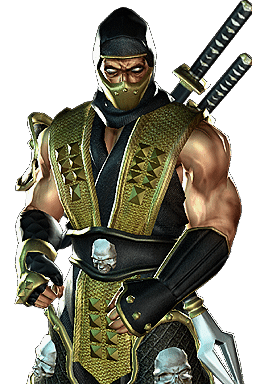
The gist of the video is that throughout the series, the Mortal Kombat games have introduced plot points that were about to heat up only for the devs to go in a different direction. With over 30 years out on the market, you’ve got your pick of the litter to choose from. For this week, it’s the 3D games from MK Deadly Alliance to Armageddon. Here’s the f[scream of pain]king short version: starting with Deadly Alliance, Quan Chi escaped from a fiery ass-whoopin’ at Scorpion’s hands, discovering the Dragon King’s “undefeatable” army in the process and bringing these mummified warriors to Shang Tsung where they formed a bond based on ignorance.

Context:

Channel: Kamidogu

After the Deadly Alliance is formed, they remove all obstacles that would block them from ruling all existence. Not happy sucking up to Shao Kahn for millennia, they kill him in his throne room then make their way to the Wu Shi Academy where Shang Tsung finally gets to consume the soul of the greatest warrior in Mortal Kombat History: The Great Kung Lao I mean, Liu Kang!

OGs can’t be beat!

So with Liu Kang and Shao Kahn dead, they operate a tournament under false pretenses in Outworld and use the defeated to return the mummified army to life with the goal of marching on Earthrealm with malicious intent. Raiden saw this from the heavens and organized the remaining warriors across the realms to stop them. Fun fact, you can find archived websites and forums debating the plot points of then-upcoming games, like this website MKSecrets.net, which for some reason still looks like it was made in 2001 even though it has details on MK1 (2023)… I thought that was most Japanese websites…?

Anyway, MK: Deception picks up from the premise of Deadly Alliance only the sorcerers were too powerful for all of the warriors (could’ve probably sent them all as a group, but MK9 proves that that wouldn’t have helped much) and so at his wits end, Raiden challenges them himself. Not even a thunder god could defeat the sorcerers and realizing that their goals were nearly complete, what was left was the amulet Quan Chi stole from Shinnok in MK4. He hangs onto it defeating Shang Tsung in the process, only to have Onaga reborn (hinted at from Reptile’s ending in the last game) and return to reclaim the army that the sorcerers so generously returned to life with the souls of conquered fighters.

All three men realize that danger was marching towards them and while they managed to temporarily hold them back, Raiden uses a last ditch attack on the Dragon King. It failed to even scratch him and he grabs a hold of the amulet which will be needed to form the six Kamidogu into a single entity.

Channel: MKIceAndFire

As for how Onaga acquired the Kamidogu, well it involved tricking a young boy named Shujinko and leading him across reality by the nose for 40 years. If this game were canon, that would’ve come back to bite Onaga in the ass, only for Shujinko’s efforts to go unrecognized as redemption and still get punished by a Dark Raiden. This will become important later.

Shaolin Monks was a bit of a beat ’em up remake of MKII (kinda) and I’d already talked about that before, so we’re skipping it considering it has nothing to do with the 3D trilogy anyway.

Armageddon was supposed to cap it all off and the more I’ve thought about it, the more it felt like a final send off before Midway got the crappy ideas out of the way in time to file for Chapter 11 bankruptcy in 2010.

Let’s not be too harsh though, it did help pave the way for the Injustice line.

Story-wise, the protector god of Edenia, Argus, is made aware that between the actions of the sorcerers and Shujinko being duped for that long, the warriors of the realms were learning more about the construction of the realms than the Elder Gods would be comfortable with and proposed to Argus to come up with a solution. He suggested total annihilation to protect the realms from their own residents, but his wife Delia suggested depowering them all since there were many heroes who fought tooth and nail to defend the realms from evil, not the least of which was Shao Kahn and Shinnok (whom we learn later was banished to the Netherrealm for eternity for treachery, leaving Quan Chi to do the heavy lifting through the Brotherhood of Shadow).

They’re granted the power to do this and choose to do so by making a competition of things for their sons Taven and Daegon. If things went to plan, the two men would engage in a friendly competition, grab their weapons and armor and race to defeat their mother’s firespawn (half-brother?) Blaze to achieve full godhood as both of them are demigods. In reality, the two brothers, under the watchful eye of a pair of dragons, Orin and Caro, are set on a different path. Caro, who was the guardian dragon of Daegon, lost contact with Blaze believing it to be an early sign to set him on his path. Instead, Daegon forms the Red Dragon clan in Caro’s name and signs off on unethical science experiments for the purpose of choking existence into coughing Blaze up. The way its presented makes me think of Unit 731 in Manchuria and its surgeon general Shiro Ishii. If you don’t know, look it up at your own peril.

This makes Daegon the antagonist of the Konquest mode and through no fault of his own Taven loses sight of the purpose of his quest. And his frustration and confusion at this whole course of events is best reflected at the several times he’s questioned and even considered abandoning ship. The quest stopped being fun for him as he lost the things he cherished. Blaze appeared at the end to catch him up to at least what the true purpose of the quest was and Taven is a hero if we compare him to the Ancient Greek model similar to Perseus or Theseus. Self-serving at times, but the guy still knows the difference between good and evil. Daegon’s descent into evil seems random until he learned that he was supposed to lose the quest and decided to take matters into his own hands, hence the birth of the Red Dragon.

Dropped and abandoned plot points are still a problem for the series as it’s developed a reputation for introducing points and leaving them to collect dust. We barely get five minutes with the concept before the devs (read: Ed Boon and John Tobias) moved onto something else. You could say the fandom is also to blame for this as dedicated fans have asked (demanded) the team to release canonically deceased characters as DLC, but staying with the 3D games where the problem expanded, there’s more to say about it during this era than anywhere else in the series.

Starting with Deadly Alliance, Shao Kahn was established to be killed in the intro to this game, with Deception and Shujinko’s story acting as a prequel taking place some years before the events of Deadly Alliance where it all converges. Shujinko himself was invited twice by the White Lotus Society and later by Shang Tsung himself to represent Earthrealm in the tournament but couldn’t attend for different reasons. The White Lotus got tired of waiting for him to power up (never mind that the tournament is hosted every 50 years) and due to his cleansing journey with Nightwolf, he had to go back to the Netherrealm to gather more hatred, from none other than the ghost of Hanzo Hasashi.

This part doesn’t necessarily screw around with the timeline as egregiously as following plot points, but Armageddon is where it all breaks down. Canonically dead characters are resurrected off-screen and based on what we know we can connect the dots, but often the devs are a bit cagey when it comes to showing how, who and/or why characters are returned to life. The 2011 continuity shows that Quan Chi has brought Noob and Sindel back to life and claimed the souls of those killed by Sindel herself in the eleventh hour, but it’s not shown whether he brought Shao Kahn back to life or if he did why he’d do so, or even why the rest of the villains would agree to this arrangement.

Channel: BruskPoet

I’m not saying this moment in the story is bad, I like it a lot. But the nonexistent explanation for how all this can come to be is what sours me on it somewhat. I’d say there’s no care for a consistent timeline especially in a fighting game (something that doesn’t escape Tekken), but I think it’s more along the lines of the devs wanting their personal favorites to shine brighter than the others, which is why the franchise works better as video games and toy lines than it does movies.

Most of the time…

For what it’s worth, the characters have been mostly consistent with a few touch ups here and there, but if you ask people like The4thSnake, there’s a lot under the hood that could use some light to heavy rewiring from individual characters to whole ass f[swords clashing]king plot points, like what I’ve been writing about here. I’m a bit torn personally, because it brings a charm not found in other series, but this many plot holes treats the timeline like a redheaded step child. Doesn’t stop people from trying, as I’ve stated before, I rewrote MK: Shaolin Monks myself like it was Dragon Ball as that was what I was watching at the time.

Why bother with the 3D games, though? Well, of all the plot points introduced and left by the wayside, the 3D games did it the most and the worst of any other era, which seems to be the result of developmental inconsistencies prior to release on store shelves. It certainly hasn’t stopped people from trying though and it likely will keep going for as long as there is a Mortal Kombat to fix. Nothing too serious at this point, but it’s both fun to expand on what was and offer critique for one of the series most tumultuous times in its history.

Shimoneta, High School DxD, and Monster Musume: Horny Trio

The three that carried me in community college

Yonks ago, I mentioned an upcoming post that was initially meant to be just another double bill, but it occurred to me that there was a third series that I felt was appropriate to lump in with the other two. These are the three anime that I watched all through college:

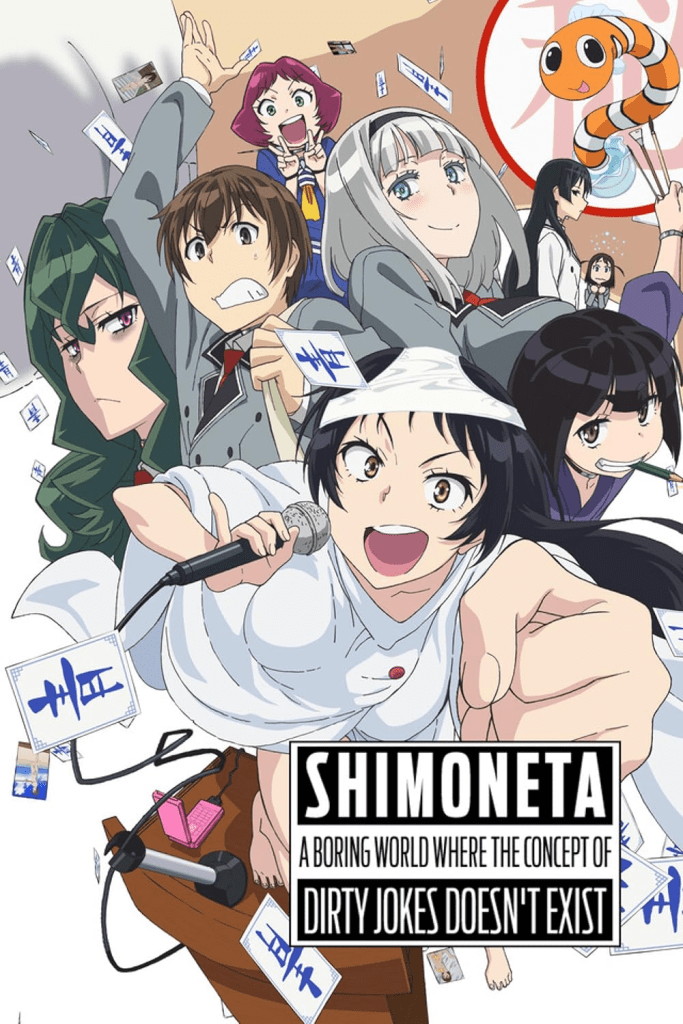
  1. Shimoneta: A Boring World Where the Concept of Dirty Jokes Doesn’t Exist
  2. High School DxD, and;
  3. Monster Musume

And we’ll go through them one-by-one. The titles of each should be a giveaway but just in case: each of these series contains sexually suggestive themes, language and imagery. Reader discretion is advised.

Shimoneta (2015):

Another anime to get its start in the world of early 2010s light novels, Shimoneta’s concept is exactly as it says on the tin. All language of a sexually suggestive or provocative nature is illegal and if uttered, the speaker(s) is/are arrested by the Decency Squad, a specialized morality police unit whose purpose is to track down and subdue anyone who dares utter such obscene words.

How do they know people are saying s[poop]t, f[moans]k, and ass? By the collars around their necks. They’re designed (read: programmed) to monitor different trigger words, I suspect, by way of detecting the movements of the mouth when certain words are spoken, sort of like how most YouTubers, TikTokers, etc. have to censor/monitor their own speech to keep from the Demon of Demonitization at bay. (Side note: f[plastic wrap]k the algorithm for doing that to our favorite creators.)

One such character is the protagonist, Tanukichi Okuma. He’s a brand new student to Tokioka Academy and a witness to the indecency of another character he meets later: Blue Snow, real name Ayame Kajou. Ayame takes the alias of Blue Snow whilst on a crusade to dismantle the shackles of this dystopian system of policing speech by way of challenging the response time of the Decency Squad. Under normal circumstances, suggestive language is how you get slapped on the dick (or in Ayame’s case, the tits), but she evades that by dialing a number on her cellphone that deactivates the collar on her neck for three minutes a day, letting her unleash a bevy of inappropriate sayings.

Based on her appearance here, Ayame adopts a Clark Kent persona when around others only to don a mask (a pair of panties, yes, really) when it’s time for her 180 seconds of lewd infamy.

The series isn’t just a man vs society conflict at play, there’s an actual antagonist in the series and she starts off as innocent and pure until the following happens to her:

Channe: Khánh Senseii Anime Kiss

The birth of the villainess of this series. Anna Nishikinomiya begins the series as the class president of Tokioka, but after a mishap in one of the episodes, Okuma plants a kiss on her by accident. If she had any knowledge of even romance, she’d probably have a normal reaction, but this unleashes metaphorical and literal floodgates. She conflates love with lust and 85% of the scenes that she’s in is a display of female-on-male sexual assault/rape. I’m not kidding.

Obviously, it’s played for laughs in the series and there’s a lot to be said about societal discourse surrounding male victims and their female perpetrators (a discussion I’m not qualified to talk about on a blog based on entertainment, but would have no problem entertaining in mixed company), but without getting too dark and focusing mainly on the central theme of the series, Shimoneta is a display of the consequences of policing morality and human behavior. If you’ve been on the internet for quite some time, you may recall an era when cancel culture went haywire and a small fraction of forum posters chastised trolls online to hell and back for a few racy comments here and there. Not that it was unwarranted, the internet around the time of the GamerGate controversy was an interesting time to be on the internet, but interspersed with genuine policing were impromptu witch hunts conflating ignorance with curiosity, and this went beyond just suggestive or provocative commentary, lest we forget the cultural appropriation vs appreciation argument that was prevalent at the time. Though these days, the conversation has moved towards intentionally ignoring sex organs, due to a variety of factors that have massively influenced the internet. Sorry, digressing.

In Shimoneta’s case, it proves how difficult at the least; Sisyphean at the most such a task of policing even speech can be. Not to mention a shortfall that accompanies the series from start to finish about how to go about this. You’ll notice that speech patterns themselves are the main crime, not the physical aspect itself. Now, there would still be procreation which this world would likely allow for survival’s sake, but another conversation can be had about how conspiracy to commit is addressed more seriously than an actual crime in this world.

This blog from 2018 has more to say about Anna herself and with a finer brush than the broadstrokes I employed here.

Having said all that, I still recommend this anime for anyone wanting a closer look at an example of how bad overpolicing behavior can get or if you just wanna see the most athletic Japanese school girl in the world hunt down the object of her “affection.” Beware her homemade cookies, IYKYK. Now onto:

High School DxD (2012-2018)

My personal favorite for being R-rated and uncensored, the light novel ran from 2008 to 2018, ending around the same time as the anime’s fourth season. Whereas Shimoneta’s content is light on explicit nudity and fan service, High School DxD throws the censorship to the wind. Back during the Funimation days, the English dub played up both the nudity and the jiggle physics. From threatening to get naked to actually getting naked; I like the progression so far.

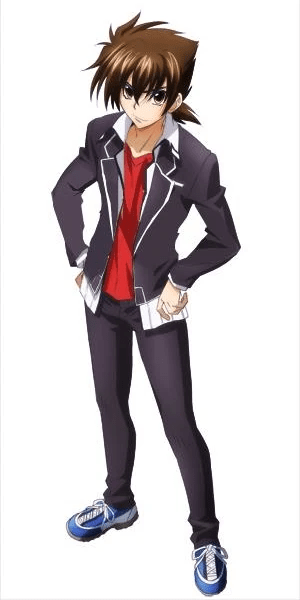
In High School DxD, Kuoh Academy recently transitions into a co-ed school for the new schoolyear. A few male students enroll, likely taking advantage of the 8 to 1 ratio of girls to boys in the hopes of scoring big before Kuoh fully integrates. One of these boys is a massive pervert and otaku named Issei Hyoudo. He initially fits the bill of a stereotypical otaku in all but appearance. Body pillows, an alarm clock with different anime girl archetypes waking him up every morning, an extensive hentai and porn collection shared with his two other friends, and a MIGHTY NEED to get some titty.

It just so happens that one particular set of breasts happens to belong to this devilishly gorgeous redhead, Rias Gremory. More than just a sight for sore eyes, Lady Rias is a fierce fighter and one to defend those she cherishes to her dying breath. Outside of battle, she’s a kindhearted young woman, compassionate, and reliable. She’s the head of Kuoh’s occult club, thinly masking her connection to the paranormal as a devil herself and making great use of the common tropes associated with angels and demons/devils: angels are depicted as bone ugly to ward off evil while demons are depicted as drop dead gorgeous to tempt mankind into following their id. In an ironic twist, the series depicts devils as more heroic than the beings they fight against.

As much as I make that sound like an engagement wearing the clothes of praise, there’s an actual plot behind the plot here. It takes a lot of cues and tropes from the Christian bible with the concept of angels, devils, and fallen angels. Following the devils, their depiction seems more sympathetic in the series as the factions do have a fair share of shady and unscrupulous characters. The overall plot plays up the biblical angle with the fan service going into overdrive, so Rias, Issei, and the Occult club are all (knights) in service of Satan, or in this case, in service of one of those appointed as a satan. To quote Anton Szandor LaVey, founder of the Church of Satan, “if you’re gonna be a sinner, be the best sinner on the block,” and it seems that Issei is guaranteed to live up to those ideals.

The juxtaposition of magical action and theological babble with T and A and convenient panty shots is what kept me going until about halfway through the fourth season. When it comes to censorship, normally I’m an opponent depending on the company I’m with. Throwing out f[crunch]ks, s[footsteps]ts, damns, asses, and other such forbidden words in a room full of bureaucrats allergic to the sun makes you seem immature compared to a gathering of mobsters, gangsters, or even servicemembers, all things considered. I censor swearing and nudity here for presentability and professionalism, but seeing as I’m writing about a trio of anime that joke or outright show you uncensored boobs, if it wasn’t for the presentation, this whole blog would have no reins. Before we move on to the third and final series I want to talk about, let this ending convince you to watch High School DxD if the above hasn’t already:

Channel: SE NPAI

And last but certainly not least:

Monster Musume (2015):

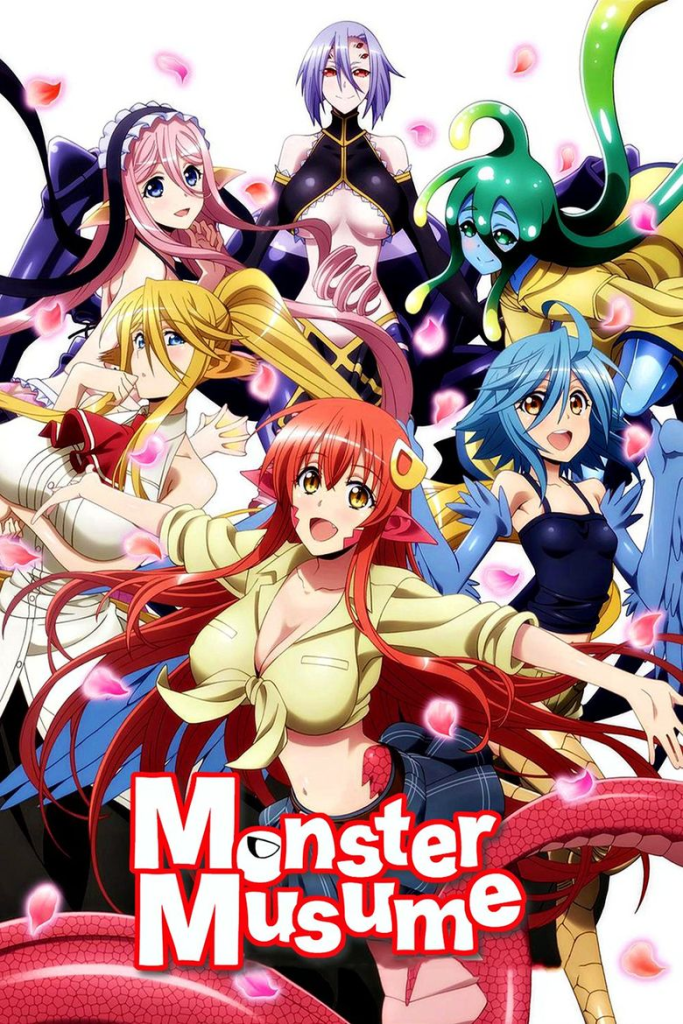
A harem series like High School DxD but appealing to even more fetishes while also putting the protagonist in a tricky situation like Shimoneta, though with a different context. The plot of this horny adjacent series is that monster girls of various mythical origins are enrolled in a program not dissimilar from foreign exchange student programs in real life and one of the people who is accidented/voluntold into the program is regular human person No. 4986 Kimihito Kurusu.

One of the coordinators, Agent Smith, mistakenly sends a lamia (snake girl) Miia to his house to take care of her under the the circumstances that they refrain from conflict or copulation. Easy rules for Kurusu to follow considering the consequences, but as the series goes on and more and more monster girls share a roof with the man, his physical restraints are put to the test seeing as these women are physically capable of bending him like straw. More than once, he’s been grievously injured through accidents as none of the girls are even remotely aware of their gap in human endurance and their own strength.

Basically, it’s the equivalent of swapping Kratos, a character of pure strength and raw anger with Lester the Unlikely from his titular game. Kurusu exists in a world where monster girls damage him even without the promise or threat of snu snu, and yet, he’s not that kind of guy to engage in his temptations. Using Okuma and Issei as a scale of unfortunate to pervy, Kurusu is definitely closer to Okuma, yet we can put in a different category for him specifically seeing as how he doesn’t exactly live to fulfill is silly desires. He’s a blank slate of sorts that the viewer may put themselves in the shoes of.

Monster Musume has the makings of a horror show without the horror. It’s a harem romcom slice of life with horror elements featuring a protagonist who simply wants to live the most normal life allowed by this society, but is forced to share not only this world, but his dwelling with a harem of monster girls he’s forbidden from touching intimately because the agent that f[piano]ked him is functionally identical to Aqua from KonoSuba.

Don’t let the Matrix reference fool you, she’s not as efficient as those clones. But she does look good in a suit.

Another thing worth mentioning is that while the other two series in this post began as light novels, Monster Musume is a manga first, with a spin off light novel series that also got an anime adaptation: Monster Girl Doctor.

Take these three as my recommendations for when you think there’s too much wholesomeness to go around and not enough lewdness. There’s the possibility of getting muscled by the thirstiest girl in the world whilst on a crusade to curtail censorship; a harem of lovely ladies whose tits shake even when still; and a harem of lovely mythical monster ladies who’d each be wife material all their own if it wasn’t for the rules.

Whatever pirate site you watch your anime on (don’t worry, your secret is safe with me), give these all a watch if you haven’t done so already. And if you’ve seen them, see them again! Do it!!

Date A Live: On a Whim Again

The life I live is watching anime with friends…

…and I can’t wait to do it on a whim again. I’m not apologizing for that Willie Nelson reference.

Date A Live honestly needs no introduction. It’s a series that I’d heard of for a couple years prior to actually watching it only to hear of a fourth season planned last year while I was already six episodes into the series.

It began life as a light novel with a run from March 2011 to March 2020, exactly nine years of writing from author Koshi Tachibana. A sci-fi fantasy romcom whose anime adaptation was released in 2013 and whose fifth season debuted in April of this year. Funny that light novels from the last decade are going strong in the 2020s.

So what’s Date A Live really about? Breaking it down by its genres, the sci-fi aspect comes from the world itself. It’s somewhat set in the future though no specifics are given so you the reader/viewer may fill in the blanks how you see fit. Spatial quakes or tremors in the solar system start affecting earth in a very negative manner, by way of leaving behind giant craters in the earth, one of the most notable being somewhere along the Eurasian steppe. Bad day to be wandering around Kazakhstan that day.

The in-universe explanation for this is that the space tremors follow the arrival of beings known as Spirits who all appear in the form of girls around the same age as the main character, Shido Itsuka–and protagonist powers aside he does have a crucial role that I’ll get to later.

Further, these Spirits possess abnormal powers, not the least of which involves the likes superhuman strength and devastating abilities the likes of which would make Babidi from Dragon Ball very, very jealous–and also ties in with the fantasy aspect of the series. There are two ways to combat these Spirits: one is by way of actual combat; and the other adds in the romance aspect and our main protagonist, Shido Itsuka.

Now that we’re putting two and two to get to four, you may have predicted that Shido’s task in this series is to romance the Spirits and prevent utter bedlam with the power of love, and you’d be right. The harem aspect is well advertised and if you know a few things about the harem genre in animanga, then you’re probably also aware of the main selling point: fanservice. Flash a boob once or twice, get some cheeky panty shots in, throw in an accidental pervert with multiple different -dere types and voila! you’re cooking a mean beef stew.

However, what I think separates Date A Live from contemporaries of this type would have to be the individual girls themselves. Even as I’ve only just wrapped up the second season of the anime, I’m seeing more than just comedically sexy eye candy. And I’ll even throw a bone to Shido himself. Rather than be just the generic harem protagonist who behaves as a stand-in for the audience, there is a personality to the boy for once. He’s shown to be persuasive and caring, especially since his position in the series is that of nonviolence. He’s basically playing the pacifist route in Undertale.

Meanwhile, the other main adversary present aside from rogue Spirits yet to be wooed by our hunk Shido is the Anti-Spirit Team. Similar to Japanese Special Forces, their purpose is to find and contain the damage the Spirits cause, a lot of the time through lethal force.

Then there’s the girls that Shido romances to the good, less destructive side. A lot of the time they fit well into the typical archetypes we’ve seen in other romance anime, but the backstories and personalities do make them intriguing. Some of them do genuinely want to live quietly and comfortably with Shido, but others answer the question “Violence?” with an enthusiastic “Yes!” Case in point: one of the most iconic characters in the series:

You can’t fix her, nor will she fix you or even try to make you worse. She’ll just leave a massive stain where you standing three seconds ago.

The series explains that the Spirits themselves come from different dimensions, but (minor spoiler) it’s possible for a human from this dimension to become a Spirit as well as what happened to some of the characters in the series. The AST is another display of the sci-fi within the series. With the Spirits being what they are–superpowered high school girls–the members of this elite team have to take the “fight fire with fire” approach to combating them with hi-tech battle suits. Not on par with what has been depicted all over the Gundam genre, but impressive all the same. It’s more like stripped down Iron Man armor in appearance.

Depending on your investment in the series overall and how you feel about the genres explained, you might get a kick out of it, or it might just be another harem series to add to the pile. Neither of these assessments are right or wrong, but it shows that it’s a product of its time. Does that mean the series hasn’t aged well? No. As I said, I got into it weeks before a fourth season was greenlit, not to mention a fifth season debuted a few months ago which suggests a determination to see it through to the end.

I know I’m not the first person to talk about this series and I will not be the last to do so. What I can do is simply point you in the direction of the series and however you choose to consume it. If possible for you, I say finish all five seasons of the anime and while you’re waiting on confirmation of a sixth, beat them to the punch with the light novels.

Before I sign off, since there’s a certain demographic that loves the type of character that I put further above, I feel the video below best describes that mindset:

Channel: Gianni Matragano

But hey, I like kickass ladies too.

For Saturday, June 8, 2024, I recommend the YouTube channel Christopher Chaos.

https://www.youtube.com/@christopherchaos/videos

Run by a retired Army Sergeant and Motor Transport Operator (Military Truck Driver), Christopher Chaos is a military explanation channel dedicated to detailing the possibilities and benefits that come with enlisting in the Army along with the occasional anecdote about his own personal service. Each servicemember’s/veteran’s story is unique due to how big the U.S. military is and how fast changes can be made while serving. Christopher himself explains that he served from 1999 to 2010, so most of his stories show the culture of the Army during his service. That being said, he does still keep up with Army and military news for the purpose of educating would-be recruit candidates.

And if you’re concerned about it, he’s not endorsed or sponsored by the U.S. Army. That chapter in his life is behind him.