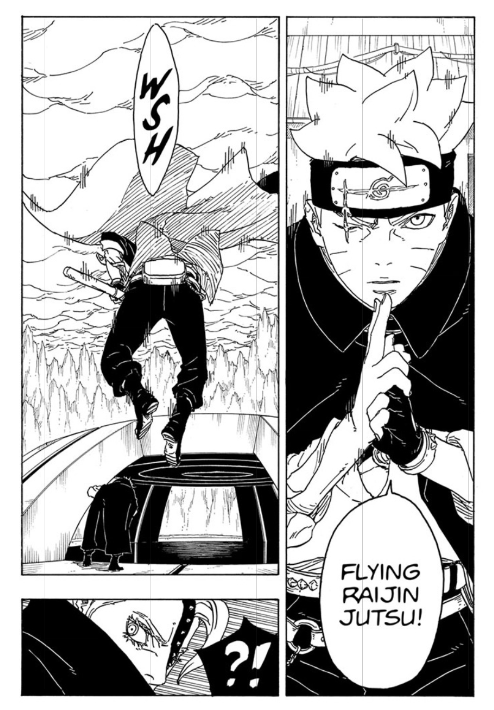
Part of what the Boruto fandom has been asking for for a few months now has been a flashback of sorts to some training between Boruto and Sasuke during the timeskip. If it’s an arc they’re looking for, it remains to be seen if that’ll be honored, but the closest we’ve got is the opening pages of chapter 5, released a few hours ago. Last time on Two Blue Vortex, Boruto displayed his prowess as the third ever shinobi in history to learn and use the Flying Raijin Technique.
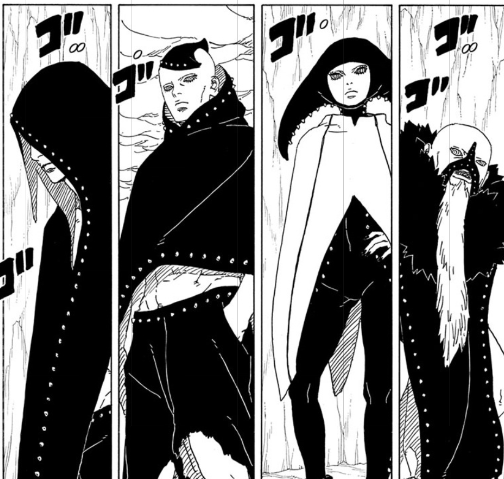
Using the technique, he traveled to the Ten Tails’ dimension, but discovered that it was gone from its restraints and he and Code were surrounded by four intelligent claw grime humanoids. Boruto expected to twist Code’s arm into a truce, but the deceitful Ohtsutsuki hopeful nearly left him to die. Guided by a mechanical summoning toad, Boruto escaped to safety and towards a few familiar faces: one long thought defeated and one in a coma.
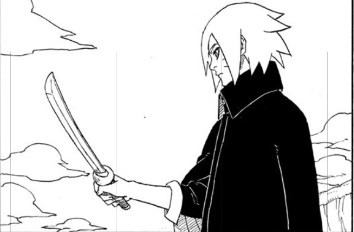
This month’s chapter began with a quick flashback. Sasuke initially doubted his memory, repeating that he was doing this for Sarada, not for Boruto, but by the time Boruto had finished his training, he was beginning to imitate the Uchiha patriarch in attire and even hair.
He always did say he wanted to be like Sasuke, even if these straits were forced upon him.
Since debuting in August of 2023, Boruto’s timeskip seems to have delivered on its new threats. The Chekhov’s gun is getting used so often, it might be time to clean the barrel. In this instance, Code’s claw grimes have another sequence to them. The previous four chapters show that whenever they bite someone, the victim of the bite turns into a tree. In chronological order, we’ve had four victims of a claw grime’s bite:
Bug
Sasuke
Unnamed Leaf Shinobi
Moegi
Not only that, a claw grime replica is created in their stead. They inherit the appearance of the host, but maintain the original desires of the Ohtsutsuki, which is to consume enough chakra to bear a fruit-bearing tree, just as it was revealed in the Fourth Shinobi War all those years ago. Good grief, Madara’s influence and meddling still scar the shinobi world after all this time. In this case, the sentient trees have expressed desirable targets of their own:
The unnamed Leaf Jounin clone wants to devour Naruto.
Moegi’s clone wants to hunt Konohamaru.
Sasuke’s clone wants to make a beeline for Sarada.
and the clone of Bug wants to target Eida herself.
Meanwhile, Sumire and Amado discuss Boruto’s return and response to Code’s attack on the Leaf. Amado explains that the Karma acts as a storehouse for one’s DNA and since he’s trying to revive his daughter, Akebi, he needs a Karma seal with her memories to revive her as he remembers. Prior to the Shinjutsu event pre-timeskip, Kawaki would’ve been the only person of interest since Amado remembers implanting that DNA in his Karma.
If it was Kawaki who fled the village after scarring Boruto, and practically orphaning him and Himawari, I could imagine Shikamaru as Hokage dispatching ANBU shinobi teams to track him down if not designating a special unit of the ANBU to handle that, similar to the Hidden Mist’s Tracker Ninja. But post-Shinjutsu event, this doesn’t happen. False memories or not, Amado can tell that he was the one who modified Kawaki’s body as shown in the flashbacks across Boruto Part I, but has no definitive way to prove it. And let’s be real, this is the same universe where the whole village conflated their annoyance with Naruto with their hatred at the Nine Tailed Fox, almost no one being able to tell that he looked just like the Fourth Hokage. I made the connection when he was featured in Ultimate Ninja 3, and that game came out when I was 9 years old. Back then, it was a theory not yet proved fact in the manga.
Thankfully for Amado’s endeavors, Kawaki doesn’t pose any flight risk, so he’s got his target right where he wants him. But as a “son” of a former Hokage, the Leaf government won’t make it easy. Kawaki’s and Boruto’s roles are switched, but Amado’s prior employment in Kara makes him far from trustworthy, especially in Shikamaru’s eyes. And Kawaki’s attitude and history with the scientist pretty much leave that move off the table for Amado. He’ll probably have to get to him when he’s incapacitated. How he’ll get to that point also remains to be seen, but as a scientist, he’s patient enough to observe the results with all the data on hand. Amado’s patience is matched with a Bodhisattva — you think another minute will faze him?
The chapter closes off with Sumire and Sarada discussing what Sumire learned from Amado and a heartfelt reunion between the young Uchiha and the exile.
From what I’ve gathered this chapter, the claw grimes are more dangerous than Code himself. Forgive me for power-scaling, but the grimes are a cut above Code, and the divine trees created from their victims might turn out worse when they get their chance to shine. I do have a flowchart of sorts to showcase the direction of the claw grimes: Claw grime bites human -> human turns into tree -> divine tree clone emerges -> divine tree clone hungers for chakra… and I have to leave it as such until the next chapter launches in January, though for reasons I’ll explain on New Year’s Eve, that may not be feasible for me.
Until then I leave you with some questions for thought: What happens if a divine tree bites a specific person? A Jinchuriki? Someone with vast chakra reserves like Kisame? What else do they inherit from their hosts? And since the divine tree clones aren’t loyal to Code, what happens if they get to him or someone like Eida, who has a Senrigan and access to Shinjutsu? Time will tell, but I hope I’ll be able take notes and write about it all by then.
Before I close off, here’s some wholesome from the latest Two Blue Vortex chapter for the holidays.
I chose the topics for the year many months ago. In the case of visual novels, I didn’t think I’d have a lot to say about them, but when I got one for free this summer on Steam, it initially got me thinking about how I feel about them… for a bit. Then I stopped largely due to my play style. I do get absorbed in video game narratives — I felt compelled by MK: Shaolin Monks enough to try to fix the narrative like a weekly anime a la Dragon Ball — but my play style successfully blends dialogue with button pressing. Mortal Kombat, God of War, Call of Duty, the Naruto games, Midnight Club, Need for Speed; indicting myself here, the action is the selling point.
But I still decided to give that free VN a chance, specifically this one:
The goal of Find Love or Die Trying is to romance one of the five girls on a televised game show not dissimilar from The Bachelor/ette. If you fail to get even one of them to fall for you, you die. So specifically it’s a dating sim game. I recall tuning into DashieGames in the latter part of high school when he was playing that one dating sim puzzle match game HuniePop, where that game’s goal is to score with all the girls.
I know what visual novels are, and there’s a chance you’ve come across some yourself or even their most famous anime adaptations (Fate, Clannad, Danganronpa, etc.), and I was about to say that they’re not for me, but that’s just not true. I just forgot because I have way more memories of being very involved in other video games not limited to the ones listed above. The truth is more that I’m a bit torn on VNs somewhat. I’ve run into several in my childhood, especially on the practically defunct Stickpage, and while not VNs themselves, the Choose Your Own Adventure template of Telltale Games’ video game adaptations of popular properties as well as Don’t Nod Entertainment’s Life is Strange series served as something of an introduction to VNs or something close to a VN.
I still have my copies of Minecraft: Story Mode Seasons 1 and 2, I’ve watched gameplay of Life is Strange 1, Before the Storm, and 2, along with criticisms of each (for more information on LiS, see GCN, Dumbsville, or uricksaladbar on YouTube for more details), and if you’re familiar with games like these you might see the path I’m walking down here. Diet VNs or not, these tended to have more player involvement than something like Doki Doki Literature Club or literally Highschool Romance. Clearly, I’ve got a preference for one type of game over the other, but it’s not like I won’t give a VN the time of day. I did stick around Find Love long enough to reach at least one ending, and a few years ago I watched an old playthrough of The Anime Man playing Highschool Romance; I watched all the endings on his channel. This is what it looks like.
So why are VNs toward the middle of my tier list? Is the limited involvement that it comes with, prioritizing the reading and storytelling over the action? I doubt it… if that were the case I probably wouldn’t have seen the Telltale Games through to the end or bothered watching that Anime Man gameplay of it. I think it’s effort necessary to get through a VN. Don’t get me wrong, I think VNs can tell great stories with the right kind of writing, setup, and characters. The 4chan sponsored VN Katawa Shoujo about romancing girls with disabilities is said to be one such example of amazing storytelling, but I think part of what keeps me from exploring more further has to do with length.
This may sound weird for me since I’ve stuck around some long running anime and have several novels in my possession right now as well as a published novel out available for purchase, but part of the difference between a physical book or a graphic novel or even a webcomic would probably be the visible page count. With the exception of Choose Your Own Adventure, few books or other such media have branching paths. Sometimes what I do when looking at a book in Barnes and Noble or any other bookstore or even with books I own, I count the pages of the chapters. I don’t always have the time to just read for fun and in those instances I count how many pages a chapter has and whether there’s page breaks for me to stop on just in case I need to put it down and divert my attention elsewhere. They’ve become to me what most mobile games are for someone on public transit.
Visual novels on the other hand feel more deceptive. Because so many have branching paths and multiple choices affecting the narrative, a single run could theoretically take moments of your life away, especially if you plan on going back to unlock different endings. This might come from the side of me that wants to experience a lot of things at different moments or it might be something else, but seeing how long some VNs can be can get pretty daunting. I could do it, but seeing the progress bar move at the speed of sleep might motivate me to try another look for speedrun to watch on YouTube or try one myself to juxtapose.
More popular VNs like Fate also notoriously ridiculous launching points. Gigguk took the piss out of this a few years ago with his video on getting into Fate, but it touches on another problem with some VNs: starting point.
Channel: Gigguk
To be fair, I’ve heard from Fate fans that the memes of where to start getting into Fate take it overboard at times, and I like to believe there’s some truth to that, but other times VNs can run on for very long and seemingly have no clear path to walk on. From the outside looking in, they can look like they’re all over the place narratively. I don’t always like taking notes when I’m reading, but a labyrinthine writing style can make that look like a National Guard deployment to an approaching disaster.
I’ve called my own levels of patience into question before, but it looks like I draw the line at really long VNs, though more of a dotted line than a solid one. I could see myself getting into more VNs if I knew where to look for more, and ideally none that are years long or seconds short. The Highschool Romance dating sim gives me an idea and I may go back to Find Love in the future (especially since I started a second run and didn’t finish), but until then I’m probably gonna keep VNs towards the middle of my personal list. I recognize the appeal and I could see myself getting absorbed in them one day, but it’ll take a while for that to happen. For an in-depth look at what a visual novel is and what most of them consist of, see this video from Get in the Robot for more details:
Channel: Get in the Robot
This week’s channel recommendation is Company Man.
Company Man is a channel dedicated to exploring the businesses and markets that have since become household names in the U.S. and abroad. Restaurant chains, pizzerias, candy companies, grocers, and numerous others. Often in my writing, I’ll make obscure references to famous products or companies and whatnot and I like that Company Man offers a lot of insight on the history and success or sometimes failures of many of the brands we grew up with or heard about. It may not sound as ecstatic or exciting, but I think it’s interesting to explore these different brands.
History – it’s the story of us. – The Cynical Historian
Fitting that I started this with a quote from a YouTube recommendation I gave out last week. So I did have this planned for yesterday, but postponed it due to dental work, and as of writing this post-oral surgical care by way of a saltwater rinse and ice.
Feeling better now than I did last night, I’d like to get to a topic I’ve come to love: history. I didn’t really come to appreciate the subject until high school and most of it came down to a succession of teachers who otherwise did their jobs well, but failed to make it appealing to me. I liken it to one of the many memes to have come from the Megamind movie: the difference between a villain and a supervillain is in the presentation.
Credit: LindeRock, DeviantArt
You know the saying a great salesman can sell ice to a snowman? Or any of the other ones along those lines? I like to think that’s applicable to teaching. A good teacher can make the worst student give a damn about math and science and watch them pass with flying colors. And as previously stated, a conga line of boring and ineffective teachers failed to get me to care. Then when I was in the 10th grade, I had a teacher who was beloved by everyone in his class. He counted as one of the few who could bring entertainment to an otherwise dull subject.
This was about 9 to 10 years ago during the 2013-14 school year, so my memory of everything I learned in school from that time is naturally hazy. But there were a few standout lessons from that class. Being a global history class, the world wars did show up, but like in real life, the Second World War in history class kicked it up a notch. Stop me if this sounds familiar, but when it came to the D-Day and Normandy landings, did your teacher ever show you this scene from Saving Private Ryan?
Channel: MovieClip
One of the most iconic and effective scenes in cinematic history, if it’s realistic enough to trigger PTSD in even the youngest veterans in 1998, it’s realistic enough for a high school history lesson. Funny enough, I believe high school was the second time in all my schooling that I’d seen that scene; the first time being in middle school in the 7th grade.
Another lesson I recall from 10th grade was the life of Nelson Mandela. A South African lawyer and politician, standing against apartheid, getting jailed for life only to be released by President F. W. de Klerk in 1990 and becoming the first black president of South Africa after successful implementation of free and fair elections in 1994, dying at the age of 95.
He also has his name on a widespread false memory phenomenon. Doing some quick research on the Mandela effect by the way, it might have been a crossing of the wires between the numerous “Free Mandela” campaign slogans and his hospitalization while incarcerated, but I don’t think there’s a definitive answer for why it was so widespread until his death.
Still, I and others from that class remember him doing an excellent job and while not straight A’s, I remember doing well enough to advance to the next class. Slightly curious now what was given out in the AP classes. Since leaving high school though, I’ve gradually been getting more and more of my history lessons from YouTube of all places, most notably, Extra Credits and their series, Extra History.
I know there’s probably a handful of reasons for why many U.S. history lessons gloss over or outright omit select historical eras like timing or the credits of the teacher/professor, but the deficit of some meaningful history lessons is definitely felt when there’s an entire smorgasbord of history and history adjacent channels on YouTube alone and it’s not even the History Channel anymore.
In the case of Extra History, I remember first watching their debut history topic on the Punic Wars and when I was in college for the Spring 2017 semester, the Seminal Tragedy series helped me write up a report on World War I. My choice for that topic was because of the 100th anniversary of U.S. entry into World War I coming up that year. Interestingly, I did this for an English course, not a History one. It was an exercise in reading and writing comprehension, and I believe I got a decent grade for that.
As for my history journey, again as a subscriber to Extra Credits, now Extra History which was split off from the latter, there was a time in YouTube history where different creators would collaborate on different projects, often two different versions of the same subject on their respective channels. These days, especially in the HistoryTube sphere, they’ve expanded to include multiple history YouTubers covering aspects of the same or similar topics, like Revolutions, the YouTuber’s home state or country, or for special occasions, Holocaust Remembrance.
In one such collaboration, the E.C. crew collaborated with Cody Franklin of AlternateHistoryHub. Right as they wrapped up their series on the Articles of Confederation, Cody barged in at the end to propose a scenario where the U.S. kept the Articles of Confederation on the books.
Channel: AlternateHistoryHub
Following that, this branched out into the discovery of multiple different YouTubers who cover history occasionally or make it their specialty. M. Laser, Oversimplified, The Cynical Historian, Knowing Better, Overly Sarcastic Productions and others. I know that earlier I made it sound like an indictment on the school system that numerous topics in history aren’t covered very well, if at all, but I’ve done the research on why this would be the case and I can see the other side of this debate.
In the U.S., I’ve heard that most schooling is meant to be generalized in the hope that the student will eventually find something that’ll click with them in the formative years. Then again, when I was in school, college and university was looked on and admired with the same praise saved for a famous statue. On the one hand, it may increase the chances of someone becoming passionate enough to make a subject their entire life (or in the worst case scenario, their personality), but it’s not a 100% guarantee. People don’t work that way.
But whatever, these things do happen sooner or later, and as I’ve written about in October, one of my passions became writing and literature, such was the case of both this blog and another one from two years ago. Getting back to history, I do owe gratitude to my high school history teachers for inspiring my deep dive into history as well as the several dozen or so history YouTubers picking up the slack, even when the YouTube algorithm refuses to acknowledge their contributions to the subject. Some of these channels, I’ve recommended before but I do so again for some subjects in which I can say the channel in question is a specialist.
For my take, I often use history in the plots of my novels, whether as a centerpiece for a character or an event that would be in the back of a character’s mind. Other times, I come across a reference to an event in other media or look up the event that inspired X to read up on whether the reference is true for the former or if creative liberties are being taken for the latter, such as the case with the manga, The Elusive Samurai.
Having said that though, I seriously doubt I could ever become a seasoned historian. The research and groundwork of it all doesn’t seem all that appealing or even particularly challenging. Maybe this is me writing from the mindset of a student and there’s a historian reading this who’ll shed some light on the process of writing a dissertation or getting certified to teach history especially on a given subject, but I think I’m satisfied with just tracing the sources back on Wikipedia or Encyclopaedia Britannica.
For this week, I’m recommending the channel TLDR News and its subsidiaries.
TLDR News is described as a network of short form news content channels with the intended aim of taking the world’s headlines and boiling them down into a digestible, easy to understand, video format. Each of the channels is specialized to a region. Since their British, TLDR News is centered on British news cycles concerning politics, economics, and society. The EU variant covers issues facing Europe, the US for the United States, Global for the rest of the world, Daily runs down the top headlines of the day with a segment saved at the end for good news and uplifting stories and finally, this year, they’ve done a relaunch of their business channel covering corporate and business news. The link to their main UK channel is above and from there you can find their other channels as well as their social media links in the about sections of their YouTube channels.
Also, if you’re already subscribed to it, you can find them on the streaming service Nebula.
Citizens of the internet will know that fake trailers make the rounds several years or so after a popular franchise entry is on the market. I recall looking at fake videos of what GTA V would look like shortly after announcement in the middle of 2012. Me and my friends were hyped for the latter half of that year and 2013 waiting for the game to come out and when it did, in a nutshell it broke records back to back.
A few weeks after initial release, GTA Online debuted and despite an initial hiccup for those who were there (I was one of them), Online alone probably counted for lifetime revenue for the game. The most expensive piece of media in history made back all of its money and then some. If Rockstar was feeling philanthropic, every employee could probably retire and have enough savings for their descendants.
Over the years, critics have popped up questioning Rockstar’s design philosophy and direction. GTA V was said to have a DLC that was functionally stolen by GTA Online, which has enough DLC on its own to be released as a standalone semi-RPG (an idea that Rockstar could capitalize on if done more honestly), and even after the release of the phenomenally made, if overdone Red Dead Redemption 2, players often defaulted to GTA. Answering to the money (read: gold) found in the criminal funhouse that GTA Online was and still is, Red Dead Online suffered as a result and some haven’t forgiven Rockstar for it.
Nevertheless, Rockstar’s reputation as a more patient company has paid off. Gone are the days where they were a small team of British programmers asset flipping successful titles with only a year in difference. Projects have gotten bigger and bigger since at least 2007 coming to fruition with the following year’s GTA IV.
I think I have a theory on why the games have taken a more contemporary approach as opposed to the older unnumbered titles like Vice City or Liberty City Stories, and that theory starts with “it’s easier to capture what is than thumb through records looking at what was.” Maybe there’ll come a day when I elaborate further, but today we’re talking about a very long, very awaited installment in the GTA franchise.
On December 1, Rockstar announced the trailer would release on December 5, at 9:00 AM but the full trailer was leaked 15 hours ahead of schedule, racking up a record breaking view-count in minutes.
Channel: Rockstar Games
The internet has been demanding a follow-up to GTA V for a number of reasons, the most popular of them being criticism over the gluttonous mass that is GTA Online. I can’t say with certainty if these are the same people who default to GTA Online, but if there is some of that overlap, then it’s true what they say about a view from a glasshouse.
So following up on GTAs IV and V, GTA VI is yet another entry into the contemporary setting of modern-day Miami/South Florida. After looking myself, commenters who are from or have been to Florida have applauded the downright authentic portrayal of life as a Florida man or woman. Exploration of the Everglades and Keys, run ins with alligators, regular folks putting bizarre twists on normal activities and other easter eggs to the unpredictable nature of Florida man. Here’s a fun game you can play: google your birthday and put Florida man in and see what comes up.
Unlike the portrayal of South Florida from Vice City, where it takes home the allegations of a copy of 1983’s Scarface with a few references to Miami Vice, this time the game incorporates pretty much any given report on life in Florida. Much of the in-game footage captured seems to be recorded on Rockstar’s as of yet released parody of TikTok. Allow me to repeat a similar soundbite when I say that the graphics have never looked so amazing. YongYea recorded a video on this the previous night speaking similarly about the graphics and there’s no hyperbole when I say that minor things like hair and clothing affected by the wind, or facial rendering right down to the muscles, or even the local wildlife all come alive in just the trailer.
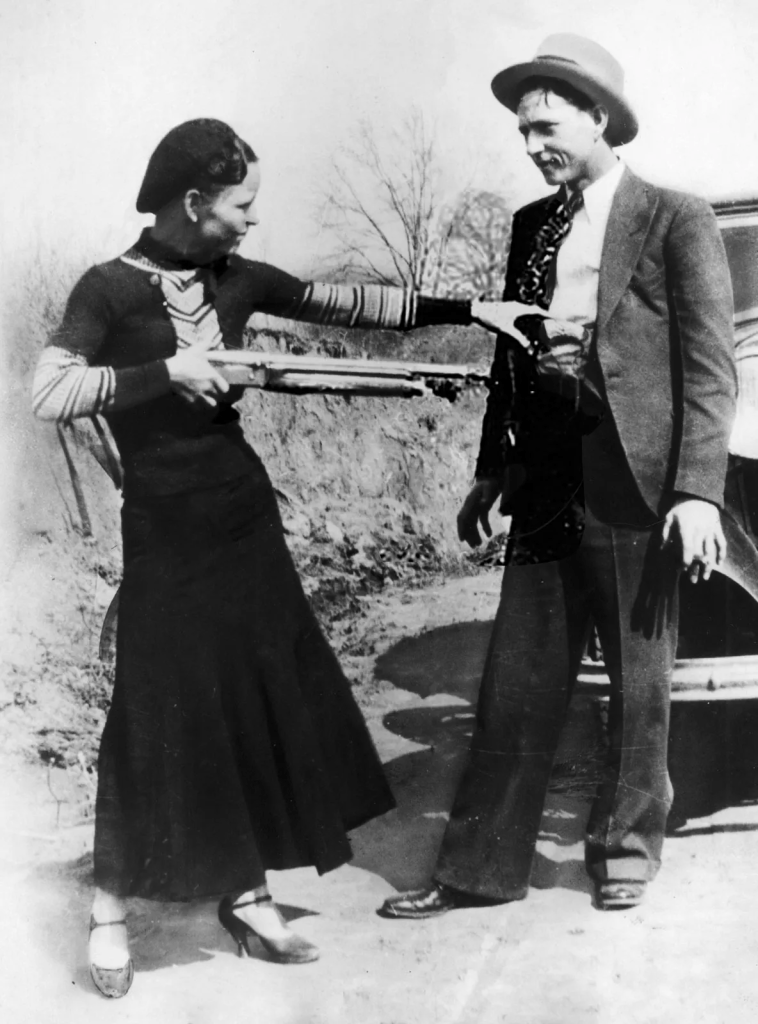
As for the plot, I’m personally saving my viewing eyes for later trailers to follow in 2024 and ’25, but from what we’ve heard and seen, it’s heavily inspired by the 1930s outlaw pairing of Bonnie and Clyde.
Also a first for GTA is a female protagonist. Rather than make your own in Online (as I have), the female lead is named Lucia and the male lead is named Jason. Plot details are obviously scarce and I intend to keep myself surprised until release even though select details have leaked yonks ago. From what I can gather from the trailer, it begins not dissimilar from JoJo’s Bizarre Adventure: Stone Ocean.
Think about it: young Florida woman begins in the prison system; Lucia herself most likely dodging worse versions of what Jolyne was forced to share a detention complex with during her own incarceration; a boyfriend with an equally sketchy history… and again without anymore information from that, I can’t say where else the story goes, but it clearly doesn’t take place in a prison, though the prison is likely to play a role in the story in some capacity. By the way, the initial comparisons weren’t lost on the JoJo community.
Credit: u/klydex210, r/ShitPostCrusaders
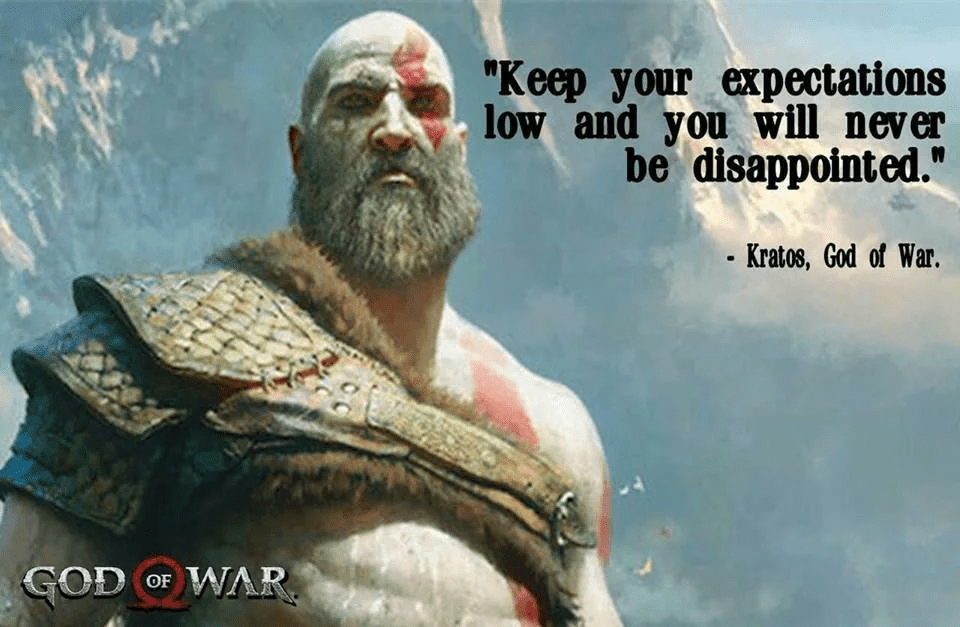
I honestly thought, as did others, that the release window would be, say, Q4 2024, but the trailer ends with a vague 2025 release window. As of writing this, in-depth analyses of the trailer are releasing on YouTube and more will follow with more trailers in 2024. All that time cooking up a five-course meal, so many people have been waiting for the main dish and it looks like whatever trailers are releasing next year and after until release will hold us all over as appetizers. I’m excited, but all throughout this post, I’ve been keeping a level and realistic outlook on this. As exciting as this reveal trailer was, I’ve learned from past mistakes and disappointments to wait for as much information to be made available. Remember Kratos’s words:
Credit: u/Shaho99, r/GodofWar
Open your mind to the possibilities and all that. Now have some analysis videos to hold you over until the next trailer.
As both a history buff and a weeb, I like to think that history can work well even in graphic novel form. I’d bring proof, but so many political cartoons and, as mentioned before, graphic novels, have come out that the proof is everywhere you look. Here’s one of my favorite examples:
For the topic of this post (and something more lighthearted), I bring to you the manga series Golden Kamuy.
Created by Satoru Noda, Golden Kamuy is about a former Imperial Japanese soldier and Russo-Japanese war veteran named Saichi Sugimoto. After his military contract expires, Sugimoto hears from an ex-convict about a complicated story involving a legendary convict who hid a large stash of gold from the Ainu people of northern Japan, Hokkaido, and the Kuril Islands. When he was caught, he tattooed a map onto nearly 40 other convicts, each of whom is a specialist in his own right. After this, the prisoners were set to be relocated to another prison in the north of Japan, but the guards were ambushed and the convicts went into hiding. Sugimoto doesn’t buy into the story at first, but when the ex-con reveals that he’s one of the dozens tattooed by the legendary convict, he reveals the tattooist as “Noppera-bo.”
So far, we’ve got some interesting and familiar hooks, don’t we? A retired soldier searching for treasure, interactions with indigenous people groups, a changing political landscape, and slight spoilers for later, competing groups with similar interests. Almost sounds like a western… A story that fantastical would normally disappear into legend until you meet undeniable proof of its existence, but before we delve deeper into that, I want to discuss the historical background on which the manga is based.
Very briefly oversimplifying, Russo-Japanese relations in the early 20th century, the Russian and Japanese empires, both had conflicting interests in East Asia: for Russia, they wanted warm water ports and more land for the Trans-Siberian railway, and for Japan, they wanted to maintain political influence over East Asia, particularly Korea–but so did Russia. War broke out due to these conflicts and Russia maintaining a military presence in Manchuria when the original promise was for them to demobilize.
By 1905, the Theodore Roosevelt administration brokered a peace between the two powers that saw Japan as the victor, gaining the southern half of Sakhalin Island, political influence on the Korean peninsula, while Russia had to abandon its railway plans and its warm water port in Asia, the former of these later becoming Japan’s Southern Manchuria Railway which connected to that warm water port of Port Arthur.
Golden Kamuy is set in the aftermath of this. The fighting is long done away with, but the outside influences do have an impact on the characters. Keep in mind that decades before Japan went to blows with Russia, it was busy organizing itself into a modern country, and its first step was the reorganization of domestic territory into the modern day prefectures, all the while convincing the last of the samurai and feudal lords to surrender their holdings. Many did, but there were still a few holdouts, the most famous of them was the Vice Commander of the Shinsengumi, a hastily organized group of swordsmen with samurai sponsorship: Hijikata Toshizo.
This was all done during the Meiji Restoration of the 1860s. Although Golden Kamuy is decades after that, select characters with strong memories of the pre-Meiji days do still hang around. It’s also worth keeping in mind that the manga takes several liberties with history and some characters’ roles in specific events. Since I bring him up, Hijikata does appear in the manga, and is a part of a few flashback panels, but in the manga he appears as an old man and political prisoner since the Shinsengumi opposed the Meiji government. In real life, Hijikata Toshizo was shot dead on horseback while commanding troops in a major theatre of the Boshin War.
For the rest of the population of Japan, the Japanese government and media these days tend to promote an image of a homogenous populace, but reality is far different than what you’d believe. I briefly brought them up earlier, but the Ainu people are another central piece to the manga. The prisoner called “Noppera-bo” or “No Face” was the one who buried their gold in a hidden location and it takes the help of numerous Ainu peoples to help locate it. The Ainu people typically includes the indigenous groups found often in northern Japan and Hokkaido as mentioned before, but there are similar related groups elsewhere, on Sakhalin and in Russian Manchuria. These include but are not limited to the Uilta/Oroks, the Nivkh, the Nanai, and many more. One of these characters whom Sugimoto meets in Golden Kamuy is a little girl named Asirpa.
Asirpa serves as the audience’s window to an ethnic group that Japan has at best ignored and at worst disrespected. In history, the Yamato people of Japan gradually fought with them even into the Tokugawa Shogunate where they were forcefully relocated to Tohoku and Hokkaido. During the Meiji government in 1899, non-Japanese who were subjects of Japan (including the then-recently added Taiwan and soon to be added Korea) were forced to adopt Japanese names and use those publicly. True to this, even Asirpa has a Japanese name that would have to be used on official documents, as explained in her associated wiki page.
Nevertheless, love and appreciation for Ainu culture is evident and expressed in the Ainu characters, especially Asirpa when she explains language, naming customs, rituals, folk beliefs and several others. The name given to that convict who tattooed the map onto his fellow prisoners, Noppera-bo, is a reference to a Japanese spirit or “yokai.” The yokai come in a wide range of forms and depending on the legend, some are harmless or vicious. The Noppera-bo is described as a harmless yokai that takes the form of a human, only they have no face. Sorta like this:
Though as explained before, it normally takes the shape of a faceless human.
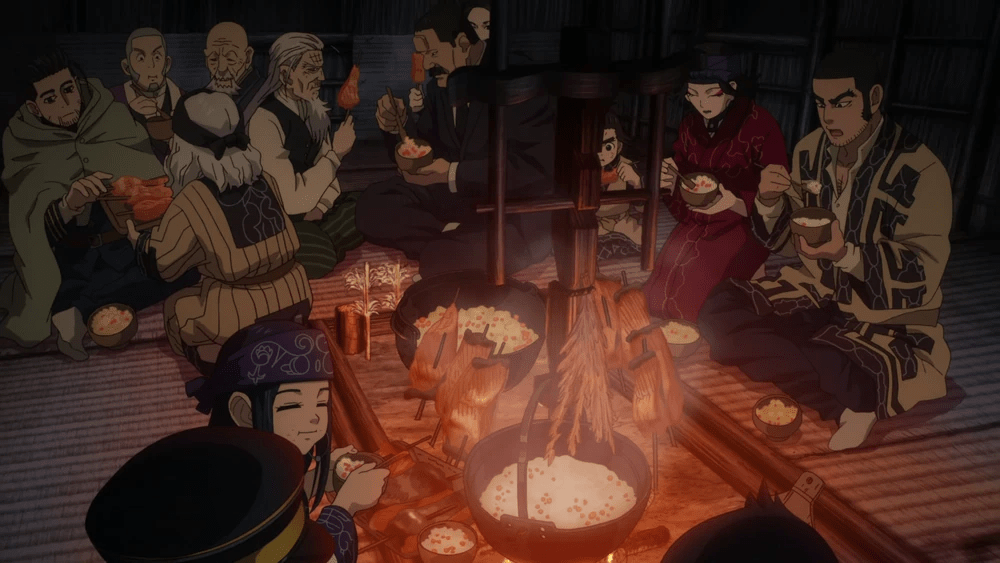
Regarding Ainu customs, the most famous aspect of the series among fans is the cuisine. It’s a common joke to refer to the series as a cooking show, which isn’t exactly inaccurate. Playing dodge bullet with loads of contentious groups is a key point of the series, but when there’s enough Arisaka rifle rounds flying for one scene, the next one transitions to Noda’s briefest possible tutorial on Ainu cooking, like so.
Channel: Crunchyroll Collection
It may seem insignificant plot-wise considering where the story takes our main leads, but funny enough, there’s a healthy hosting of food scenes throughout the series. Noda explained that much of his experience comes from growing up in Hokkaido as an ethnic Japanese. The conceptualization and characterization of the Ainu in particular comes both from his own experiences, which he admitted were limited and from research, which there’s a lot of.
The characters as a whole are all varied more so in personality than in ethnic group, though there’s a couple of the latter such as the Matagi, or traditional winter hunters also in Tohoku, or even people with varied accents and dialects, notably Satsuma dialect.
Although Japan also promotes a singular dialect of Standard Japanese, there’s a variety of accents in the archipelago. Like the U.S. or U.K., there’s often different words for many of the same thing like soda, pop, or coke in many U.S. regions or what lunch in dinner are called in different parts of the U.K.
Personality wise, the characters all differ in what they want the Ainu gold for. Sugimoto made a promise with a wartime and childhood friend that he’d look after his wife who moved to the United States who was at risk of going blind. A mutinous faction of soldiers, led by 1st Lieutenant Tokushiro Tsurumi, a vengeful intelligence officer, wants the gold to fund a separatist state in Hokkaido to spite the Meiji government. Asirpa was influenced by her father and another Ainu character to also use the gold to separate the Ainu from Japan but for different reasons, and some characters never reveal the truth of their intentions with the gold.
For the most part, the characters are in some way based on real life characters from history. Some are obvious like Hijikata Toshizo living for another 40 years in this universe, and others require some more research to determine their inspirations. My favorite has to be the character Yoshitake Shiraishi who was based on the similarly named prisoner and escape artist, Yoshie Shiratori. Like his inspiration, Shiraishi is described as a master escape artist, finding creative and innovative ways to get out of a jam from contorting his joints to making false keys and using lockpicks. You’d probably need a rotating body of prison guards to keep him in place.
Between Shiraishi and Tsurumi, these characters are both unique and not unique. Their quirks make them stand out from regular background characters, but there’s a bunch of characters who match that description anyone. Sugimoto, for example, gained fame during the war as the Immortal Sugimoto and has thus carried this nomme de guerre in the civilian world. Tsurumi and select soldiers within his unit — 27th Infantry Regiment, 7th Infantry Division — are all quirky as well. One might describe it as a circus of sorts. And this is a similar case concerning the prisoners who carry the map on their bodies.
Just about everyone is a specialist in some singular skill or trade. This may make them one-trick ponies by themselves, but there’s a lot of moments where they get to shine independently or in mixed company. Asirpa, for one, may initially seem like a monolithic standard-bearer for the Ainu, especially since she’s introduced with an old and negative stereotype of indigenous people groups from westerns, but both her and the rest of the Ainu presented don’t seem to adhere fully to these misconceptions.
Similar to the Amerindians in the Americas, the Ainu and other people groups in North Asia would’ve spent their lives directly or indirectly interacting with non-indigenous folks, fighting, trading, working, befriending them among other things. They would’ve been exposed to foreign customs and technology sooner or later, hence why during the Manifest Destiny era of the U.S., bands and tribes of American Indians would have fought back with the same rifles that were being used on them. Off the battlefield, cooking and craftsmanship have also caught up with the times, so old depictions of indigenous folk as backwards and removed are just that: they’re old and quite inaccurate.
My introduction to the series came from some old Funimation ads in 2018. At the same time as my anime speedrun during college, bouncing between Crunchyroll, Funimation, and the now defunct VRV, the ads for then-recently adapted Golden Kamuy were showing and initially, I wasn’t that interested. Most people weren’t either. No matter how high the marks, the average viewer would’ve been looking for “time well spent.” This conflicts with the overall negative opinion of CG in anime and with most of the ads depicting Sugimoto’s battle with a CGI bear, prospective audiences were initially turned off.
Then I started watching in 2019 and continued to do so during the pandemic. My opinions on CG have been somewhat influenced by those expressed online, but in all honesty, if it looks good and it means the animators don’t have to crunch to get an episode out, then it can work well for an anime production, and I feel it does here. I honestly didn’t realize the bear was CG until a few frames in. Just goes to show how rare and at times apprehensive studios can be about integrating this technology into a production.
The manga concluded in April 2022, but the anime recently wrapped up it’s fourth season in June after taking a hiatus out of respect for a treasured cast member’s passing in November 2022. A fifth season is currently in development, though as of writing there’s no release date. This is ample time to go through the anime and then continue in the manga or start the manga and compare/contrast the anime. Whatever works best for you.
It’s a month divisible by 2, and the last of the year so as a final sendoff, December’s first YouTube recommendation gets to the heart of a topic I have in store for next week: Cynical Historian.
The Cynical Historian is a YouTube channel that covers the history of the American Southwest primarily, and other topics in history secondarily. Started in March 2013, by former Army cavalry scout and noted historian Joseph Hall-Patton, the Cynical Historian has himself produced lessons and dissertations on his specialty in the American Southwest, namely violence and conflict, sometimes touching on the historicity of the local American Indian groups and figures active during the era. He runs a tight ship on his YouTube channel and has little tolerance for bigotry, hatred, or conspiracy theories of any kind.
One series he does that I recommend above all else is his Based on a True Story series that compares and contrasts historical moments and their silver screen depictions. Since the most recent video he did was in the lead up to the theatrical release of Ridley Scott’s Napoleon film, I suspect that a Based on a True Story video on the little corporal is somewhere in the pipeline, but without clairvoyance, I can’t say more. Be sure to check him out when you find the time.
Before I sign off proper, I had another video lined up emphasizing the surprising significance of food in Golden Kamuy, but couldn’t put it anywhere above, so I’ll link it down here.
The drawback of keeping up to date with a manga is that the expectations I put on myself are to summarize a chapter each time it releases, but the benefits of a monthly manga come with its release window. The larger amount of time it takes to write and draw a chapter give me ample time until the next chapter to get to writing. I’ll try not to make this a pattern, but I can’t promise that. Real life will interfere at times.
So on November 20, Chapter 4 of Boruto: TBV released and continually revealed more surprises especially from Boruto. I talked about events last time where Boruto had planted a toad onto Code’s person; this time around, with the Ten Tails restrained he attempted to cut a deal, but an unforeseen snag cropped up, and it’s somewhat involved with Code and his claw grimes. Whenever the grimes strike someone, they turn comatose and are encased in a tree.
In this panel, one of the Leaf shinobi was bitten by a claw grime and thus became a tree. In a similar manner, at the end of Chapter 3, Boruto used rods and other restraints to trap the Ten Tails, but when he transported himself to its location, the Ten Tails was missing. Instead, he and Code met a few beings that have a connection to the claw grimes. The trees they make when attacking aren’t ordinary trees, but they’re described as divine trees, and since Boruto explains that the beings created are living divine trees, then the conclusion I can draw from this is that the Ten Tails managed to turn itself into numerous divine trees and escape from Boruto’s restraints.
As for how he transported himself, you might recall that as an Ohtsutsuki vessel, he has the Karma seal and its space-time ninjutsu capabilities. Yes, but that’s not what he used to get to the other dimension. In fact, he has a familiar Jutsu to fans of his grandfather: The Flying Raijin.
The legendary technique has a third user on the roster. Created by the Second Hokage, used extensively by Minato Namikaze (and giving him the moniker Yellow Flash of the Leaf) and now Boruto Uzumaki is the newest user of the Jutsu. Continuing with the drip-feed method of exposition, we’re learning just as we go on, so it’s not revealed in this chapter when or how he learned this Jutsu the same way, Naruto learned how to do the Rasenshuriken or go into Sage Mode. Then again, in Naruto’s defense, he learned that long after he’d come back to the village in Shippuden and following the trend, his son may be geared up for a similar training arc.
Whatever the case, part of Boruto’s plan seems to have been to use the Ten Tails as a bargaining chip for Code, but when it turned into divine trees, the plan failed. There’s no Ten Tails to hold hostage and the trees are going to do what they were programmed, absorb as many chakra sources as it can so that it can cultivate a chakra fruit–same as had happened when Kaguya came down from the moon, same as when Momoshiki and Kinshiki and the other Ohtsutsuki invaded and attacked.
These were the only divine trees shown, but there could be others to be revealed in subsequent chapters. Not yet done with the surprises, the clues to Boruto’s Flying Raijin and mechanical toads lies with another familiar face: Koji Kashin. The synthetic clone of Jiraiya, operating as a spy in Amado’s pocket, seems to be working with Boruto, but it’s not yet known who made the proposition. Still, some things can be inferred at the moment.
Before the chapter ends, we get the answer to at least one question: Sasuke’s fate. As I said, the claw grimes make divine trees every time they bite someone and considering the image below, he was also probably unlucky in this regard.
This was a meme for a bit last week, along with another frame of Kakashi planting younger Sasuke. Nice to see the Uchiha tree has finally matured in spite of Tobirama’s efforts to cut it down.
In all seriousness, I wasn’t all that bothered with the so-called nerfing of the old gen to make the new gen look good. In lore, it’s explained that 15 years of peace time led to complacency and only a select few ninja still actively taking missions and whatnot would be the only ones prepared for when a real threat comes around and not just rogue ninja number 1,254–but Sasuke is one of the few ninja who was still going out on missions, many of them taking him either outside of the village or just outside of this reality. For f[Sharingan activation sound]k’s sake, he didn’t even know what his daughter looked like because it’s been so long.
Never mind that he lost the Rinnegan in a surprise attack (not that Boruto being possessed was a surprise, it was a matter of when), it just seems that Sasuke wasn’t as prepared as we all thought, which becomes even more damning when you consider that he’s had much of Sarada’s childhood to prepare and learn about the Ohtsutsuki and their goals. Naruto’s capture works as it shows how badly his Talk no Jutsu backfired, especially on someone like Kawaki who went to extremes to protect him from anything Ohtsutsuki even killing Boruto once.
If Sasuke did get unlucky, then I wouldn’t have problems with it depending on how well it’s explained. And if it’s not that then Kishimoto and Ikemoto oughta work their magic because it doesn’t seem like much of the old gen is getting theirs.
Before we begin, hope you all had filling Thanksgiving festivities for those who celebrate. I went through a slight hiccup with frozen food, but the other stuff was taken care of, so nothing to worry about. Now to the post.
If you’re looking at the title and thinking, “didn’t you do this two weeks ago?” Technically, yes I did. But that was about true crime, documentaries or media next to documentaries about real life crimes that have happened before, i.e. the Five Families, the Winter Hill gang, Al Capone, Bonnie and Clyde, and countless other criminal figures of yesteryear, all of them inspiring many of our fictional crime lords and kingpins in other media like Gus Fring and Don Eladio in Breaking Bad/Better Call Saul, Clay and Jax Teller in Sons of Anarchy, or for this post, most of the GTA and Mafia games’ lineup of characters. These are long-running series with colorful casts so allow me to preview the short version:
If I were a documentarian, I’d put characters like Tommy Vercetti in the bin of “Amalgamation of Prior Characters Seen in Media.” And not just him; other GTA protagonists and/or GTA moments have taken inspiration from movies released in the past. Some of the games take place in a specific time period and thus take inspiration from movies released around the same time. This video from WatchMojo.com lists different examples:
Channel: WatchMojo.com
Some of these may be easter eggs, but it goes to show how many fans of [Insert Movie Here] work or worked at RockStar. Call it a tradition to sneak some of these in, but they come in full force in GTA V, coupled with call backs to older games, including but not limited to:
a car that references James Bond on its license plate, equipped with spy gadgets
the cargo train’s registration number on the front referencing the year of the PS2’s highest selling video game (San Andreas)
Lester listing off successful heists initiated by prior protagonists; one of those characters being recruitable for a job later in the game
Michael’s special ability calling back to the bullet time mechanics of Max Payne
and if you wanna get technical, the five-year release gap between GTA’s IV and V, also calling back to CJ’s opening lines in San Andreas
As for real-life inspirations in the GTA series, well, that’s complicated. Vice City provides the easiest example taking inspiration from 1983’s Scarface which is a remake of the 1932 movie of the same name which was about its real-life namesake, Alphonse “Snorky/Scarface” Capone.
From my research, GTA’s influences do call back to high crime eras in American (and sometimes British history), but don’t take direct inspiration from any named criminal or mobster, comfortable to let Hollywood do it for generations before developing a love-letter masquerading as a video game. Sounds like a bit of a letdown, but a series that collects controversy like Yu-Gi-Oh! cards would probably try its hardest to let the games speak for itself, hence why RockStar’s problems weren’t in the headlines until later. Gratuitous cartoon violence was still thought of at the time as limited to Hanna-Barbera cartoons, so facsimiles of someone’s granny legging it after a gun goes off, or rural folk from D[bell noise]k-Fart, NorCal going hog wild thanks to cheat codes would be unheard of in the series’ early days.
I doubt it was much the same for the Mafia series, since that one could sneak past unnoticed, and if it did, the Mafia movie comparisons were proudly warn on its chest like a veteran’s war medals. You didn’t need to convince me that Tommy Angelo was Al Capone or that Mafia II was The Sopranos. It admits that by way of the title, and in stride. The Mafia series also heavily fictionalizes real-life locales, but thankfully offers more than the New York-Miami-Los Angeles trifecta that contemporary media blows its load over. It may just be me, but as a native New Yorker, I could do with a lot less New York. If a thousand monkeys can eventually produce Shakespeare, surely it can take a greater than or equal to number of monkeys to make modern-day Amarillo, Texas more exciting. The Coen brothers achieved that with Fargo back in the day.
So getting away from the usual three, Mafia: The City of Lost Heaven’s titular city is meant to be a fictionalization of Chicago in the 1930s, during and after Prohibition. Mafia II takes place in the mid-1940s and early-50s in Empire Bay, a fictionalized version of several East Coast cities, but having the trademark Mid-Atlantic accents that later defined New York and, depending on who you ask, Baltimore. Mafia III comes right out of left field by throwing the player into the Deep South in the 1960s, stuck between the counterculture movement at home and Vietnam abroad. Specifically, it creates a more in-depth though still fictional version of New Orleans, this time known as New Bordeaux, complete with all the neighborhoods that are said to be in New Orleans, though as I’ve writing, I’d never been. I wouldn’t mind a trip though, I hear Mardi Gras is a hoot.
So while the RockStar series is content with pure fiction, the Mafia series uses history as a jumping ground. Having said that, crime games have proven to be more imaginative than just these examples; I just have a lot of expertise in this field as an avid player of both GTA and Mafia. I believe I said this a few weeks ago, but this isn’t exclusively an American or British thing. Throw a dart on a map, and the country the dart lands on may have something next to a fictional depiction of organized crime–even if it’s beat out by a more popular neighbor. Consider how the western populace learned about organized crime in East Asia or the former Soviet Union, or how crime and law enforcement probably goes back even further than Hammurabi and Babylon.
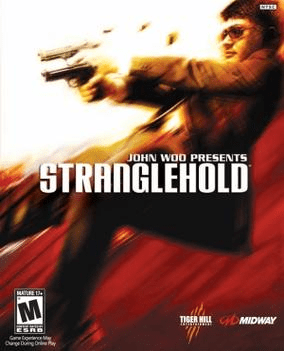
And obviously not all crime games put you at odds with the law; sometimes it’s you flashing the badge instead of blasting away at the guys who do. Followers already know about my love life with Max Payne, but I’ve definitely watched more crime drama shows and played more games where you are the law. One of the earliest games I played called back to Max Payne: may I present to you Stranglehold:
Full disclosure, I have this game (I don’t remember how I got it, it might’ve been from a bargain bin at Target or Game Stop), but I don’t recall ever finishing it. I’d play it again, but I need to check if it’s backwards compatible with the Xbox One before I try, or failing that, emulation or a YouTube Let’s Play can be found to catch me up to speed.
All I remember is that famed Hong Kong cinema director John Woo was contacted by Midway Games, makers of NFL Blitz and Mortal Kombat, to help produce a Max Payne clone with the likes of Chow Yun-fat reprising his role as Inspector Tequila from the 1992 film Hard Boiled, which I haven’t seen. Not that seeing the movie first would put me in the right head space to play the game since I started with the game, but if it helps me get an idea of who Tequila is supposed to be then it’s a good thing it’s in my long-ass watchlist because I’ve got some time to kill.
Traditionally, video games based on movies have been notoriously terrible, but some select developers have tried their best with the material given, sometimes even expanding on the formula established. I know that RockStar paid homage to the 1979 cult classic film The Warriors with a 2005 video game based on the movie, and I remember having fun with Stranglehold, so not all of them are crapshoots.
A more memorable game featuring Hong Kong-based Triad groups came out a few years later. We all know it as Sleeping Dogs, developed by the now-defunct United Front Games and published by the still-in-business Square Enix.
This one does have the Max Payne style of combat and maneuverability. In fact, it’s not comparable to Max Payne aside from the fact that both the respective protagonists are law enforcement officers deep undercover in an organized crime syndicate, but I’m getting ahead of myself. It’s meant to be a spiritual successor to the True Crime series.
Sleeping Dogs is set in contemporary Hong Kong where the protagonist, former San Francisco police officer Wei Shen is transferred to the Hong Kong Police Force to go deep undercover in the Sun On Yee. This presents an interesting dichotomy for Shen as he’s caught between two loyalties: the Triads and the law. I’d elaborate even further, but this ventures into spoiler territory and from what I recall the latter half of the game doesn’t stay as close to this as it originally set out to. This review has more insight.
Channel: The Escapist
Then there’s L.A. Noire, which I’ve mentioned at length or featured videos and articles that have mentioned it at length before, especially the development side of things.
The gist of all this would have to be that life influences culture, I guess. This all had to come from somewhere and the North Side Gang wasn’t gonna emerge from the dirt like Adam in Genesis. But it’s a generally good way to comment on contemporary society. Other times, people just wanna tell a story and whether a million people find it mediocre or one hundred start a fan club around it, the primary focus of entertainment had been fulfilled.
For crime dramas, that succeeds in spades taking home more gold than the original California 49ers. Part of the downside to the crime drama is that it’s come under scrutiny before for inspiring similar crimes, and not just the true crime genre. Violence in media is heavily scrutinized and when it’s in a video game, it’s a media circus that brings more attention than what was previously projected. I know I’ve harped on this before, but I feel that it bears repeating. Sorry to leave on a sour note, but calling back to a video put out by Alternate History Hub: the news should stop glorifying and perpetuating violence. It’s shown time and time again to do more harm than good.
Last thing, before I properly close off: I wanted to make a post about the fourth chapter of Boruto: Two Blue Vortex, but Thanksgiving preparations kept me from properly preparing the notes. I’ll try to get one out sometime in the next week, ideally before next week’s post.
Before we start, concerning last week’s surprise destruction of The Escapist’s video team, the YouTube channel Clownfish TV (which I’ve recommended before) uploaded a video a few days later that I contemplated dedicating a post to, but ultimately decided that it wasn’t worth it. The minds behind the channel are staunchly independent of any corporate oversight and maintain this position above all else for a better deal in the long-run. The Escapist was bought by a conglomerate which complicated things, and while the team of Kneon and Geeky Sparkles have zero love for dishonest games journalism, part of what motivated a possible post would’ve been to correct the record and clarify what actually went on… or at least I would have.
After sitting back and analyzing what the video concerned, I realized that most of the criticism was elsewhere on The Escapist site and that one’s opinions seldom influence business rules especially from the outside looking in. For me, it didn’t feel like that because the comments section was what got to me.
It’s worth noting that this tends to be the nature of YouTube communities; channels do have their dedicated base and this often leads to biased echo chambers with again very little influence on what goes on in the afflicted realm. Also worth keeping in mind was that reporting on pop culture in any capacity is merely another day in the office for Clownfish TV. Malice can’t be assumed all things considered. As for the community, the one piece of advice that works for me is to get the entire story before judgment is passed. Get all the context and then give your final thoughts.
Now for the real topic I want to write about: military novels. Personally, I’ve never been all that interested in them, and since I’ve been around on r/Army, reading the occasional news stories of controversiessurrounding thespecial forces community in particular, I’ve held a dash of skepticism to go along with what describe as a Heroic Tit-wank in Print form. If you don’t know, special forces like Army Green Berets or Rangers, Navy SEALs, Recon Marines, Air Force Combat Controllers and all of them tend to get the Hollywood treatment more often than not. I’m not saying they don’t deserve the recognition for their sacrifices, their missions, their stories, but they’re not exactly a monolith.
For every Medal of Honor recipient of any capacity like Dan Daly or Ralph Puckett or Alwyn Cashe, there’s also these guys making fools of themselves:
Credit: Getty Images
Clearly, the worst or more embarrassing stories of the military’s finest aren’t reflective of everyone including the HR folks or the intelligence or signal branches or anyone else who sees it as just another job, but sometimes it gives me pause for thought. As a history buff, I do like military history as well. The Elusive Samurai motivated me to research the Kenmu Restoration and the Ashikaga Shogunate in medieval Japan, for instance, and more than once I’ve done some light research on Civil War battle orders or even the Roman Empire, among numerous other things.
Channel: Metatron
Before even entertaining the idea of the military as a whole, the movies and whatnot all seemed so cool. Call of Duty and Battlefield led the way in cinematic experiences and memorable characters. After watching some more movies, and going to basic training myself, it’s safe to say that if you’ve been in the military — any military — you’re preconceptions are going to be challenged and your newfound knowledge on how things go in the real military will ruin a lot of movies for you.
Prior to shipping, I thought the boot camp portion of Full Metal Jacket was the highlight of that movie, primarily because of the characters: Joker, Pyle, Cowboy, and Gunny Hartman all make that movie, but stepping back from that, it’s divided first into how Marines are trained (sort of), followed by an active combat deployment to South Vietnam. The greatest irony of that movie is that for an anti-war film, so many incoming recruits watch and quote it ad infinitum, and expectedly so. The actors are the highlights of the movie and if it wasn’t for R. Lee Ermey and the jelly doughnut scene, then it probably wouldn’t have the same influence as it does almost 40 years post-release.
In the veteran community, lots and lots of media is heavily scanned and scrutinized based on what we’re all taught in boot camp and when we go off to train for the occupation we chose or have chosen for us based on test scores. This explains why movies like Generation Kill and the Hollywood misfit In The Army Now are more beloved amongst veterans and servicemembers compared to something like Zero Dark Thirty, American Sniper, or The Hurt Locker. Even vets who’ve never deployed to a combat zone (yes, this happens, ask around) will tell you that an overwhelming majority of the time is spent waiting to do something and that something goes by exceptionally fast. Such urgency…
Also, fair warning: the military has a frat house mentality. Keep in mind the ages of the people signing up.
So I’ve been rattling on over about military/war media and the reception based on the community viewing it, but I haven’t mentioned what I’ve been reading. As I said, I hardly ever had an interest, even in passing about these kinds of things, and even over time, now that I’ve been in a military training environment, I trend quite lightly these days. You’re drilled day and night about how to properly wear a uniform and even mishaps in film can get a vet’s dander up more so than stolen valor incidents.
I try my best not to overanalyze this stuff or make a monolith or standard-bearer of military/war media since a lot of it is for the public and like a lot of their real-life units, the special forces movies tend to play by their own rules. My rule for whether I should give something a watch or a read is wide reception. Even if the community hates it, it’s not good to let those opinions overtake or form future opinions on XYZ. But so far I have been enjoying Generation Kill, and I do like Saving Private Ryan and Dunkirk. Some of these I’m introduced to by proxy and they wind up being pretty good.
For Generation Kill, I went for the book first for comparison to the HBO miniseries. Nearly done with the book and the show so I might come back with some final thoughts. And getting back to controversies in the special forces community, there was one book that caught my eye. I don’t remember how I found it, but it’s called Code over Country by Matthew Cole. It’s based on the wide range of corruption and lax oversight within Navy SEAL Team Six. Once I get my hands on the book and get through reading it, I’ll try to make an effort to give my thoughts. Bear in mind, most vets and servicemembers won’t run into anything close to a special forces unit and for security reasons, most of what they do isn’t revealed until after the fact, so corroborating what I hear will have to be done by way of news reports like those featured on Military Times or its branch specific variants.
This post was kind of a misnomer all around, but before I close off, I want to make a case for the manga series Golden Kamuy.
I say this is a military series for a lot of the obvious reasons: veterans of a major war (Russo-Japanese War), active duty soldiers in uniform, commanders doling out orders by their judgment, and more. But it also takes the tropes of traditional westerns like those of the Clint Eastwood or Dances with Wolves variety.
I have a post in the pipeline regarding Golden Kamuy itself so look forward to it in the next few weeks. I’ll elaborate further on my case then.
I planned on making a post about this soon after the news came out, but I was waiting on more information relating to the news to come out. I was also busy with other real-world stuff, so if I’m able, this should be up either late Monday night or early Tuesday morning.
If you hadn’t heard yet, The Escapist’s video team resigned en masse following the firing of their editor-in-chief Nick Calandra. Nick’s firing was preceded by The Escapist’s parent company Gamurs placing impossible deadlines and goals for him and the team to meet and when he didn’t live up to those standards, he got the sack. Everyone, myself included, sees corporate avarice biting them in the ass with this since Nick oversaw a close-knit ship since most of his coworkers quit to join him for greener pastures. For more information on the situation from last week, see this video by YongYea:
Channel: YongYea
Gamurs bought the site in 2022 and seem to now be regretting their decision to axe Nick and by extension the entire video team. Some of The Escapist’s recent additions like Cold Take, Stuff of Legends, and other stuff is still available to view on the channel and seem to predate the The Escapist as told by some of the video team’s recently resigned members, but one of the major casualties out of this was the popular review series Zero Punctuation. Yahtzee explained in a stream last week that he was going to continue reviewing video games on his site, Fully Ramblomatic, which also predates ZP’s lineup in The Escapist, but whether The Escapist under Gamurs’ wing is gonna toss it for good or try something with the ZP license, I can’t say with certainty. All I know is what everyone knows about it in that Yahtzee couldn’t take ZP with him which is why he’s reviewing on Fully Ramblomatic. It might retain the Wednesday noon schedule as ZP but again it remains to be seen.
As for where it’s all going to go, the team relaunched and got back to business as usual by launching Second Wind.
This isn’t sponsored or anything. I’m making this to say that as a fan of ZP and of The Escapist’s other shows, like Jimquisition, the aforementioned, Stuff of Legends, Cold Take, 3 Minute Review, their livestreams, etc. that it’s terrible that the owners were so tunnel visioned that they’d axe a well-beloved member of the team, but looking at how well they bounced back into the fold on their own, I’m happy that they haven’t been too badly affected by the surprise changes.
Also, I’m putting this up as a YouTube recommendation. After the controversy earlier this year with Blair Zon of the iilluminaughtii, I expected another redacted recommendation to be controversy related or if the channel was mysteriously vanished. While I will keep my recommendation up for The Escapist until further notice, mainly as an archive, I’m also recommending Second Wind because the main video personalities have migrated their to continue their craft unimpeded.
As it stands, the channel has yet to set everything up, but by December or even January, it should start looking like a proper YouTube channel so get ready for that.
Hello, subscribers and tourists catching this on the fly. I’m known as the one who publishes ironically non-controversial takes on entertainment, mostly video games and animanga as of late. As I recall, the only hot takes I have on hand are these three:
1. Kratos did nothing wrong (sorta)
2. Boruto is slightly above average, and;
3. Chainsaw Man was predictable (to me)
And some others that might be expressed in the future. I’m writing to inform you all of something I should have updated everyone on in October 2023. After ten long years, I’d finally self-published my book. It’s called Dawn of Freedom. It’s a fictional crime story set in the early 2010s in New York, which was modern-day when I wrote it years ago. I’d struggled trying to navigate the publishing world and had to rewrite the manuscript multiple times, but I pushed through and saw it come to print. If you’d like to check it out, I have an Amazon link below for you.