
See, there’s, uh, just one thing that doesn’t look right.
Before you, dear reader, is an atypical series with an atypical protagonist played by a rather atypical actor for an atypical runtime.
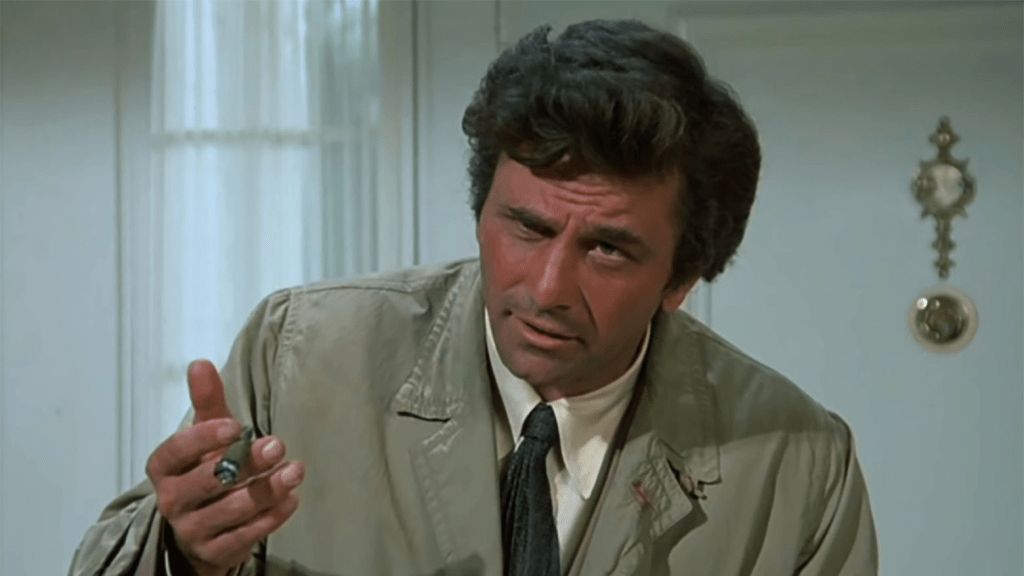
Columbo!
Created initially as a standalone character for the TV series The Chevy Mystery Show in 1960 by Robert Levinson and William Link, Det. Frank Columbo deviates from the time-honored tradition of whodunit mysteries. Columbo shows you the crime and if you pay attention and think about what the perp tells the police, read into their actions, you’re gonna find the inconsistencies that don’t make a lot of sense. For Lt. Columbo isn’t a whodunit guy, he’s a howcatchem guy. Seeing the action ain’t enough, you gotta dissect the action, consider the logic, some of the science, see more of the parts moving as they begin to move and voila! it starts to make sense how they get caught in the end.
Now, before I continue, I’d like for you to pause and answer the following question: What is your idea of a TV detective? Gil Grissom? Raymond Langston? D. B. Russell? Horatio Caine? Mac Taylor? Any of those guys from CSI original, Miami, or NY? Law and Order? Criminal Minds? Bones? Yeah, we make a lot of cop shows in the States; but Columbo is none of those. He’s confident, but not camera dominant. He’s exceptional, but not superhuman. He’s humble, but not imperfect. What is Det. Columbo? A bumbling cop who puts his prowess behind a mask of clumsiness and bolsters that crime-solving expertise with his relentless tenacity. The man can be told a story, but it doesn’t make sense completely because it’s not the story.
The main separation between Bobblehead Detective and Crime Scene Assertion and its twenty thousand derivatives is that Columbo doesn’t make use of fancy-shmancy technology. The crimes he investigates are all run through tests and labs, police have been doing that since the technology’s caught up, but it slows it down and walks with the audience through the process. It gets as close as it can to the timeline of police work from crime to investigation to suspicion to arrest with receipts, yet a not insignificant portion of the show is fantastical. Cops are always partnered up, they don’t show the evidence to the suspect while at their place of work or their domicile–that part is saved for the interrogation–and most importantly, they don’t carry themselves like Columbo in appearance. His position as a police lieutenant may give him a lot of leeway to choose how to carry an investigation, but the way he looks is improper for a cop. But this is the key advantage the show has.
Let’s put him side-by-side with a chronologically older example: Cole Phelps in 1947.
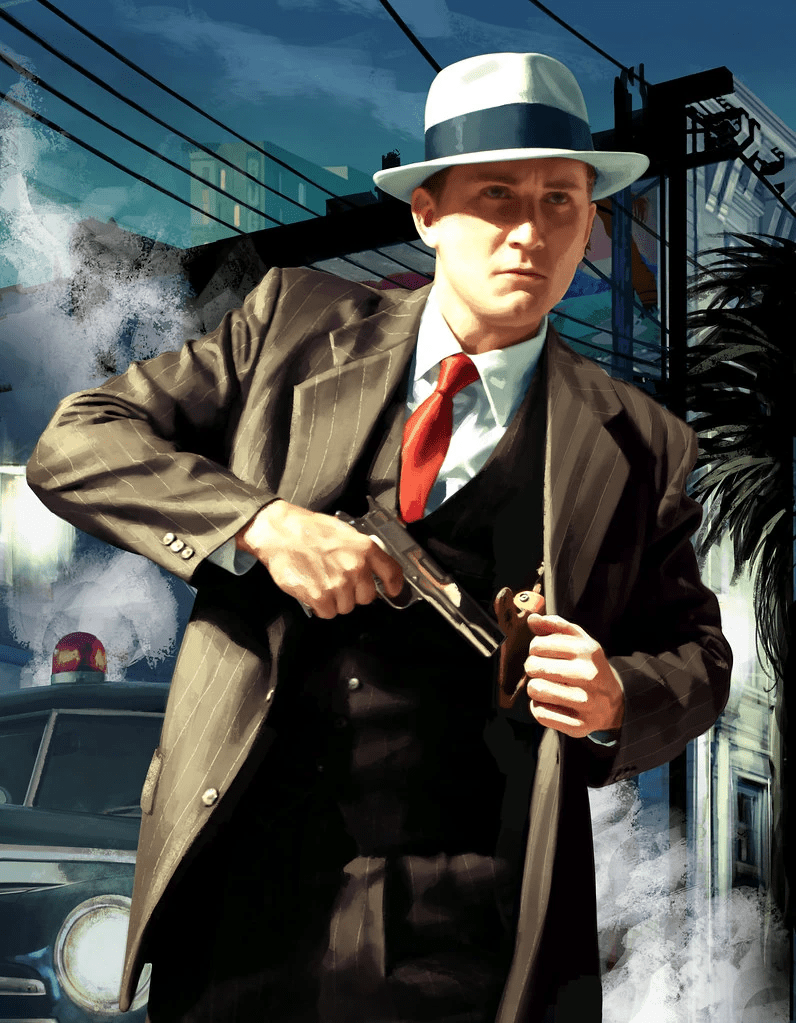
As you can see here, Detective Phelps and his partners don’t dress all that differently from him. Three-piece suit, badge at the waist, gun in the coat, fedora on top covering the exact same hairstyle that separates the societal pushers from the societal chains. Columbo has the look of a homeless man but performs with the confidence and experience of a seasoned detective. Phelps may not clock Columbo as a fellow officer until he pulls out his badge. Phelps’ foolhardiness and Custer Syndrome in the Marines turned him into the best detective in Los Angeles for the 1940s and the system still defeated him.
Columbo is not a tragic character who thinks he’s above them all though. He’s not a vigilante like Max Payne, even if he fits the role appearance-wise. He’s more of a founder for what the Ace Attorney series would become decades later.

This point will be relevant later.
Most of the whodunit mystery series all have a thriller angle thrown in. For Columbo, because he takes it a lot slower than the breakneck, whiplash pace of successor police and courtroom procedurals, the thriller isn’t in finding out who did the crime, it’s in breaking down how the crime was done on a microscopic logical level. Columbo looks at things the viewer may not have considered before the victim appears, the logic applied to the crime, the motives, the breakdown of these intimate relationships between victim and perpetrator, further reinforcing the often true assertion that a majority of criminals know the victim, even personally, which is why the label of “inside job” is better saved for something more elaborate, like Naruto’s Uchiha Clan Downfall.
It’s also worth considering that not only do these criminals know their victims, they’re established personalities with exalted positions. They’re politicians, military officials, realtors, wine tasters, artists, curators, doctors, chess masters, scientists; the criminal has a master’s degree in insert specialty here. They’re masters of their chosen craft and yet… the bloodlust is indiscriminate. You don’t need to be a squalid nothing to have a desire to kill. The only requirements are simply being human. Human enough to think you’re infallible, human enough to go above and beyond the core words, human enough to want something and know you can’t have it without going off the deep end. And most importantly, human enough to stumble over your own two feet.
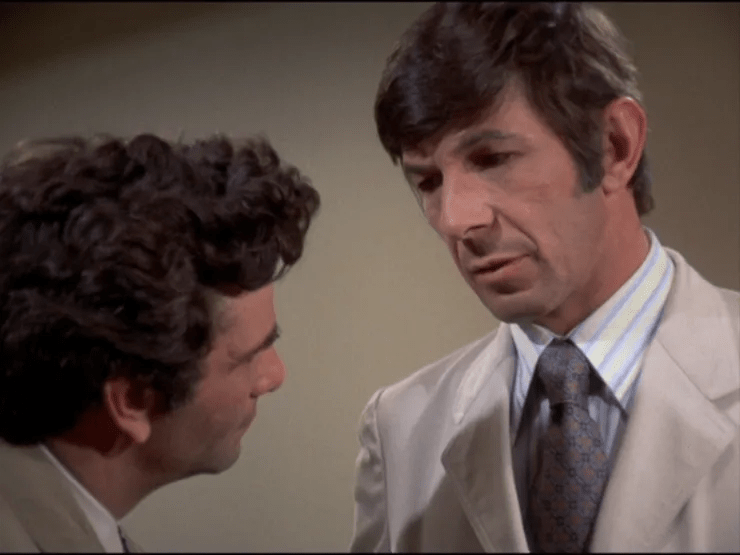
Your eyes do not deceive you, dear reader. That is indeed Peter Falk as Lt. Columbo standing in front of Leonard Nimoy of Star Trek fame. Playing as an opportunistic surgeon, his crime is, in fact, highly illogical.
One more thing to point out is the standard runtime. Let’s circle back to CSI, Law and Order, NCIS, and the other thriller-spilling shows of this type. How long do they run? Roughly an hour if you include all the commercials trying to sell you worthless bunk. Columbo is filmed in a manner that makes each episode less episodic and more of a self-contained film. I’ve been watching the series on Tubi and my first time watching it there carried me through a soul food dinner with chicken, peas, and mac and cheese. It’s not a series you binge in excess, it’s a series you watch one episode of, ponder, then watch more. How long is that grace period between episodes? Give or take, depending on you, it could be once every one or two weeks. I wasn’t there when it was on serialized TV from 1968 to 2003, but the slow burn feel of this series is one for a journey. The destination has been long mapped out, there’s no need to rush. Take your time and you’ll find your way.
Now let’s pull back and analyze it by way of broad analysis. An American inverted detective story whose central character feigns incompetence to get the suspect to gas themselves up only to notice an unsecured rope and watch them tumble into handcuffs and a criminal trial.

My sources tell me that Columbo is, in fact, the father of the Ace Attorney series, and the next topic will confirm that.
How so? Well, the way Columbo is portrayed is that of a bumbling, but earnest gentleman. And this was what Japan loved about him so much.

Even without meaning to, the choice to make Columbo a silent, humble genius resonated very well with Japanese cultural nuances, and I suspect the East Asian concept of face culture was a major factor. Clumsy on the surface, expert behind the scenes. These apply to the concepts of honne and tatemae (本音と建前). The short version description of this is that you don’t show everyone you know your ass. Your close family knows you better than most friends and acquaintances. Is this uniquely Japanese? No, for me being a westerner, I know people who are genuine with everyone whether everyone cares or not (most of the time, they don’t), and I know people who would be derisively known as two-faced. It’s not like keeping your personal affairs personal, it’s like presenting yourself as respectable to those who need to see that, and unwinding and being your goofy self in the privacy of your own home. Case in point:

Source: Iggy-Bomb, Newgrounds. I promise, I didn’t pull this up for the obvious Great Big Booba Joke.
This fanart depicts Yuriko Okada from Tojima Wants to be the Kamen Rider in different forms of dress, her professional schoolteacher appearance on the left and her Electro-Wave Human Tackle persona on the right. Yeah, this struggle is near universal; you wanna be your natural self, but society will shoot you out of a cannon if you do so (T_T).
Columbo accidentally struck the balance, by not having the titular detective be a standard, bust the door down and arrest the guy in such a brazen move. Instead, he shows an extreme level of politeness that may just outdo Japan itself. Even if he stops in front of a wall, he’s not the type to take it sitting down, for it’d be highly illogical for a cop to just up and quit. No, he finds workarounds, looks for further clues to investigate, zeroes in on inconsistencies and his tenacity for justice is outdone only by his love of cigars.
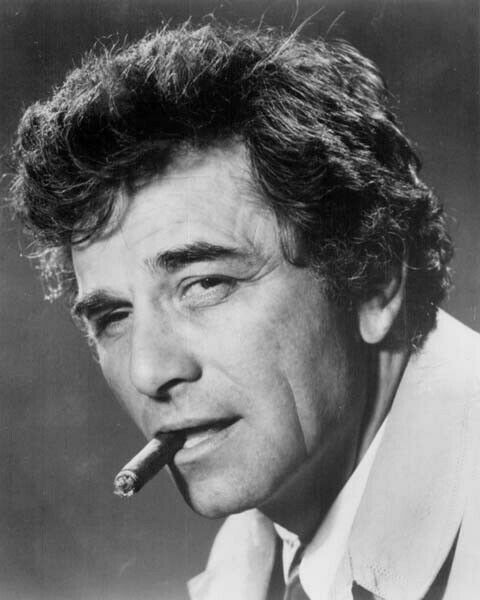
Peter Falk didn’t zero in on a singular brand of cigars, and neither do I. But if I were to choose a brand, Factory Smokes, El Septimo, and Cohiba stand out the most. Runner ups are Brickhouse, Warfighter, and Joya de Nicaragua.
So, Tiberius, what exactly am I getting from watching Columbo? A trope inversion for a start. Even when something is clear, breaking down what the average bloke misses is a strength of the detective. Another one would be guest appearances. Big name actors have appeared in various episodes of the time. Granted, some of these may pass you by if you haven’t seen other TV series where they appeared in, but if you know the name you may know the other property they star or co-star in, especially if its a long-lasting franchise like Leonard Nimoy from Star Trek above. And most of all: longevity. 1968 to 2003 is 35 solid years of show to thumb through with considerably less episodes than a soap opera. 10 seasons with a pause between 1978 and 1989, so it’s less straight 1968-2003 and more 1968; 1971-78; 1989-2003.
Tubi once again has the series in full on its platform and you can watch it for free. No need to pirate this time, but in case they can’t hold onto it forever, then:

This post doesn’t exist.
 Opinions on Entertainment