
Alternatively known as: Jack, And, S[monkeys]t
Breaking up the Red Ninja: End of Honor Blog Post Saga momentarily to bring you the wonderful world of an animanga series featuring otaku culture and the comedic deconstruction of otaku culture.
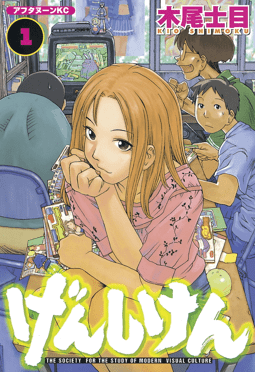
No, not that one. We did that before. Twice.
No, the series on topic this week is a classic one that’s roughly about schoolgirls doing otaku things rather than cute things with music or just silly things goofily. Damn, I’m not making a good case for myself here.
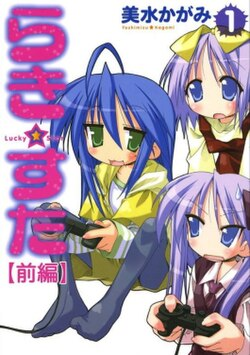
It’s this one. Lucky Star.
Rather than pull out all the stops to showcase a cast of six high school girls navigating academics and their friendships from first- to third-year, this one showcases four. Konata Izumi, an insightful otaku girl coming from a family of otaku (no wonder I like her so much); fraternal twin sisters, Kagami and Tsukasa Hiiragi, the former acting as the straight man to Konata the funny man in double act terms, and Miyuki Takara, the prim and proper class representative who’s humanly clumsy.
Combining these four creates an interesting cast and could theoretically put Kagami in the Tsundere bin if there’s a trace of romance, but in both the manga and the anime, it’s slice-of-life through and through, so the earlier mentioning of AzuDaioh and K-On! would be apt if the plot progression wasn’t limited to “how does Konata weeb herself out of this one?” All things considered, the learning processes of the girls is comparatively static. They don’t change in outlandishly big ways from Episode 1 to end, but rather in small incremental ways.
The rest of the cast shows up over the course of the series, mainly to take the piss out of other animanga prior to 2007 as though it was following an unwritten and unacknowledged law. Most notably:
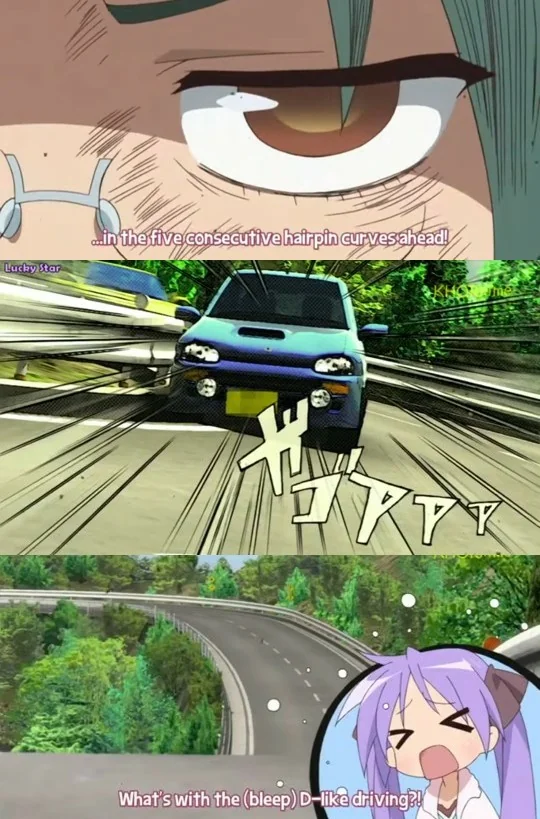
Credit: u/YaBoiErr_Sk1nnYP3n15, r/InitialD
Yeah, Initial D was ripe for the parodying at the time and a good look at the series reveals why.
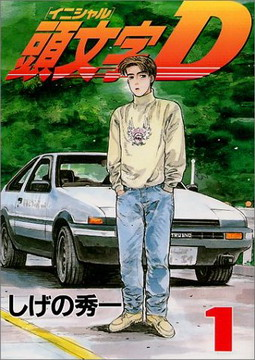
The original manga ran for 18 years, by the way.
The charm of Kagami Yoshimizu’s yonkoma is that through the format and characters, nothing is off the table for referencing or parody, and Yoshimizu’s taste seems to be something of a diet of Toshiyuki “Hirohiko” Araki’s JoJo’s Bizarre Adventure, but with less music references and more animanga references. If you’re a fan of The Melancholy of Haruhi Suzumiya, you may already know then that the Japanese voice actress for Konata is the same one for the titular Haruhi in that series: Aya Hirano. The joke is deliberate and Konata herself takes the piss out of that in very malicious fashion. She already looks like Haruhi, why wouldn’t they share a VA?
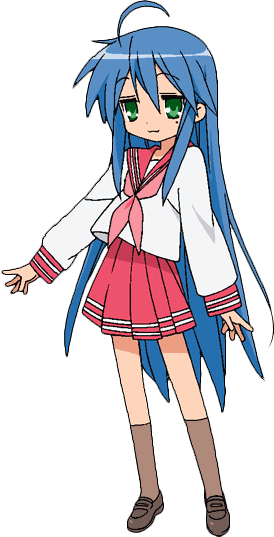
SHE’S A SENIOR.
Between the parodies and callbacks to popular concurrent media, the main gag revolves around a double act format but with an extended side cast to fill in the spots to maintain consistency. Konata does something stupid or ridiculous, Tsukasa and/or Miyuki follow the motions, and Kagami calls it out for what it is. Simple, right? Well, no. The formula is more fluid with instances where one person is right and the other reassesses, or it backfires spectacularly.
Having said that, the series does have its moments. For all the funnies and references, there are some deep touching moments. If ever it has been said that comedy/parody/satire, are a reflection of the thing it takes the piss out of, then Lucky Star is a reflection of a lot of things. Idol culture, otaku, gaming, friendships, Japanese high school life; and I suspect most high school/college-centric series are like this. Unlike western high school tropes where life is dreadful, tests are painful, and the archetypes never evolved past the 1980s culture of jerky jocks, eccentric nerds, and brute force, brainless bullies, Japan’s reverence for seniority and politeness is a time-honored tradition with its own filial philosophy airlifted from ancient Chinese traditions and one repeatedly poked fun at with how absurd it can get at times. Of course, these tropes are lost in translation which makes western debate on a Japanese cultural staple seem braindead without that understanding. Seriously, is it that hard to request information from Google-sama these days?
Thanks in no small part to dubbing and distribution in the west by the likes of Funimation, recently consumed by Crunchyroll, the parody of select concurrent media has become parodied itself to oblivion. To death. Back to life. And to death again, to the point where this is canon:
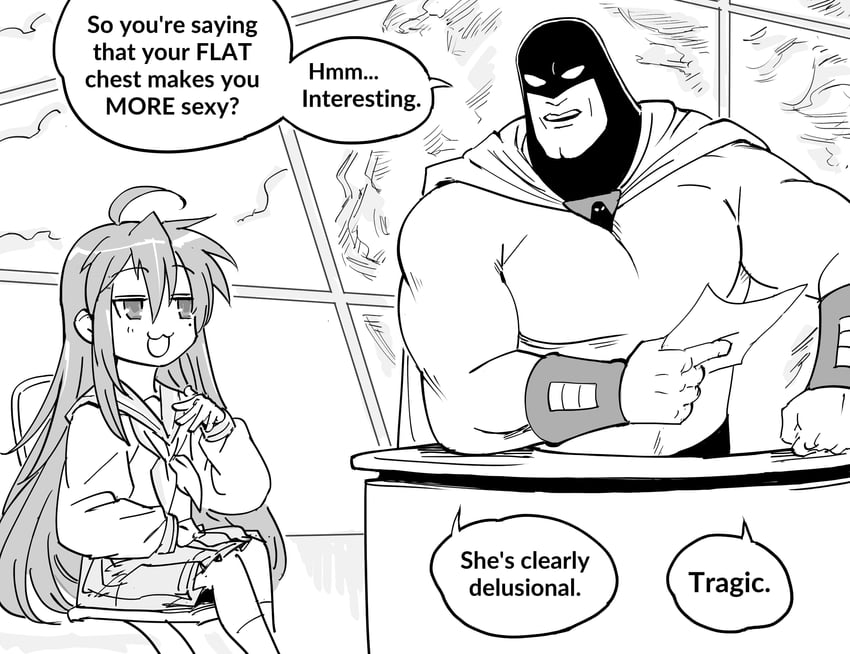
If you know, you know.
A test of time for a series depends almost entirely on how well it survives pop culture. Good or bad, internet jokesters on forums and artists contributing to 20-year-old imageboards will find something to make a meme or image-macro out of, even if it comes decades after the fact.
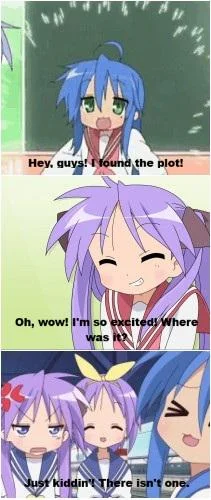
This one describes the crux of my custard pie quite well and in one less panel than the original source material.
Another thing to point towards in Lucky Star comes from the post-credits in-universe idol channel known as Lucky Channel.
Credit: Jas A
The gag in this one is even more static than the rest of the show. Akira Kogami and Minoru Shiraishi reflect a deep cut parody at the likes of idol culture in East Asia, something I’ve mentioned before briefly. They play nice for the cameras about a minute in before Akira wishes for it all to end and sidelines her co-host like a stuck-up celebrity, which itself may or may not be a dig at Hollywood at the time. Yoshimizu allegedly consumes about 25% western media among the native animanga he regularly parodies, so who’s to say he hasn’t poked L.A. once or twice? Lambasting Hollywood through media is a time-honored American tradition, but it’s something else when non-Americans do it, even these days. Calling back this meme:
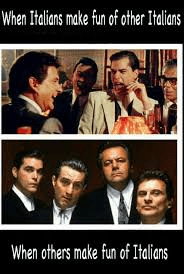
The meme in question also applies to military branches, presumably worldwide, so my brothers in arms in Britain would also know what’s up.
If at all it feels like Hollywood has been flailing like a “lol cow” in response to constant negative reception, keep in mind Hollywood has always been this way. A controversy appears like a Ratatat in Pokémon and Hollywood gets clumsily defensive over its image. That, or it’s an actor reacting negatively to the changing tide. Tinsel Town just can’t take the heat anymore.
Lucky Star’s anime has 24 episodes that aired in 2007 with the manga starting in 2003, and is said to be still running after nearly 25 years, give or take, one or two hiatuses, as well as a smorgasbord of other media from OVAs to light novel to presumably lost DS games (╯°□°)╯︵ ┻━┻ f[door slam] lost media!! Probably. Who knows if an emulator has archived the games? But the main draw here are the anime, the manga, and the OVA, where this screenshot exists:
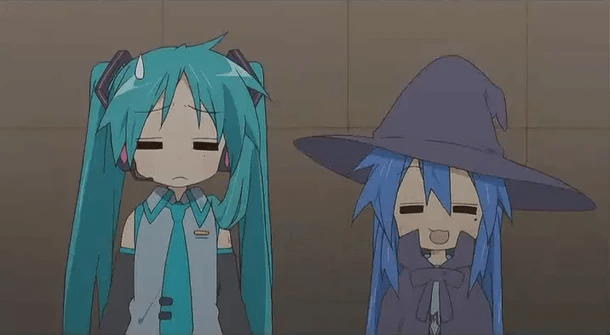
Have I ever lied about the parodies? ARE YOU NOT ENTERTAINED!!??!
Normally, I’d advocate for pirating here, but there are chads on YouTube uploading the whole series in dub and sub for whichever appeals to you so you have wider choices as of this writing.
Channel: CrackerBountyHD
See? Told you it was about f[kazoo]k, and, all.
 Opinions on Entertainment