Forgotten Mortal Kombat Plot Points that Had Potential

With more time and care, these could’ve helped the old games

This post was originally supposed to be about different archetypes in anime, though I’m delaying that to sometime in December as I don’t yet have enough research to discuss those in full detail. This week, however, I’ll bring up something that has crossed my mind before, but not with enough frequency to expand upon: forgotten plot points from the 3D Mortal Kombat universe.

The original idea came from a MojoPlays video that I couldn’t f[head rip]king find until a few minutes before writing this because I misremembered the title. Abandoned Story Threads instead of Forgotten Plot Points; potato, potahto. Either way, the video can be viewed on the MojoPlays channel through the link below.

Credit: MojoPlays

The gist of the video is that throughout the series, the Mortal Kombat games have introduced plot points that were about to heat up only for the devs to go in a different direction. With over 30 years out on the market, you’ve got your pick of the litter to choose from. For this week, it’s the 3D games from MK Deadly Alliance to Armageddon. Here’s the f[scream of pain]king short version: starting with Deadly Alliance, Quan Chi escaped from a fiery ass-whoopin’ at Scorpion’s hands, discovering the Dragon King’s “undefeatable” army in the process and bringing these mummified warriors to Shang Tsung where they formed a bond based on ignorance.

Context:

Channel: Kamidogu

After the Deadly Alliance is formed, they remove all obstacles that would block them from ruling all existence. Not happy sucking up to Shao Kahn for millennia, they kill him in his throne room then make their way to the Wu Shi Academy where Shang Tsung finally gets to consume the soul of the greatest warrior in Mortal Kombat History: The Great Kung Lao I mean, Liu Kang!

OGs can’t be beat!

So with Liu Kang and Shao Kahn dead, they operate a tournament under false pretenses in Outworld and use the defeated to return the mummified army to life with the goal of marching on Earthrealm with malicious intent. Raiden saw this from the heavens and organized the remaining warriors across the realms to stop them. Fun fact, you can find archived websites and forums debating the plot points of then-upcoming games, like this website MKSecrets.net, which for some reason still looks like it was made in 2001 even though it has details on MK1 (2023)… I thought that was most Japanese websites…?

Anyway, MK: Deception picks up from the premise of Deadly Alliance only the sorcerers were too powerful for all of the warriors (could’ve probably sent them all as a group, but MK9 proves that that wouldn’t have helped much) and so at his wits end, Raiden challenges them himself. Not even a thunder god could defeat the sorcerers and realizing that their goals were nearly complete, what was left was the amulet Quan Chi stole from Shinnok in MK4. He hangs onto it defeating Shang Tsung in the process, only to have Onaga reborn (hinted at from Reptile’s ending in the last game) and return to reclaim the army that the sorcerers so generously returned to life with the souls of conquered fighters.

All three men realize that danger was marching towards them and while they managed to temporarily hold them back, Raiden uses a last ditch attack on the Dragon King. It failed to even scratch him and he grabs a hold of the amulet which will be needed to form the six Kamidogu into a single entity.

Channel: MKIceAndFire

As for how Onaga acquired the Kamidogu, well it involved tricking a young boy named Shujinko and leading him across reality by the nose for 40 years. If this game were canon, that would’ve come back to bite Onaga in the ass, only for Shujinko’s efforts to go unrecognized as redemption and still get punished by a Dark Raiden. This will become important later.

Shaolin Monks was a bit of a beat ’em up remake of MKII (kinda) and I’d already talked about that before, so we’re skipping it considering it has nothing to do with the 3D trilogy anyway.

Armageddon was supposed to cap it all off and the more I’ve thought about it, the more it felt like a final send off before Midway got the crappy ideas out of the way in time to file for Chapter 11 bankruptcy in 2010.

Let’s not be too harsh though, it did help pave the way for the Injustice line.

Story-wise, the protector god of Edenia, Argus, is made aware that between the actions of the sorcerers and Shujinko being duped for that long, the warriors of the realms were learning more about the construction of the realms than the Elder Gods would be comfortable with and proposed to Argus to come up with a solution. He suggested total annihilation to protect the realms from their own residents, but his wife Delia suggested depowering them all since there were many heroes who fought tooth and nail to defend the realms from evil, not the least of which was Shao Kahn and Shinnok (whom we learn later was banished to the Netherrealm for eternity for treachery, leaving Quan Chi to do the heavy lifting through the Brotherhood of Shadow).

They’re granted the power to do this and choose to do so by making a competition of things for their sons Taven and Daegon. If things went to plan, the two men would engage in a friendly competition, grab their weapons and armor and race to defeat their mother’s firespawn (half-brother?) Blaze to achieve full godhood as both of them are demigods. In reality, the two brothers, under the watchful eye of a pair of dragons, Orin and Caro, are set on a different path. Caro, who was the guardian dragon of Daegon, lost contact with Blaze believing it to be an early sign to set him on his path. Instead, Daegon forms the Red Dragon clan in Caro’s name and signs off on unethical science experiments for the purpose of choking existence into coughing Blaze up. The way its presented makes me think of Unit 731 in Manchuria and its surgeon general Shiro Ishii. If you don’t know, look it up at your own peril.

This makes Daegon the antagonist of the Konquest mode and through no fault of his own Taven loses sight of the purpose of his quest. And his frustration and confusion at this whole course of events is best reflected at the several times he’s questioned and even considered abandoning ship. The quest stopped being fun for him as he lost the things he cherished. Blaze appeared at the end to catch him up to at least what the true purpose of the quest was and Taven is a hero if we compare him to the Ancient Greek model similar to Perseus or Theseus. Self-serving at times, but the guy still knows the difference between good and evil. Daegon’s descent into evil seems random until he learned that he was supposed to lose the quest and decided to take matters into his own hands, hence the birth of the Red Dragon.

Dropped and abandoned plot points are still a problem for the series as it’s developed a reputation for introducing points and leaving them to collect dust. We barely get five minutes with the concept before the devs (read: Ed Boon and John Tobias) moved onto something else. You could say the fandom is also to blame for this as dedicated fans have asked (demanded) the team to release canonically deceased characters as DLC, but staying with the 3D games where the problem expanded, there’s more to say about it during this era than anywhere else in the series.

Starting with Deadly Alliance, Shao Kahn was established to be killed in the intro to this game, with Deception and Shujinko’s story acting as a prequel taking place some years before the events of Deadly Alliance where it all converges. Shujinko himself was invited twice by the White Lotus Society and later by Shang Tsung himself to represent Earthrealm in the tournament but couldn’t attend for different reasons. The White Lotus got tired of waiting for him to power up (never mind that the tournament is hosted every 50 years) and due to his cleansing journey with Nightwolf, he had to go back to the Netherrealm to gather more hatred, from none other than the ghost of Hanzo Hasashi.
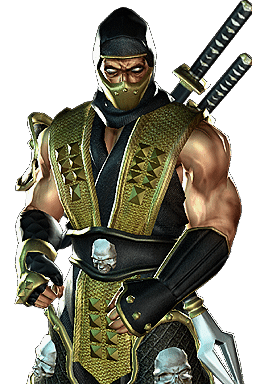
This part doesn’t necessarily screw around with the timeline as egregiously as following plot points, but Armageddon is where it all breaks down. Canonically dead characters are resurrected off-screen and based on what we know we can connect the dots, but often the devs are a bit cagey when it comes to showing how, who and/or why characters are returned to life. The 2011 continuity shows that Quan Chi has brought Noob and Sindel back to life and claimed the souls of those killed by Sindel herself in the eleventh hour, but it’s not shown whether he brought Shao Kahn back to life or if he did why he’d do so, or even why the rest of the villains would agree to this arrangement.

Channel: BruskPoet

I’m not saying this moment in the story is bad, I like it a lot. But the nonexistent explanation for how all this can come to be is what sours me on it somewhat. I’d say there’s no care for a consistent timeline especially in a fighting game (something that doesn’t escape Tekken), but I think it’s more along the lines of the devs wanting their personal favorites to shine brighter than the others, which is why the franchise works better as video games and toy lines than it does movies.

Most of the time…

For what it’s worth, the characters have been mostly consistent with a few touch ups here and there, but if you ask people like The4thSnake, there’s a lot under the hood that could use some light to heavy rewiring from individual characters to whole ass f[swords clashing]king plot points, like what I’ve been writing about here. I’m a bit torn personally, because it brings a charm not found in other series, but this many plot holes treats the timeline like a redheaded step child. Doesn’t stop people from trying, as I’ve stated before, I rewrote MK: Shaolin Monks myself like it was Dragon Ball as that was what I was watching at the time.

Why bother with the 3D games, though? Well, of all the plot points introduced and left by the wayside, the 3D games did it the most and the worst of any other era, which seems to be the result of developmental inconsistencies prior to release on store shelves. It certainly hasn’t stopped people from trying though and it likely will keep going for as long as there is a Mortal Kombat to fix. Nothing too serious at this point, but it’s both fun to expand on what was and offer critique for one of the series most tumultuous times in its history.

Genshiken: A Full Review*

Well, more episodes to cover at least

Gonna have to be entirely honest here, the timeline I gave myself to fully watch Genshiken couldn’t be adhered to. Life got in the way. C’est la vie. But now that I think about it, having covered series before only partly, halfway, or most of the way through, it got me thinking that I don’t necessarily have to complete a series to review it. I think I get more mileage if I watch enough to understand without necessarily having to complete the series. Completion does help, but to quote Jack Torrance, “All work and no play makes [Tiberius] a dull boy.” Now to the review.

It wasn’t long ago that I caught this anime by way of one of the anime subreddits and in that clip, four otaku speak wildly to a normie about the beauties of a niche Japanese rape game.

Not necessarily a turn off for weebs, if the Redo of Healer’s overwhelmingly female fanbase is any indicator and certainly not one for me as I ventured into this anime expecting more off-the-cuff conversations and it’s a lot more mellow than that clip would lead anyone to believe. As I’ve said before, it’s an anime about a quartet of otaku, sometimes joined by the sometimes Y otaku who has himself a girlfriend hellbent on shaming them into being normal. As a weeb, I take offense, but knowing what I know about the internet when this anime was on air in 2004, she wasn’t the only one yelling this from the heavens.

Further, even I have my limits on my own hobbies, though limit doesn’t necessarily mean quit. Moderation is the key. So as I watched more of Genshiken, the more I saw of the slice of life aspects, similar to shows like Azumanga Daioh, Lucky Star, and K-On!, but instead of a multitude of cute girls doing cute things cutely, it’s a bunch of college dudes taking half the share of the oppression shared by gamers because they were brave enough to say no to the rat race by engaging in their hobbies. But it does share a similarity with the aforementioned series, namely progression. Azumanga follows the girls throughout high school; Lucky Star does the same even if it’s famous for talking about nothing, and K-On! adds to the roster in the form of Azunyan, weak to the power of the headpat.

Credit: r/HeadPats, u/BTN099

The slice of life genre has its detractors who balk at the idea of a show about f[pages flipping]k and all, but as someone who enjoys many genres SoL being one of them, it’s a nice break from all the methamphetamine fueled action found in Shonen or the isekai singularity. I like beating up ghosts or searching for the One Piece or defeating space Hitler as much as the next guy, but I don’t always want to see that. Something something variety, something something slice of life.

Besides, Genshiken is a series that speaks to weebs because it’s about weebs. You definitely have nerd friends and may yourself be a nerd in some aspect, especially if you’re subscribed to this blog or check in every week. We all have that circle of friends who geeks out over the same things. I had mine in middle and high school and I met mine both times I was in basic training and when I was in AIT, and that passion turned from video games to anime (but of course, games are still a major part of my life; I’m currently building a gaming PC).

Credit: Naumovski

The passion is what speaks to me, this collection of nerds coming together to discuss the important things in life, such as Oppai, Medium or Flat — which is a trick debate because all size makes the wood rise, especially when paired with thicc thighs that save lives. I do recall that rant on the character of Saki Kasukabe and her intense criticism of the medium of animanga as a whole. Watching further was the right choice and I do recommend continuing the series in whichever form you find best as further episodes see her eating her own words every time she gets humbled.

No one can be this dedicated to animanga, you say? Well, conventions beg to differ. Childish, you say? Well, yesterday’s weebs are parents now — see Latin America’s love of Dragon Ball for more details. Women are definitely not interested, you say? Well, not only does my comment about Redo of Healer having a massive female fanbase stand tall, but so does a new character introduced in Season 1: Kanako Ono:

Makes me think of Tomoko Kuroki from WataMote.

Beyond that, Genshiken is a chronicle of passionate animanga geeks whose love of the medium is not tempered by naysayers and is surprisingly large to newcomers and tourists. Once again, for those who wish to view the series, I implore you to find whatever piracy site works best for you. Most anime streaming sites (read: Crunchyroll) aren’t guaranteed to have the full series.

Now That You’ve Tasted My Saliva, Wanna be My Boyfriend?

Perhaps romance has always been weird

No matter your relationship status, you’ve definitely seen pictures and memes or heard stories through the grapevine about how certain people are made for each other. When applied to fiction, fanbases notoriously put certain characters together and creatively put whatever circumstances they can concoct to make it happen in their own fanfics. Sometimes it works, but other times it’s more or less an appeal to a certain character for a variety of reasons. And as you might expect, other aspects of the fanbase can get perverse in this matter. This typically happens when a series is presented as neutrally as possible. The series I’m talking about here starts off in a strange position by virtue of its own title:

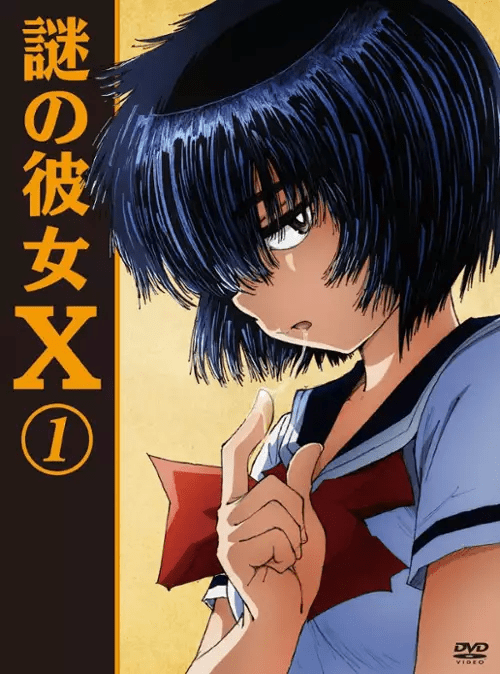
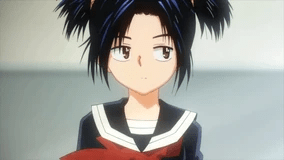
Nazo no Kanojo X or Mysterious Girlfriend X gained fame at the time of release for one of its characters, Mikoto Urabe, releasing the sluice gate she has for a mouth and leaking all of her drool. A sane man would probably be put off by this aspect, but curiosity overrules sanity and the other character, Akira Tsubaki, licks some of the drool she leaves on her desk while napping during lunch. Why would he do that? Don’t bother looking for answers to that question because it goes unacknowledged for the remainder of the show.

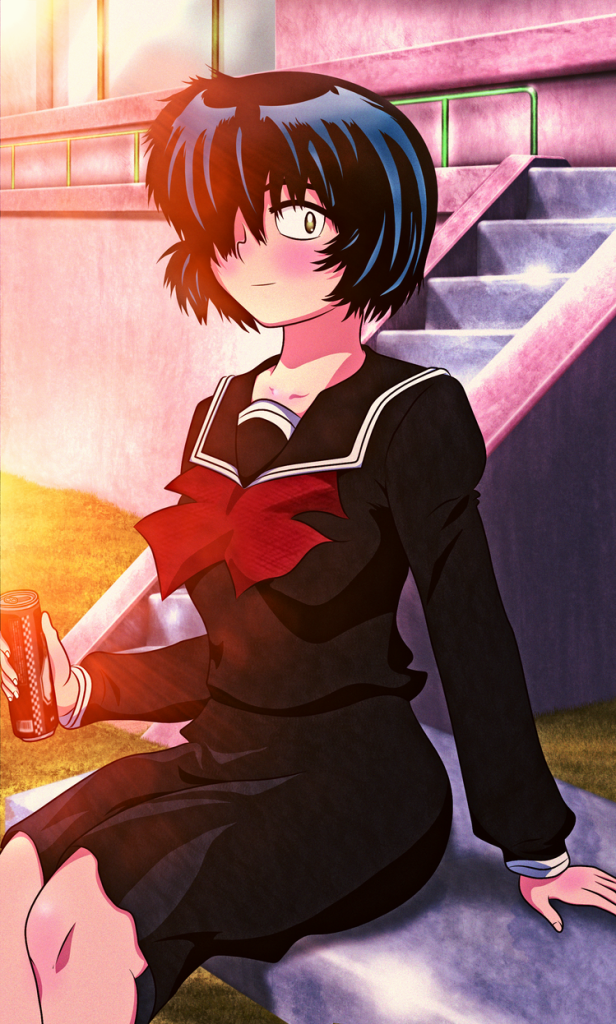
Urabe is a riddle inside a mystery wrapped in an enigma. She’s introduced as the new girl and in the first episode bursts into uncontrollable laughter. She’s awfully cagey for a girl romantically involved with Tsubaki, and more or less prefers this sort of arrangement, even keeping a pair of scissors tucked into her underwear. Of all the talk you hear on social media of fighting back suspected and would-be rapists, Urabe is ready to make sashimi out of anyone. S[sword unsheathing]t-talking is for the weak.

Credit: SoundwaveSuperior69 on DeviantArt

Tsubaki meanwhile is the polar opposite of his girlfriend. An open book with an evident circle of friends and interests, you don’t really have to guess what’s on his mind, what he did or what he’s gonna do next. Obligatory: run-of-the-mill male protagonist ends up with “quirky” female protagonist. There’s a name for this specific trope and I won’t rest until I learn it! The closest would probably be manic pixie dream girl, but I personally think that’s a dubious label to throw into this.

Either way, the two are practically ripped from the bizarro world of shipping. Whereas established characters will be randomly paired by the fandom, mangaka Riichi Ueshiba started out that way. Call Urabe a foil to this slice of bread we call a male protagonist with her hentai protagonist hair, anti-molestor blades, unorthodox outlook on life, and obsession with saliva. The last of those being the tamest fetish I’ve seen or heard of, and no I won’t elaborate on what I think is the wildest one I’m aware of.

So that’s them as individuals, how do they behave as a couple? Initially, I was gonna say that her cagey personality gets in the way of things, but on closer inspection, it feels a bit more like she wears a slightly longer pair of pants. Think of it this way, Tsubaki is smitten yet nervous around her due to a lack of dating/romantic experience whereas Urabe has scissors rated E for everyone… and I do mean everyone. She sets hard boundaries, but will make concessions to let her Tsubaki into her space. Her flavor of introvert is honest yet taciturn as she won’t even fake a smile for a picture. Lack of sportsmanship? Considering, she talks to only like two or three people all anime, that’s an easy assumption to make though I’ve heard it explained (can’t remember where, sorry) that most of the action happens offscreen. In this case, any number of wild stories can be made about the girl and Ueshiba may or may not elaborate further. Actually, it’s possible to argue that Urabe herself is in some capacity an extension of Ueshiba, the mangaka.

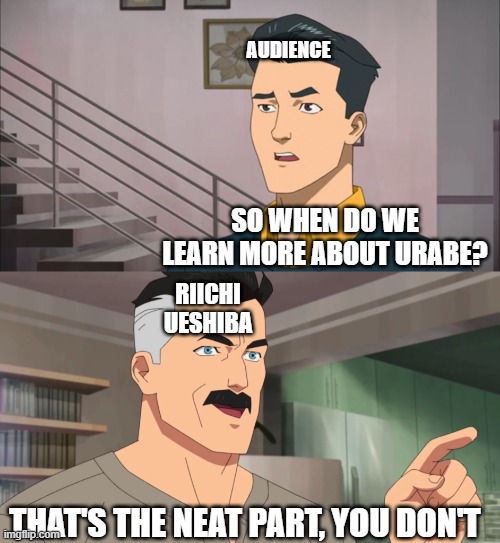
A quick googling shows that the number of interviews he’s done is close to the number of fingers on the average human hand. Photographs are even more elusive as I’m certain there don’t exist any that he’s agreed to share. Even without any expectations, I knew for a fact that Urabe would live up to the mysterious moniker but for it to likely be connected to the man who conceptualized her character is practically “write what you know” in living color. And in this instance, Ueshiba seems to be the only one who knows. Not that he’s the first or only one to subscribe to that philosophy.

Now why am I watching this anime? Once again, I’m doing so on a whim. The romance does intrigue me, but more so the appeal of Who’s This Drooling Girl? is the fact that it’s a break from the action-heavy series we’re getting these days. It had its 15 minutes of fame a decade ago, but now that more people are paying attention to other things developing in contemporary manga (as well as disappointing endings), going to series only five people globally know about is a nice change of pace.

I’d also like to highlight how much of a deconstruction of many tropes Urabe is.

Unlike most other characters, she leaves the audience and the characters guessing. Again, not the first character to do this, but one of the few who does it in less overt ways. The most she’ll do is test whether you can stomach her drool (that sounded better in my head (>_<)); if you can succeed, you two are meant to be. If not, well the effort was made and the question was answered.

Based on my description of her in regard to Tsubaki in general, it sounds like I described a yandere, but Urabe isn’t like that. She shows that she cares about him, but is the last person who’d reach out for a hug from him, especially in public. She’s like a planet: her gravitational pull reels him in, but not too close. As explained in the series (and this blog from 2018), she doesn’t need him to be physically close for there to be a bond. Her drool does the heavy lifting for her there. More than just a test of her connection to whomever tastes it, it’s properties seem to activate different senses and feelings especially in Tsubaki. It’ll make him sick, feel pain, give him a window into Urabe’s true feelings; I’ve never heard of anyone’s saliva doing that so the bond is either that strong or she’s aN aLiEn?!?!?

Again, neither Urabe nor Ueshiba will elaborate, so that’s up to you to decide. For what it’s worth, the manga has 12 volumes, 13 episodes and an OVA ripe for the pirating. Enjoy having questions go unanswered.

Also, Urabe can definitely make twintails work. Shame it’s only in one episode, but fanart thankfully picks up the slack.

Rewatching One Piece

Following up on some classics

About two months ago, I made a declaration to go back to some classic anime, those being Dragon Ball Z (the Kai dub) and One Piece. Why these two specifically? No particular reason, just that with Kai, it was a redub of the original DBZ anime that aired when I was a kid and in an abridged fashion. The reason Funimation did this was to commemorate the anime’s 20th anniversary. As for One Piece, you’d be hard pressed to find an anime fan who hasn’t heard of or watched or planned on watching One Piece. As I write this, someone just finished the most recent episode of One Piece and is blazing through the manga right now. Someone else has the entire box set and omnibus and a third fan has taken it further, emulating Zoro in appearance, technique and awful sense of direction.

I made the declaration to give One Piece a rewatch and try (keyword: try) to play catch ups. Kind of ridiculous 1,000 episodes in, but not impossible. Thing is, I kept getting held up either by work or my personal desires at the time. That declaration was made in September and as of writing this, I’m only 19 episodes in. It would be more, but I have an explanation for the part that’s within my control. The simplest answer is that I’m not the biggest fan of binge watching.

Netflix spearheaded this phenomenon in the mid-2010s and I had been questioning it for the better part of a decade. The more I learned about Netflix’s formula, the more I began to criticize it. It’s normal for a show to get pulled or stop airing after several years, but Netflix’s pattern of batch releases has created a culture built around rapid mass consumption of media… with little thought given to subcultures built around a particular show. Not to mention, too many great shows of theirs get s[banging metal]t-canned after one season and the hype is lost on me. Shows that have already aired though are the only reason I’m still on that platform for now, but the influence of one can trickle elsewhere and I don’t like how influential Netflix has been over the years.

This blog covers obscure and old media as its bread and butter; and while I do cover recently aired/currently airing shows or recently released video games, I don’t recall covering that many newer series of any kind. That’s more suited to guys like this:

He can afford to watch and talk about anime on a regular basis now that he and Trash Taste are under the GeeXPlus umbrella, whereas I’m currently doing Signal Corps things in the Army. Sidenote: if you join the Army and are put in Air Defense Artillery, I strongly implore you to choose any other branch. You’ll get more time to yourself when able.

As for the time I’ve been able to scrounge up for myself and spend on watching things I like, I’ve been dividing it between One Piece and other shows. I’m still not all that far into Genshiken (and I plan to write that up in two weeks), and I’ve been caught up watching my favorite history documentaries, as well as another manuscript. Can I get all of this done outside of duty? Yes. Is it easy? F[bonobo screech]k no. It’s a very challenging series of feats I’ve taken on for myself, and my laziness has stifled progress in a few areas. Couple it with a gacha game addiction and it’s a miracle I got to the first 20 episodes.

Variety is the spice of life, Terry!

Still, 19 episodes gives me a decent amount to talk about even for an anime this long and old. So how did I enjoy starting from number 1? Pretty well! I can’t recall the last time I watched One Piece before this quest of mine, but the most memorable arc I watched before it became too inconvenient was the one where Nami came down with a bad fever. Quick googling revealed that that’s known as the Five-Day Disease. This was at least ten years ago and Toonami was (and still is) airing the reruns to my knowledge. A show that helped build the block and make these shows household names isn’t gonna be dropped by the network, but it will be moved to make room for new shows. To my knowledge, it had been moved to at least 2:30AM or 3AM and my days of watching episodes in rapid succession are long gone.

C’est la vie.

I’m still watching One Piece and hope to at least clear 250 episodes by sometime next year, probably by Spring or early Summer. So far, Luffy had gathered a crew of three and is about to recruit the fourth member. Zoro was freed from capital punishment, Nami was insistent that her relationship is purely transactional and she’s not a pirate (not dissimilar from the “I’m not a furry” crowd), and Usopp whose sweet little lies would make him a match for Hol Horse in a game of wits. It also goes to show that similar to Hol Horse, he’s not prone to hurting unnecessarily. Lies, yes, but attacking the innocent isn’t something he’ll do. It might be the same for Hol Horse, but until I finish Crazy Diamond’s Demonic Heartbreak, I’ll confirm for sure.

As of writing this, Sanji is set to join the crew next (those who know, don’t spoil anything so I can still see for myself how everyone joins the crew). The wheels turn slowly but they turn either way, so I hope to follow up with an update sometime in the future.

Back to YouTube channel recommendations, this time with Dr Mod

https://www.youtube.com/@DrModGTA

A recent discovery of mine, this channel covers just about everything GTA-related. Older games, recent games, and even the upcoming GTA VI are a staple on this channel. Some of my own early work covers the GTA series, though not to the lengths that Dr Mod does, so if you’d like something to hold you over until we return to modern day Vice City, enjoy Dr Mod.

And maybe also pirate Vice City and Vice City Stories as well. They won’t take up a lot of space on your hard drive. I speak from experience.

You Dropped This, Queen of Karuta

Another niche series about Japanese culture

Certainly has been a while since I’ve covered a more niche animanga series, one that had a marketing push on the associated streaming sites, notably Crunchyroll and the now-defunct VRV in 2018. I remember as I’d paid them no mind whilst watching Boruto or FLCL or Soul Eater. Recently, I’d been looking more into Chihayafuru as I’d found very few people talking about it and due to more and more action-heavy series getting adapted that year and the years to follow, it’s no wonder it flew under the radar. As I’d looked further into it, it got me thinking about a series I’d talked about sometime last year: Akane-banashi.

Both are about traditional Japanese cultural products that require research for outsiders to get an idea of what it entails, but can still be enjoyed without prior knowledge; both feature female protagonists engaged in a sport of the mind, further broadening the definition of what a sport is or can entail; both of those female protagonists have a giant competitive edge in said sport; and personality-wise, both girls have a tomboyish history that shines when engaged in their respective sports.

Akane-banashi’s specialty is rakugo, where a lone performer tells any number of comedic stories on a center stage. Normally, they’re old folktales from Japanese history and mythology, and the last time I read the manga, they hardly strayed from the style of storytelling expected of the time they written/spoken, but can sometimes be adapted to more modern audiences, similar to the 1996 adaptation of Shakespeare’s Romeo and Juliet.

For Chihayafuru, the tradition this time is Karuta, a card game based on matching similar looking cards, though in the series it’s more about Japanese poetry. This version of the game has a caller who reads a portion of a poem written in Hiragana and the player nabs the card as fast as they can. Experts can get them before the stanza is fully read aloud. The main lead protagonist is Chihaya Ayase.

Initially, she was (and still is) supportive of her big sister’s modeling future, but became infatuated with Karuta after being introduced to it by a boy from Fukui Prefecture named Arata Wataya. The impoverished little boy didn’t have a lot to his name, living in a dirty, cluttered dwelling with 80% of his clothes being hand-me-downs from relatives. Further isolating him from the rest of his Tokyoite classmates as a child was his “hick” accent. For some reason, people outside of Tokyo Prefecture are referred to like this, which I think is ridiculous, but then again, I live in a country that celebrates even linguistic diversity, so personally, not much separates a Mississippian from a Michigander or a Nevadan. All Americans, different circumstances.

Still, while Arata struggles to fit in, he’s a Karuta prodigy at a young age, taking to heart the adage of: “If you’re going to do one thing, be good at that one thing,” like Zenitsu’s Thunder Breathing.

One-trick pony? It’s easy to say that, but different series like Golden Kamuy capitalize hard on one-trick pony characters, from Sugimoto’s extreme (and painful) survivalism to Shiraishi’s Houdini tactics to Ushiyama’s history as a dangerous judoka. Being good at one thing really only matters if its applicable to other things and in this case, Karuta is both the main connecting element for all the characters and the center of a competition within the series.

Learning from Arata the fundamentals of Karuta, Chihaya is encouraged to go big and make it her dream to become a de facto Karuta world champion, mostly because Karuta doesn’t really exist outside of Japan with the same claim to fame as Mahjong or Hanafuda. Along with the two, an old friend Taichi joins them and his contrast to himself is stark both financially and socially. Taichi is a rich Tokyoite who can actually afford to be petty while Arata’s childhood poverty humbles him greatly. As such, Taichi starts off spoiled and jealous, but his best excuse is due to the high expectations put on him by his family, namely his strict mother. And you thought wealth would be easy!

Yet as the three rejoin as adolescents, they found an afterschool club called the Mizusawa Karuta club and work towards the goal of becoming Karuta champions. I’m still checking the series out as of writing, having only completed episode 1 and the first chapter (and thus getting the research from the Wikipedia page), but other things that stand out is that it’s my first Josei series. Josei is typically aimed at a demographic of young women and is notorious for its inclusion of romance into the plot. Josei itself, sadly, doesn’t get as much exposure as Shonen, Seinen, or Shojo genres which is part of what hurts series like Chihayafuru compared to Akane-banashi, which is under the Shonen genre and licensed by Shonen Jump and Viz Media.

Couple these with the niche of Karuta, whoever expected the series to get wide praise would’ve had to fight sleepless nights for something to hardly ever come from conventional animanga media outlets. And that’s quite a shame. No matter what you think of the concept, the series is beautifully drawn and animated–the production quality narrows the gap between itself and something like The Elusive Samurai.

Channel: Crunchyroll

Speaking of animation, it’s worth pointing out that Chihayafuru was adapted by Madhouse, responsible for Overlord, Trigun, and No Game No Life. This also brings me to another matter going back to Akane-banashi. Niche subjects especially those that would be found in a book on Japanese history and/or culture don’t often get the animanga treatment and if/when they do, not always successfully. Rurouni Kenshin benefits from the battle aspect more so than its setting, as does Samurai Champloo because both series have a concept that has universal knowledge: the samurai and the ronin.

Akane-banashi and Chihayafuru differ by offering battles of wit instead of battles of physical strength and power. They both also rely on parts of Japanese culture that rarely get outside notoriety, leading to limited viewership. I have no idea if the performance of the Chihayafuru anime is a case for why not everything will get an anime adaptation or should not, but if by some chance that was the metric in use, then it’s not a fair assessment to make. Even then, it wouldn’t be the first time the art of rakugo was animated.

Be honest, you only know what this is because of its hyper-energetic ending animation.

No matter the future of Akane-banashi, it still has a future, whereas Chihayafuru’s manga ran from 2007 to 2022 and its anime running from 2011 to 2020. Once again, I call upon my advocacy of piracy to view the anime and/or the manga with little issue.