
War journalism brought to life
I’m doing something different this week. It had come to light that the author of the novel Generation Kill, Evan Wright, had taken his life on July 12, 2024 at the age of only 59. I’ll be upfront and say that I lack the expertise to deal with a subject as delicate as suicide and the most I can do for those who’ve fought or are currently fighting those demons is direct them to crisis prevention organizations and hotlines, which I feel would come across as hollow since anyone can do those things.
Instead, I’d like to do something that I think would be more thoughtful and remember Wright by his work, namely the novel that I’d had a lot of time reading and it’s TV miniseries adaptation: Generation Kill.

My introduction to the book was a bit of a cascade. I first heard of it through reviews of the miniseries of the same name, licensed by HBO in 2008. It got a brief mention in Knowing Better’s video on his own service in the U.S. Army, where he said it was as accurate a depiction of the average servicemember as one could get, next to actually signing up.
And also a more in-depth review of the series by The Almighty Loli.
Yeah, the subject matter means you’d have to view it on the site. Good viewing if you have 1.5 hours to spare.
To summarize it, Evan Wright was attached to the Marines’ 1st Recon Battalion during the invasion of Iraq in 2003, documenting every single action of the jarheads from actual combat operations to random silliness and off-color conversations carried in their off time. Anyone whose exposure to military operations is limited only to Hollywood would be surprised to learn how juvenile and sophomoric the humor can get, but to circle back to something Knowing Better said in a different video, the military doesn’t influence Hollywood. It’s often the other way around, and this makes a lot of sense if you think about it. Just because you wear camouflage and a helmet doesn’t mean you’re not also a nerd about something. And in my own little circle, the Army’s Signal Corps has a bunch of sci-fi fans interspersed with weebs, two things I happen to be as evidenced by all my blog posts.
I can’t speak for every veteran, but from what I’ve heard and read, military media gets a lot of scrutiny from these groups. Living day-to-day in the military trains you to pick through every detail with a fine-tooth comb, and the small details often make or break a piece of media for a servicemember. There’s a bunch of regulations on how things should look and how to behave or react or respond to fire. No matter the branch, the US military follows the rules of engagement to heart. As a result, there’s loads of ire launched at films like The Hurt Locker whereas In the Army Now, Black Hawk Down, or even Saving Private Ryan get praise not just for the storytelling but the miniscule details that vets and servicemembers would notice from a mile away. A single deviation from the standard tells them all they need to know about how much or how little the producers cared about the subject matter.
Because Evan Wright saw the Marines fight tooth and nail to capture and secure Baghdad, he had earned himself a lot of respect from military vets and the community on a wide scale for sticking his neck out, even if he didn’t have to. That said, war journalism is nothing to scoff at. It’s a serious and dangerous branch of journalism that can and does kill the reporters on scene. In just the invasion of Ukraine by Russia, little more than a dozen war correspondents have come under fire, some of them fatally and more may follow as the conflict progresses. Both sides know who their enemy is, but the tools of war are themselves not loyal to a flag, president, or even constitution. A pen isn’t going to miss you if it gets lost in your house and in a similar vein, a rocket’s area of impact largely depends on the capabilities of the mapper; and even then the enemy isn’t a guaranteed hit. Sometimes friendlies or civilians get caught in the crossfire.

Wright and countless others in his position knew this prior to going into the conflict zone and many more following such examples will take that to heart before stepping off attached to a unit in the field.
It’s worth mentioning that popular as the book was and still is, it wasn’t controversy-free. Some of the Marines at the center of the book faced backlash initially until 1st Recon commanders intervened and advocated for firsthand viewership of the book. A few of those same Marines even helped with the miniseries adaptation in 2008 and starred as themselves in the show during its run. Even now, over a decade and a half later, Generation Kill gets praise for its reporting and up close depiction of the lower enlisted as they were neck deep in the fight between the Iraqi Army, Saddam’s Republican Guard, and the Fedayeen death squads.
Speaking of which, another thing the book and series does well is display the troubles of modern warfare. The early stages of the War on Terror were wrought with controversy and opposition most of which still lives on to this day in the form of popular myths. In the case of the Iraq War specifically, some of those concerns centered around fighting an atypical war against a largely faceless adversary. Loose groups of terror cells in dangerous parts of the world made fighting the war incredibly difficult and complicated with some groups fighting each other and their listed enemies, the West being among them.
Because they were often dressed casually or “plainclothes,” picking apart friend from foe turned into a clusterf[boots stomping]k of massive proportion. The rules of engagement weren’t always applicable to the situation. Common sense isn’t common or even as widely available as we wish it were, that’s why there’ve been travesties, many of which don’t make it to screens and newsprint often until years after the fact, since empathizing with both the warfighters and the victims of oppression is a balancing act. Protesting wars is old — I don’t know how old — but I know that when a line is crossed, the aggravated public gets restless if in a democracy. It might have something to do with war correspondents having widespread freedom of information, but I think it’s safe to say that the public discourse against the military reached its zenith during the Vietnam War.

You may not know it, but this man helped put an end to a war crime… and he was essentially laughed into depressive episodes for “snitching” on his criminal comrades.
Wright’s novel and the miniseries based on it show how complicated even “black-and-white” wars can get. What becomes of the civilians involved? How do you treat non-uniformed combatants? How do you atone for devastating mishaps? Questions and dilemmas like these are what make and break people in war, whether they’re fighting it or just witnessing it. Often, it’s the sword of Damocles problem–the blade changes position with every move a leader makes, and sometimes there are hard logistical choices you have to make in modern wars. Slight spoiler: one scene in the miniseries depicts the Marines deliberating on whether to bring civilians with them, but the idea is (no pun intended) shot down to the dangers of having civilians in tow, as Wright himself could attest. But there were equally bad if not worse consequences for sending them on their way, that being the Fedayeen death squads mowing down suspected traitors of Saddam.
This article on Military.com has more to say about Evan Wright’s professional work away from Generation Kill, but adding to the praise, I like how honest and unjudgmental it is. It gives you as many of the facts as can be recalled while letting the audience see inside the mind of a young Marine ready to let ‘er rip in a combat zone.
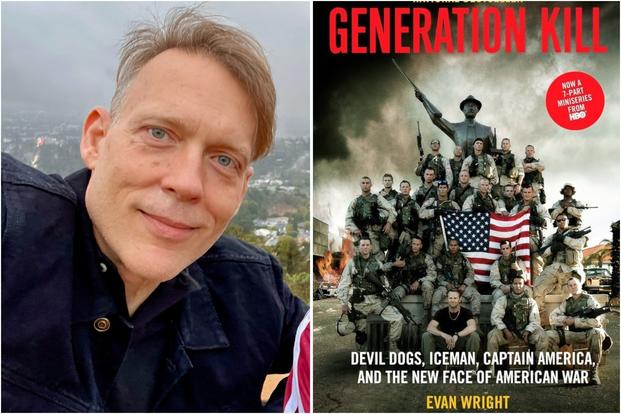
Normally, I’d put a link to where the series can be viewed, especially for free, but for once, I won’t be sailing the high seas for this. In fact, for those who are able, I’ll leave a link to the book and if you want to watch the miniseries, it’s still available on HBO if you can afford the cable package or are able to subscribe on the app.
Results on Amazon: https://www.amazon.com/s?k=generation+kill+book&crid=1OKAPP40AEAOG&sprefix=generation+kill%2Caps%2C91&ref=nb_sb_ss_pltr-data-refreshed_3_15
HBO miniseries: https://www.hbo.com/generation-kill
Evan Wright (1964-2024)
 Opinions on Entertainment