I had been in Army basic training from January ’til the ides of March, so I didn’t learn of Akira Toriyama’s passing until a couple weeks after it had happened. Of course, everybody would’ve gotten their honors and tributes out to the late author by then so my words are coming later than normal, but I’d still like to remember and recount some of his work.
My introduction to his magnum opus was similar to a lot of kids in the early 2000s. There wasn’t a distinction between anime and regular cartoons back then, so anime fans young and old accepted them with open arms as more cartoons to watch every Saturday morning, further bolstered by programming blocks like 4KidsTV. Seeing a golden legacy ahead of them, many notable programming blocks acquired the rights to air anime in the west. No doubt you or someone you know remembers the ham-fisted attempts at censorship or cultural adjustments because “no westerner has ever heard of rice balls,” or “think of the kids when depicting cigarettes.”
Obviously, Dragon Ball was no different when it came to censorship. Swearing (however slight) was edited out, scenes were edited or cut, and numerous references from the original Japanese were lost in translation due to how tough it was back then to research a lot of the cultural and historical references considering Dragon Ball’s source material is the Chinese classic Journey to the West. This video can better explain the history of censorship in the Dragon Ball franchise.
Credit: Nerdstalgic
Nevertheless, Dragon Ball or more popularly it’s better known successor Dragon Ball Z gained the lion’s share of the fame in the west, albeit with a much wider reception in Latin America. Once Toriyama’s crazy diamond got an English dub, there was nowhere else to go but up.
My DBZ collection of media was a bit more miniscule compared to my Naruto diet, but it was still fairly noticeable. A few puzzle and DS games, the console fighting games, memes and image macros, fan-made projects featuring some of the characters or the whole cast; an entire production company based in Texas has Toriyama to thank for their success, and they started as a series of parodies.
In 2008, Team Four Star blessed us with an abridged parodical take on Dragon Ball Z, movies included. Covering the original major sagas, they rewrote and jokingly recontextualized all of DBZ over the course of a decade on YouTube and on their own website.
Other programming blocks like Toonami, have also owed their success to Toriyama’s star franchise. They began with re-runs back in the summer of 1998, but even so, the English cast never left the project. For decades now, VAs like Sean Schemmel, Christopher Sabat, and Kyle Hebert have gotten their recognition from the English dub and have since lent their talents to other anime ever since. I think it’s safe to say that Dragon Ball has been the connecting element to a lot of media worldwide. You could trip on a Dragon Ball reference and it doesn’t even need to be animated.
Credit: iiAFX
But Toriyama was more than just the creator of a manga inspired by Chinese literature. Away from his studio, he worked on other series like Dr. Slump and video games like Dragon Quest and Chrono Trigger. His distinctive art style has even been emulated by his fans over the years. Sites that are hubs for artists, classical and digital alike, are guaranteed to have some attempt at drawing at least one character. Even professional artists and other mangaka have redrawn entire scenes or individual characters, either while working with Toriyama or to honor him in his lifetime. Some of these other mangaka grew up watching or reading his work too.
What makes Toriyama’s passing especially sad is that, like Kentaro Miura before him, he also left behind unfinished work. Miura never finished Berserk after two decades plus and it felt as if even though Goku’s original story had concluded so long ago, there was a lot of fun to have with the Z fighters, especially with all the video games, references, and spin-offs that have come out ever since. The direction of the Dragon Ball Super manga and the newest installment in the franchise, DAIMA, are likely going to be put on hold for a while until an announcement is made.
Whatever the case, Dragon Ball fans, numerous anime fans, artists and many more have paid their tributes to a prolific and influential artist since his passing. This post is one of them having found out so late and being away from technology during training. And on that note, the block that was made famous for airing and helping perpetuate the Dragon Ball series also made a tribute complete with a marathon in his honor.
Howdy, audience! I come to you from my advanced individual training location at Fort Eisenhower, previously known as Fort Gordon with a few announcements, first for what I’ve been doing, how the schedule might work for now, and what may or may not be in my future. But first, a brief.
I’ve been open before about my previous enlistment in the Army during the Summer 2021 cycle, getting injured and getting out and fighting tooth and nail to come back and finish and get what I enlisted for: benefits and a future. Well, I’m pleased to report that I had completed my Army basic training for the Winter 2024 cycle. Knowing I’d have no time or means to continue writing/blogging, I kept a notebook to use as a personal journal of mine as a supplement for the blogging. I might not reproduce those writings here since there’s a lot that’s either not suitable for the blog both language- and content-wise, but I do want to provide a summary of my time at BCT.
We don’t use that pattern for the uniforms anymore, by the way. The photo is supposed to be from 2006, but considering those uniforms were the universal wear by January 2008, I’m a bit curious why there isn’t a mix of the old and then-new uniforms.
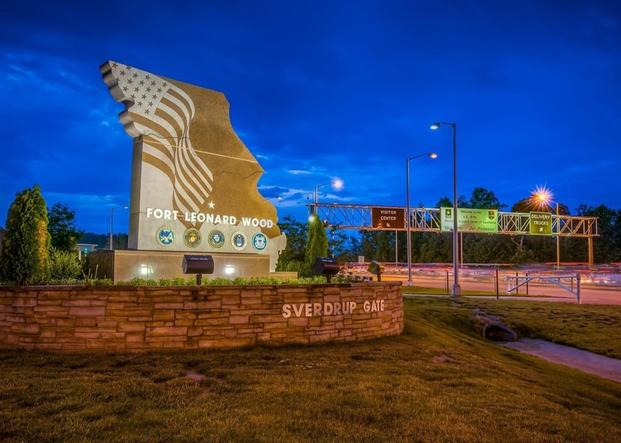
Anyway, I found out the day of ship-out that I was going to the second worst BCT location for training: Fort Leonard Wood, Missouri.
Credit: Military.com
Before I continue, I just wanna say f[gunshots]k that place. I hope the Army doesn’t send me back over there for any reason at all.
I checked into 43rd Adjutant General Battalion, a reception unit for all incoming trainees, waiting to be assigned to my training unit elsewhere. Those of you who are older or have relatives who’ve served before, you might remember old cattle trucks being used to ferry trainees everywhere. Yes, they’re still in use, but in my experience, they were converted and fitted with seating, so if you wanted to hear about how we were all sardined into a giant cattle truck going across the bumpiest roads, sorry to disappoint you in that aspect.
The day we were taken to our training unit, it started to snow, or technically sleet on us. We were called one-by-one by the company first sergeant to our respective training platoons to grab our civilian stuff that we stuck in these black duffel bags at reception and form up in the freezing cold. In case you don’t know, the heart of the Midwest gets cold, dry air especially in the wintertime. Being out in -10 degree weather in thin physical fitness uniforms was not a fun experience. Neither was being on a sidewalk that froze overnight.
For the cadre, drill sergeants often come in a variety of different flavors and styles. I was part of 2nd Platoon (MAD DOGS!) and we lucked out by having some of the most softspoken drill sergeants in the company. Most people’s idea of a drill sergeant/instructor comes from movies like Full Metal Jacket, Jarhead, or the Army scenes in Forrest Gump, and it’s not like there aren’t drills who try to behave in the ways of Gunnery Sergeant Hartman or D.I. Fitch, but to get pedantic, they were part of a different branch – the Marines – and are representative of different times in the military’s history. But for all intents and purposes, military instructors aren’t allowed to put their hands on trainees except in the case of an instruction. For instance, if you’re called on to demonstrate a certain firing position, the instructor needs to ask for consent before repositioning your hands or arms. This is to avoid accusations of inappropriate behavior between a trainer and trainee and to maintain strict professionalism in a training environment, i.e. no abuse of power, no hazing, all that stuff.
For punishments, it was the standard repetition of a specific exercise. Half-right face (45 degree turn), front leaning rest position, move (get ready to do X number of pushups). And yes, even our whispering drill sergeants did this either to just the platoon or the whole company.
After getting chaptered out in September 2021, I thought I was off their records until I got back in and everything restarted from scratch, but I learned at the last minute that this never happened and I was given an automatic promotion from private first class with a paygrade of E-3 to specialist with a paygrade of E-4. I can’t explain how this is since I don’t know how and it likely wouldn’t be a good idea to do so. All I know is that I’ve been a member of the E-4 Mafia for about a month and never even realized until I graduated.
Credit: Military-Ranks.org
After this rank, if I have the points necessary, I’ll have to go to a promotion board at my unit wherever that is since I’m still in training.
The first week of training was getting more gear issued to us: a ruck sack, a fighting load carrier with a family of buckles and pouches, helmets, an extra duffel bag, and some winter weather gear that would’ve been nice to have when it snowed on us during the week of MLK day. Call me bitter, but just because we were shivering together doesn’t necessarily mean we had to. Yeah, we’ve adjusted to the cold, but if the summer has overheating precautions then the winter also had hypothermia precautions.
After we got our gear, training went forward as usual. Introductions to the preparatory exercises, learning the chains of command, basic medical and comms classes, especially during the field training exercises, all the fun stuff. Of course, not everything went the way we wanted it all to. The weather did get in the way at times, and on good days where I and my battle buddies (read: fellow trainees) were doing the right thing, someone else was off doing the wrong thing and at least in the beginning we paid for it. As training progresses, the punishments become individualized and you stop having to push because Pvt. Pyle wanted a jelly doughnut from the chow hall.
Credit: Full Metal Jacket (1987), Warner Bros. YT: mercurio0100
For the training exercises, there’s three: the Hammer which lasts one day and one night; the Anvil for two days and one night; and the Forge for three days and two nights. The best, if not necessarily accurate way to describe these exercises and BCT most of the time is living for two months as an infantryman, which I say is inaccurate because U.S. Army Infantry (along with other combat-oriented military occupational specialties or MOSs) go through a longer and more rigorous training course called One Station Unit Training. BCT and AIT are separate locations either at a different base or elsewhere on the same base. One Station Unit Training or OSUT is BCT and AIT back-to-back.
In between all of this is what the morning physical training or PT is for: the Army Combat Fitness Test or ACFT. A six-course event covering all the things a Soldier, MOS notwithstanding, could do in the event of a combat deployment. Timed strength and endurance tests for the body and the spirit. The first one I did yielded an awful score because it was raining and there was no opportunity to rest in between events. Thankfully, it was better the second time and my goal to improve actually showed itself. Starting off with a 25.5 minute two-mile and ending with a 19.5 minute two-mile was a hell of an improvement, I’ll tell you that.
Towards the end of basic training, I had a singular mantra pushing me forward: the Anvil, the ACFT, the Forge. Two FTXs and a fitness test. I was in no hurry to stay in goddamn Missouri for any longer than I had to. That’s not to say I’m turn off from the state. If/when I get the chance, I’ll use my leave to frolic around St. Louis or KCMO one day. I definitely wanna use that time to explore East Texas after meeting a few battle buddies from that area. And also because Texas hearts military folk.
Whether a good section of my life will be in this state is another story. I know now that my MOS may put me in either Killeen or El Paso and based on the reputations of the installations there (Fort Hood/Cavazos for the former, Fort Bliss for the latter), I’ve gotta find some good, safe entertainment outside of Armying and soldiering all day.
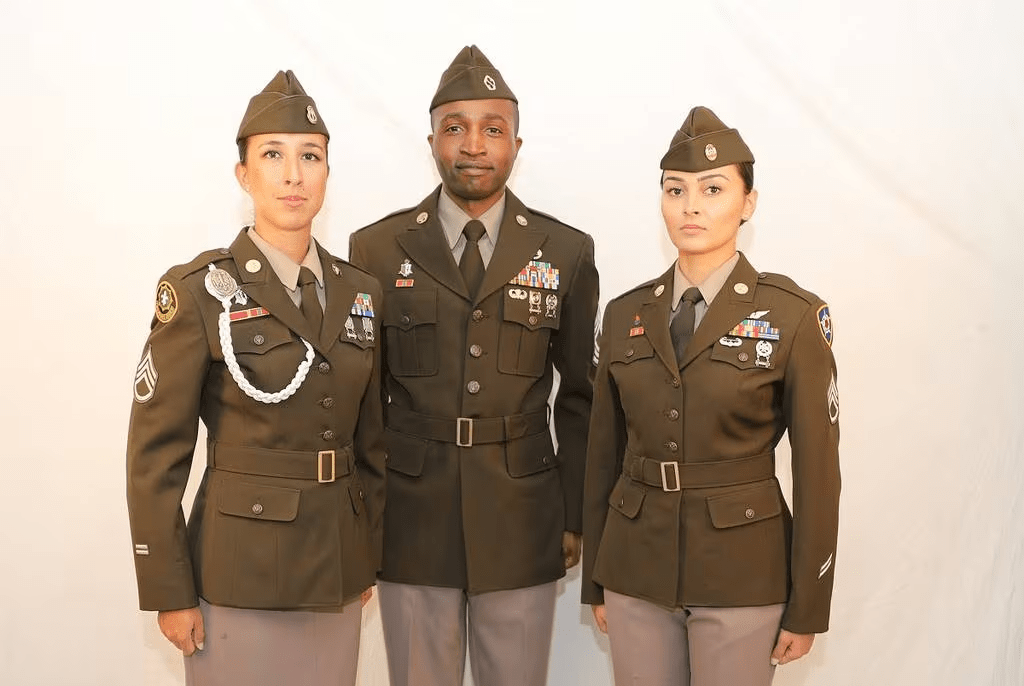
When all the graduation requirements are finished, the last few days were dedicated to cleaning and returning equipment, getting our U.S. Army shoulder patches as a symbol that we graduated, a Warrior’s meal of the drill sergeants’ discretion complete with skits, and then Family Day and Graduation rehearsal. Family Day is pretty much what it sounds like: trainees hang out with their families all day until around 7PM, then it’s back to the company for the night. Same thing for graduation, but the uniform is different. While the graduates wear their combat uniform and black berets on Family Day, on Graduation Day it’s the green service uniform, AKA the pinks and greens. These bad boys:
Credit: Army Times, U.S. Army
Obviously, the uniforms look snazzier with evidence of experience on your chest. Having grown up seeing soldiers wear the older dress blue uniforms, learning that they were bringing back the WWII-era uniforms a few years ago had me scratching my head. I have theories, but again, someone smarter and more experienced than me has a clearer, if not necessarily better, explanation.
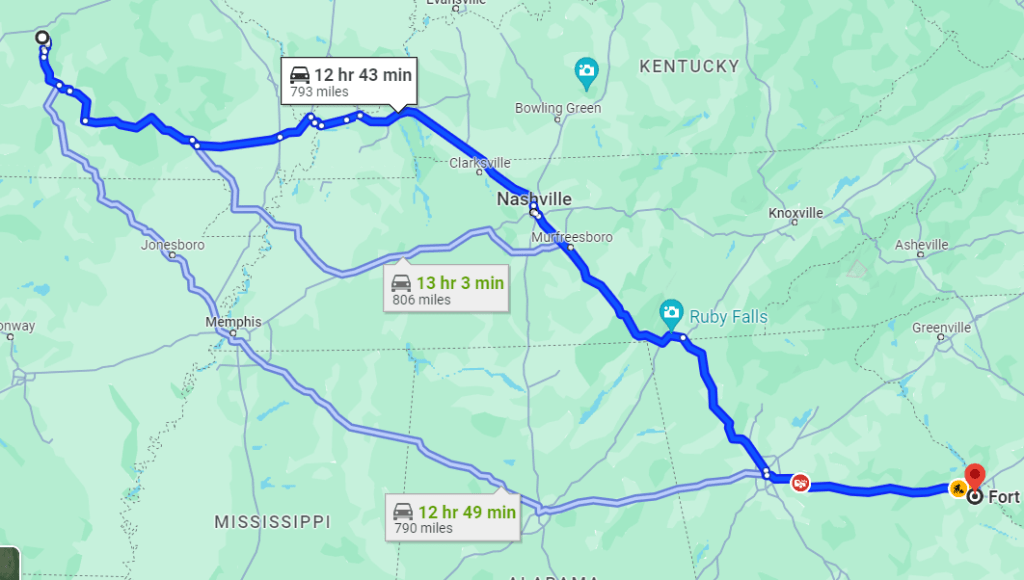
The last day with all our returnables return, we were up ’til at least 1 in the morning scrubbing our bunks and the barracks. Leave times for our AITs varied by MOS. Mine was one of the first, so we ate our MREs and hopped on a bus from Lost in the Woods, Misery to Fort Gordon/Eisenhower, Georgia. A 12.5 hour bus ride from the chem school to the signal school. I’m not kidding.
Reception at Fort Eisenhower was a lot faster considering we were already in the system. As of writing, I’m taking my classes for my MOS and the classes are expected to end by late July.
With all that out of the way, will I be able to go back to my regularly scheduled blogs? Probably… Keep in mind the military trains you to expect surprises all around, some benign, some major, and you don’t even need to be a stone’s throw away from a combat zone for something to happen. Even in training not everything goes to schedule, but that’s life sometimes. Everything I wrote about so far isn’t exactly a secret, though I’m still encouraged to practice operational security so obviously no secrets are going to be scared. General stuff, yes, but anything that could threaten security will never be shared, even after I get out.
I’m still in a training environment, I just have more freedoms from when I was in basic. If I’m able, I’ll try to get back to business as usual every Saturday, assuming no funny business comes my way. If not, then get ready for periodic posts and updates. I’ve been away from the media and I have a lot of catching up to do after duty hours and dinner chow. Speaking of media surprises:
I found out at the end of basic that Toriyama passed away. While I have a list of desired topics to talk about or expand upon since my last post, I feel I should dedicate the next one to one of animanga’s most legendary manga artists. His worked shaped mine and other people’s childhoods after all.





 Opinions on Entertainment