Boruto: Timeskip Update 2

Two Blue Vortex

As much as I’ve written about not wanting to be the Boruto guy, I honestly don’t mind such a connotation just as long as I’m allowed more topics to cover and in that regard on this blog, I’ve succeeded. But to circle back to the topic of this week’s post, Boruto’s timeskip arc has an update. Last week, third party sources brought news to the Boruto community concerning the upcoming timeskip arc. The next chapter is expected to release on August 21 under the new subtitle, Two Blue Vortex, and joining Kawaki and Boruto who both have future redesigns is Sarada Uchiha.
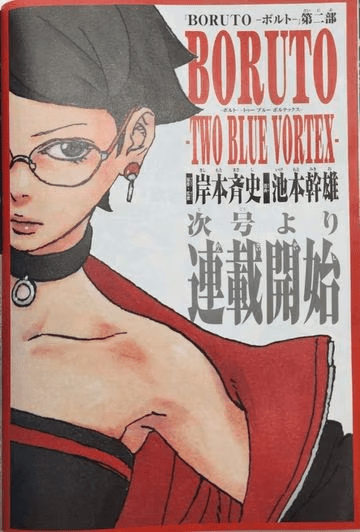
Consistent with trends, there’s already fan art of the new design. Here’s a personal favorite of mine:
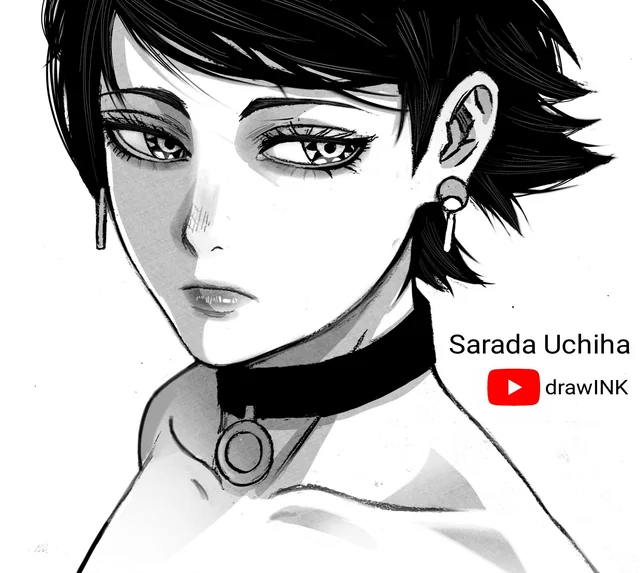
And no, the Bayonetta comparisons aren’t lost on the community. Simultaneously, the reveal debunks previous predictions made years prior while also shedding some light on existing concepts. For starters, rather than follow the Naruto convention of the subtitle Shippuden with Raiden and the associated kanji for lightning (雷), Two Blue Vortex deviates significantly from the formula used to craft Naruto and Naruto Shippuden as further proof that Boruto is simply not that kind of guy. Naruto had Sage Mode, was a Jinchuriki, shunned by the village for being the host of the Nine-tailed fox and fought tooth and nail to be seen as more than just the sum of his parts. Boruto, in contrast, was designed with nearly everything handed to him on a silver platter, largely because his parents either had none of it or weren’t allowed all that much to enjoy what they got. And seemingly overnight, he eventually loses it all.
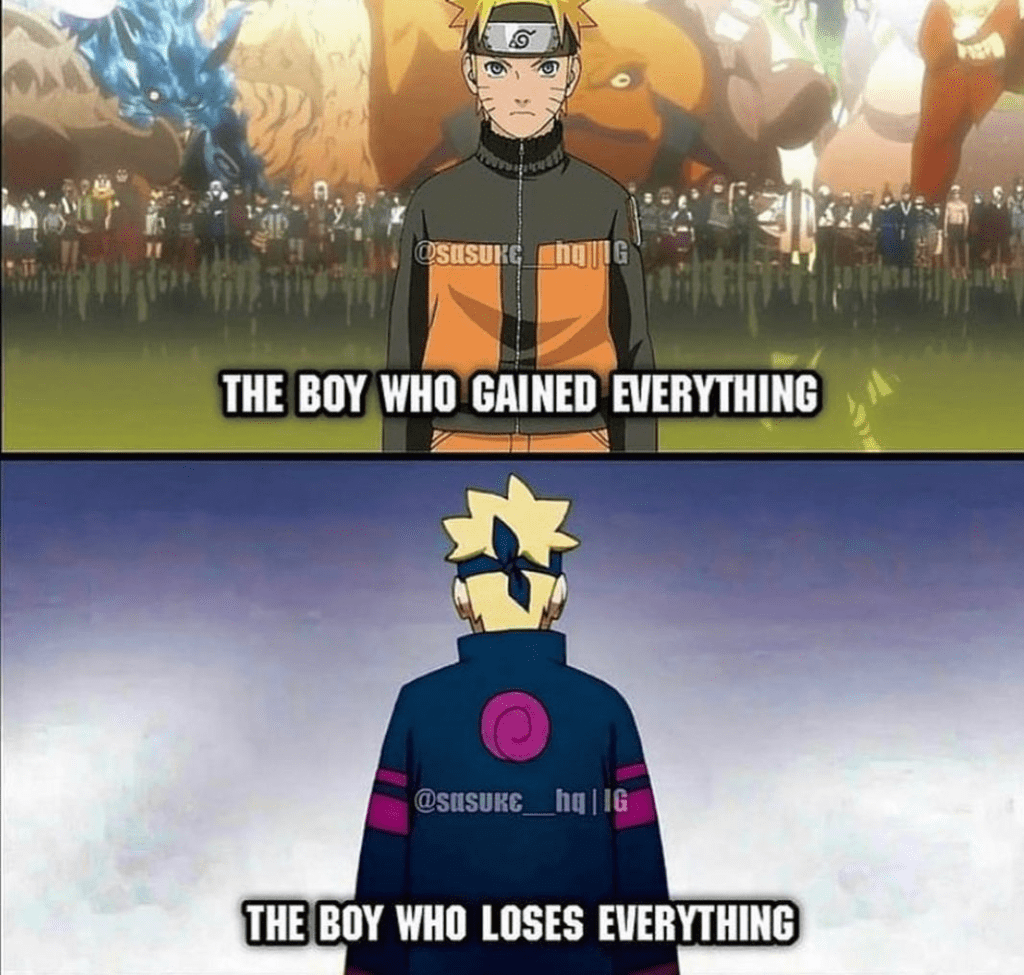
When the story starts proper, Boruto is pretty much a spoiled little brat with a legacy over his head. Naruto was inaugurated as the Seventh Hokage, following a lifelong dream that everyone said was impossible, and his grandfather Minato Namikaze, had the distinction of being the Leaf Village’s shortest serving Fourth Hokage. Considering the negative connotations associated with the number four in East Asia, the Four is Death trope is a time-honored tradition. Guido Mista was right to worry.

Boruto being spoiled is a direct consequence of the shaping of the Ninja World in both his father’s and grandfather’s times. From Minato’s time period, it was expected and tacitly accepted that ninja would have enemies. Constant warfare meant friends were made as fast as they were lost and often from a young age. Minato’s ninja cell were the equivalent of child soldiers during the Third Shinobi War. Even after becoming Fourth Hokage, the peace was tenuous at best, and the ninja villages would essentially shift from fighting organized militaries to disorganized terror cells. This problem didn’t really begin because of anything Minato did, but Naruto’s adolescence was where it got worse.

The Akatsuki, close to achieving its’ goal under false pretenses, and with only a few members left, outright started the Fourth Shinobi War, by way of necromancy and cloning. Initially, through desperation and gradually through teamwork, the ninja villages set aside all differences to combat a worse threat: Madara, Obito, and soon Kaguya Ohtsutsuki. After their defeat, it was a time to rebuild a better world for the future. Naruto’s tenure as the seventh led to many gifted children, some of them directly from the old Konoha 12 of before. They essentially lived so that Boruto’s generation would have it easy, but the down side to that is they don’t see what others are lacking in until it’s missing from them. Which does happen to Boruto gradually. Starting with the seal on his hand and the control that Momoshiki is always threatening to take away, though for the most part he doesn’t have to as long as he leaves things up to Kara, Isshiki, or Kawaki.

With Kara in tatters and Isshiki soundly defeated, Kawaki and Code are the last enemies Boruto has to face in the timeskip. How that comes to pass will be revealed after August 21 when TBV debuts properly so for now, here’s what I know and what I see from the reveal. It’s been confirmed from years prior how Kawaki and Boruto would look. Kawaki would wield a staff/rod-like weapon in the future, and aside from a change in attire, he wouldn’t differ all that much from the Chapter/Episode 1 teaser. In the redesign, he sports longer hair and a tunic and haori that bears a striking resemblance to what Isshiki had.

Boruto meanwhile had a scar over his eye, a headband with two perpendicular scratches, slightly longer hair, a cloak, a sword, and better control of his Jougan. The updated design stays true to what was seen in the manga in 2017, but with a few noticeable changes. The cloak is similar to how Sasuke wears his, the scar is shorter, and the hair is almost the same if not shorter than his current look. We haven’t seen the sword yet, so it’s not known if he’s using one of his own or if Sasuke has an arsenal and let him have an old relic.

From what we saw of Sarada’s design, with all the talks and fanart depicting her with longer hair and a longer tunic similar to what Sakura had in Shippuden, but the Bayonetta-style design immediately tosses that out of the window and calls back to when fans of Naruto thought or expected Naruto himself to have longer hair as he aged.

Additionally, Sarada’s presence on the cover may suggest that the new chapter will include her somewhere in it. As I recall, a beginning scene in Shippuden shows now-genin Konohamaru running into Teuchi. We’ve already made clear that Boruto as a character and as a manga is not the same as Naruto so the tone may be a bit more sullen or serious compared to this classic Shonen slapstick.

Some on the Boruto subreddit also noticed the symbolism in this preliminary design for Sarada, with Uchiha clan earrings, the ring on the choker, and the cloak she seems to be donning. If it’s a cloak she’s wearing, then it may be paying homage to Sasuke. If it’s a jacket, then it could be an homage to Boruto. Or both, but with everyone under the shinjutsu and believing Boruto to be the traitor, everyone’ll think it’s only to remember Sasuke who seemingly abandoned the village once again.

Speaking of shinjutsu, Eida, love her or not, still has a critical role to play in the plot. The shinjutsu she subconsciously used to reverse Kawaki’s and Boruto’s lives has yet to be fully explained. The same goes for her Senrigan.

All we have on both are what was shown in the manga and Amado’s exposition. According to Amado, shinjutsu, like omnipotence, essentially make facts out of fiction and as Amado has surmised, all ninjutsu are humans’ best attempt at recreating the shinjutsu. If that’s the case, then the Omnipotence that kicked off this predicament would function at an even higher level than that of Madara’s or Kaguya’s Rinnegan/Rinnesharingan. Whatever has been the most powerful genjutsu shown in canon or in filler, Omnipotence is even more broken than that.

As for the Senrigan, since it literally translates to “clairvoyance” Eida essentially knows everything that’s going on anywhere in the world and what has happened. Like a very powerful librarian or historian.

As powerful as the Senrigan, it’s not like Eida will know what’s going to happen next in general or to individual people. Again, it’s more like reaching into the past than it is about the future. So far, it’s served as a means of communication between Eida and Shikamaru, her and Amado, and whoever else she likes or can tolerate. Circling briefly back to the Omnipotence, of all the people affected, Sarada remains unchanged which appears to be linked to how much Eida liked being with her and Sumire. As such, it was also shown that Sumire was unaffected by the shinjutsu.

I can’t promise anything on accuracy for this next chapter as shown by my track record thus far. Any predictions I make are going to play it fast and loose until the chapter proper comes out. Having said that, there are some things I can’t see with any degree of accuracy. There are three that are, as of writing this, anyone’s guess: Sumire, Himawari, and Daemon.

Starting with the most significant one plot-wise:
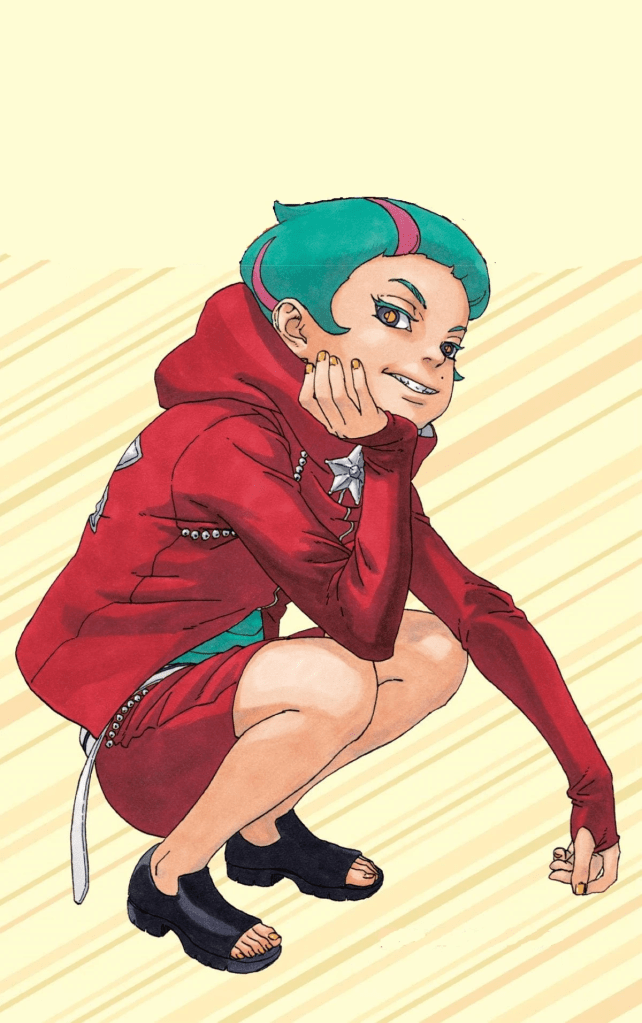
The extent of Daemon’s abilities are that just thinking about harming him is reflected in real time back at the would-be attacker. For instance, there’s a panel where Boruto and Kawaki both think about teaching the little runt a lesson only for it to literally backfire. So they both need to put up with his silliness to keep Eida from running off until further notice. For what can be said about him going forward, the only level of development seen was that he sensed an energy from Himawari, and we don’t know for certain how well the manga will follow up on that until then. Speaking of which:

The latter episodes of the anime put her in an academic setting with Kawaki going in as well on an undercover mission. For Himawari’s abilities, the Byakugan emerged in her the same day as Naruto’s inauguration and she’s shown to attack with the signature killing intent that each ninja knows about in battle. But for the most part, it’s been depicted as subconscious and while she was shown to be effective during this late anime arc, it remains to be seen if it even gets a reference in the manga if not an accompanying light novel.

Finally, there’s Sumire Kakei, who admittedly got a more generous treatment in the show, despite her starting out as a spawn of a former member of Danzo Shimura’s Foundation within the ANBU Black Ops. The show and the children accepted her with open arms and since the students graduated, she took on an apprenticeship with Dr. Katasuke Tohno. As far as a prediction, this will likely continue unabated, save for the subject area of their study being Boruto instead of Kawaki, but on the side she might be keeping in touch with Sarada on her progress to the best of her ability. And this is just the Hidden Leaf Village. The anime might bring the Sand Ninja back into the fold, but for what or how I can’t foresee. Even if it feels like Shinki et al don’t impact the story much, they’re not unaffected by the events thus far, and are at the mercy of the Sand Village’s moves as shinobi as well. Even a short filler or catch up for the audience to remind us they exist would be acceptable to me.

No matter what happens, Code is still a problem and it’s all up in the air how they choose to address that. Either way, I’m eagerly awaiting the manga’s and anime’s return.

My Favorite Podcasts

How I found my favorite series to listen to

Before I start off proper, I want to say that I had a draft lined up for a hypothetical compare and contrast post between God of War’s Kratos and Grand Theft Auto V’s Michael DeSanta/Townley, based on some throwaway lines that I looked too into, specifically Thor lamenting that Kratos wasn’t the same as the Ghost of Sparta that physically deconstructed Mt. Olympus the hard way; and Trevor refusing to let Michael forget that he was a bank robber, a thief, a career criminal like he is and trying tooth and nail to bring him back into the fold. As you would expect, the comparison was very apples to oranges. RockStar doesn’t hang onto most of their cast from previous games. There’s a balance there between old nostalgia and new characters, and RockStar has a rotating body of protagonists compared to SCE Santa Monica. As a result, most RockStar characters have self-contained arcs while Kratos spent the better part of about nine games growing from pride to mournful to determined to vengeful in a manner of writing that whether by accident or on purpose mirrors the story structure of ancient Greek epics and recently Norse epics. One is a parody of American pop culture and the other is loosely inspired by Greco-Roman tales of adventure. If there’s a grain of truth to something like infinite monkey theorem, then I could probably produce a Shakespearean comparison between these convincingly, but until then I’ll keep it on the backburner.

So let’s get to the topic of podcasts.

I’m writing this from the perspective of a listener, not a seasoned podcaster. But I’ve spent a pretty long time listening to several so I figured I’d throw some pennies into that fountain. How I started was with Rooster Teeth Productions’ namesake podcast. It began around 2009 as the Drunk Tank, but at the time needed to switch names at a later date if it hoped to attract sponsors. I think, after a few years, Drunk Tank as a name would’ve been great for a podcast.

I found this out a few years ago on YouTube thumbing through the old videos because I wanted to see how much they’ve grown over the years. The first episode of the Rooster Teeth Podcast/Drunk Tank was much, much shorter than anything that had been produced after nearly a decade as an active podcast. An hour and ten minutes in 2009 compared to about three hours or more after 2014. Incidentally, the podcast wasn’t what made me an active subscriber of Rooster Teeth’s website or their YT channel. There were honestly different opportunities for me to become a subscriber early on that were brushed off. The first time was in 2013 around the Halloween season when I was 20 videos deep into a Dead Space 3 Let’s Play video, and RT’s gaming division, Achievement Hunter, bought ad space for an admittedly creative Halloween costume to show off. Almost fifteen-year-old me wanted to get back to the sci-fi action horror. I subbed to RT in 2018 after catching clips of their anime-style show RWBY in a WatchMojo.com video, and have since discovered their network of content in the Rooster Teeth podcast and Achievement Hunter’s Off Topic podcast, both of which I listened to while in college and during the pandemic.

As of writing this, they have several more podcasts that they produce, including Red Web, Black Box Down, F**kface (yes, really), and a few others, some of which I’ve listened to or are still listening to to this day. Halfway through the pandemic and in the leadup to my enlistment in the Army, I was somewhat spoiled for choice and bounced around podcasts like I bounce around YouTube channels.

A podcast I was tuned into briefly was the Joe Rogan Experience podcast. Weird story for that one, select media outlets had mentioned Joe Rogan’s name before but in a negative light. Naturally, I took to listening to some episodes myself and the context of the conversation about Rogan was out of a concern that he’d been inadvertently promoting then-unproven COVID-19 precautions as cure-alls by allowing controversial practitioners to speak on his show. When I thumbed through his episodes, I found that as an entertainer and commentator by trade, there’s no shortage of eccentric people. Rogan knows this and going back to WatchMojo.com, they have different videos detailing Rogan’s many different guests, some of which have gotten “interesting.” Here’s one video:

The sensationalism seen in modern media tends to lift firebrand personalities and ideologues to a point where a full story isn’t guaranteed. Personally, I put the blame on sensationalism around horror stories and reports, but an unintended benefit of that is wherever I see this type of outrage media, I’m at least patient enough to keep an ear to the ground and wait for every detail to be discovered before I pass judgment.

For the JRE itself, I like to think of it as a catch-all type of podcast. There’s no single point of focus; every guest is unique and brings many individual takes and opinions with them. This rotating body of personalities makes for a unique experience for each episode. Political outlets would make me believe that he’s made his platform a home for fringe ideals and beliefs, but that’s not what I found. Individuals of this stride do come on the JRE but so do many others. All in all, my conclusion is that outrage bait in modern media is very ineffective as expressed in this video:

For Joe Rogan, it’s also very misleading. Talking heads in American media can make you believe the wrong thing about a person, but then you see more of what they have to show for themselves and in my experience I’ve shaken my fists at demagogic rhetoric for lying to me and I’ll continue to do so. For more obviously political podcasts, Tim Pool is more consistent in that field, among others who were also guests on the JRE. I also think he was dealt a bad hand, especially during the height of the pandemic. All things considered, the U.S. at the time had a frustrating response to the pandemic, and I think some journalists really wanted to vent at the time. I’ve no horse in that race, so I won’t comment further on that.

As for the rest of the podcasts I’ve listened to or subscribe to regularly, the ones under the RT umbrella do have a singular focus most of the time. Red Web is hosted by Achievement Hunter personalities Trevor Collins and Alfredo Diaz and delves into unsolved mysteries, some of which have a criminal element, others tend to be centered around modern phenomena like cryptocurrency or strangely placed architecture or local abnormalities and cryptids. I emailed them once in 2021 to see if they had plans on doing an episode about the Toynbee tiles which I have seen in Lower Manhattan when I was in college.

They do have an episode on these mysterious tiles, though I can’t claim to have been the inspiration for that episode. Black Box Down is all about aviation incidents throughout history. From the early days of Wilbur and Orville Wright to modern airline industries and carriers, there’s always a story surrounding an aviation mishap of some sort. One thing I’ve noticed during a filler episode (don’t remember which one) was that most of the audience had either never flown, rarely flown, or held some irrational fear of flying in some capacity. But when they learn more about aviation and planes, the fears are alleviated somewhat.

Personally, we never made enough to fly continuously growing up. Other family members have taken me flying twice to Miami and Orlando for Disney World and Universal Studios theme park respectively, so I never had a fear of flying or aviation. Nor have I really had as much of an interest in flying. So what’s the draw for me? Well, I also wanted to know the secrets behind why planes fall out of the sky and whatever you think that may be, a lot of times it comes down to luck. It may have something to do with terrorism in a post-9/11 world, but flashy articles about aviation are likely to be older than that. You’d be shocked to learn that air hijackings were common during the Cold War era and most of the time the planes landed safely.

BBD’s hosts are also Rooster Teeth personalities, Gus Sorola and Chris Demarais. To my knowledge, this podcast is going to cease production soon as one of the hosts, Gus, has plans elsewhere, but if you want to catch up, the Rooster Teeth website and podcast apps have all the episodes.

F**kface is hosted by three more RT personalities, Geoff Ramsey, Gavin Free and Andrew Panton. The premise behind this podcast is a series of personal stories of the three guys being idiots. Funny and embarrassing stories from childhood, school, work, etc. It’s the podcast equivalent of “if you ever feel like an idiot, remember [insert overlooked example of stupidity here].” F**kface is one of my favorite podcasts, partly because its relatable and also because I’m not always in a learning mood like with Red Web and BBD. Sometimes I wanna turn my brain off.

Speaking of which:

Trash Taste Podcast is the crown jewel podcast that I subscribed to back in 2020 during the pandemic and haven’t looked back ever since. Of all the podcasts I’ve looked at (and they aren’t that numerous honestly), TT is the one that I could forget about for a while and come back to, which was what happened after I was medically separated from the Army.

Trash Taste started off with the goal of being the prime anime podcast and has gradually morphed into a slice of life experience about living in Japan, specifically the Tokyo Metro area which might itself be a city-state like Singapore. Just sayin’, I’d love a manga series at least that took place in Matsuyama or Fukuoka or something. I won’t stop ’til I find that series.

If the name is familiar to readers, then you may recall that I recommended Trash Taste and the three hosts’ YouTube channels all the way back in February of this year. The three hosts are the anime YouTubers, British-based Connor Colquhoun or CDawgVA and Garnt Maneetapho or Gigguk, and Australian-based Joey Bizinger or The Anime Man. All three of them began their journeys on YouTube mostly independent of each other, but with a soft spot for anime.

Garnt’s first videos were reuploads from 2007 reviews he did of series like Bleach, FLCL, Lucky Star, and K-On! as examples. Early on, the inspiration of Zero Punctuation was strong, but similar to what befalls many creators, Garnt eventually found his footing and got to reviewing anime his way. So if the first video is titled “Bleach Review,” a review of Chainsaw Man or Call of the Night would be something along the lines of “Manga’s Newest Best Boy,” with Pochita in the thumbnail somewhere. Additionally, with many anime getting slated for adaptations in a year, a smart move on Gigguk’s part was to quickly summarize the anime of the season.

Connor’s early videos were made up of prank calls while impersonating the star character of the Black Butler anime. He also briefly hosted a podcast based around voice acting, which is what the VA in his online handle stands for. Connor’s content doesn’t really separate himself from his hobbies; he makes himself quite clear that he’s a gamer, a JoJo fan, a Hunter x Hunter fan, a Black Butler enjoyer, and a voice actor. As an added bonus, he mentioned a few times on his channel, in collabs and on the podcast itself that initially, his audience was 93% female, hence the moniker on the associated subreddit “The 93%.”

Finally, Joey. Unlike the other two, Joey the Anime Man has a closer connection to Japanese pop culture being half-white, half-Japanese, or in Japanese law, a hafu. He’s very in tune with his Japanese side to the point where his articulation is better than most Japanese people in Japan. Much of his older content, from my point of view, was rather short form. He started off with anime-centered content (read: hot takes), but was also doing a bunch of other stuff as well. Anime news, manga recommendations, and also gameplay videos, which he has long since moved away from.

All three do still make content on their individual channels, stream on Twitch and upload the VODs for those who are unable to tune in on Twitch live. All of these are recommendations all their own if you’re capable of supporting their content.

The reasons for choice in podcasts are all complex and varied, but I remember listening more closely to the Rooster Teeth and Off Topic podcasts so that I could have non-distracting background noise for homework assignments. I had the radio in the background tuned to my city’s classic rock radio station perpetually since around middle school. It relaxes me. But around the time I was in college, I wanted more. So I turned to podcasts, which admittedly was rough around the edges in the beginning. Only now have I realized after trial and error that you don’t exactly need to put all of your undivided attention into a podcast episode 100% of the time. You can, but all in all, I like to think most podcasters expect a healthy mix of active and passive listeners.

I should also mention that years before Trash Taste debuted in 2020, Gigguk had an anime podcast on his own channel known as Podtaku, a portmanteau of Podcast and Otaku, but as explained in this video, that podcast ran into a whole host of problems surrounding direction and timing:

I’m certain there are OGs who remember these days, and thanks to these experiences, the anime community arguably has one of the best podcasts to date, even if it’s more about living in Japan then just anime alone. And I think that’s for the best — Podtaku practically walked so Trash Taste could run.

Hokkaido Gals are Super Adorable Coming Soon

Reorganizing my list is sometimes a blessing in disguise.

Over the course of this blog, I’ve put sneak peeks at the end for the next week’s topic, and I did that last week in light of some recent news. The manga Hokkaido Gals are Super Adorable (alternate name: Dosanko Gyaru is Mega Cute) has been greenlit for an anime adaptation in January of 2024.

I believe I’ve also made it aware that more often than not manga series I champion just sit in the back of the class unnoticed and unsung by handful of devotees while popular manga that I don’t pay a lot of attention to are the ones that get a greenlight relatively quickly. This is a rare instance of another manga I happen to enjoy getting the anime treatment, and soon. I recall reporting about adaptational rumors in late June concerning the My Hero Academia spinoff, but so far, no further reports on that have surfaced as of this writing, sadly. But at least you have a complete arc to round out the picture of the MHA franchise.

For Hokkaido Gals, let’s catch up to speed. In Japanese pop culture, the gal (or gyaru) is a subculture of usually teenage girls engaging in fashion trends. The typical gyaru is seen normally with a sweater (wrapped around their waist or actually wearing it), a bright-colored mini skirt, thigh socks or leg warmers, a blouse with the top few buttons undone, often light or even blonde-dyed hair, makeup, jewelry, and an attachment to her cell phone. Derisively, gyarus are said to also have a stigma of being loose and promiscuous. Call it fanservice or a mean-spirited inside joke, but of the gal-focused series I’ve seen or observed, in all but demeanor they give me the impression of Hollywood’s idea of the popular girl/cheerleader archetype.

All things considered, I think these tropes were the writers’ best attempt at therapy for an unresolved wrong. But between Galko-chan, Hajimete no Gal, and even Dosanko Gyaru among others, I’m finding that this negative stereotype is getting debunked as we go on, though its replacement isn’t all that much better.

Hokkaido Gals are Super Adorable does a few things differently than previous gyaru-centric series. The typical trope is that it’s centered in Tokyo, the male MC is from elsewhere in Japan, and the gyaru MC is a native who knows her way around the Tokyo Metro. In reality, it’s a statement that means she can navigate the tens of millions of citizens, residents, and tourists who coalesce around the main hot spots of Akihabara and the famous Shibuya crossing. It’s really no different from highlighting any given tourist-y spot in any major city like NYC or L.A.

So to turn this trope on its head, the main MC is himself a Tokyoite who comes up to Hokkaido. This teaches me the power of a popular thing physical or conceived, so there might be an equivalent in other parts of Japan. The male protagonist of this manga is Tsubasa Shiki, the rather upper-class sheltered Tokyoite who has moved north to Hokkaido with his grandmother. On the way to school, he runs into gyaru and female protagonist of this manga, Minami Fuyuki, and while he attends the high school up in Hokkaido, Tsubasa meets other gyaru characters in the form of Sayuri Akino, Rena Natsukawa, and interestingly, Fuyuki’s mother.

When I say Tsubasa’s a sheltered upper-class guy, I mean it in the sense that he grew up comfortably and averagely enough to openly declare his main attraction to a very average type of Japanese woman; dark hair, composed, reserved, prim and proper — none of which are inherent in Fuyuki. As a matter of fact, she’s the type of gyaru I described earlier in this post. As for that stereotype that seems to have replaced the derisive promiscuity one, Fuyuki is also somewhat ditzy and short-sighted. In the early chapters of the manga, she’s shown to struggle with studying and even test-taking as Tsubasa and Sayuri make strides when all of them study together while Fuyuki struggles to catch up. It would be more accurate and charitable to say that she doesn’t have the kind of academic intelligence. Honestly, for all the sightseeing done in the manga, she’s a shoe-in for Hokkaido tourism, especially in a place like Sapporo or Hakodate.

Sayuri combines two tropes into one, but also comes with several surprises of her own. In appearance, she’s exactly Tsubasa’s type of girl and in fashion she dresses like a gyaru, even if only slightly. For the surprises, early in the manga, there’s two and they have an uneven connection. Sayuri has a condition known as hyperhidrosis, or excessive sweating, and thus she refrained from intense physical activity. Instead, she’s become a hardcore gamer goth girl, probably the type to skip over cutscenes and 100% a game. Sounds like someone else I know of.

Rena Natsukawa is a third gyaru character, but is also a hafu, meaning that she has one parent who isn’t ethnically Japanese. She’s also a high-achieving student who just so happens to have near-unrestricted access to the library and is a tutor to her peers. Moreover, she’s admired by Fuyuki herself, so if Fuyuki ever needs help with her studies, Natsukawa-san is not too hard to find.

What’s interesting about this manga is the common tropes that are broken down. It borrows from series like Hajimete no Gal and Sono Bisque Doll, while also carving something new for itself. Call it for what it is, but with so many series alluding to or stating that they’re set in Tokyo, it’s nice to see other parts of Japan get the spotlight they need. It’s something I welcome personally when someone outside the U.S. goes to a place that probably doesn’t have a strong tourism industry, though on the other hand, the isolation tends to suit places like this better. No outside disturbances to ruin what makes a certain place unique.

The gyaru characters come into stride in their own unique ways. Since I’m only about twenty chapters in with the manga clocking in about almost 100 so far, I can’t say with certainty if there are more gyaru characters who show up down the line, but keeping the cast so small thus far does a lot to flesh them out evenly and gradually as the series progresses. Most of what I described of the characters thus far is in the chapters they each debut in with more to be revealed, but again, I’m not that far as of writing this so even if I wanted to spoil, I couldn’t. I really want those who’re interested to catch up to the manga in time for Silver Link to start distributing the anime next January.

Once it airs, if there’s nothing else taking my time away, I’ll report my findings as it airs.

While my hopes are up, some poking around in associated forums on Reddit leave me with a few concerns. I refrained from spoiling myself, but I’ve heard through the grapevine, that the most recent chapters haven’t been as good in regard to characterization, seemingly undoing the character development since the beginning and, to my interpretation, trapping Tsubasa in a needless love triangle. But I’m regarding these observations as rumors until I see it for myself, and I advise anyone to do the same. As for where to read the manga, it is getting released in volumes here in the west, but to catch the chapters as they release, my source has been the Manga Plus website and app run by Shueisha themselves.

https://mangaplus.shueisha.co.jp/titles/100116

Alternatively, there’s pirate sites, though it’s best to use caution. I recommend Manga Plus for this series specifically, because every chapter is available without subscription if you’re short of cash yourself. It’s a fun series overall and I hope it makes a seamless transition to anime. Still, holding out hope for Vigilantes though…

Mob Psycho 100

Of the boy who lifted… with his mind

And now to turn your attention to a series that needed to be moved to the first week of July to make way for anime rumors: Mob Psycho 100.

This series was started by the mangaka One of One Punch Man fame as a contrast of sorts to both his previous manga and its central protagonist, Saitama. The protagonist of Mob Psycho is middle schooler Shigeo Kageyama, a boy who possesses the power of telekinesis but is remarkably restrained with their application. In fact, when we’re first introduced to the boy, at times he activates these powers accidentally.

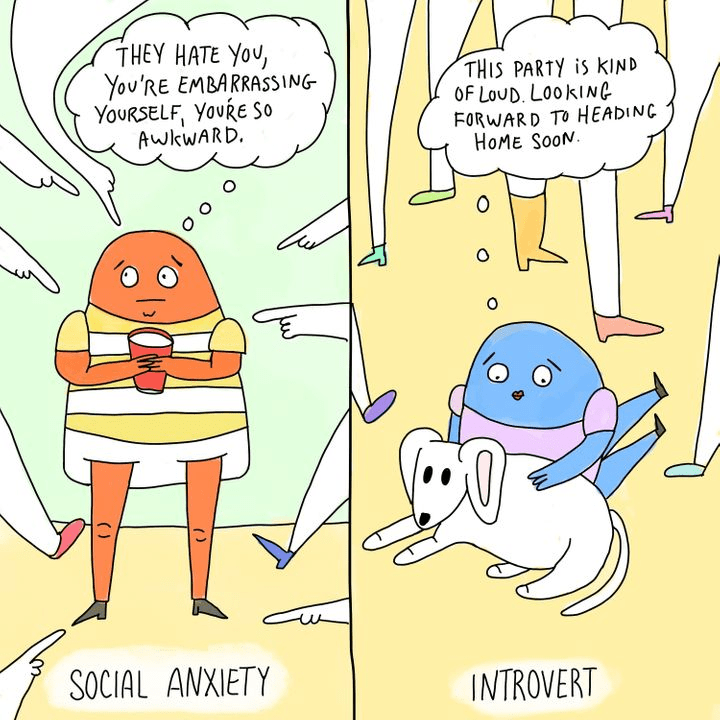
Growing up, Shigeo, nicknamed “Mob,” is well-aware of his abilities and how much it makes him stand out. His main goals are to fit in with the rest of his peers at school and hopefully tell his crush his true feelings unimpeded, but there’s a bit of a snag: the boy has trouble reading social cues. Being an introvert is one thing, and it tends to overlap a lot with social anxiety and/or awkwardness, but they’re not the same thing. In summary, introversion in practice means that while the introvert has no problem interacting with folks, they don’t always favor having a rotating body of friends. In my experience in high school, in college, and in the Army, as much as I interacted with most of my peers, I stuck around with the same five or six people I always had, and that was fine for me.

Mob is generally similar, starting small and having, by my count, around ten people he talks to the most, over half of them outside of the school they all attend. Whereas Saitama from One Punch Man looked and often behaved disinterested in his job as a hero due to every single battle ending in a single punch and somewhat ruining the fun, Mob may look disinterested in a lot of things, but this is a trademark of his personality.

He has trouble expressing himself physically or verbally and often falls back on short sentences and responses in contrast to these hyperactive classmates of his. You could argue that this is a tell that he might be on the autism spectrum as noted by this Tumblr post:

And this video:

Keep in mind, the opinions expressed in both of these are those of the creators based on their own observations and are meant to be points of debate rather than absolute truth, so read and watch with an open mind, but take these opinions for what they are.

To achieve his goals, Mob shacks up with a fitness club at his school. In context, this is a direct snub to the club that had originally requested (read: begged) for him to join their numbers: the telepathy club. This club, started by student Tome Kurata is focused mainly on paranormal like that of telekinesis and extrasensory perception or ESP, which is applicable to Mob’s physical traits rather than something more personal. As another example of Mob being treated differently, the club tries to get him to join based on that alone, and was more of an excuse for a bunch of nerds to eat snacks and hang out compared to the body improvement club that actively works out every day.

When I say being treated differently based on a single trait, it’s easy to look at that as being dismissive or distracted by that single trait instead of treating it as part of a whole and think of bullying or teasing, but on the other end of the spectrum is parading that difference as though it’s the most amazing thing in the world when the reality is markedly different.

Largely by virtue of possessing such powers, Mob’s difficulty with others is that he wants to stand shoulder to shoulder with his peers, but his inability to read the atmosphere holds him back. Conversely, others want him to be able to react to the environment of a situation, but can’t understand themselves why he’s unable to do so. In the scene I described where he joins the fitness guys instead of the paranormal folks, the student council president in a somewhat hostile tone of voice doesn’t chide him for his indecision, but emphasizes that Mob should neither be pressured nor judged for his choices. It all needs to come from within, and so his decision to join a body improvement club may seem random at first until you recall that he wants to impress his crush. He didn’t let the telepathy club pull him in, instead he chose the team that would yield positive results, and one where his powers could reliably take a backseat.

Having said that, as the series goes on the paranormal finds him one way or another, sort of like Stands in JoJo’s Bizarre Adventure, he turns out to be a huge ESP magnet. Most of these people start off highlighting these traits as the be-all, end-all and expect Mob to follow suit, but as I’ve noticed, he’s not that kind of kid. As much as he doesn’t want these abilities to be hindrance, he doesn’t want them to be a highlight either; Mob wants them to be seen as regular as anyone who, say, has double-joints or light gray eyes or a scar or blemish–it’s a part of him, not all of him. And while a few characters learn to see him as they see themselves — a kid who wants to fit in no matter what — others, mostly antagonists, zero in on that aspect because it worked for them and they hoped to accomplish similar success after pairing or using Mob for themselves.

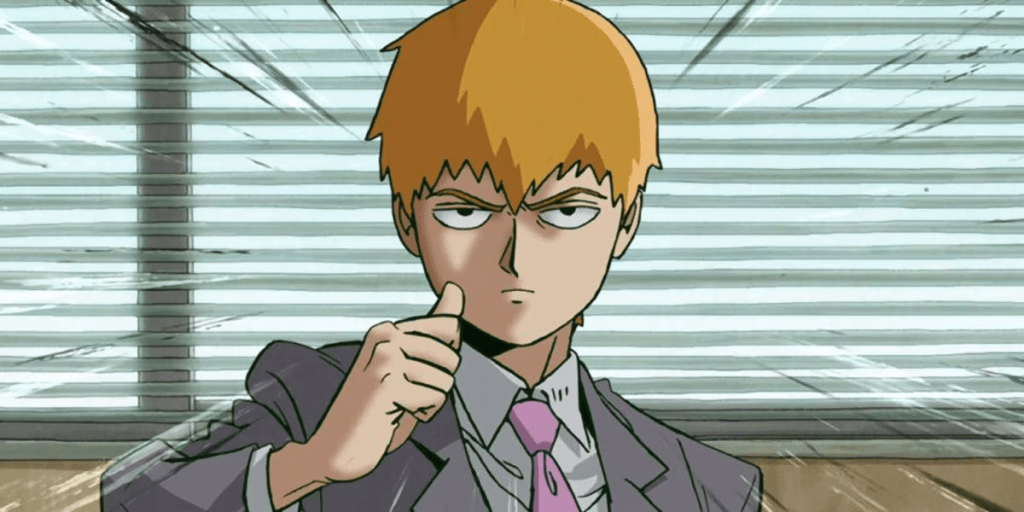
Outside of Mob’s immediate family, another person who shows him respect no matter what is his boss and mentor: Arataka Reigen.

In contrast with the boy, Reigen is an extrovert who can read people so well, if humans came with a manual, he could convince you that he co-wrote it. Note that I said “convince” as this is a part of Reigen’s character. While Mob is honest and kindhearted for the most part, Reigen is a con-man with all the confidence of an old west snake oil salesman. I jest, but these are lines referenced in either the manga or the anime. Reigen is fully aware of the scam he operates at his paranormal consulting firm Spirits and Such Consultation Office, where Mob works part-time after school. The name of the business doesn’t take itself all that seriously, and he knows that he’s more or less a glorified masseuse who markets home remedies as foolproof methods against ghosts and hauntings, but what makes him such a draw for many in the series and even people reading/watching the series is that in the face of adversity he can think on the fly.

Only some folks can stay composed under pressure and Reigen belongs in that camp. He consciously uses lying and exaggeration as a tool in almost every aspect of his life, professional and personal. It doesn’t work all the time, but it gets him quite far when it does. Mob though tries his best to fit in as honestly as he can but finds more difficulty in this aspect than Reigen, who can stumble his way into fame if he could. And this is largely the point, they’re opposites in personality but neither let’s that get in the way of what is portrayed as a fruitful mentor-pupil relationship.

Reigen is knowingly duplicitous to everyone, but doesn’t want Mob to become a shady individual like he is. Mob is honest and pure, but largely because he’s just a kid, he’s also somewhat naïve to how people really behave. Mob, above all, wants to fit in and have friends, and Reigen wants him to be kind, but also smart, which is part of what I love so much about the series. Mob’s a quiet boy, who wouldn’t hurt a fly unless pushed to do so, but still his a lot of growing up to do. Reigen will gladly help him out in this aspect, but doesn’t really throw him in at the deep end.

In regard to Mob’s telekinesis, it’s in line with his emotions. In response to different situations in the series, there’s a counter from 0 to 100. The more stressful a situation, the higher the number climbs and when he reaches his limit, his powers go into overdrive. How he’s feeling when he gets there also plays a factor and his powers are proportional to his emotions. On a good day, Mob can pass the telekinesis off as the parlor trick he would want it to be, but extreme feelings of rage, sadness, compassion, or even ecstasy results in great and, depending on the circumstances, dire consequences.

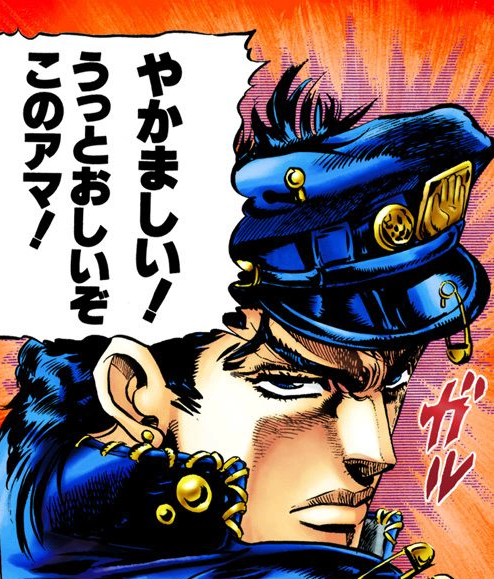
I’ve watched all three current seasons of Mob Psycho 100 and only recently did I discover the theory that he may be autistic. The two sources I pointed to at the beginning of this post hold a lot of weight, but I’m not sure how I feel about the theory. Both the sources provided are stating their own opinions, but I’ve heard similar theories thrown around for different characters in manga and anime, often as a joke due in large part to the overlapping of autism and similar disorders like Asperger’s, social anxiety, or just plain old introversion. The two prime examples that have taken residence in my head as of late are those of Chainsaw Man’s Asa Mitaka and JoJo’s Bizarre Adventure’s Jotaro Kujo. Even if it’s also a joke, the CSM fanbase has some more evidence of Asa’s traits than the JoJo base does regarding Jotaro. He just doesn’t like loud and boisterous people, and even wants his own mother to lay off a bit.

But it’s not like Jotaro is careless. Just rough around the edges.

For Mob though, the theory does highlight the complexity of autism and similar disorders, but most internet theories throw terms around like darts on a dartboard. And I think the only way to be certain is to ask One himself, but then again, these are just theories so I’ll just leave them be. It is interesting viewing for those who are interested. But of course if you wanna form your own conclusions, you can watch the anime or read the manga for yourself.

Before I leave, I want to preview next week’s topic in light of more anime news.

As far as I’m concerned, we’re getting a good serving.