
2D graphics in the HD world
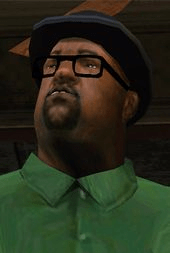
Whether you play it or not, you likely know at least a few things about the Grand Theft Auto series: 1) it’s pretty much an organized crime simulator, 2) it’s violently comedic, 3) and the character Big Smoke exists to this day as a meme machine.
The more knowledgeable of you may also know some fun facts about the series as a whole, not the least of which involves the series’ humble beginnings. The concept of the game was under the working title of Race ‘n’ Chase with a release date set for sometime in 1997 by Scottish developers DMA Design. The original goal was top-down street racing with an added bonus of a police response that would become common for series like Midnight Club and Need for Speed.
The point of divergence for the concept was a tough-to-patch glitch. The police cars were extraordinarily relentless in pursuit of the player and most of the time, the devs couldn’t correct the issue, so instead they decided to team up with the madness and make it an action-adventure game retitled Grand Theft Auto. Across all the games, the skeleton of the objective is the same: the protagonist changes with each game, but they’re all tasked with completing a set of tasks for increasingly high payment with proportional risk to the player. As the games progress, the player unlocks new weapons, safe houses, locations, and in some cases clothing options. The police wanted level has influenced the game and others across the industry — the response is often proportional to the crime from mild disturbances having a single cop car investigating to high level crimes involving stand-ins for real life federal agencies like the FBI. Up until GTA V took away one of the stars, the military would be called for the highest wanted level of six stars all just to take you down. A look on YouTube may find you some compilation videos of the police partaking in the Darwin Awards, or interestingly analysis videos on the police in GTA games. My favorite comes from Game Theory where they experimented on whether real-life instances of brutality have been programmed into the game. In a serious tone, this is a debate best suited for a platform better equipped to make comment on it, so this is more of a comedic tone.
GTA and GTA 2 in 1999 were both 2D games despite the late 1990s being the era of the emerging 3D graphics market. Almost every developer was launching a video game with full 3D graphics with resounding success stories like Medal of Honor and GoldenEye 007 coupled with lackluster releases like Mortal Kombat 4 and what would’ve been Star Fox 2 if it came out on time.
One can argue that Grand Theft Auto III’s 2001 release was somewhat later than what was expected of games at the time as RockStar’s formula is to one-up itself with each new release and GTA III came swinging at the hip, guns ablaze. The graphics and mechanics at the time set the stage for a ginormous change all throughout the gaming industry and one of the first notable examples of GTA’s influence was the many clones, though I doubt the men in charge of RockStar cared all that much. Leslie Benzies and the Houser Bros., Sam and Dan, were busy making games and as shameless as some of the clones were, taking elements from a proven success story isn’t the end of the world. Other devs could do what they wanted while RockStar Games released, 2002’s GTA Vice City, 2004’s GTA San Andreas (which to this day is the reason the PS2 sold well over 150 million units), 2006’s Vice City Stories — one of two underrated GTA games that I talked about months ago on this blog, and one of the most expensive games at the time, 2008’s GTA IV.

Coupled with DLC content in the form of The Lost and Damned and The Ballad of Gay Tony expansions, GTA IV signified a change in the GTA series. The HD era was upon us and the next generation of consoles was its home. Better graphics, a more serious tone, new mechanics, and reimagined cities and locales. GTA IV’s Liberty City looked more like the Big Apple than its 3D rendition, and a lot of small details from older games have remained unchanged or were tweaked to fit the era.
As we all know, RockStar’s prize success story is that of GTA V in 2013, which reimagines Los Angeles and some surrounding areas in the HD universe, but before that, there was another HD game in the 2D style: Grand Theft Auto: Chinatown Wars.

I was originally going to mention how much of a difference there is between this game and the two GTAs released before and after it, but every GTA game differs in some capacity so that would’ve been a useless metric for the game. The basic plot of this game involves Hong Kong immigrant Huang Lee who flies to Liberty City and is welcomed with violence. He arrived in the city to deliver a sword to his uncle Wu “Kenny” Lee, but things turned sideways when he was ambushed at the airport, so now he has to work to make up for the loss of the sword. Obviously, there’s more to this story and if you want to look at the series from beginning to end, The Professional, GTASeriesVideos (a RockStar fan channel), and Willzyyy are your best sources of gameplay on YouTube along with some other channels.
Now the plot is the standard, started at the bottom, now we’re here fare, but the most notable difference was that when it released in March of 2009, Nintendo allowed RockStar to publish it on the DS.
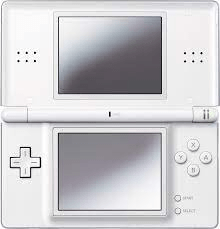
Yeah, the same company that heavily censored Mortal Kombat in the 1990s and lives and breathes by Super Mario and Kirby allowed a notoriously violent video game on one of their star handheld platforms. Granted, 2000s Nintendo was far removed from 1990s Nintendo. There was still the family-friendly image on the face of the company, but at this point Nintendo was letting the chains loosen a bit on the family friendly image by allowing Ultimate Mortal Kombat 3 to be played on the DS as well. It’s a large company with a large history, run by a council of suits and while there’s nothing detailing how this arrangement came to be in detail, the main connecting element is extensive use of the touchscreen function in some manner.
This might have been part of the deal to get certain types of games on the Nintendo DS: design it in a way that the touchscreen doesn’t go ignored, and while that works well for touch games like the Touchmaster series, third parties are hit and miss. From best use to worst use in my personal experience, it’s Chinatown Wars at best, Mortal Kombat in the middle, and Call of Duty at the worst. Or rather just awkward for that last one.

If I didn’t know any better, I’d say the rest of that deal included a lap dance of some sort. For Chinatown Wars, it might be a good example of a game whose mechanics are tied to the touchscreen, but not necessarily dependent on that feature. Certain minigames and combat sequences make good use of the feature and it flows naturally enough into gameplay that you won’t really notice it as much half the time. Don’t quote me on this, but I don’t think this was actually the first time a GTA game was on a Nintendo system. Prior to GTA III, there was GTA Advance available for the Game Boy, and once again, I doubt attempting to research that arrangement will net me anything interesting, unless I use a time machine or the wayback machine.
Some mechanics in Chinatown Wars that use the touchscreen include filling your own bottles of Molotov cocktails at the gas station; rigging stolen cars by way of screwdriver, hotwire, or PDA hacking (sidenote: this was most likely the last time in the modern era that PDAs would ever be important in any medium); assembling the sniper rifle for certain occasions, like a story mission; and controversially, drug dealing.
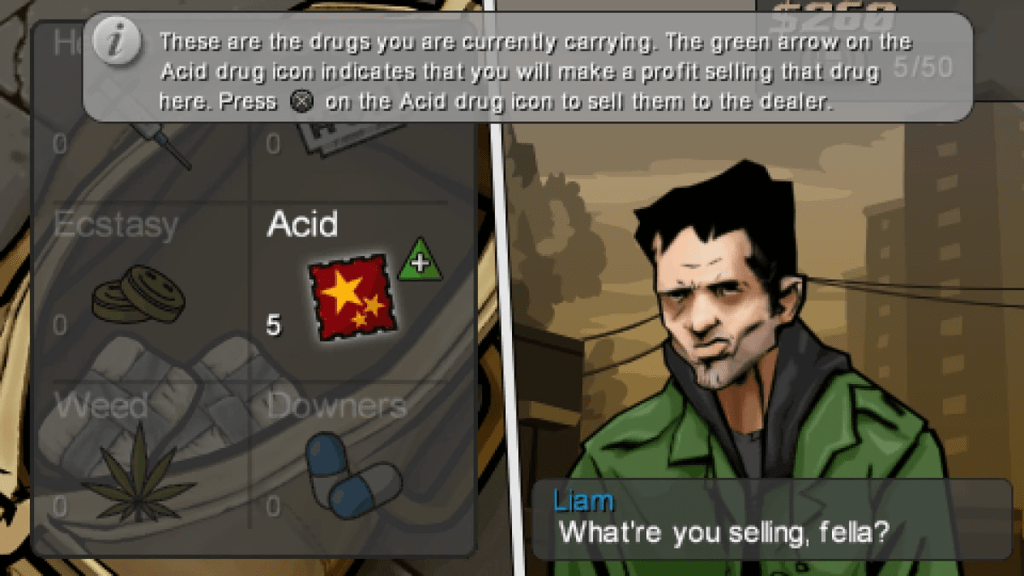
Grand Theft Auto belongs to a list of media properties that courts controversy like Casanova rounding third base for the fifth time in a week, and until recently, RockStar Games themselves have been known for their controversial money maker. Seasoned veterans of the series who skipped over this game may be curious why the drug dealing specifically was a sore point for critics to look at when the game was released. Well, another part of what makes the game different from the others was the player’s direct involvement in the drug dealing. For the most part, the protagonist is merely a glorified middleman who moves things from A to B, rarely having a role in the direct purchase or sale of such things save for cutscenes.
Chinatown Wars breaks away from that and allows the player to do so in their free time away from missions and sometimes as a prerequisite to activate a certain mission. Of course, it comes with its own set of risks. Sometimes the dealers — who come from multiple different gangs and factions — meet up in locations where a police camera is. The presence of the camera can help determine whether a deal is about to be busted, but its presence also raises the prices of a certain product. Minimizing the police response by destroying the cameras is also an option, but the price of the drugs bought or sold also takes a hit. This mechanic makes more use of the high risk, high rewards system that GTA is usually known for.
And I’m certain this is needless to say, but no, video game violence doesn’t lead to real life violence. There was one incident in 2003 when Alabama teen Devin Moore went on a rampage inspired by GTA Vice City that left three people dead and put him on death row where he still sits as of writing this, but if that were the metric used to judge games based on their content, then laws around video games in the US would closely resemble what Australia has on the books which was why GTA III was banned their for over twenty years.
This guy knows how it feels.
This is the part where after reviewing a game and listing its gameplay in detail, I’d encourage you to track down a copy and a working console to play it, or find an emulator to use, but unlike Warner Bros. who practically force us nostalgic types to emulate the 3D Mortal Kombat games, RockStar’s been a big fan of anniversary releases with GTA III, Vice City and San Andreas all getting updates every ten years to correspond with the games’ respective release dates, and GTA Chinatown Wars is the same being made available on smartphones as of late. There’s also a PSP version that adds another character, the opportunistic journalist Melanie Mallard as an extra character. To my knowledge, the smartphone versions are upgrades from the original DS version so, I guess it’s a matter of personal preference.
I had both versions available to me at the time and I personally recommend the PSP version for the extra character and extra music stations alone. Admittedly, there’s no voice lines in this games, except for the DS version where the game says a short dialogue line when the DS is closed and then opened, so the cutscenes are a bit like a visual novel or, since we have precedent, the cutscenes featured in 1988’s Ninja Gaiden on the NES.

As I said, gameplay videos exist on YouTube and however you experience the game is all up to you.
 Opinions on Entertainment